Building Family Health Literacy: Essential Skills for Informed Choices
Author: Feras Alayed
Published:
Updated:
Category: family-health-literacy
Reading Time: 10 minutes
Building Family Health Literacy: Skills for Reading and Conscious Evaluation
1. Introduction to Health Literacy: Defining the Modern Household Goal
Health literacy is the cornerstone of a conscious society capable of proactively managing its well-being. At ATHAR Center, we believe that health literacy is not merely the ability to read and write; it encompasses the capacity to access, understand, evaluate, and apply health information to make informed daily decisions. For the modern family in the Gulf region, the goal is no longer just treating illnesses when they occur, but creating a home environment that supports prevention and enhances quality of life through a deep understanding of health influences. Moving from a passive recipient of medical information to an active participant in healthcare requires specific skills that begin within the home.
Family health literacy involves the parents' ability to accurately interpret doctor's instructions, understand medication dosages, comprehend food labels, and even distinguish between scientific advice and myths spread on social media. When a family possesses a strong foundation of health literacy, they become less prone to home medical errors and more capable of communicating effectively with healthcare providers. This awareness, in turn, reduces anxiety associated with emergency health situations, as the family possesses the cognitive tools necessary to assess the situation and determine the next steps based on knowledge rather than mere emotional reaction.
Furthermore, building health literacy within the family is a long-term investment in future generations. When children see their parents analyzing product ingredients or asking precise questions to doctors, they acquire these skills naturally. The ultimate goal is to empower every family member to be their own "health manager," possessing the ability to navigate the complex healthcare system with confidence and clarity. We are shifting from the concept of healthcare as a service received in a hospital to the concept of health as a lifestyle practiced and developed daily through awareness and knowledge.
2. Decoding Medical Terminology: A Practical Glossary for Families
Individuals often feel confused when hearing complex medical terms used by professionals. However, most of these terms rely on linguistic roots (often Latin or Greek) that can be easily understood once a few simple rules are learned. This section aims to simplify medical language, transforming it from an obscure jargon into an effective communication tool. For example, knowing that the suffix "-itis" means inflammation (such as arthritis or tonsillitis) can help a family understand the nature of a condition as soon as they hear the diagnosis. Similarly, the suffix "-ology" means the study of, helping to identify the specialty of the doctor they need.
It is important for families to realize that medical terminology is not designed for exclusion but for precision. However, as care recipients, you have every right to request clarification in simple language. Here is an educational table of some common roots and terms a family might encounter:
| Term / Suffix | General Meaning | Illustrative Example |
|---|---|---|
| Hyper- | Above or excessive | Hypertension (High blood pressure) |
| Hypo- | Below or deficient | Hypoglycemia (Low blood sugar) |
| Cardio- | Related to the heart | Cardiologist (Heart specialist) |
| Gastro- | Related to the stomach/digestive system | Gastritis (Stomach inflammation) |
| Chronic | A condition that lasts a long time | Asthma or Diabetes |
| Acute | A condition that starts suddenly/short-term | Flu or sudden injuries |
In addition to linguistic roots, families should understand the difference between "symptoms" (what the patient feels, like pain) and "signs" (what the doctor observes, like a rash or fever). Possessing this simple glossary reduces the knowledge gap between the doctor and the patient, allowing the family to participate in medical decision-making based on real understanding rather than assumptions. We always advise families to write down any misunderstood term during a medical visit and look it up in reliable sources or ask the doctor directly before leaving the clinic.
3. Mastering the Art of Reading Labels: Food and Household Products
Label reading is one of the most important daily health literacy tools, serving as the first line of defense against harmful ingredients and unhealthy dietary choices. A food label is not just a list of numbers; it is a map of what enters our bodies. Families should start by looking at the "Serving Size," as much of the nutritional data provided is for a single serving, while the package may contain two or more. Overlooking this point can lead to consuming double the intended amount of sugar or sodium without realizing it.
When reading the ingredients list, it is crucial to know that ingredients are listed in descending order by weight; the first ingredient is what the product contains most. If sugar or hydrogenated oils are at the top of the list, this is a strong indicator of the product's quality. One must also be wary of the multiple names for sugar, such as high fructose corn syrup, maltodextrin, or sucrose. For household products like cleaners and toiletries, understanding warning symbols and chemical ingredient lists helps protect family members from allergies or toxic reactions, especially in homes with children or the elderly.
"Reading a label is a negotiation between your desire for the product and your body's health needs. The more you know about what you are reading, the greater your ability to make a decision that serves your long-term health."
A checklist for evaluating products includes:
- Checking expiration dates and storage conditions.
- Looking for the percentage of saturated and trans fats.
- Monitoring sodium (salt) levels, especially for those with blood pressure concerns.
- Ensuring products are free from preservatives that might cause specific allergies in family members.
4. The Habit Journal: Tracking Daily Patterns for Better Communication
Accurate medical diagnosis often depends on the information a patient provides about their lifestyle. This is where the "Habit Journal" comes in as a vital tool for enhancing family health literacy. Instead of relying on memory, which can fail under the pressure of a medical visit, the journal provides an objective record of daily patterns. These patterns include sleep hours, diet quality, physical activity levels, and even mood swings or occasional physical symptoms like headaches or stomach aches.
A habit journal helps the family discover links between behavior and health outcomes. For instance, a family might notice through tracking that a child's allergy flare-ups increase on certain days or after eating specific foods. This type of "home-collected" data is invaluable to doctors because it provides a temporal context that cannot be seen in a single blood test or a short clinic visit. It transforms general complaints like "I'm always tired" into precise data like "I feel tired in the afternoons after eating high-carb meals."
To activate this habit, families can use a simple notebook or digital apps, focusing on consistency rather than complex details. The journal should include:
- Wake-up and sleep times and sleep quality.
- Types and timing of main meals.
- Energy levels throughout the day (on a scale of 1 to 10).
- Any notes on medications or supplements taken.
5. Preparing for Consultations: Developing a Comprehensive Question List
Medical visits often end with the patient feeling they forgot to ask the most important questions or didn't fully understand the treatment plan. Health literacy requires being prepared before entering the examination room. Preparing for a consultation starts with writing a list of questions and concerns, prioritizing them. It is also important to bring a list of all current medications and supplements to avoid dangerous drug interactions. We encourage families to use the "Ask Me 3" technique, which involves three core questions to be answered before leaving the doctor: What is my main problem? What do I need to do? And why is it important for me to do this?
Additionally, family members should practice the "Teach-Back" technique. After the doctor explains the diagnosis or how to use a medication, the patient re-explains what they understood in their own words. This ensures there is no misunderstanding and allows the doctor to correct any misinformation immediately. Effective communication is a two-way street, and doctors appreciate a patient who shows interest and understanding of their condition, as this increases the likelihood of treatment adherence.
Suggested question list for the next visit:
- Are there alternatives to this treatment or procedure?
- What are the potential side effects and how should I handle them?
- When can I expect to see an improvement in my condition?
- Do I need to change anything in my diet or physical activity?
- What is the next step if symptoms do not improve?
6. Evaluating Digital Information: Distinguishing Fact from Opinion Online
In the age of information explosion, the internet has become the primary source for health information, but it is also a fertile ground for misinformation. Digital health literacy is the ability to filter this vast amount of data and reach scientific facts. Families must learn how to evaluate sources; websites ending in (.gov) or (.edu) or those belonging to reputable global and local health organizations are usually more reliable than personal blogs or social media posts aimed at gaining views or selling products.
One of the fundamental rules in evaluating digital content is looking for the "Update Date." Medical science evolves rapidly, and information that was correct five years ago may have changed by now. One must also be wary of clickbait headlines that promise "miracle cures" or "instant results," as medical facts are rarely that simple. Families should also verify the presence of scientific references or studies supporting the claims made and ensure the author is a qualified specialist in the field they are discussing.
The SIFT strategy for verifying information:
- S (Stop): Stop before believing or sharing the information.
- I (Investigate): Investigate the source; who is the author and what is their background?
- F (Find): Find better coverage; do other reliable sources agree with this claim?
- T (Trace): Trace claims and quotes back to their original context.
7. Building a Shared Family Library of Reliable and Verified Resources
The final step in enhancing health literacy is institutionalizing knowledge within the home by building a shared family health library. This does not only mean physical books; it also includes digital folders, lists of trusted websites, and family medical history records. Having a unified reference that is easily accessible in emergencies enhances the family's sense of control and security. This library should contain information on first aid, a guide to medications used at home, and copies of medical reports and periodic test results for each member.
This library can be organized in a physical file or a secure electronic cloud, accessible to all adult family members. A special section for nutritional literacy can also be added, including approved healthy recipes and information on balanced nutrition. Building this library is an ongoing process; it is updated with every doctor's visit and every new piece of verified information learned. This approach makes health a present topic in daily family dialogue, rather than just a file opened only during illness.
Tips for organizing the family health library:
- Dedicate a section for each family member containing their medical history and vaccinations.
- Keep an updated list of emergency numbers and nearby health centers.
- Collect educational brochures from official sources regarding health conditions of interest to the family.
- Allocate space for simplified scientific magazines suitable for children's ages to encourage healthy reading.
Related ATHAR paths

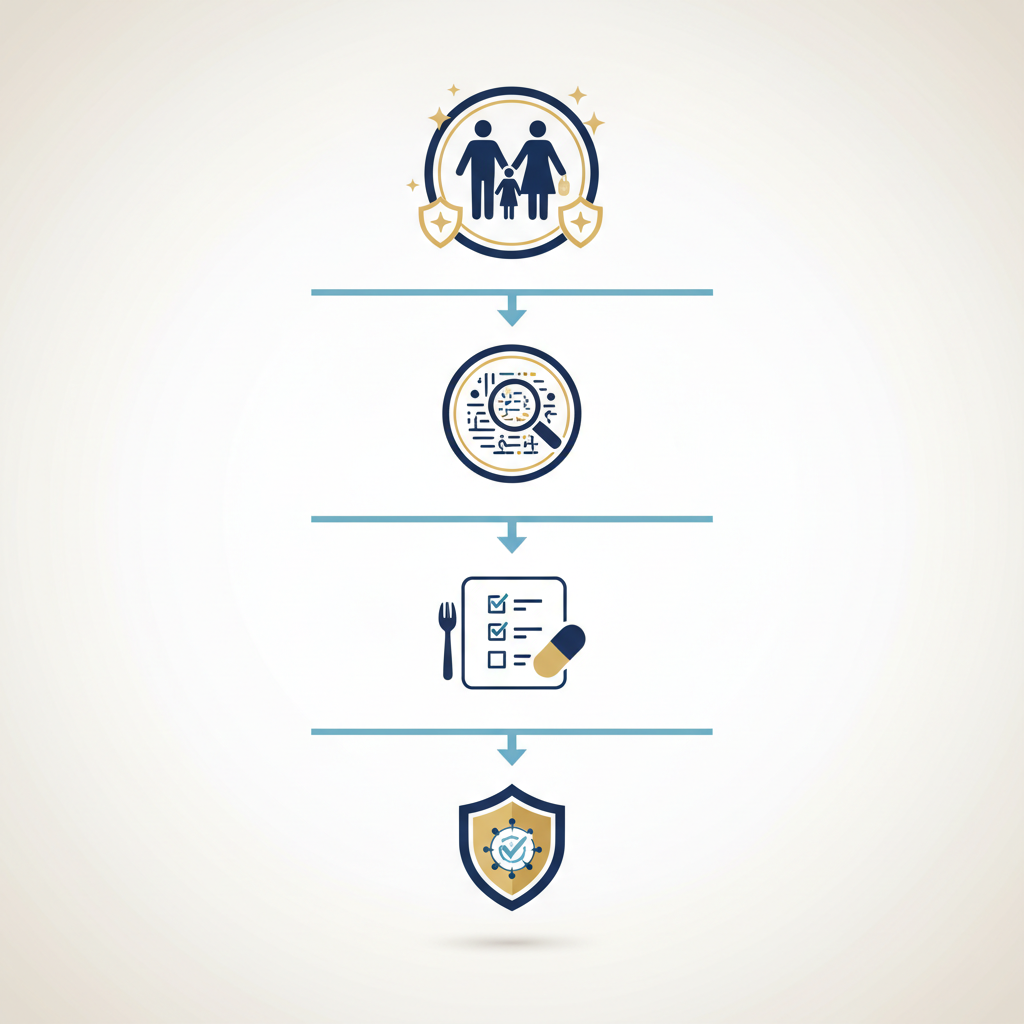
Explore health education step by step
Use the educational guides and practical tools to choose your next learning step.