Cholesterol Levels Canada Guidelines: LDL & HDL Explained (mmol/L)
Author: Feras Alayed
Published:
Updated:
Category: canadian-health
Reading Time: 9 minutes
Key Takeaways
- Canadian cholesterol guidance frames LDL targets according to overall cardiovascular risk — very high-risk patients often aim for LDL < 1.8 mmol/L (sometimes lower).
- HDL is associated with cardiovascular risk in observational studies but is not usually a sole therapeutic target in modern guidelines.
- Lifestyle changes (Canada's Food Guide-based diet, physical activity, quitting smoking) and weight management are foundational steps to improve the lipid profile.
- Statins and other lipid-lowering drugs are recommended based on risk assessment; provincial access and drug coverage (Ontario, BC, Alberta, Quebec) may affect treatment choices.
- Feel Great components (Balance soluble fibre, Unimate yerba mate, 4-4-12 intermittent fasting) may help as part of a lifestyle approach but are not medications — discuss with your healthcare provider.
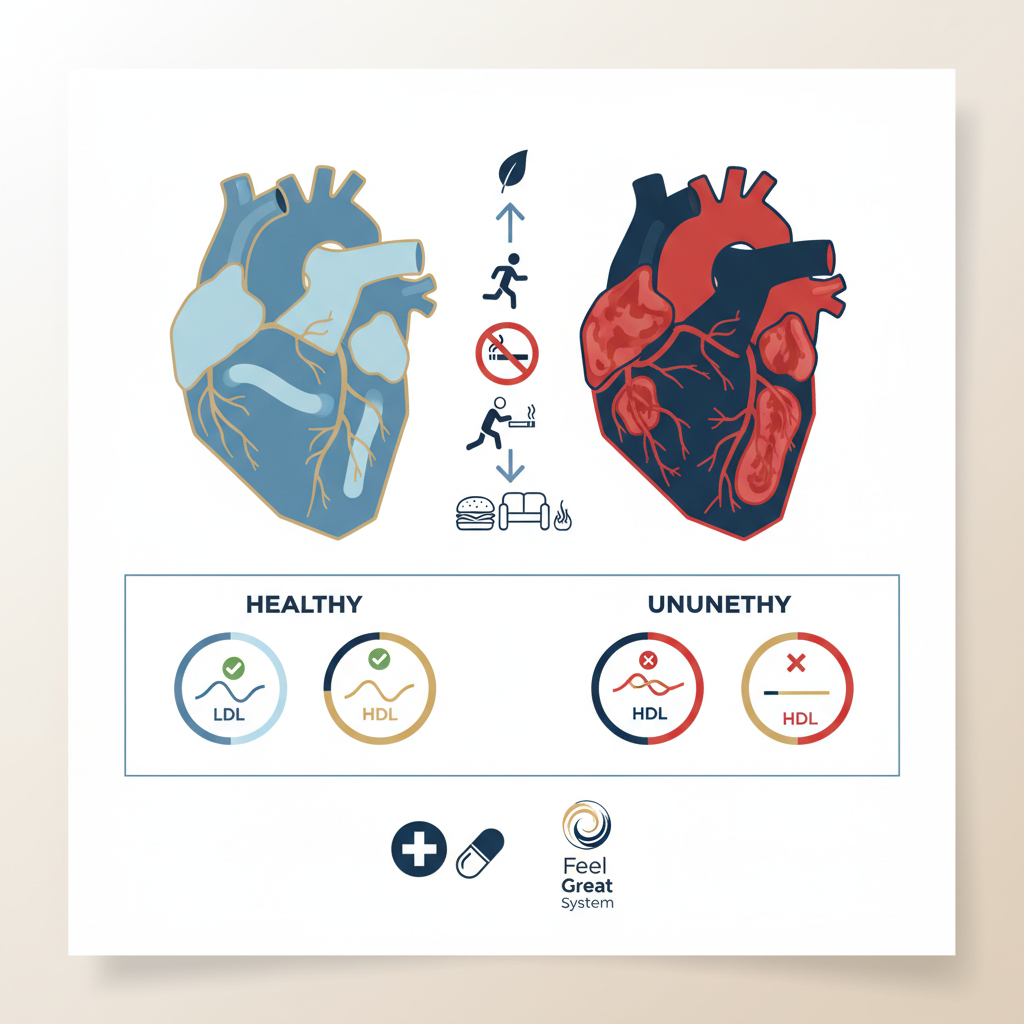
TL;DR
Canadian guidelines use overall cardiovascular risk to set LDL cholesterol goals (e.g., <1.8 mmol/L for very high-risk). HDL is informative but usually not the main treatment target. Lifestyle modification plus medication when indicated is the standard pathway; consult your family doctor or cardiologist for personalised targets.
🇨🇦 Thousands of Canadians are using Feel Great to support their metabolic health naturally. Learn more & order here →
Cholesterol Guidelines in Canada: LDL and HDL Explained
Introduction — a striking Canadian statistic
Cardiovascular disease remains a leading cause of death in Canada. Data from the Canadian Institute for Health Information (CIHI) show substantial morbidity and mortality from heart disease and stroke across provinces, with notable regional differences between Ontario, Quebec, British Columbia and Alberta (CIHI, 2023). Understanding cholesterol targets is critical to reducing these risks.
Why cholesterol matters
Cholesterol is essential for cell membranes and hormones, but excess levels of low-density lipoprotein (LDL) can deposit in arteries and increase the risk of heart attack and stroke. High-density lipoprotein (HDL) is often described as 'good' cholesterol, but its role is more complex — raising HDL pharmacologically has not consistently reduced cardiovascular events in trials.
Quick terminology
- LDL (low-density lipoprotein): often called “bad” cholesterol — higher levels are associated with greater cardiovascular risk.
- HDL (high-density lipoprotein): often called “good” cholesterol — higher observationally associated with lower risk, but not always causal.
- Non-HDL cholesterol: total minus HDL — useful when triglycerides are elevated.
- mmol/L: the unit used in Canada for blood tests (not mg/dL).
What are the Canadian guideline targets?
Canadian recommendations take an individualized risk-based approach. Organisations like the Heart & Stroke Foundation of Canada, Diabetes Canada, and national clinical practice guidelines emphasise treatment thresholds and LDL targets based on estimated 10-year cardiovascular risk.
Simplified goal table (overview)
| Risk Category | Typical LDL Goal (mmol/L) | Notes |
|---|---|---|
| Very high risk (prior MI/stroke, severe coronary disease) | < 1.8 mmol/L (sometimes < 1.4 mmol/L depending on case) | Combination therapy may be needed (statin + ezetimibe or PCSK9 inhibitors). |
| High risk (other atherosclerotic disease, diabetes with risk factors) | < 1.8–2.0 mmol/L | Depends on age and comorbidities. |
| Intermediate risk | Usually < 2.6 mmol/L | Focus on lifestyle; medication considered based on risk discussion. |
| Low risk | No strict drug target; prevent progression | Periodic monitoring; lifestyle first. |
These values are a practical summary reflecting Canadian and international guidance; individual targets should be determined with a healthcare professional (sources: Heart & Stroke, Diabetes Canada, CIHI).
How should we interpret HDL?
Although higher HDL correlates with lower cardiovascular risk in observational studies, clinical trials that raised HDL pharmacologically did not consistently reduce cardiac events. Therefore, guidelines prioritise LDL reduction and management of other risk factors (blood pressure, smoking, diabetes, weight) rather than raising HDL as a primary goal (CMAJ reviews).
Lifestyle measures and Canada's Food Guide
Canada's Food Guide recommends a diet rich in vegetables and fruit, whole grains, and protein foods — prioritising plant-based proteins and low-fat sources. Replacing saturated fats with unsaturated vegetable oils, increasing soluble fibre (oats, legumes, psyllium), and reducing trans fats and added sugars are practical steps shown to affect LDL values at the population level (Canada's Food Guide).
Evidence-based lifestyle strategies (summary)
- Reduce saturated fat intake — associated with moderate LDL reductions.
- Increase soluble fibre (beta-glucan from oats, legumes) — contributes to LDL lowering.
- Regular physical activity — benefits lipid profile and cardiovascular risk.
- Quit smoking and limit excessive alcohol — both affect overall cardiovascular risk.
When are medications recommended?
Statins are the primary pharmacologic therapy for lowering LDL and are recommended for those at intermediate to high cardiovascular risk, based on an individual risk assessment. The decision to start medication considers age, diabetes, blood pressure, smoking status, family history, and overall cardiovascular risk. Access to specialists and drug coverage can vary by province — consult your family doctor and check provincial drug formularies (Ontario, Alberta, BC, Quebec).
Provincial considerations and access
Access to specialists and medication coverage differs across Canada. Urban centres in Ontario, Quebec, BC and Alberta may have quicker access to cardiology services than rural areas. Public drug plans (e.g., Ontario Drug Benefit, Alberta Blue Cross variations) and private insurance influence medication affordability. Check provincial resources or your pharmacist for shipping and coverage options across provinces (shipping available BC to Newfoundland).
Cholesterol and blood sugar (mmol/L) — the diabetes link
People with diabetes have higher cardiovascular risk; Diabetes Canada recommends more intensive lipid management in many patients with diabetes. Blood glucose is measured in mmol/L in Canada — improving glycaemic control may favourably influence some cardiovascular risk factors, while lipid targets for diabetic patients are frequently more stringent.
Which tests and how often?
In adults without major risk factors, a lipid panel every 3–5 years is reasonable. For those with risk factors (diabetes, family history, hypertension, smokers), more frequent monitoring and a tailored plan are recommended. Testing can often be done at family doctors' offices, walk-in clinics, or community labs — provincial practices vary.
LDL vs Non-HDL vs ApoB — choosing the best marker
| Marker | Why use it? | When it's most useful |
|---|---|---|
| LDL | Traditional treatment target for lipid-lowering decisions | Most patients — widely used |
| Non-HDL | Reflects all atherogenic particles — better when triglycerides are high | High triglycerides or non-fasting samples |
| ApoB | Direct measure of atherogenic particle number — strong predictor | High-risk patients or discordant LDL/non-HDL |
What does the evidence say?
Meta-analyses and systematic reviews show that lowering LDL reduces major cardiovascular events across different populations. Recent trials and reviews (2021–2024) support risk-based lipid management and the use of combination therapies for very high-risk individuals. Canadian guidance aligns with international evidence and recommends shared decision-making between patient and clinician.
How Feel Great fits into a cholesterol management plan
Feel Great is a lifestyle support system rather than a medication. Its core elements include:
- Balance — a soluble fibre matrix designed to moderate post-meal glucose responses and influence lipid absorption patterns.
- Unimate — a yerba mate extract containing chlorogenic acids, which may help energy and adherence to active routines.
- 4-4-12 intermittent fasting protocol — a timing strategy that may facilitate weight management and metabolic improvements.
- 50+ clinical studies referenced in PDR for individual ingredients — used as a complementary approach.
These elements may help with weight, glycaemic control (measured in mmol/L), and adherence to healthy behaviours, all of which can indirectly influence lipid profiles. They are not substitutes for prescribed lipid-lowering therapies when clinically indicated.
Practical advice for Canadians
- Get a baseline lipid panel and risk assessment with your family physician or local clinic.
- Follow Canada's Food Guide: increase soluble fibre (oats, legumes), choose unsaturated fats, reduce saturated/trans fats.
- Stay active year-round — plan indoor activities for long Canadian winters and consider vitamin D if advised by your clinician.
- If medication is recommended, discuss expected LDL goals (e.g., < 1.8 mmol/L if very high risk), side effects, and provincial coverage options.
- If using Feel Great or supplements, inform your clinician to avoid interactions and ensure coordinated care.
People Also Ask
- What is a healthy LDL level in Canada? It depends on your overall risk; very high-risk patients often aim for LDL < 1.8 mmol/L.
- Can HDL be increased by pills? Drugs that raise HDL have not consistently shown cardiovascular benefit; focus remains on LDL reduction and lifestyle.
- Are cholesterol tests done fasting in Canada? Many labs accept non-fasting lipid panels; your clinician will advise based on circumstances.
- How fast can lifestyle changes lower LDL? Some dietary changes and soluble fibres can lower LDL within weeks to months, with greater changes over time.
- Does provincial drug coverage affect my options? Yes — access and reimbursement for newer agents (e.g., PCSK9 inhibitors) vary by province.
FAQ
- How is LDL measured and reported in Canada?
LDL is reported in mmol/L. Labs may calculate LDL using Friedewald equation or measure directly if triglycerides are high. - When should I see a cardiologist?
If you have very high LDL despite treatment, established coronary artery disease, or complex comorbidities, a referral is appropriate; access varies by province. - Are PCSK9 inhibitors used in Canada?
Yes, for select very high-risk patients, often after maximally tolerated statin + ezetimibe; coverage varies regionally. - Does weight loss improve cholesterol?
Yes — sustained weight loss typically improves LDL, triglycerides and HDL in many people. - Can supplements replace medication?
Supplements and products like Balance may help as adjuncts but are not replacements for evidence-based lipid-lowering therapy when indicated.
References & Scientific Sources
- Health Canada — Canada's Food Guide. https://www.canada.ca/en/health-canada/services/canada-food-guide.html
- Heart & Stroke Foundation of Canada — Cardiovascular disease and cholesterol resources. https://www.heartandstroke.ca
- Diabetes Canada — Clinical Practice Guidelines (lipids & cardiovascular disease). https://www.diabetes.ca
- Canadian Institute for Health Information (CIHI) — cardiovascular disease data and reports. https://www.cihi.ca
- Statistics Canada — national health statistics and regional comparisons. https://www.statcan.gc.ca
- Canadian Medical Association Journal (CMAJ) — reviews and guideline commentary. https://www.cmaj.ca
- Public Health Agency of Canada (PHAC) — chronic disease prevention. https://www.canada.ca/en/public-health.html
- PubMed — systematic reviews and meta-analyses on LDL lowering and cardiovascular outcomes (search hub). https://pubmed.ncbi.nlm.nih.gov
- NEJM — clinical trials and reviews on lipid-lowering therapies. https://www.nejm.org
- JAMA — cardiovascular risk and lipid management studies. https://jamanetwork.com
- Cochrane Library — reviews on dietary and pharmacologic interventions for cholesterol. https://www.cochranelibrary.com
- Harvard Health Publishing — cholesterol basics and patient information. https://www.health.harvard.edu
Medical disclaimer
The content here is for general education only and not medical advice. Consult your healthcare provider before making clinical decisions or starting/stopping treatments. If you are in Canada and require urgent care call 911 or visit the nearest emergency department.

Related ATHAR paths
🇨🇦 Ready to Start Your Health Transformation?
Join thousands of Canadians who have improved their metabolic health with the Feel Great system. Backed by 50+ clinical studies and listed in the Physicians' Desk Reference (PDR).
✅ Ships to all provinces: BC, Alberta, Saskatchewan, Manitoba, Ontario, Quebec, New Brunswick, Nova Scotia, PEI, Newfoundland & Labrador | 90-Day Money-Back Guarantee