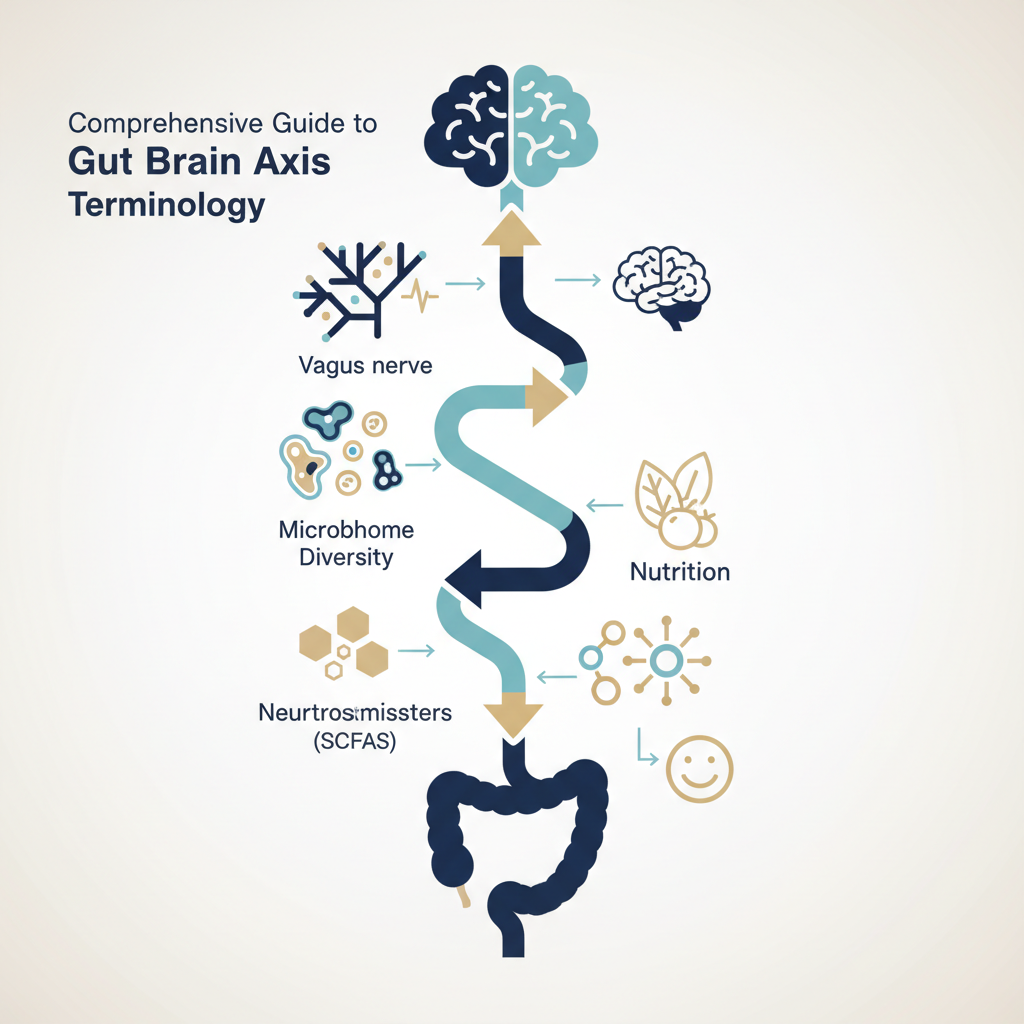
Comprehensive Guide to Gut Brain Axis Terminology: Enhancing Mental Health Literacy
Author: Feras Alayed
Published:
Updated:
Category: mental-nutrition
Reading Time: 9 minutes
The gut-brain axis is a bidirectional communication system linking the CNS and the enteric nervous system.
Understanding terms like 'Vagus Nerve' and 'Microbiome' is crucial for informed dietary choices.
Nutrition acts as chemical signaling that directly influences mood and cognitive function.
Research literacy protects you from pseudoscience and unverified health claims.
The Gut-Brain Axis (GBA) is the vital link explaining how our digestive system influences our emotions and thoughts. By mastering 'gut brain axis terminology,' you can enhance your ability to interpret research and understand how dietary shifts can help manage stress and anxiety, emphasizing science over myths.
Introduction to the Gut-Brain Axis: Beyond the Words
When we discuss 'gut brain axis terminology,' we aren't just talking about dry medical jargon; we are describing the most sophisticated communication system in the human body. The gut-brain axis is a complex network of chemical and electrical signals connecting your brain and your digestive tract. This bidirectional communication means that what happens in your gut can send signals to your brain that affect your mood, and conversely, your psychological state can directly impact your digestive functions. In daily life, we see this link when we feel 'butterflies in the stomach' during anxiety or lose our appetite when sad. Understanding these terms is the first step toward nutrition mood research literacy—the ability to comprehend the science linking diet and mental health. It's important to recognize that the gut contains millions of neurons, leading scientists to call it the 'second brain.' This system doesn't work in isolation; it is influenced by every bite we eat and every thought we think. Learning this language helps you distinguish fact from fiction in a world saturated with conflicting health information.
A visual glossary mapping key gut-brain axis terms to their impact on mental health and nutrition.
Anatomical Terms: The Vagus Nerve and Beyond
To understand how this axis works, we must identify the physical components that carry the messages. The most prominent term here is the Vagus Nerve. This nerve is the longest of the autonomic nervous system, extending from the brainstem down to the abdominal organs. The vagus nerve acts as a primary 'telephone line' transmitting information from the gut to the brain and vice versa. When we talk about the Enteric Nervous System (ENS), we refer to the complex web of neurons lining the gastrointestinal tract, which can operate independently of the central brain. Understanding this anatomy helps us see why we might turn to food during stress, a topic we explore in depth in our article on Break the Stress-Eating Cycle: stress eating cycle breaking strategies. Additionally, there are vital 'barriers,' such as the Blood-Brain Barrier and the Intestinal Barrier. These act as security guards, allowing beneficial nutrients and messages to pass while blocking toxins. When the integrity of these barriers is compromised, it can lead to issues affecting cognitive function and mood. Awareness of these anatomical terms provides a solid foundation for understanding how breathing exercises or fermented foods can physically influence your calmness by stimulating the vagus nerve.
Microbiome Lexicon: Probiotics and Dysbiosis
One cannot discuss 'gut brain axis terms' without diving into the world of the microbiome. The Microbiome is the community of microorganisms (bacteria, fungi, viruses) living in your gut. These organisms are not just passengers; they are active chemical factories. Three essential terms to know are: Probiotics, the live beneficial bacteria found in yogurt and fermented foods; Prebiotics, the fibers that feed these bacteria; and Postbiotics, the beneficial byproducts produced by bacteria after digesting fiber. Another critical term is Dysbiosis, which occurs when harmful bacteria outweigh the beneficial ones, potentially leading to inflammation that affects mental health. In many cultures, traditional foods like kefir or naturally fermented pickles serve as natural probiotic sources. Understanding these terms aids in evaluating nutrition claims; when you see a product claiming to boost mood, you can look for specific bacterial strains and the research supporting them. A diverse and resilient microbiome is closely linked to psychological resilience and anxiety management.
Biochemical Signaling: Neurotransmitters and SCFAs
How does the gut translate food into feelings? The answer lies in biochemistry. The most famous term is Serotonin, often called the 'happiness hormone.' Surprisingly, about 90-95% of the body's serotonin is produced in the gut. However, gut-derived serotonin does not cross the blood-brain barrier directly; it influences the brain via vagus nerve signaling or through chemical precursors like Tryptophan. Another term is GABA (Gamma-Aminobutyric Acid), a calming neurotransmitter produced by certain gut bacteria. Furthermore, Short-Chain Fatty Acids (SCFAs), such as butyrate, play a vital role in brain protection and reducing inflammation. When you record your intake in a food mood journal, you are essentially tracking how these biochemical interactions affect your daily state. Understanding these processes demystifies the idea that 'food affects mood' and turns it into a tangible scientific reality that you can manage through conscious dietary choices.
Research Literacy: Evaluating Nutrition Claims
In the information age, nutrition mood research literacy is a vital skill. When reading an article or watching a video about the gut-brain axis, you must know the difference between Correlation and Causation. Just because a certain bacteria is present in happy people doesn't necessarily mean that bacteria caused their happiness. The term Randomized Controlled Trials (RCTs) represents the gold standard in scientific research; if a nutritional claim isn't backed by this type of study, proceed with caution. Also, be aware of Publication Bias, where journals tend to publish only positive results. When evaluating nutrition claims, ask yourself: Was the study done on humans or animals? Was the sample size large enough? Are there conflicts of interest? Understanding these research terms protects you from falling victim to 'health marketing' that might sell expensive supplements based on preliminary, unconfirmed studies. Research literacy is your shield against misinformation in the field of mental health and nutrition.
Practical Tools: Food-Mood Journaling Vocabulary
To turn science into practice, we need practical tools. A Food-Mood Journal is a simple yet powerful tool. Associated terms include Mindful Eating, the practice of maintaining full attention on the eating experience, and Physiological vs. Emotional Hunger. Physiological hunger comes on gradually and is felt in the stomach, while emotional hunger is sudden and often linked to cravings for specific high-sugar or high-fat foods to soothe negative emotions. This is closely linked to stress eating cycle breaking, where understanding these terms helps you interrupt the cycle of stress-related eating. Another term is the Elimination Diet, a protocol used under professional supervision to identify foods that may trigger inflammation or mood disturbances. Using these tools requires honesty and the ability to notice recurring patterns. By linking what you eat to how you feel hours or even a day later, you begin to build your personal gut-brain axis dictionary.
Clarifying Concepts: Common Misunderstandings
There is much confusion in 'gut brain axis terminology.' A common mistake is using the term 'Leaky Gut' as a catch-all medical diagnosis for all mental health issues, whereas the accurate scientific term is Increased Intestinal Permeability, a complex condition still under intense study. Another error is believing that a single probiotic capsule can cure clinical depression; science suggests that Psychobiotics—bacteria that influence the mind—work as part of a holistic approach including lifestyle and professional therapy. Also, some believe the 'second brain' can think and make logical decisions, while its primary role is regulating digestion and communicating with the main brain. It is also important not to confuse Food Allergy with Food Intolerance; the former is an immediate immune reaction, while the latter can lead to chronic symptoms affecting mood and energy subtly. Correcting these misconceptions helps you set realistic expectations for your health journey.
Professional Dialogue: Questions for Your Provider
When visiting a doctor or a licensed dietitian, using the correct 'gut brain axis terms' facilitates communication and ensures you receive the best care. Don't hesitate to ask specific questions like: 'How might my current diet influence inflammation levels and, consequently, my mood?' or 'Are there microbiome tests you recommend for my situation?'. It is also important to discuss Food-Drug Interactions, especially if you are taking psychiatric medications, as certain foods can affect drug absorption. Ask about Fermentable Fibers and their role in supporting your mental health. Remember, the goal of learning these terms is not self-diagnosis but to be an informed partner in your treatment plan. A licensed professional will appreciate your nutrition mood research literacy and will be able to guide you toward reliable resources tailored to your individual needs, away from the inaccurate general advice prevalent on social media.
Common Mistakes in Gut-Brain Axis Terminology:
Viewing probiotics as a magic, instant fix for psychological disorders without considering overall lifestyle.
Confusing the 'second brain' with the capacity for conscious cognitive thought.
Using 'Leaky Gut' to describe any digestive discomfort without a proper diagnosis.
Neglecting the role of fiber (prebiotics) and focusing only on live bacteria (probiotics).
Believing that gut-produced serotonin is the direct and only cause of happiness in the brain.