Diabetes in Indigenous Communities Canada: Crisis, Causes & Action
Author: Feras Alayed
Published:
Updated:
Category: canadian-health
Reading Time: 8 minutes
Key Takeaways
- Age-standardized diabetes prevalence among First Nations living on-reserve is about 17.2% vs ~5.0% in the non‑Indigenous Canadian population — a gap of more than three-fold. ([diabetes.ca](https://www.diabetes.ca/health-care-providers/clinical-practice-guidelines/chapter-38?utm_source=openai))
- Roots of the crisis include colonial history, intergenerational trauma, food insecurity, limited access to culturally safe care, and socioeconomic inequities. ([canada.ca](https://www.canada.ca/en/public-health/services/publications/diseases-conditions/framework-diabetes-canada.html?utm_source=openai))
- Diagnosis in Canada uses mmol/L: fasting plasma glucose ≥7.0 mmol/L or A1C ≥6.5% as diagnostic thresholds per Diabetes Canada. ([guidelines.diabetes.ca](https://guidelines.diabetes.ca/cpg/chapter3?utm_source=openai))
- Community‑led, culturally safe interventions (community health workers, Indigenous governance of programs, food sovereignty) show the most promise. ([pubmed.ncbi.nlm.nih.gov](https://pubmed.ncbi.nlm.nih.gov/32029402/?utm_source=openai))
- Feel Great can be a lifestyle support tool (Balance = soluble fibre matrix; Unimate = yerba mate; 4‑4‑12 fasting protocol) but is not a medication — use it within integrated, culturally appropriate care.
TL;DR
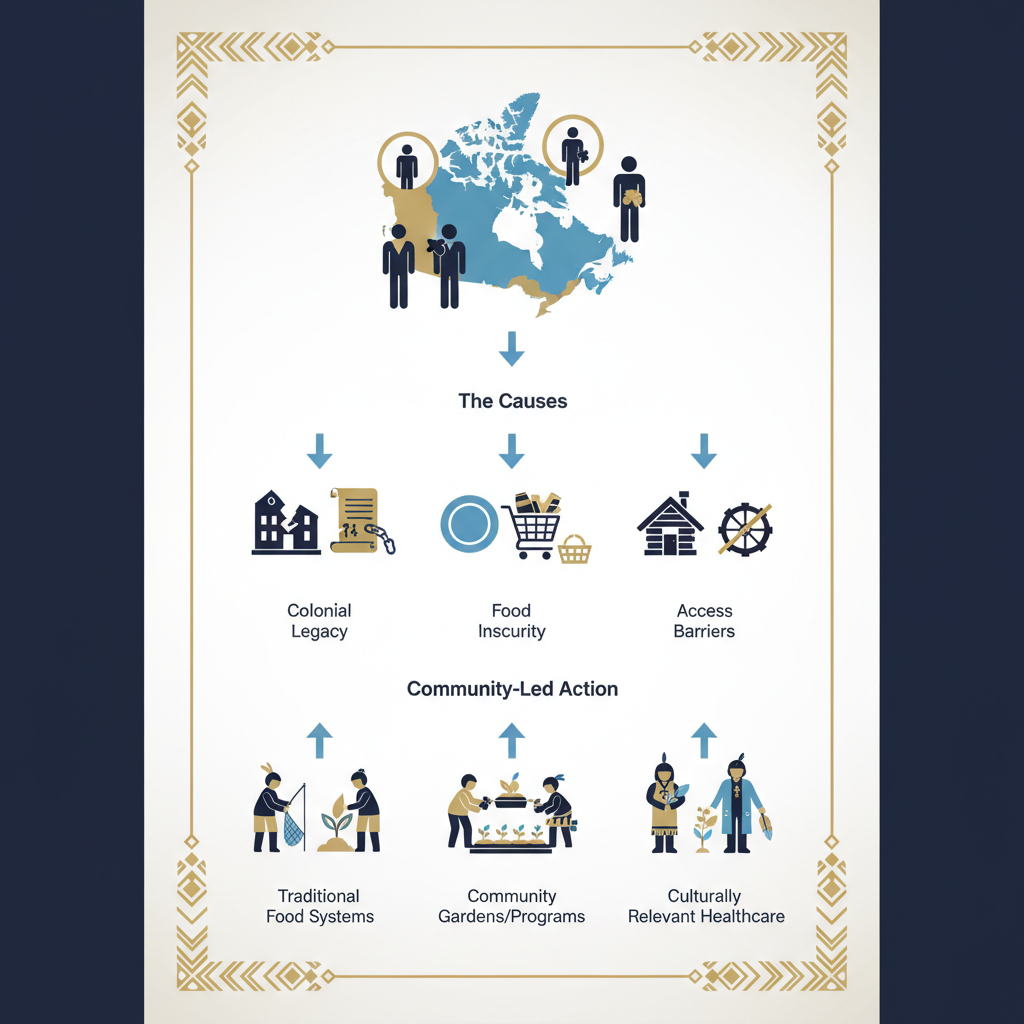
Diabetes among Indigenous communities in Canada is a national health crisis driven by historical, social and environmental factors. Closing the gap requires Indigenous‑led solutions that address food security, culturally safe primary care, and sustained policy investment. Sources: Diabetes Canada, Health Canada, CIHI, Statistics Canada. ([diabetes.ca](https://diabetes.ca/advocacy-policies/advocacy-reports/national-and-provincial-backgrounders/diabetes-in-canada?utm_source=openai))
🇨🇦 Thousands of Canadians are using Feel Great to support their metabolic health naturally. Learn more & order here →
Indigenous Communities and Diabetes: Canada’s Health Crisis
Introduction — a shocking Canadian statistic
Age‑standardized prevalence rates for diabetes reach approximately 17.2% among First Nations people living on‑reserve, compared with about 5.0% in the non‑Indigenous Canadian population — more than a threefold difference. This stark gap underscores entrenched health inequities rooted in social determinants and colonial legacy. ([diabetes.ca](https://www.diabetes.ca/health-care-providers/clinical-practice-guidelines/chapter-38?utm_source=openai))
Why this matters
Diabetes increases the risk of cardiovascular disease, kidney failure, vision loss and lower‑limb amputation. In Canada, over 3 million people have diagnosed diabetes, and prevalence continues to rise with population ageing and changing risk exposures. The economic and human costs are large — particularly when diabetes is poorly controlled or diagnosed late. ([canada.ca](https://www.canada.ca/en/public-health/services/publications/diseases-conditions/framework-diabetes-canada.html?utm_source=openai))
Who is affected: First Nations, Métis and Inuit
National and community data show different patterns by Indigenous identity:
- First Nations on‑reserve: ~17.2% age‑standardized prevalence. First Nations off‑reserve: ~10.3%. ([diabetes.ca](https://www.diabetes.ca/health-care-providers/clinical-practice-guidelines/chapter-38?utm_source=openai))
- Métis: estimated ~7.3% age‑standardized prevalence in some reports. ([diabetes.ca](https://www.diabetes.ca/health-care-providers/clinical-practice-guidelines/chapter-38?utm_source=openai))
- Inuit: historically lower rates, but there is concern rates will rise rapidly with nutrition and lifestyle transition in the North. ([diabetes.ca](https://www.diabetes.ca/health-care-providers/clinical-practice-guidelines/chapter-38?utm_source=openai))
Root causes — a multifactorial problem
1. Colonial history and intergenerational trauma
Loss of land, language and traditional food systems, residential schools and discriminatory policies disrupted Indigenous foodways and social structures. These historical processes contribute to present‑day risk factors for diabetes through complex psycho‑social and material pathways. ([canada.ca](https://www.canada.ca/en/public-health/services/publications/diseases-conditions/framework-diabetes-canada.html?utm_source=openai))
2. Food insecurity and altered food environments
Food insecurity is prevalent in many First Nations communities; some community studies report rates as high as ~48% in certain regions. Food insecurity correlates with poorer diet quality, higher obesity prevalence, and higher diabetes risk. Restoring access to traditional foods and strengthening food sovereignty is central to prevention. ([en.wikipedia.org](https://en.wikipedia.org/wiki/Indigenous_food_security_in_Canada?utm_source=openai))
3. Barriers to culturally safe, accessible care
Remote geography, understaffed clinics, high turnover of healthcare workers and fragmented funding impede timely diagnosis and chronic disease management. Cultural safety — care that respects Indigenous worldviews and priorities — improves engagement and outcomes. ([cihi.ca](https://www.cihi.ca/sites/default/files/document/cihi-annual-report-2022-2023-en.pdf?utm_source=openai))
4. Socioeconomic determinants
Poverty, housing instability and lower educational attainment all raise the risk for chronic disease. Addressing diabetes without tackling these upstream determinants will have limited impact. ([www150.statcan.gc.ca](https://www150.statcan.gc.ca/n1/en/pub/82-570-x/82-570-x2023001-eng.pdf?st=wr1pTfNi&utm_source=openai))
Diagnosis and numbers you should know (units in mmol/L)
Clinical thresholds used in Canada (Diabetes Canada):
- Fasting plasma glucose (FPG) ≥ 7.0 mmol/L is diagnostic for diabetes. ([guidelines.diabetes.ca](https://guidelines.diabetes.ca/cpg/chapter3?utm_source=openai))
- A 2‑hour plasma glucose ≥ 11.1 mmol/L after a 75 g OGTT also indicates diabetes. ([guidelines.diabetes.ca](https://guidelines.diabetes.ca/GuideLines/media/Docs/cpg/Ch3-Definition-Classification-and-Diagnosis-of-Diabetes-Prediabetes-and-Metabolic-Syndrome.pdf?utm_source=openai))
- A1C ≥ 6.5% is another diagnostic criterion; A1C 6.0–6.4% can indicate high‑risk/prediabetes in Canadian practice. ([guidelines.diabetes.ca](https://guidelines.diabetes.ca/cpg/chapter3?utm_source=openai))
Clinical consequences and burden
People living with diabetes have higher rates of hypertension, cardiovascular disease and complications requiring costly health services. CIHI and PHAC report significant healthcare resource use linked to diabetes and its complications, particularly where care is delayed or access is limited. ([cihi.ca](https://www.cihi.ca/sites/default/files/document/cihi-annual-report-2022-2023-en.pdf?utm_source=openai))
What the evidence says about effective interventions
Systematic reviews across Canada, Australia, New Zealand and the U.S. identify common components of effective programs for Indigenous populations:
- Indigenous leadership and community governance in program design and delivery. ([pubmed.ncbi.nlm.nih.gov](https://pubmed.ncbi.nlm.nih.gov/32029402/?utm_source=openai))
- Use of community health workers or Indigenous health providers to deliver culturally adapted education and case management. ([pubmed.ncbi.nlm.nih.gov](https://pubmed.ncbi.nlm.nih.gov/36355789/?utm_source=openai))
- Short intensive programs and group‑based models that build social supports and self‑management skills. ([pubmed.ncbi.nlm.nih.gov](https://pubmed.ncbi.nlm.nih.gov/36355789/?utm_source=openai))
- Food security and food sovereignty initiatives linked to nutrition interventions. ([diabetes.ca](https://www.diabetes.ca/DiabetesCanadaWebsite/media/Advocacy-and-Policy/Diabetes-Canada_Food-Security-Diabetes_Executive-Summary_March-2020.pdf?utm_source=openai))
Regional differences (Ontario, BC, Alberta, Quebec — what matters)
Prevalence and service availability differ by province. Ontario and the Prairie provinces have large Indigenous populations with variable access to local services; northern and remote communities in Yukon, NWT and Nunavut face additional barriers due to distance and higher food costs. Interventions must be adapted regionally and supported by provincial funding streams. ([www150.statcan.gc.ca](https://www150.statcan.gc.ca/n1/en/pub/82-570-x/82-570-x2023001-eng.pdf?st=wr1pTfNi&utm_source=openai))
Prevention across the life course
Early prevention is critical. Childhood obesity and youth onset type 2 diabetes are increasing concerns. Community‑based, culturally grounded youth programs and enhanced maternal health and gestational diabetes care are key prevention levers. ([pubmed.ncbi.nlm.nih.gov](https://pubmed.ncbi.nlm.nih.gov/38412067/?utm_source=openai))
How 'Feel Great' fits responsibly into community strategies
Feel Great is positioned as a lifestyle support system rather than a therapeutic or pharmacological treatment. Practical, evidence‑aligned ways Feel Great may be integrated:
- Balance — a soluble‑fibre matrix that may help blunt post‑meal glucose excursions when used alongside healthy eating guided by Canada’s Food Guide. This is supportive, not curative. ([canada.ca](https://www.canada.ca/en/health-canada/services/food-guide.html?utm_source=openai))
- Unimate — yerba mate extract contains chlorogenic acids that in some studies relate to energy, cognition and metabolic effects; consider individual tolerability and medication interactions.
- 4‑4‑12 intermittent fasting — an outlined protocol that some adults use to improve insulin sensitivity and weight when supervised by healthcare professionals; evidence is evolving and results vary. ([guidelines.diabetes.ca](https://guidelines.diabetes.ca/cpg/special-article-remission-of-type-2-diabetes?utm_source=openai))
- Always plan product use with primary care or diabetes teams, particularly for people on medications that affect glucose (insulin, sulfonylureas) to prevent hypoglycaemia.
People Also Ask
- Why is diabetes more common in Indigenous communities in Canada? — Interacting effects of historical, social and economic determinants plus changes in food systems and access to healthcare. ([canada.ca](https://www.canada.ca/en/public-health/services/publications/diseases-conditions/framework-diabetes-canada.html?utm_source=openai))
- How is diabetes diagnosed in Canada? — Fasting plasma glucose ≥7.0 mmol/L, OGTT 2‑hour ≥11.1 mmol/L, or A1C ≥6.5% (Diabetes Canada). ([guidelines.diabetes.ca](https://guidelines.diabetes.ca/GuideLines/media/Docs/cpg/Ch3-Definition-Classification-and-Diagnosis-of-Diabetes-Prediabetes-and-Metabolic-Syndrome.pdf?utm_source=openai))
- Can Indigenous‑led programs reduce diabetes rates? — Evidence suggests culturally safe, community‑driven programs improve outcomes and engagement. ([pubmed.ncbi.nlm.nih.gov](https://pubmed.ncbi.nlm.nih.gov/32029402/?utm_source=openai))
- What role does food security play? — Major role; improving access to nutritious and traditional foods is central to prevention. ([diabetes.ca](https://www.diabetes.ca/DiabetesCanadaWebsite/media/Advocacy-and-Policy/Diabetes-Canada_Food-Security-Diabetes_Executive-Summary_March-2020.pdf?utm_source=openai))
- Are there provincial programs I can access? — Yes, services vary by province; contact local health authorities, your family physician, or community health centre for specific programmes. ([www150.statcan.gc.ca](https://www150.statcan.gc.ca/n1/en/pub/82-570-x/82-570-x2023001-eng.pdf?st=wr1pTfNi&utm_source=openai))
FAQ
- What blood sugar numbers are concerning? — Fasting ≥7.0 mmol/L or random ≥11.1 mmol/L and A1C ≥6.5% suggest diabetes; prediabetes ranges include A1C 6.0–6.4% and fasting 6.1–6.9 mmol/L per Diabetes Canada. ([guidelines.diabetes.ca](https://guidelines.diabetes.ca/cpg/chapter3?utm_source=openai))
- How can clinicians provide culturally safe care? — Engage Indigenous leadership, train staff in cultural safety, employ community health workers and co‑design programs with the community. ([pubmed.ncbi.nlm.nih.gov](https://pubmed.ncbi.nlm.nih.gov/33350572/?utm_source=openai))
- Can intermittent fasting help people with diabetes? — Some protocols may improve insulin sensitivity for certain people, but fasting must be medically supervised for those on glucose‑lowering medications. ([guidelines.diabetes.ca](https://guidelines.diabetes.ca/cpg/special-article-remission-of-type-2-diabetes?utm_source=openai))
- Is screening recommended in Indigenous communities? — Yes: earlier and regular screening is often recommended due to higher prevalence; follow Diabetes Canada screening guidance and local protocols. ([guidelines.diabetes.ca](https://guidelines.diabetes.ca/cpg/chapter4?utm_source=openai))
- How does Canada’s Food Guide apply here? — Canada’s Food Guide provides a practical, evidence‑based framework to build healthy meals; programs should adapt recommendations to local food availability and cultural preferences. ([canada.ca](https://www.canada.ca/en/health-canada/services/food-guide.html?utm_source=openai))
Selected references & scientific sources
- Diabetes Canada — Type 2 Diabetes and Indigenous Peoples; Clinical Practice Guidelines. ([diabetes.ca](https://www.diabetes.ca/health-care-providers/clinical-practice-guidelines/chapter-38?utm_source=openai))
- Diabetes in Canada — Health Infobase (Government of Canada interactive report). ([health-infobase.canada.ca](https://health-infobase.canada.ca/diabetes/?utm_source=openai))
- Framework for Diabetes in Canada — Public Health Agency of Canada. ([canada.ca](https://www.canada.ca/en/public-health/services/publications/diseases-conditions/framework-diabetes-canada.html?utm_source=openai))
- CIHI — Annual Report and Indigenous health analyses. ([cihi.ca](https://www.cihi.ca/sites/default/files/document/cihi-annual-report-2022-2023-en.pdf?utm_source=openai))
- Statistics Canada — Health of Canadians: chronic conditions by Indigenous group. ([www150.statcan.gc.ca](https://www150.statcan.gc.ca/n1/en/pub/82-570-x/82-570-x2023001-eng.pdf?st=wr1pTfNi&utm_source=openai))
- Tremblay MC et al., Systematic rapid review on cultural safety in diabetes care for Indigenous populations. PubMed. ([pubmed.ncbi.nlm.nih.gov](https://pubmed.ncbi.nlm.nih.gov/32029402/?utm_source=openai))
- Chopra et al., Effective primary care management of T2D for Indigenous populations — systematic review. PubMed. ([pubmed.ncbi.nlm.nih.gov](https://pubmed.ncbi.nlm.nih.gov/36355789/?utm_source=openai))
- Systematic reviews of community‑based exercise and youth prevention studies (2023–2024). PubMed. ([pubmed.ncbi.nlm.nih.gov](https://pubmed.ncbi.nlm.nih.gov/38541290/?utm_source=openai))
- Diabetes Canada — Food Security and Diabetes position statement. ([diabetes.ca](https://www.diabetes.ca/DiabetesCanadaWebsite/media/Advocacy-and-Policy/Diabetes-Canada_Food-Security-Diabetes_Executive-Summary_March-2020.pdf?utm_source=openai))
- Mayo Clinic — Type 2 diabetes diagnosis and management overview. ([mayoclinic.org](https://www.mayoclinic.org/diseases-conditions/type-2-diabetes/diagnosis-treatment/drc-20351199?utm_source=openai))
Medical disclaimer
This article is for information only and does not replace medical advice. For diagnosis, treatment, or medication adjustments consult your family doctor, Indigenous health centre, or local walk‑in clinic. In emergencies call 911.

Related ATHAR paths
🇨🇦 Ready to Start Your Health Transformation?
Join thousands of Canadians who have improved their metabolic health with the Feel Great system. Backed by 50+ clinical studies and listed in the Physicians' Desk Reference (PDR).
✅ Ships to all provinces: BC, Alberta, Saskatchewan, Manitoba, Ontario, Quebec, New Brunswick, Nova Scotia, PEI, Newfoundland & Labrador | 90-Day Money-Back Guarantee