Gulf-Friendly Sleep Journal Guide: Building Your Daily Habit Log
Author: Feras Alayed
Published:
Updated:
Category: sleep-journal-gulf
Reading Time: 10 minutes
A Gulf-Friendly Sleep Journal Guide: Starting Your Daily Health Diary
1. Introduction: The Importance of Journaling for Pattern Awareness
Sleep is the fundamental pillar of physical and mental health, yet it is often the most neglected aspect of our fast-paced modern lives. In the Gulf region, our lifestyle is characterized by unique cultural and environmental factors. Social activities frequently extend late into the night, and family commitments, along with religious practices, play a central role in shaping our daily schedules. In this context, a sleep journal emerges as a strategic tool—not merely for recording hours, but as a mirror reflecting the complex interaction between our behaviors, environment, and rest quality.
Daily journaling helps individuals move from guesswork to observation-based awareness. Many people feel daytime fatigue without knowing the root cause, often attributing it solely to work stress. However, a journal might reveal that the cause lies in fragmented sleep due to room temperature or heavy late-night meals. Journaling allows you to spot recurring patterns; for instance, you might notice that your sleep quality improves significantly on days when you engage in light physical activity before sunset, or that consuming Arabic coffee in the evening delays your ability to fall asleep longer than anticipated.
Furthermore, a sleep journal acts as an objective communication bridge between you and healthcare professionals. Instead of offering a vague description like "I don't sleep well," you provide precise data regarding wake-up times, sleep onset latency, and environmental factors. This self-awareness is the first step toward improving overall health, allowing you to understand your specific biological rhythm and adjust your lifestyle to meet your body's natural needs, moving away from quick fixes or unverified claims.
2. Understanding the Terms: What are Sleep Efficiency and Latency?
When you begin journaling, you will encounter scientific terms essential for a deeper understanding of your sleep quality. The first and perhaps most critical term is Sleep Latency, which is the time it takes to transition from full wakefulness to actual sleep. Ideally, this transition should take a reasonable amount of time; if it is too short (less than 5 minutes), it may indicate severe sleep deprivation. If it is too long (more than 30 minutes), it might reflect anxiety or poor pre-sleep environment preparation. Tracking this helps you evaluate the effectiveness of your bedtime routine.
The second term is Sleep Efficiency, which is the percentage of time you spend actually asleep compared to the total time spent in bed. For example, if you spend 8 hours in bed but are only asleep for 6 hours due to frequent awakenings or difficulty falling asleep, your sleep efficiency is considered low. The goal of journaling is to monitor factors affecting this percentage, such as ambient noise, lighting, or intrusive thoughts that occur once your head hits the pillow.
Additionally, it is important to understand Sleep Architecture, which refers to the cycles the body goes through, including light sleep, deep sleep, and Rapid Eye Movement (REM) sleep. While a paper journal cannot measure these stages with laboratory precision, recording how refreshed or groggy you feel upon waking provides a strong indicator of whether these cycles were completed. Understanding these terms transforms your journal from a list of numbers into a technical report that helps you analyze your vital health and understand how your body recovers its energy overnight.
3. Steps to Setting Up a Sleep Journal Compatible with a Gulf Schedule
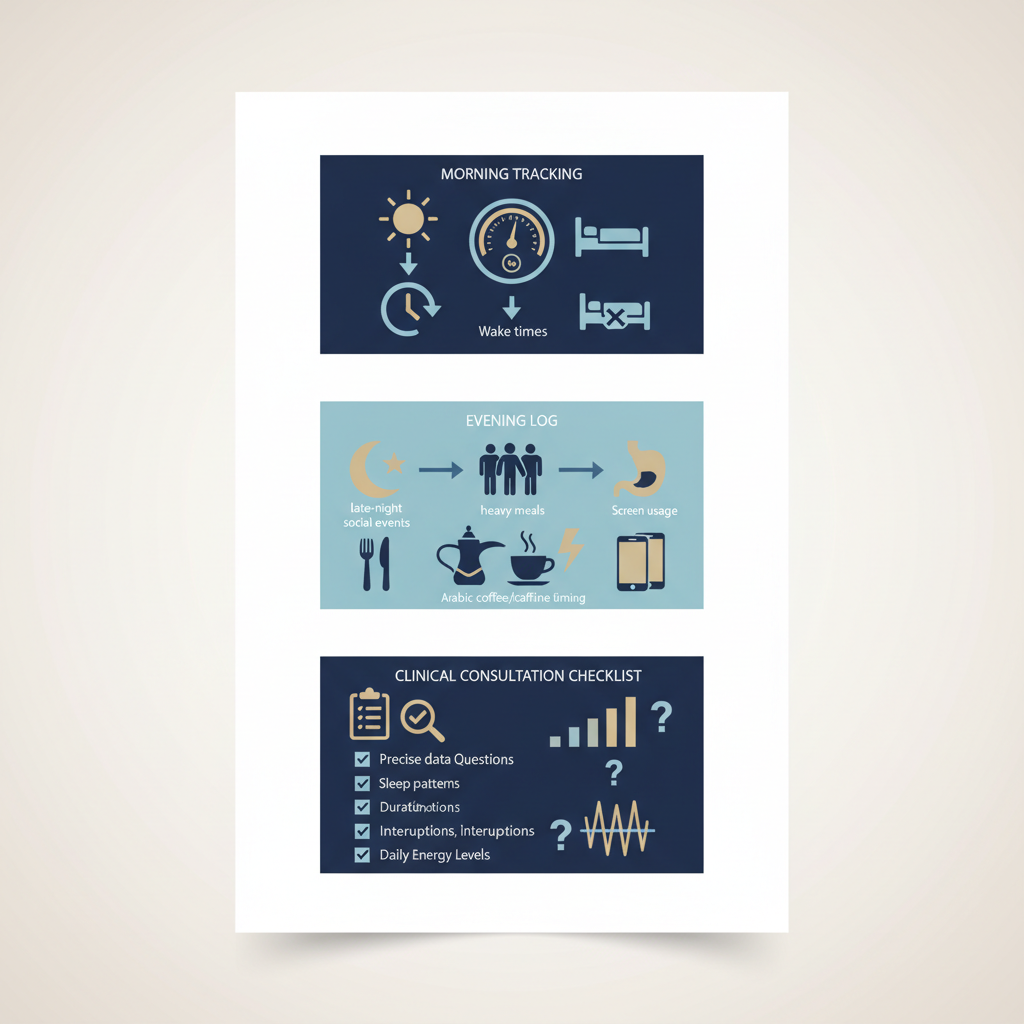
To create an effective journal that fits the nature of life in the Gulf, the design must be flexible and comprehensive. Start by dividing your entries into two periods: immediately after waking and just before bed. In the morning, record your actual wake-up time, how you felt (a scale of 1 to 10 for alertness), and the number of times you woke up during the night. In the evening, record the activities preceding sleep, such as the timing of your last meal (especially the heavy meals common in evening gatherings), caffeine intake, and social activities that may have influenced your mental state.
The journal must account for local environmental factors. Dedicate a section to room temperature and air conditioning settings, as coolness plays a crucial role in sleep quality in our desert climate. It is also beneficial to record prayer times, especially Fajr, and how you return to sleep afterward. This interruption is an integral part of the daily schedule for many and should be managed consciously to ensure total rest hours are not compromised. Documenting these details helps determine if social schedules are negatively interfering with biological sleep needs.
Use symbols to simplify the process; for example, a sun icon for natural light exposure during the day and a phone icon for screen use before bed. Ensure consistency by journaling for at least two weeks to get a clear picture. The goal is not perfection in sleep, but honesty in recording. Remember that this journal is a personal educational tool, and the data you collect will be the foundation for any future changes in your health habits, empowering you to take control of your daily quality of life.
4. How to Read Wearable Tech Labels and Sleep Metrics
In the digital age, smartwatches and fitness trackers have become integral to health monitoring. However, it is essential to understand how to read the data these devices provide and avoid the trap of "number obsession." Most of these technologies rely on an accelerometer to track movement and photoplethysmography (PPG) sensors to estimate heart rate and sleep stages. When a device shows a "Sleep Score," you must realize it is an algorithm combining sleep duration, resting heart rate, and movement fluctuations.
When reviewing your device data, focus on Heart Rate Variability (HRV), a strong indicator of how your nervous system responds to rest and stress. If you notice a consistent decline in this metric, it may be evidence that your body is not recovering sufficiently, even if sleep hours seem adequate. Some devices also provide data on blood oxygen levels (SpO2) during sleep; while not a substitute for a medical exam, noticing frequent drops may warrant consulting a specialist to rule out respiratory issues.
It is important to treat this data as "indicators" rather than "definitive diagnoses." Wearables can mistake total stillness for actual sleep, which may inflate recorded sleep efficiency. Therefore, always compare what the device says with your subjective feelings recorded in your journal. If the device indicates excellent sleep while you feel exhausted, your personal experience is paramount. Use technology to enhance your awareness of general patterns, such as the effect of late-night exercise on your sleeping heart rate, and let it complement your manual notes rather than replace them.
5. Evaluating Health Information: Distinguishing Reliable Sources from General Claims
With the proliferation of health content on social media platforms, it has become easy to fall victim to misleading information or inaccurate marketing claims regarding "miracle" sleep solutions. To evaluate any health information, first consider the source. Is the information from an academic institution or an accredited health organization? Or is it merely the personal experience of a social influencer? Individual experiences do not constitute a scientific basis, and what works for one person may not suit another due to biological and genetic differences.
Secondly, look for science-based evidence. Claims promoting specific products as the sole solution for all sleep problems without mentioning lifestyle changes are often commercial. Robust science always focuses on holistic solutions, including behavior, environment, and psychological aspects. When reading medical advice, ensure it does not crudely link a specific product to a guaranteed health outcome, as health responses are complex and influenced by multiple factors. Being wary of buzzwords like "instant cure" or "secrets doctors hide" is part of necessary health literacy.
Thirdly, use your sleep journal as a verification tool. If you read advice about the benefits of drinking a certain herb before bed, try it and record the results accurately in your diary. Did sleep latency improve? Did the number of awakenings increase? By applying a personal experimental approach, you will become less susceptible to general claims and more reliant on what your body actually proves. Remember, the goal of health education is to empower you to make informed decisions based on reliable information and accurate observations, not to follow trends without critical thinking.
6. Preparing Effective Questions for Specialists Based on Your Journal
A medical visit is much more effective when supported by clear data. Instead of waiting for the doctor to ask general questions, take the initiative by providing a summary from your sleep journal. Start by identifying the primary issue based on your entries; is it difficulty falling asleep, frequent awakenings, or feeling unrefreshed despite long duration? Here is how to phrase your questions: "I have noticed through two weeks of journaling that my sleep latency frequently exceeds 45 minutes; are there behavioral factors I might have overlooked?"
Use your data to discuss environmental and lifestyle factors. You might ask: "I recorded a correlation between late meals at family gatherings and fragmented sleep; how can I balance social obligations with my need for rest?" or "My smartwatch data shows my heart rate drops very slowly after falling asleep; does this indicate persistent physical stress?" These questions show the specialist that you are an active partner in your health journey and help them provide more accurate, personalized advice.
Also, do not hesitate to ask about terms you didn't understand in smart device reports or scientific articles you've read. Inquire about Sleep Hygiene and how to apply it within our local environment. The goal of these questions is to transform the consultation from a mere diagnosis into an educational action plan. Remember that the doctor possesses scientific expertise, while you possess the daily data of your own body; by combining them, you achieve the best possible health outcomes. Journaling makes your voice heard and grounded in tangible facts.
7. Conclusion: Journaling as a Bridge for Effective Communication with Healthcare Providers
In conclusion, a sleep journal represents more than just pen and paper; it is a commitment to your health and self-awareness. In our Gulf society, where social customs intertwine with biological requirements, journaling becomes a means to regain control over our life's rhythm. By understanding scientific terms, using technology mindfully, evaluating information critically, and preparing well for medical consultations, you lay the foundation for a more active and productive life. Sleep is not lost time; it is an investment in your alertness and sustainable health.
The ultimate goal of this practice is to transform you from a passive recipient of health information into an informed, active participant. When you bring your journal to a specialist's clinic, you provide them with a clear roadmap to help them help you. This effective communication reduces the likelihood of misdiagnosis and increases the chances of success for proposed behavioral changes. Make journaling a simple daily habit, and you will discover over time that the small details you used to ignore are the keys to achieving your desired health balance.
Journaling is the process of turning silent experiences into vocal data that helps us better understand the language of our bodies.
| Term | Educational Description | Why Record It? |
|---|---|---|
| Sleep Latency | The time taken to fall asleep after turning off the lights. | To understand how quickly the body and brain relax. |
| Sleep Efficiency | The ratio of actual sleep time to time spent in bed. | To evaluate the quality of time spent in bed. |
| Sleep Hygiene | Practices and environments that promote good sleep. | To identify external factors that can be modified. |
| Heart Rate Variability (HRV) | The variation in time between consecutive heartbeats. | As an indicator of physical recovery and stress levels. |
Related ATHAR paths
Explore health education step by step
Use the educational guides and practical tools to choose your next learning step.