Gulf Women's Guide: Preparing for Health Visits and Asking the Right Questions
Author: Feras Alayed
Published:
Updated:
Category: women-health-questions
Reading Time: 10 minutes
Gulf Women's Guide: Preparing for Health Appointments and Asking the Right Questions
1. Introduction: The Importance of Health Literacy for Women in Gulf Society
Health literacy is the cornerstone of building a healthy society. In the Gulf region, women play a pivotal role, not just as individuals caring for their own health, but as the primary health managers for their entire families. Health literacy goes beyond knowing the names of diseases; it is about the ability to access, understand, and use health information to make informed decisions. In recent years, Gulf societies have witnessed a significant shift towards preventive medicine, where the focus has moved to maintaining wellness rather than just treating symptoms when they arise.
Empowering women with health knowledge means they can distinguish between science-based health practices and misconceptions that may spread in social gatherings or across social media. When a woman enters a clinic armed with knowledge, she transforms from a passive recipient of instructions into an active partner in her treatment plan. This shift contributes to improved long-term health outcomes and reduces the anxiety associated with medical ambiguity. Investing in women's health literacy is an investment in the health of future generations, as mothers pass these values and healthy habits to their children, creating a home environment that supports sustainable healthy choices.
Furthermore, the cultural specificities in the Gulf region require a special approach to health communication. Understanding how to ask questions regarding reproductive health, nutrition, or mental health in a way that aligns with societal values while maintaining scientific accuracy is an essential skill. This article aims to provide Gulf women with the tools necessary to be confident advocates for their health needs and to extract the maximum possible benefit from every medical visit, ensuring a more vibrant and productive life for themselves and their families.
2. Understanding Medical Terminology: Simplifying Common Clinic Concepts
Patients often feel confused when hearing complex medical terms, which can lead to a communication barrier between the doctor and the patient. Understanding basic terminology is the first step to breaking this barrier. For example, the term "Metabolism" simply refers to the chemical processes the body performs to convert food and drink into energy. When a doctor talks about "metabolic health," they are referring to how efficiently your body manages this energy and how it affects blood sugar and lipid levels.
Another common term is "Screening," which is quite different from "Diagnosis." A screening is performed on people who do not have symptoms to detect the possibility of a health problem early, while a diagnosis is performed to determine the cause of an existing symptom. Understanding this difference helps you realize the importance of regular check-ups even if you feel healthy. We also find the term "Biomarkers," which are objective measurements like blood pressure or cholesterol levels that give the doctor an accurate picture of what is happening inside the body, beyond the verbal description of symptoms.
Educational Note: Never hesitate to ask for a term to be simplified. You can say: "Could you explain this term in simple language?" or "What does this mean for my daily life?".
Additionally, it is important to understand the concept of "Hormonal Balance," a broad term referring to the complex interaction between the body's chemical messengers that regulate everything from mood to the menstrual cycle and metabolism. Recognizing that hormones do not work in isolation helps in understanding why a doctor might order comprehensive tests instead of focusing on a single hormone. Building your personal medical dictionary empowers you to discuss treatment options clearly and understand the potential side effects of any medical intervention.
3. The Daily Habit Journal: How Tracking Enriches Your Health Discussion
Health journaling is one of the most powerful tools a woman can use to improve the quality of the healthcare she receives. Human memory can sometimes fail us, especially under the time pressure of a consultation room, but a health journal provides objective facts to the doctor. Start by recording your sleep patterns: the number of hours, the quality of sleep, and how energetic you feel upon waking. Sleep is not just rest time; it is a vital period for cell repair and hormonal regulation, and sharing this data helps the doctor assess your general condition.
Secondly, record your eating habits and energy levels. There is no need for precise calorie counting; instead, focus on linking what you eat to how you feel. Do you feel lethargic after a certain meal? Are there specific times of the day when your focus drops? This connection helps identify patterns that may indicate fluctuations in blood sugar levels or undetected food sensitivities. Also, recording physical activity, whether walking or exercising, gives a picture of your fitness level and your body's endurance.
For women, tracking the menstrual cycle and associated symptoms is fundamental. Record dates, pain intensity, mood changes, and any unusual symptoms. This historical data enables the doctor to notice patterns that might not appear in a single examination. Use a paper diary or mobile apps; the important thing is consistency. When you provide the doctor with a summary like: "I noticed a drop in my energy in the three days preceding my period for the last three months," you are providing a valuable diagnostic thread that saves a lot of time and effort in unnecessary tests.
4. Practical Steps to Prepare an Effective List of Questions Before Your Appointment
Preparing for a medical appointment starts several days before entering the clinic. Writing a list of questions ensures that core points are not forgotten and helps manage the appointment time efficiently. Start by categorizing your questions into groups. The first category is diagnostic questions: "What is the likely cause of these symptoms?", "Are there other causes that should be ruled out?". The second category relates to tests: "Why do I need this test?", "How should I prepare for it?", and "When and how will I get the results?".
The third category, often the most important, relates to treatment options and lifestyle changes. Instead of the traditional question "What should I do?", try asking more specific questions like: "What options are available to me (whether medication or lifestyle changes)?", "What are the potential benefits and risks of each option?", and "How will this treatment affect my daily routine?". Don't forget to ask about follow-up: "What signs should prompt me to contact you before the next appointment?" and "When should we meet again to evaluate progress?".
Another practical tip is to prioritize your questions; start with the most urgent to ensure they are covered in case time is short. Be honest and clear, and do not feel embarrassed to ask about sensitive topics; doctors are used to this, and your honesty is the key to a correct diagnosis. If you are taking any supplements or herbs, include them in your list to discuss their potential interaction with any proposed treatment plan. Remember that the goal of these questions is not to test the doctor, but to build a mutual understanding that makes you a confident partner in your health decisions.
5. Health Label Reading Guide: Understanding Instructions and Warnings Clearly
The ability to read and understand labels on dietary supplements and health products is an essential skill to protect yourself from misinformation or misuse. When looking at a supplement label, start with the "Ingredients List." Ingredients are usually listed by quantity from highest to lowest. Look for active ingredients and check their concentration, and be wary of added ingredients like hidden sugars, artificial colors, or preservatives that you may not want to put into your body.
Next, move to the "Serving Size" and "Daily Value" (DV). The Daily Value tells you what percentage of your daily needs this product provides based on a general diet, but remember that your individual needs may vary based on your age, activity, and health status. Another critical point is "Warnings and Drug Interactions." Some natural supplements can interact dangerously with prescribed medications, such as blood pressure medications or blood thinners. Always read warnings regarding pregnancy and breastfeeding if they apply to you.
| Term on Label | Educational Meaning |
|---|---|
| Sugar-Free | Contains less than 0.5g of sugar per serving, but may contain artificial sweeteners. |
| 100% Natural | Does not necessarily mean it is safe for everyone; some natural substances are potent and have side effects. |
| Expiration Date | The last date the manufacturer guarantees the full potency of the active ingredients. |
Finally, look for quality seals or third-party certifications. These seals indicate that the product has been independently tested to ensure that what is written on the label is actually inside the bottle and that it is free of contaminants. Spending two extra minutes reading the label carefully can save you from many health problems and ensure you get the intended benefit from the product you chose to use.
6. Evaluating Online Health Information: Distinguishing Reliable from Unreliable Sources
In the era of information explosion, the internet has become the primary source for health information, but it is a double-edged sword. To evaluate any health information you find online, use strict criteria. First, the Source: Does the site belong to a government health agency, a prestigious university, or a recognized medical organization? Sites ending in (.gov), (.edu), or (.org) are often more reliable than commercial sites ending in (.com), which may aim to sell a specific product.
Second, Recency and Scientific Verification: Medicine is a rapidly evolving science. Check the publication date of the article; information older than five years may be outdated. Is the article reviewed by doctors or experts? Does it cite scientific studies published in reputable medical journals? Beware of sensational headlines that promise "miracle cures" or "instant results," as real science is characterized by humility and precision and does not make absolute promises. Also, be cautious of personal stories (testimonials); what worked for one person may not suit you, and individual results are not considered scientific evidence.
Third, Bias: Ask yourself, who funds this site? If the site is funded by a company selling a specific product, the information may be biased toward promoting that product. Reliable sources present benefits and risks equally. Before applying any advice you find online, write it down and discuss it with your doctor at your next appointment. You can say: "I read about this approach on a reliable medical site, what do you think about its suitability for my condition?". This approach turns the internet from a source of anxiety into a tool for deepening productive medical discussion.
7. Effective Communication Strategies in the Consultation Room to Ensure Clarity
Effective communication is the safety bridge between you and your healthcare provider. Inside the consultation room, do not hesitate to use the "Teach-Back" technique. After the doctor explains the treatment plan, say: "To make sure I understood correctly, do you mean I should do (this and that)?". This ensures there is no misunderstanding and allows the doctor to correct any unclear information. Be clear in describing your symptoms; use precise words to describe pain (sharp, dull, intermittent) and specify its exact location.
Another important strategy is focusing on priorities. If you have several concerns, start with the one that most affects your quality of life. If you feel the doctor is speaking too fast or using technical language, politely interrupt and ask for clarification. Remember that you are the final decision-maker in your health, and you have the right to understand all available options. If you feel uncomfortable or that your questions are not being heard, you have the right to seek a second medical opinion; this is a normal and acceptable part of modern medical practice.
In conclusion, always keep a notebook and pen with you to take notes during the session. Writing down instructions reduces the likelihood of forgetting them once you leave the clinic. Ask about the best way to communicate with the clinic if subsequent questions arise, whether by phone or email. Building a relationship based on mutual respect and open communication with your medical team is the best investment for your long-term health. Remember that the doctor's goal is to help you, and your goal is to live healthily; with effective communication, these goals meet to achieve the best results.

Related ATHAR paths
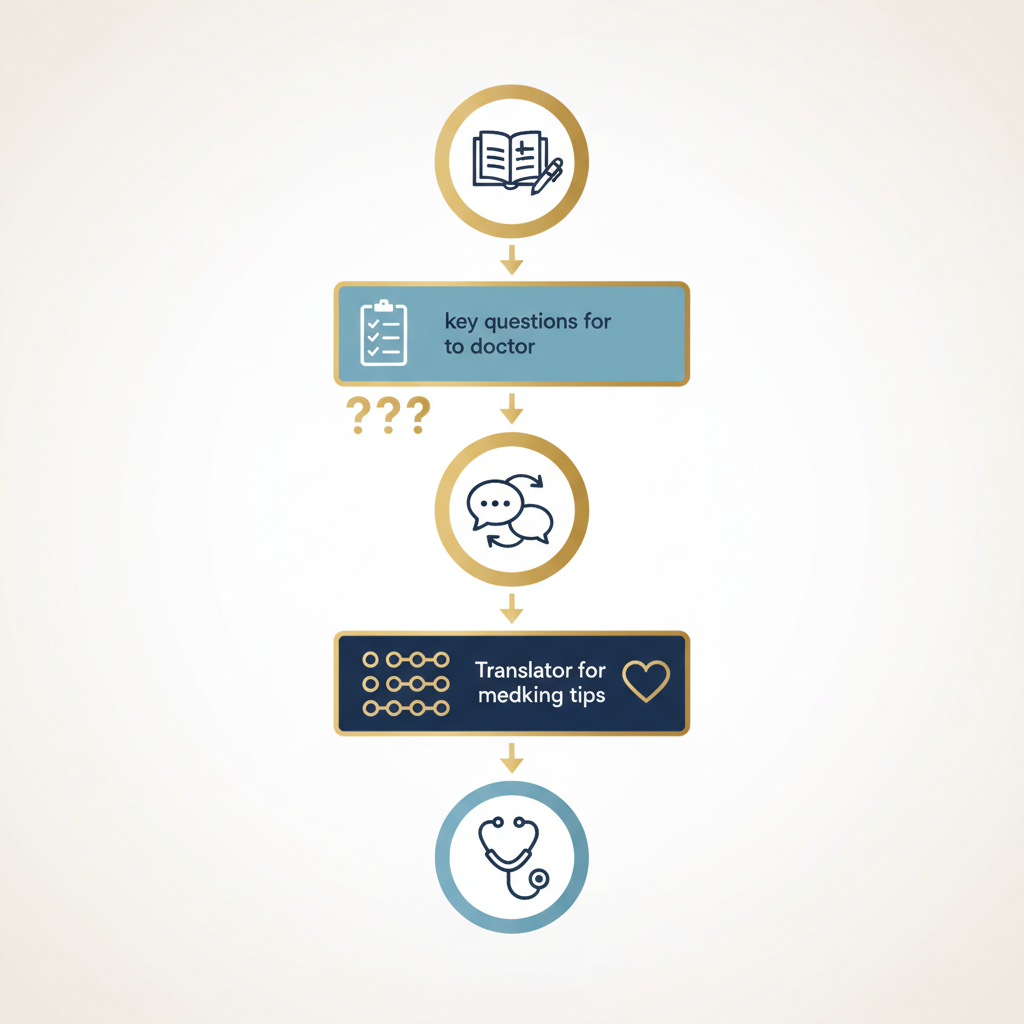
Explore health education step by step
Use the educational guides and practical tools to choose your next learning step.