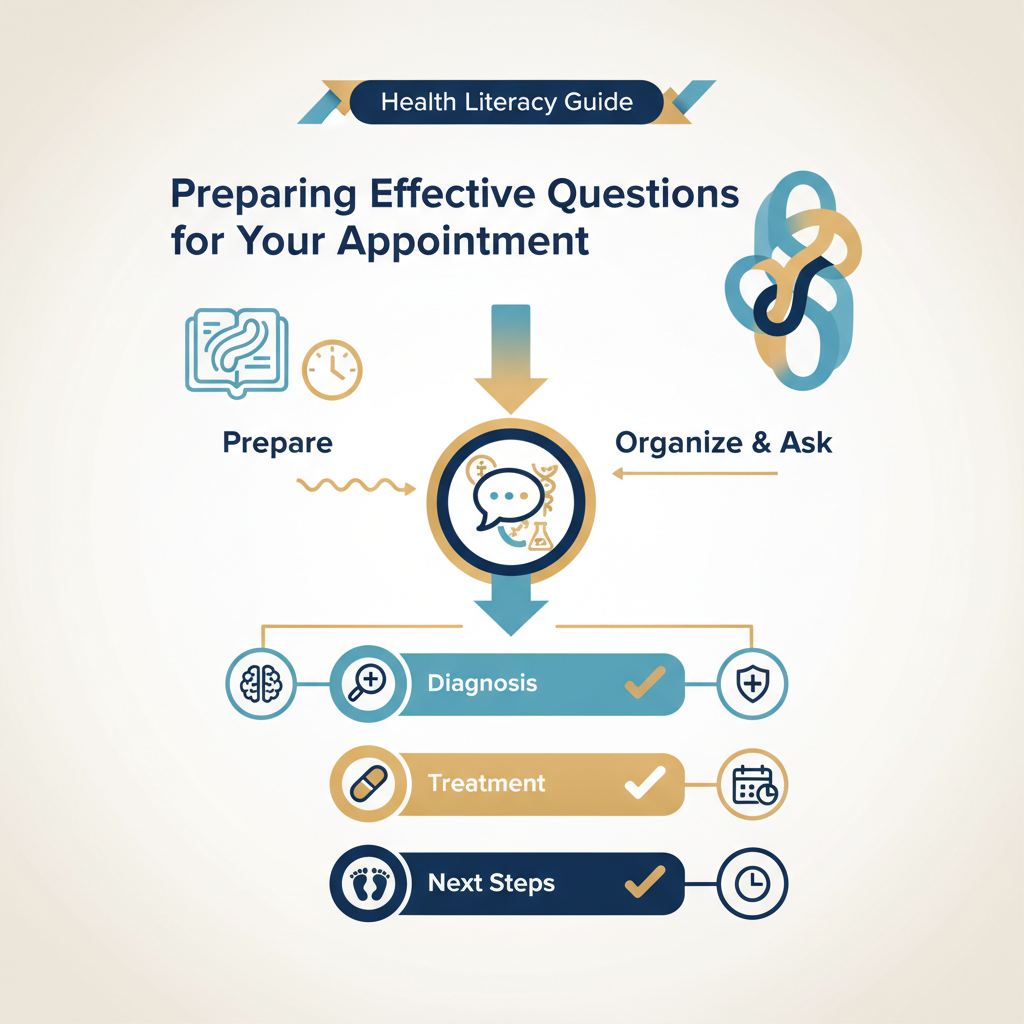
Health Literacy Guide: Preparing Effective Questions for Your Appointment
Author: Feras Alayed
Published:
Updated:
Category: appointment-questions-gulf
Reading Time: 8 minutes
Empowering Health Literacy: How to Prepare for Your Medical Appointment with Effective Questions
Health literacy is the cornerstone of building a conscious society capable of effectively managing its quality of life. At ATHAR Center, we believe that the patient is not just a recipient of service, but a fundamental partner in the health process. Preparing in advance for a medical appointment is not merely an organizational procedure; it is an investment in your time and health, ensuring you gain the maximum possible benefit from the specialist's expertise. When you enter the clinic armed with the right information and precise questions, you contribute to reducing the chances of misunderstanding and accelerate the process of reaching a clear action plan.
1. The Importance of Pre-Appointment Preparation in Enhancing Personal Health Literacy
Preparing for a medical appointment is the first step toward health empowerment. Often, visitors feel confused or forgetful as soon as they enter the examination room, leading to missed opportunities to ask essential questions. Pre-preparation helps organize thoughts and identify health priorities, making the dialogue with the specialist more focused and profound. Possessing high health literacy means the ability to access, understand, and use health information to make informed decisions, and this starts at home before heading to the health center.
When you dedicate time to writing down your concerns and recent health history, you build a bridge of effective communication with the medical team. This approach reduces the stress associated with appointments, as you feel in control and ready for discussion. Additionally, preparation helps ensure that minor symptoms, which might be key to understanding the broader picture of your condition, are not overlooked. Health literacy is not just about knowing diseases; it is about how to manage interaction with the health system efficiently, which good preparation achieves.
Good preparation for a medical appointment transforms the visit from a mere passing consultation into an interactive educational session that enhances your awareness of your body and its needs.
2. Understanding Basic Medical Terminology: How to Request Clarification of Complex Concepts
Medical language sometimes represents a barrier to a full understanding of one's health status. Terms like "chronic," "acute," "idiopathic," or "physiological response" may seem complex to the average visitor. Enhancing health literacy requires the courage to ask for simplification. Never hesitate to say: "Could you explain this term in simpler language?" or "What does this mean for my daily life?". The goal of the appointment is mutual understanding, and specialists appreciate the visitor who seeks deep comprehension.
One effective technique in this context is the "Teach-back method," where you explain what you understood in your own words to the specialist to ensure the accuracy of the information. For example, you could say: "So, what you mean is that I should do (this) because (that), is my understanding correct?". This ensures the removal of any ambiguity in technical terms. It is also always preferable to ask to write down key terms on a separate piece of paper to research later in reliable sources, which enhances your health knowledge base and makes you more capable of following your condition in the future.
3. The Methodology of Journaling Health Habits for Accurate Sharing with the Specialist
Accuracy in conveying information is the key to correct diagnosis and precise recommendations. Relying on memory alone can be misleading, especially when talking about recurring daily habits. Journaling health habits for a week before the appointment provides objective data for the specialist. This journal should include sleep patterns, the quality and quantity of meals, physical activity levels, and any stress triggers or mood changes. Any physical symptoms should also be recorded with their timing, duration, and intensity.
Using a simple table or a note-taking app can reveal patterns that you might not notice in passing. For example, you might discover that your feeling of lethargy is linked to a certain type of food or a lack of sleep on specific days. When sharing this data with the specialist, you provide them with a comprehensive view of your lifestyle, helping them offer customized advice that fits your daily reality rather than general tips. This methodology enhances your sense of responsibility toward your health and makes you more aware of the impact of your daily behaviors on your well-being.
4. Formulating a List of Questions Related to Understanding General Recommendations and Next Steps
To achieve maximum benefit, your questions should be strategic and forward-looking. Instead of closed questions that can be answered with "yes" or "no," use open-ended questions starting with "how" and "why." It is important that your list includes questions about the short-term and long-term goals of the recommendations provided. For example: "What expected changes should I notice in the coming weeks?" or "What is the next step if we don't see the desired improvement?".
Also, focus on understanding the "why" behind each recommendation. Understanding the reason increases adherence to the health plan. Ask about available alternatives and how to integrate new recommendations into your busy schedule. The list of questions should be written and arranged by importance to ensure the most pressing issues are raised first if appointment time is limited. Remember that your role is to inquire about everything related to your health, and there is no "simple" or "unimportant" question when it comes to understanding how to better care for your body.
5. Methods for Evaluating Health Information Derived from Digital Sources Before the Appointment
In the era of digital openness, many turn to search engines before visiting a doctor. While this reflects an interest in health, it can lead to unnecessary anxiety due to inaccurate or disproportionate information. To enhance your health literacy, you must learn how to evaluate sources. Always look for websites affiliated with international health organizations, academic universities, or recognized specialized centers. Avoid relying on public forums or social media posts that lack scientific attribution.
When you find information that interests or worries you, write it down and discuss it with the specialist during the appointment. You can say: "I read about (a certain topic) in a reliable source, how does this apply to my case?". This approach transforms digital information from a source of stress into a tool for scientific dialogue. The specialist can help you filter this information and clarify what is relevant to your specific case and what is just general or incorrect information. Remember that a digital diagnosis never replaces a direct clinical evaluation.
6. Skills for Reading Labels and Instructional Guidelines with Clarity and Accuracy
A fundamental part of health literacy is the ability to understand food labels and instructions attached to health products or supplements. Before the appointment, it might be helpful to bring samples or photos of the products you use regularly. Learning to read the ingredients list and understanding serving sizes helps you ask precise questions about the suitability of these products for your health plan. Pay attention to misleading terms and look for clear nutritional facts.
Also, understanding usage instructions, such as "take before eating" or "store in a cool, dry place," is vital. If you find difficulty understanding the symbols or tables on labels, make this part of your discussion with the specialist. Ask them to clarify how to read this data and what elements you should focus on based on your specific health needs. Mastering the skill of reading labels gives you greater independence in making smart daily health choices and protects you from inaccurate marketing claims.
7. Practical Tips for Note-Taking During the Appointment to Ensure Accurate Home Follow-up
Information fades quickly after leaving the clinic, so taking notes during the appointment is a necessary practice to ensure continuity. Do not rely on your memory alone; carry a special notebook or use the notes app on your phone. Record key points, upcoming appointments, and any lifestyle changes agreed upon. If the specialist speaks quickly, politely ask them to pause for a moment so you can write, or ask if you can record parts of the dialogue (after asking for permission, of course).
At the end of the appointment, dedicate two minutes to review your notes with the specialist to ensure you have recorded everything accurately. Ask them to review the "action plan" you have written down. These notes will be your primary reference at home and will help you explain your condition to family members or any other specialist you might see in the future. Note-taking reflects the visitor's seriousness and keenness to implement recommendations, which builds a relationship of trust and mutual respect with the medical team and ensures the best possible health outcomes.
Educational Checklist for Appointment Preparation
| Item | Action Required | Done? |
|---|---|---|
| Symptom List | Note when they started, severity, and what improves or worsens them. | ☐ |
| Health History | Prepare a list of any previous or current health conditions. | ☐ |
| Current Products | Write down the names of all supplements and health products currently used. | ☐ |
| Key Questions | Prepare 3-5 fundamental questions you want answers to. | ☐ |
| Recording Tools | Bring a pen and paper or ensure your phone is charged for note-taking. | ☐ |
Related ATHAR paths

Explore health education step by step
Use the educational guides and practical tools to choose your next learning step.