Heart Health Germany: DGK Guidelines 2026 – What You Need to Know
Author: Feras Alayed
Published:
Updated:
Category: german-health
Reading Time: 11 minutes
Key Takeaways
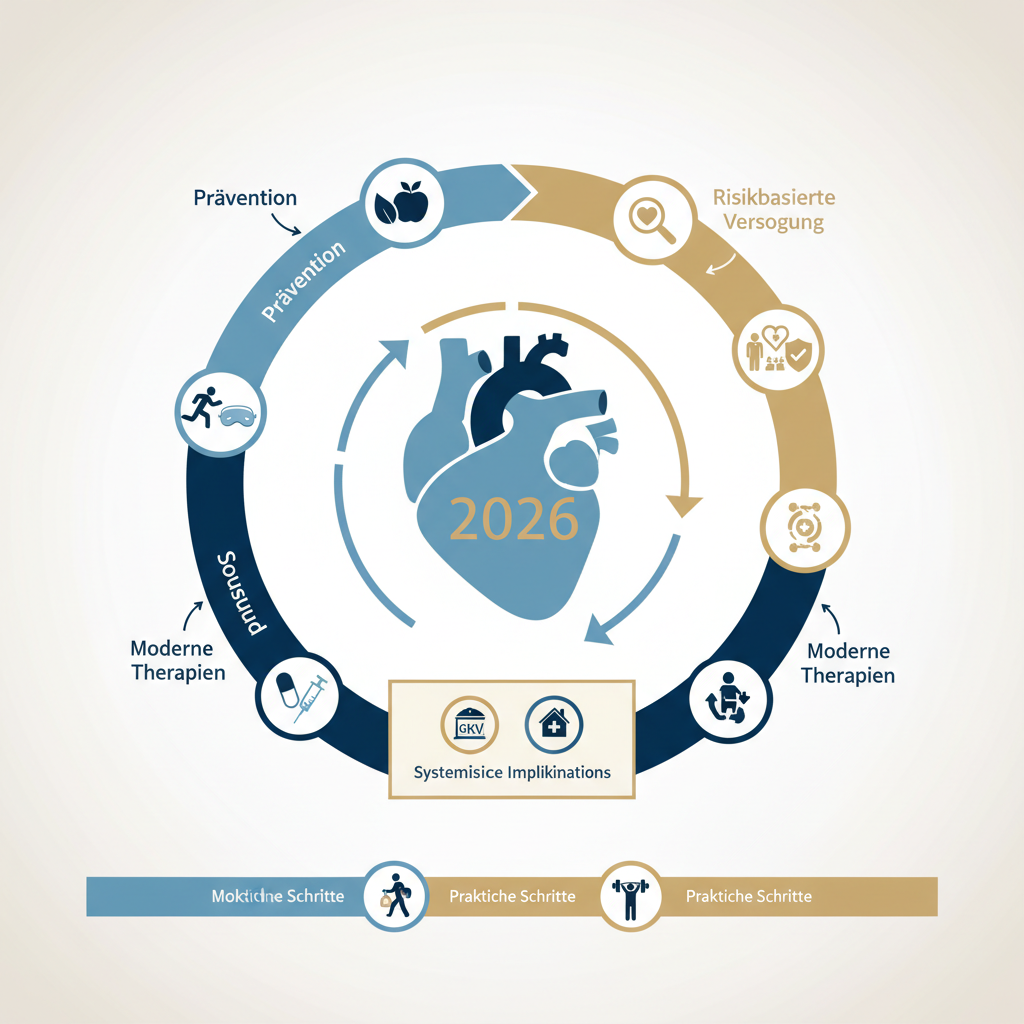
- DGK 2026 emphasises prevention, risk-stratified care and integration of modern cardiometabolic therapy into routine practice in Germany. ([dgk.org](https://dgk.org/?utm_source=openai))
- Germany faces a persistent cardiovascular burden; population-level surveillance (RKI) and the German Heart Report show regional variation across Bundesländer. ([rki.de](https://www.rki.de/DE/Themen/Nichtuebertragbare-Krankheiten/Koerperliche-Gesundheit/Herz-Kreislauf/herz-kreislauf-erkrankungen.html?utm_source=openai))
- Lifestyle-first recommendations align with DGE nutrition guidance and national prevention law changes that expand GKV and local prevention services. ([dge.de](https://www.dge.de/gesunde-ernaehrung/gut-essen-und-trinken/dge-empfehlungen/?utm_source=openai))
- Key clinical priorities in 2026 include tighter risk assessment in primary care (Hausarzt), targeted use of SGLT2 inhibitors and contemporary heart-failure pathways, optimized blood-pressure and lipid targets, and broad cardiac rehabilitation access. ([pubmed.ncbi.nlm.nih.gov](https://pubmed.ncbi.nlm.nih.gov/36041474/?utm_source=openai))
- Complementary lifestyle tools (nutrition, exercise, structured cardiac rehab) and supportive supplements or systems such as Feel Great may help people manage post-meal glucose, energy and adherence — but are not medications. See how to combine these with GKV-covered services and Hausarzt guidance.
TL;DR
The DGK 2026 recommendations emphasise prevention, individualized risk assessment (starting in primary care / Hausarzt), and contemporary therapies for heart failure and coronary disease. Germany-wide delivery via Krankenkassen (GKV) and strengthened prevention programmes are central to implementation. Key international evidence (ESC, Lancet, Cochrane, NEJM/JACC meta-analyses) underpins these shifts. ([academic.oup.com](https://academic.oup.com/eurheartj/article/42/34/3227/6358713?utm_source=openai))
🇩🇪 Want to take action now? Try Feel Great → | Chat with a coach →
Introduction: A wake-up call for heart health in Germany
Cardiovascular diseases remain among the leading causes of death and disability in Germany. Recent reporting from national surveillance highlights that coronary heart disease, myocardial infarction and stroke still account for a large share of mortality and regional differences across the Bundesländer. For clinicians and people in Germany this means prevention and evidence-based care remain urgent priorities. ([rki.de](https://www.rki.de/DE/Themen/Nichtuebertragbare-Krankheiten/Koerperliche-Gesundheit/Herz-Kreislauf/herz-kreislauf-erkrankungen.html?utm_source=openai))
Why DGK 2026 matters (short context)
The Deutsche Gesellschaft für Kardiologie (DGK) issues recommendations and comments tailored to German practice, translating European (ESC) evidence into national context and operational guidance for cardiologists, internists and primary care physicians (Hausarzt). The 2026 DGK updates focus on risk stratification, preventive medicine integration into primary care, modern pharmacotherapy pathways (including SGLT2 inhibitors in heart failure), and delivery mechanisms across the German healthcare landscape. ([dgk.org](https://dgk.org/?utm_source=openai))
Key changes and highlights in the 2026 DGK recommendations
1) Stronger risk assessment in primary care (Hausarzt)
DGK emphasizes routine risk calculation and shared decision-making beginning at the Hausarzt level. The renewed S3 and primary-care tools (including updated risk scores and guidance for lifestyle counselling) aim to make prevention accessible within GP visits and to increase targeted referrals to cardiology and cardiac rehabilitation. This aligns with recent S3 updates for GP risk counselling and the G-BA innovations to support risk-based prevention. ([register.awmf.org](https://register.awmf.org/assets/guidelines/053-024l_S3_Hausaerztliche-Risikoberatung-zur-kardiovaskulaeren-Praevention_2025-09.pdf?utm_source=openai))
2) Prevention and nutrition — DGE alignment
Dietary advice in DGK 2026 echoes the Deutsche Gesellschaft für Ernährung (DGE): increase plant-based foods (vegetables, legumes, nuts, whole grains), moderate animal products, reduce processed meats and sugar-sweetened beverages. The DGE's 2024–2025 recommendations are explicitly referenced as the national food-based guidance to support cardiovascular prevention. ([dge.de](https://www.dge.de/gesunde-ernaehrung/gut-essen-und-trinken/dge-empfehlungen/?utm_source=openai))
3) Modern pharmacotherapy pathways (heart failure, lipids)
DGK advises contemporary heart-failure pathways that integrate SGLT2 inhibitors across a broad spectrum of ejection fractions, reflecting updated evidence and international meta-analyses showing reduced HF hospitalisations. For lipid management, risk-based LDL targets remain central, with consideration of combination therapy for very-high-risk individuals. These recommendations are consistent with international randomized trials and meta-analyses. ([pubmed.ncbi.nlm.nih.gov](https://pubmed.ncbi.nlm.nih.gov/36041474/?utm_source=openai))
4) Blood pressure targets and individualized therapy
DGK commentary stresses individualized BP targets guided by overall cardiovascular risk rather than fixed BP thresholds alone — consistent with Blood Pressure Lowering Trialists’ Collaboration meta-analyses that show benefit across blood-pressure strata. Primary care physicians are encouraged to use risk-based decision making. ([pubmed.ncbi.nlm.nih.gov](https://pubmed.ncbi.nlm.nih.gov/34461040/?utm_source=openai))
5) Cardiac rehabilitation and digital delivery
Expanding access to exercise-based cardiac rehabilitation — including hybrid, home-based and digital programs — is a DGK priority, supported by recent Cochrane and network meta-analyses that show benefits for hospitalisation reduction and quality of life after heart events. DGK points to telehealth and hybrid models as ways to reach patients across all Bundesländer. ([academic.oup.com](https://academic.oup.com/eurjhf/article/25/12/2263/8341969?utm_source=openai))
Numbers that matter (Germany)
- Prevalence: Estimates show coronary heart disease affects several percent of adults and remains an important contributor to morbidity in Germany; surveillance by RKI and the German Heart Report document regional differences across Bundesländer. ([gbe.rki.de](https://www.gbe.rki.de/DE/Themen/Gesundheitszustand/KoerperlicheErkrankungen/HerzKreislaufErkrankungen/KoronareHerzerkrankungPraevalenz/koronareHerzerkrankungPraevalenz_node.html?utm_source=openai))
- Prevention spending: Federal programmes and recent BMG prevention initiatives (Gesundes-Herz-Gesetz and Präventionsoffensive) have increased prevention funding and focus on delivering services via the GKV and community settings. ([bundesgesundheitsministerium.de](https://www.bundesgesundheitsministerium.de/presse/pressemitteilungen/bundeskabinett-beschliesst-gesundes-herz-gesetz-pm-28-08-2024?utm_source=openai))
- Cardiac rehab uptake: Despite benefits, participation rates vary — DGK supports broader delivery models to improve reach across urban and rural Bundesländer. ([pmc.ncbi.nlm.nih.gov](https://pmc.ncbi.nlm.nih.gov/articles/PMC10630615/?utm_source=openai))
Practical recommendations for people in Germany (what you can do)
- See your Hausarzt (GP) for a cardiovascular risk check — ask for a risk score and action plan. Clinical pathways now encourage primary-care-initiated prevention. ([register.awmf.org](https://register.awmf.org/assets/guidelines/053-024l_S3_Hausaerztliche-Risikoberatung-zur-kardiovaskulaeren-Praevention_2025-09.pdf?utm_source=openai))
- Follow DGE-aligned dietary patterns (more plant foods, less processed meat and sugar). Small changes can lower risk factors such as LDL and blood pressure. ([dge.de](https://www.dge.de/gesunde-ernaehrung/gut-essen-und-trinken/dge-empfehlungen/?utm_source=openai))
- Move regularly — aim for the physical activity targets in national prevention guidance and consider structured cardiac rehab after events; check with your Krankenkasse for covered programs. ([bundesgesundheitsministerium.de](https://www.bundesgesundheitsministerium.de/themen/krankenversicherung/online-ratgeber-krankenversicherung/medizinische-versorgung-und-leistungen-der-krankenversicherung/gesundheitsfoerderung-und-praevention?utm_source=openai))
- Know key biometrics: blood pressure, LDL cholesterol, HbA1c (for those with diabetes) — discuss targets with your Hausarzt and cardiologist. (Note: blood glucose values are reported in mmol/L in Germany — e.g., fasting glucose normal range ~3.9–5.5 mmol/L).
- Stop smoking and manage stress — both are repeatedly emphasised in DGK and national prevention actions. ([dgk.org](https://dgk.org/?utm_source=openai))
Comparison: DGK 2026 focus vs. previous practice (quick table)
| Area | Pre-2020 approach | DGK 2026 emphasis |
|---|---|---|
| Primary care role | Variable risk assessment | Routine risk stratification; Hausarzt-led prevention pathways. ([register.awmf.org](https://register.awmf.org/assets/guidelines/053-024l_S3_Hausaerztliche-Risikoberatung-zur-kardiovaskulaeren-Praevention_2025-09.pdf?utm_source=openai)) |
| Pharmacotherapy in HF | Stepwise, EF-based | Earlier SGLT2 use across EF spectrum per updated evidence. ([pubmed.ncbi.nlm.nih.gov](https://pubmed.ncbi.nlm.nih.gov/36041474/?utm_source=openai)) |
| Nutrition | General advice | Aligned with DGE food-based recommendations; measurable dietary targets. ([dge.de](https://www.dge.de/gesunde-ernaehrung/gut-essen-und-trinken/dge-empfehlungen/?utm_source=openai)) |
| Rehab delivery | Center-based predominance | Hybrid and tele-rehab models to improve nationwide access. ([pmc.ncbi.nlm.nih.gov](https://pmc.ncbi.nlm.nih.gov/articles/PMC12246986/?utm_source=openai)) |
How the German healthcare system (GKV, Hausarzt) implements DGK 2026
Implementation depends on coordinated action between Hausärzte (GPs), cardiologists, Krankenkassen (statutory insurers — Gesetzliche Krankenversicherung, GKV) and regional providers. Policies such as the Gesundes-Herz-Gesetz and the BMG prevention initiatives expand reimbursement for prevention services, invite pharmacies and community programmes to take part, and aim to deliver services across all Bundesländer. If you have statutory insurance (GKV), many preventive consultations, cardiac rehab sessions after qualifying events, and certain diagnostics are covered — check specific pathways with your Krankenkasse and Hausarzt. ([bundesgesundheitsministerium.de](https://www.bundesgesundheitsministerium.de/presse/pressemitteilungen/bundeskabinett-beschliesst-gesundes-herz-gesetz-pm-28-08-2024?utm_source=openai))
Evidence that shaped these recommendations (selected international and German studies)
DGK draws on ESC guidance, trial evidence and meta-analyses. Highlights include:
- ESC 2021 Guidelines for CVD prevention (core framework for risk-based decisions). ([academic.oup.com](https://academic.oup.com/eurheartj/article/42/34/3227/6358713?utm_source=openai))
- Lancet 2021 individual participant-level meta-analysis showing BP-lowering reduces major CV events across baseline BP levels. ([biolincc.nhlbi.nih.gov](https://biolincc.nhlbi.nih.gov/publications/4b9b42a192934d9d80220556bf6ce7b5/?utm_source=openai))
- Meta-analyses of SGLT2 inhibitors in heart failure (reduced hospitalisation across EF ranges). ([pubmed.ncbi.nlm.nih.gov](https://pubmed.ncbi.nlm.nih.gov/36041474/?utm_source=openai))
- Systematic reviews showing benefits of exercise-based cardiac rehabilitation (Cochrane / network meta-analyses, 2023). ([academic.oup.com](https://academic.oup.com/eurjhf/article/25/12/2263/8341969?utm_source=openai))
- German surveillance & policy documents (RKI health monitoring; DGK comments; BMG prevention initiatives) informing national implementation. ([edoc.rki.de](https://edoc.rki.de/bitstream/handle/176904/12714/JHealthMonit_2025_02_risk_cardiovascular_disease.pdf?isAllowed=y&sequence=1&utm_source=openai))
What DGK means for clinicians (practical checklist)
- Implement standardized risk scoring tools in the practice workflow (documented at each preventive visit). ([register.awmf.org](https://register.awmf.org/assets/guidelines/053-024l_S3_Hausaerztliche-Risikoberatung-zur-kardiovaskulaeren-Praevention_2025-09.pdf?utm_source=openai))
- Offer structured lifestyle programmes with measurable goals and refer to DGE resources for nutrition counselling. ([dge.de](https://www.dge.de/gesunde-ernaehrung/gut-essen-und-trinken/dge-empfehlungen/?utm_source=openai))
- Use guideline-informed pharmacotherapy for high-risk patients (lipid-lowering, BP drugs, SGLT2s when indicated) and consider combination strategies for very-high risk. ([pubmed.ncbi.nlm.nih.gov](https://pubmed.ncbi.nlm.nih.gov/36041474/?utm_source=openai))
- Embed cardiac rehabilitation referral and monitor participation — push hybrid options for rural patients. ([pmc.ncbi.nlm.nih.gov](https://pmc.ncbi.nlm.nih.gov/articles/PMC12246986/?utm_source=openai))
- Coordinate with Krankenkassen for approved prevention services and reimbursement (GKV). ([bundesgesundheitsministerium.de](https://www.bundesgesundheitsministerium.de/themen/krankenversicherung/online-ratgeber-krankenversicherung/medizinische-versorgung-und-leistungen-der-krankenversicherung/gesundheitsfoerderung-und-praevention?utm_source=openai))
How Feel Great (lifestyle support system) may fit into a DGK-aligned plan
Feel Great is not a medication but a lifestyle support system that some people use alongside medical care. Within a DGK-aligned prevention path, Feel Great components can be considered adjunctive tools that may help with nutrition, energy and adherence — always in coordination with Hausarzt and cardiology care:
- Balance: a soluble-fiber matrix designed to blunt post-meal glucose excursions — helpful as part of a DGE-informed dietary pattern and for metabolic health monitoring (values such as fasting glucose and post-prandial measures should be discussed with your physician; glucose in Germany is reported in mmol/L).
- Unimate (yerba mate extract): standardized source of chlorogenic acids and caffeine that some people report for energy and mental clarity; it may help daytime focus and adherence to exercise plans when used responsibly.
- 4-4-12 intermittent fasting protocol: a structured timing approach that some people use to support weight management and metabolic markers; discuss with your Hausarzt before starting, especially if you have heart disease, take medications, or are on GKV-covered treatment plans.
DGK and German clinical practice require medical therapies and interventions to be prescribed/managed by clinicians; any supportive system should be framed as complementary and discussed with your Hausarzt and Krankenkasse. Feel Great materials reference clinical studies in a PDR listing (50+), but these products/systems are not drugs and should be used as lifestyle supports only. Always notify your treating physician before starting new supplements or dietary protocols.
People Also Ask
- Q: What are the DGK's 2026 top prevention messages for patients? — A: Risk assessment with the Hausarzt, DGE-aligned diet, physical activity, smoking cessation, and appropriate referral to cardiac rehab or cardiology where indicated. ([dgk.org](https://dgk.org/?utm_source=openai))
- Q: Will GKV cover cardiac rehab and prevention programmes? — A: Many prevention consultations and post-event cardiac rehab sessions are covered by GKV; coverage details vary by Krankenkasse and region — check with your insurer. ([bundesgesundheitsministerium.de](https://www.bundesgesundheitsministerium.de/themen/krankenversicherung/online-ratgeber-krankenversicherung/medizinische-versorgung-und-leistungen-der-krankenversicherung/gesundheitsfoerderung-und-praevention?utm_source=openai))
- Q: Do DGK recommendations change LDL and BP targets? — A: DGK supports risk-based targets consistent with ESC evidence; clinicians should individualise targets according to overall risk. ([academic.oup.com](https://academic.oup.com/eurheartj/article/42/34/3227/6358713?utm_source=openai))
- Q: Are SGLT2 inhibitors now standard for heart failure? — A: Evidence supports broader SGLT2 use across ejection fractions; DGK recommends incorporating contemporary trial evidence when clinically appropriate. ([pubmed.ncbi.nlm.nih.gov](https://pubmed.ncbi.nlm.nih.gov/36041474/?utm_source=openai))
- Q: Can lifestyle supports (like Feel Great) replace medical therapy? — A: No — supportive systems may help with lifestyle changes but are not substitutes for evidence-based medical treatment; discuss with your Hausarzt.
FAQ
- How often should I have a heart risk check with my Hausarzt? Annually if you have risk factors (hypertension, diabetes, smoking, family history); otherwise every 2–3 years depending on age and risk. New DGK-aligned pathways encourage more frequent checks for higher-risk individuals. ([register.awmf.org](https://register.awmf.org/assets/guidelines/053-024l_S3_Hausaerztliche-Risikoberatung-zur-kardiovaskulaeren-Praevention_2025-09.pdf?utm_source=openai))
- Which blood pressure and cholesterol values should I aim for? Targets are personalised. DGK and ESC frameworks favour risk-based LDL and BP targets; discuss specific mmol/L LDL and BP goals with your doctor. For glucose monitoring, remember Germany uses mmol/L (e.g., fasting ~3.9–5.5 mmol/L). ([academic.oup.com](https://academic.oup.com/eurheartj/article/42/34/3227/6358713?utm_source=openai))
- Is cardiac rehab available in rural Bundesländer? DGK supports hybrid/home-based models to extend access across all Bundesländer; ask your Krankenkasse about local or digital options. ([pmc.ncbi.nlm.nih.gov](https://pmc.ncbi.nlm.nih.gov/articles/PMC12246986/?utm_source=openai))
- Will I be offered SGLT2 therapy if I have heart failure? Many patients with heart failure are now considered for SGLT2 therapy based on recent evidence; eligibility and prescription are clinical decisions made by cardiologists and Hausärzte. ([pubmed.ncbi.nlm.nih.gov](https://pubmed.ncbi.nlm.nih.gov/36027570/?utm_source=openai))
- How do DGK recommendations connect to diet advice from DGE? DGK encourages clinicians to use DGE food-based recommendations as the national standard for dietary counselling in cardiovascular prevention. ([dge.de](https://www.dge.de/gesunde-ernaehrung/gut-essen-und-trinken/dge-empfehlungen/?utm_source=openai))
References & Scientific Sources
- Deutsche Gesellschaft für Kardiologie – DGK (Leitlinien & commentary). DGK official pages and guideline catalogues. ([dgk.org](https://dgk.org/?utm_source=openai))
- Robert Koch-Institut (RKI) — Heart and cardiovascular disease surveillance and J Health Monit reports. ([rki.de](https://www.rki.de/DE/Themen/Nichtuebertragbare-Krankheiten/Koerperliche-Gesundheit/Herz-Kreislauf/herz-kreislauf-erkrankungen.html?utm_source=openai))
- Deutsche Gesellschaft für Ernährung (DGE) — food-based dietary recommendations ("Gut essen und trinken"). ([dge.de](https://www.dge.de/gesunde-ernaehrung/gut-essen-und-trinken/dge-empfehlungen/?utm_source=openai))
- Bundesministerium für Gesundheit (BMG) — Gesundes-Herz-Gesetz and Präventionsoffensive. ([bundesgesundheitsministerium.de](https://www.bundesgesundheitsministerium.de/presse/pressemitteilungen/bundeskabinett-beschliesst-gesundes-herz-gesetz-pm-28-08-2024?utm_source=openai))
- European Society of Cardiology (ESC) — 2021 Guidelines on cardiovascular disease prevention. ([academic.oup.com](https://academic.oup.com/eurheartj/article/42/34/3227/6358713?utm_source=openai))
- Blood Pressure Lowering Treatment Trialists’ Collaboration — Lancet 2021 individual participant-level meta-analysis (BP lowering reduces major CV events across BP levels). ([biolincc.nhlbi.nih.gov](https://biolincc.nhlbi.nih.gov/publications/4b9b42a192934d9d80220556bf6ce7b5/?utm_source=openai))
- Meta-analyses of SGLT2 inhibitors in heart failure (Lancet/PubMed reviews, 2022–2023). ([pubmed.ncbi.nlm.nih.gov](https://pubmed.ncbi.nlm.nih.gov/36041474/?utm_source=openai))
- Mediterranean diet systematic reviews & meta-analyses (JACC, BMJ, 2023) and umbrella reviews. ([jacc.org](https://www.jacc.org/doi/10.1016/S0735-1097%2823%2902167-8?utm_source=openai))
- Exercise-based cardiac rehabilitation systematic reviews and network meta-analyses (Cochrane and recent NMAs, 2023–2024). ([academic.oup.com](https://academic.oup.com/eurjhf/article/25/12/2263/8341969?utm_source=openai))
- Deutsches Ärzteblatt coverage and S3 guideline updates for primary care cardiovascular risk counselling. ([aerzteblatt.de](https://www.aerzteblatt.de/news/herz-kreislauf-erkrankungen-s3-leitlinie-fur-hausarztliche-risikoberatung-aktualisiert-84e18c27-cf18-48bc-97c6-61f635e3f08a?utm_source=openai))
Medical Disclaimer
This article is for informational purposes only and does not replace medical advice. Follow up with your Hausarzt (GP) or specialist for personalised evaluation, diagnosis and treatment. Any supplements, dietary systems or lifestyle supports (including Feel Great products or protocols) should be used only after discussing with your treating clinician — they are not medications and are intended as complementary lifestyle supports that may help with metabolic health and adherence but are not proven therapies for heart disease. For urgent concerns (chest pain, sudden breathlessness, fainting) seek emergency care immediately (Notruf 112 in Germany).

Related ATHAR paths
🇩🇪 Ready to Start Your Health Transformation?
Join thousands across Germany who have improved their metabolic health with the Feel Great system. Backed by 50+ clinical studies and listed in the Physicians' Desk Reference (PDR).
✅ Lieferung in alle Bundesländer | 90-Tage-Geld-zurück-Garantie