High blood pressure Canada statistics: 7.5M affected — facts & action
Author: Feras Alayed
Published:
Updated:
Category: canadian-health
Reading Time: 9 minutes
Key Takeaways
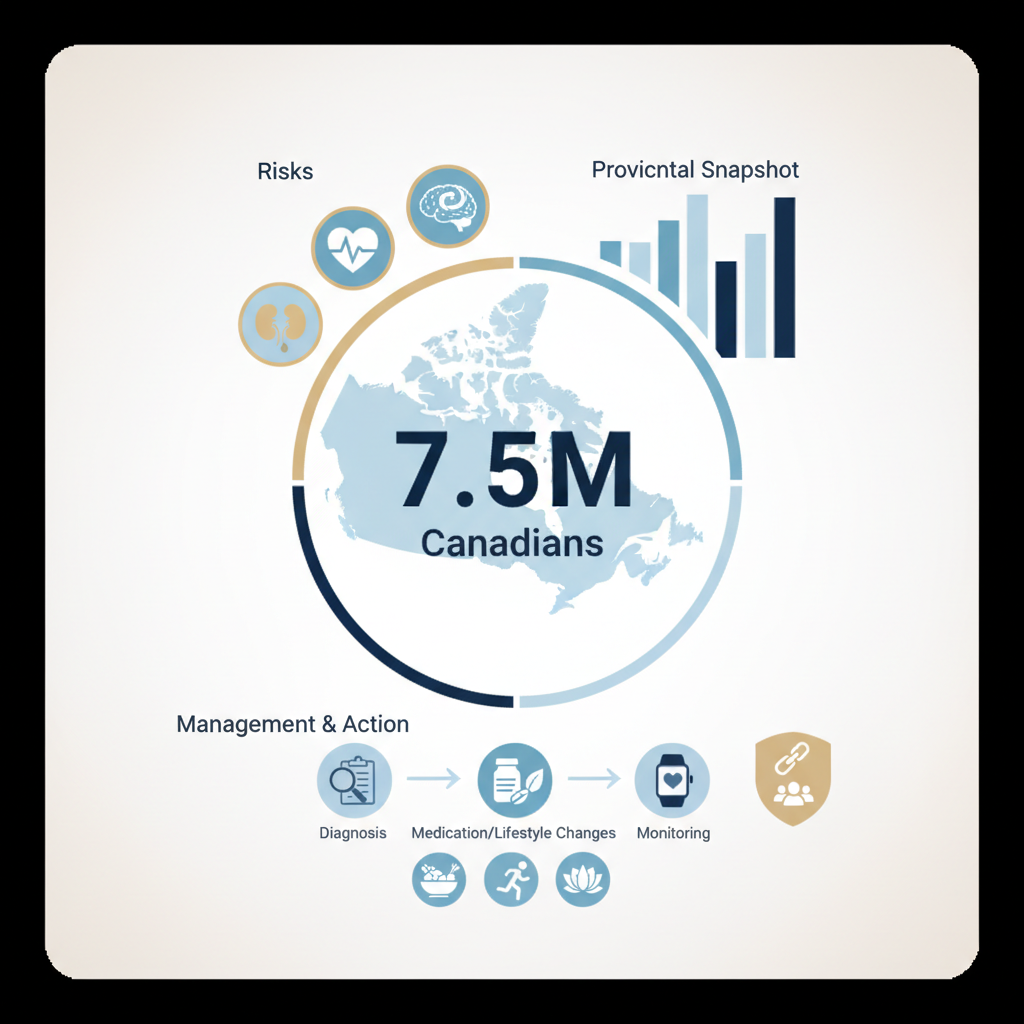
- About 7.5 million Canadians — roughly 1 in 4 adults — live with high blood pressure (hypertension). ([hypertension.ca](https://hypertension.ca/wp-content/uploads/2026/01/EN-Hypertension-Canada-Annual-report-2025.pdf?utm_source=openai))
- Hypertension is often symptomless but is the leading modifiable risk factor for heart attack, stroke, kidney disease and vascular cognitive impairment. ([statcan.gc.ca](https://www.statcan.gc.ca/o1/en/plus/9027-heart-disease-and-strokes-two-different-afflictions-one-common-risk-factor?utm_source=openai))
- Targets and treatment are individualised: people with diabetes often aim for <130/80 mmHg, per Canadian guidelines, but targets depend on age, comorbidity and tolerability. ([diabetes.ca](https://www.diabetes.ca/health-care-providers/clinical-practice-guidelines/chapter-26?utm_source=openai))
- Population and individual changes — sodium reduction, Canada's Food Guide patterns (DASH-like), weight loss and physical activity — produce measurable BP reductions. ([canada.ca](https://www.canada.ca/en/health-canada/services/publications/food-nutrition/sodium-intake-canadians-2017.html?utm_source=openai))
- Feel Great is a lifestyle-support system (Balance: soluble fibre matrix; Unimate: yerba mate extract with chlorogenic acids; 4-4-12 intermittent fasting) that may be used alongside medical care as a supportive tool, not a replacement for clinical treatment.
TL;DR
High blood pressure affects ~7.5 million Canadians (~1 in 4 adults). Early detection, dietary sodium reduction, activity, weight management and guideline-driven medicines where needed reduce risk. Use local primary care (family doctor, walk-in clinics) and evidence-based resources (Health Canada, Hypertension Canada, Diabetes Canada). ([canada.ca](https://www.canada.ca/en/public-health/services/diseases/heart-health/high-blood-pressure.html?utm_source=openai))
🇨🇦 Thousands of Canadians are using Feel Great to support their metabolic health naturally. Learn more & order here →
High Blood Pressure in Canada: 7.5 Million Affected — Data, Risks and Practical Steps
Introduction — a shocking Canadian statistic
About 7.5 million Canadians are living with high blood pressure — roughly one in four adults. That number, repeated in Hypertension Canada summaries and public health communications, is a stark reminder that hypertension is a common, often silent, condition with major consequences for heart and brain health. ([hypertension.ca](https://hypertension.ca/wp-content/uploads/2026/01/EN-Hypertension-Canada-Annual-report-2025.pdf?utm_source=openai))
Why this matters
Untreated or uncontrolled hypertension increases the risk of myocardial infarction, stroke, heart failure, chronic kidney disease and vascular cognitive impairment. Many of the strongest national data sources (Statistics Canada, CIHI, CCDSS) list high blood pressure among the top modifiable risk factors for cardiovascular morbidity and mortality. ([statcan.gc.ca](https://www.statcan.gc.ca/o1/en/plus/9027-heart-disease-and-strokes-two-different-afflictions-one-common-risk-factor?utm_source=openai))
Where the numbers come from — Canadian data sources
Three national sources underpin our understanding of hypertension in Canada:
- Canadian Chronic Disease Surveillance System (CCDSS) — case counts and incidence from provincial administrative data. ([health-infobase.canada.ca](https://health-infobase.canada.ca/ccdss/data-tool/Comp?G=00&M=4&V=2&utm_source=openai))
- Statistics Canada — Canadian Health Measures Survey (measured BP) and Canadian Community Health Survey (self-reported diagnosed hypertension). ([www150.statcan.gc.ca](https://www150.statcan.gc.ca/t1/tbl1/en/tv.action?pid=1310096501&utm_source=openai))
- CIHI (Canadian Institute for Health Information) — health system impact, hospitalisations and cost data. ([cihi.ca](https://www.cihi.ca/en/quick-stats?utm_source=openai))
Prevalence and provincial differences
Prevalence estimates vary by methodology and age groups, but recent national reports indicate ~19–25% of adults report high blood pressure (or are measured as hypertensive) with some provincial variation — for example Quebec, Alberta and BC often report slightly lower self-reported prevalence in some cycles. Always check the latest provincial data for local planning. ([www150.statcan.gc.ca](https://www150.statcan.gc.ca/n1/en/pub/82-570-x/82-570-x2024001-eng.pdf?st=d3ULDHTc&utm_source=openai))
Who is at higher risk?
Risk factors include older age, overweight/obesity, physical inactivity, diets high in sodium (processed foods), heavy alcohol use, smoking, and comorbid conditions (diabetes, chronic kidney disease). Public health messaging emphasises that many Canadians exceed recommended sodium intakes — a modifiable contributor to elevated BP. ([canada.ca](https://www.canada.ca/en/health-canada/services/publications/food-nutrition/sodium-intake-canadians-2017.html?utm_source=openai))
How hypertension is measured and diagnosed in Canada
Blood pressure is measured in mmHg using validated devices. Guidelines recommend confirmatory readings (office and/or home blood pressure monitoring) and classification based on standard thresholds; Hypertension Canada provides detailed measurement protocols. The Canadian Health Measures Survey (CHMS) also uses standardised OMRON devices to report population averages. ([hypertension.ca](https://hypertension.ca/wp-content/uploads/2024/10/HC-2024-Annual-Report-Final.pdf?utm_source=openai))
Treatment goals — what do Canadian guidelines recommend?
Targets depend on individual risk. For many adults with diabetes, Diabetes Canada and Hypertension Canada generally recommend aiming for <130/80 mmHg where tolerated; for older adults or those with frailty, targets are individualised to balance benefit and adverse effects. Medication choice and combination therapy follow guideline algorithms. ([diabetes.ca](https://www.diabetes.ca/health-care-providers/clinical-practice-guidelines/chapter-26?utm_source=openai))
What works — evidence summary (international and Canadian)
Sodium reduction
High-quality systematic reviews and meta-analyses show that lowering sodium intake reduces systolic and diastolic blood pressure at both individual and population levels. Canada has voluntary sodium reduction targets for processed foods and public education campaigns aligned with these findings. ([bmj.com](https://www.bmj.com/content/368/bmj.m315?utm_source=openai))
Dietary pattern (DASH-like / Canada’s Food Guide)
Dietary approaches rich in vegetables, fruit, whole grains, legumes and lean protein (similar to DASH) lower BP. Health Canada’s Canada’s Food Guide recommends patterns that support cardiovascular health and lower sodium, sugar and saturated fat intake. ([bmj.com](https://www.bmj.com/content/368/bmj.m315?utm_source=openai))
Weight loss & physical activity
Modest weight loss (5–10%) and 150 minutes/week of moderate-intensity activity reduce BP. Digital and behavioural programmes (including those evaluated in meta-analyses) can improve adherence and produce modest BP reductions. ([nature.com](https://www.nature.com/articles/s41371-025-01051-3.pdf?utm_source=openai))
Plant extracts & compounds (e.g., chlorogenic acids / yerba mate)
Emerging RCTs and meta-analyses on chlorogenic acid–rich extracts (from coffee, green coffee bean, yerba mate) show small but measurable reductions in systolic BP in some populations. These may complement lifestyle change but should not replace standard care. Unimate (yerba mate extract) contains chlorogenic acids that have been studied for cardiometabolic effects in human trials. ([nature.com](https://www.nature.com/articles/jhh201446?utm_source=openai))
Quick comparison — interventions and typical systolic BP change
| Intervention | Typical SBP change | Notes |
|---|---|---|
| Population sodium reduction | -2 to -5 mmHg | Powerful at scale, needs policy + industry buy-in. ([nature.com](https://www.nature.com/articles/s41440-025-02181-4?utm_source=openai)) |
| DASH / Canada’s Food Guide pattern | -4 to -11 mmHg | Greater effect when paired with salt reduction. ([bmj.com](https://www.bmj.com/content/368/bmj.m315?utm_source=openai)) |
| Weight loss 5–10% | -3 to -8 mmHg | Depends on baseline weight and adherence. ([pmc.ncbi.nlm.nih.gov](https://pmc.ncbi.nlm.nih.gov/articles/PMC10742105/?utm_source=openai)) |
| Adjunct plant extracts (chlorogenic acid) | -2 to -6 mmHg (varies) | Evidence growing; considered supportive, not curative. ([nature.com](https://www.nature.com/articles/jhh201446?utm_source=openai)) |
Practical roadmap for Canadians (6-week starter plan)
- Week 1: Baseline — measure BP at home/clinic; log readings. Ask your pharmacist or clinic about validated monitors. ([canada.ca](https://www.canada.ca/en/public-health/services/diseases/heart-health/high-blood-pressure.html?utm_source=openai))
- Week 2: Cut processed foods, read labels for sodium (use Canada’s Food Guide tips). ([canada.ca](https://www.canada.ca/en/health-canada/services/publications/food-nutrition/sodium-intake-canadians-2017.html?utm_source=openai))
- Weeks 3–4: Add 30 min brisk walk 5 days/week; increase veg/whole grains. ([heartandstroke.ca](https://www.heartandstroke.ca/-/media/pdf-files/canada/media-centre/hsf-improvements-release-key-messages-2024.pdf?rev=ad6b3d190f3a424496c1e185956afffa&utm_source=openai))
- Week 5: Reassess, talk to your family doctor about BP averages and need for medication or further tests. ([health-infobase.canada.ca](https://health-infobase.canada.ca/ccdss/data-tool/Comp?G=00&M=4&V=2&utm_source=openai))
- Week 6: Consolidate habits, join community supports (health centre, digital program), consider adjunct supportive products after clinician discussion. ([nature.com](https://www.nature.com/articles/s41371-025-01051-3.pdf?utm_source=openai))
How Feel Great fits in (balanced, evidence-based support)
Feel Great is positioned as a lifestyle support system — not a medication. Key elements linked to BP and metabolic health include:
- Balance — a soluble fibre matrix that may help moderate post-meal glycaemic response and support satiety as part of weight management (part of lifestyle measures that indirectly influence BP).
- Unimate — a standardized yerba mate extract rich in chlorogenic acids; clinical trials have reported modest improvements in blood pressure and cardiometabolic markers in at-risk groups, suggesting a potential supportive role when combined with diet and activity (not a replacement for treatment). ([pmc.ncbi.nlm.nih.gov](https://pmc.ncbi.nlm.nih.gov/articles/PMC7822211/?utm_source=openai))
- The 4-4-12 intermittent fasting protocol and behavioural tools — designed to improve adherence to dietary changes and weight management.
- Clinical evidence repository — the product literature cites >50 clinical studies (see PDR listings and product dossier); always check Health Canada NPNs and consult your healthcare provider before starting supplements.
Shipping and availability: products are distributed to all provinces and territories (BC to Newfoundland). Always purchase through official channels and verify product labelling and Health Canada classifications. ([canada.ca](https://www.canada.ca/en/health-canada/services/food-guide.html?utm_source=openai))
People Also Ask
- Is 7.5 million an up-to-date figure? Hypertension Canada reports ~7.5 million — this aligns with national surveillance estimates; check Hypertension Canada and CCDSS for updates. ([hypertension.ca](https://hypertension.ca/wp-content/uploads/2026/01/EN-Hypertension-Canada-Annual-report-2025.pdf?utm_source=openai))
- What is considered 'high' blood pressure? Definitions vary by guideline and context; many Canadian resources use thresholds consistent with Hypertension Canada’s recommendations and individualised targets. ([hypertension.ca](https://hypertension.ca/wp-content/uploads/2024/10/HC-2024-Annual-Report-Final.pdf?utm_source=openai))
- Can I lower BP without drugs? Many people lower BP with lifestyle change, but medications are often necessary depending on baseline BP and overall cardiovascular risk. ([pmc.ncbi.nlm.nih.gov](https://pmc.ncbi.nlm.nih.gov/articles/PMC10742105/?utm_source=openai))
- Are herbal supplements safe with BP meds? Interactions can occur; consult a clinician and pharmacist. Evidence for specific herbal extracts (eg. chlorogenic acid) shows modest effects but is not definitive. ([nature.com](https://www.nature.com/articles/jhh201446?utm_source=openai))
- Where can I get my BP checked in Canada? Family doctors, walk-in clinics, community pharmacies and public health clinics; some provinces have additional services. ([cihi.ca](https://www.cihi.ca/en/quick-stats?utm_source=openai))
FAQ
- How often should I check my BP at home? Follow Hypertension Canada guidance — commonly twice daily for screening periods, then as advised by your clinician. ([hypertension.ca](https://hypertension.ca/wp-content/uploads/2024/10/HC-2024-Annual-Report-Final.pdf?utm_source=openai))
- What is the link between sodium intake and BP? Strong evidence links high sodium intake to higher BP; population sodium reduction lowers average BP. Health Canada sets voluntary targets for industry to reduce sodium in processed foods. ([bmj.com](https://www.bmj.com/content/368/bmj.m315?utm_source=openai))
- Is there a single best diet for BP? Patterns resembling DASH and Canada’s Food Guide (more veg, whole grains, less processed foods) are consistently recommended. ([bmj.com](https://www.bmj.com/content/368/bmj.m315?utm_source=openai))
- Should people with diabetes aim for lower BP? Diabetes Canada often recommends targets <130/80 mmHg for many people with diabetes, balanced against risks of adverse effects. ([diabetes.ca](https://www.diabetes.ca/health-care-providers/clinical-practice-guidelines/chapter-26?utm_source=openai))
- Where can I find local help in my province? Use provincial health websites, your family doctor, community health centres and Heart & Stroke resources. Provincial availability of services varies (Ontario, BC, Alberta have different local programmes). ([www150.statcan.gc.ca](https://www150.statcan.gc.ca/n1/en/pub/82-570-x/82-570-x2024001-eng.pdf?st=d3ULDHTc&utm_source=openai))
References & Scientific Sources
- Hypertension Canada — annual reports and fact sheets (7.5 million estimate). ([hypertension.ca](https://hypertension.ca/wp-content/uploads/2026/01/EN-Hypertension-Canada-Annual-report-2025.pdf?utm_source=openai))
- Health Canada — High blood pressure overview & Canada’s Food Guide / sodium targets. ([canada.ca](https://www.canada.ca/en/public-health/services/diseases/heart-health/high-blood-pressure.html?utm_source=openai))
- Statistics Canada — CHMS / CCHS prevalence tables. ([www150.statcan.gc.ca](https://www150.statcan.gc.ca/t1/tbl1/en/tv.action?pid=1310096501&utm_source=openai))
- Canadian Institute for Health Information (CIHI) — Quick stats and health system impacts. ([cihi.ca](https://www.cihi.ca/en/quick-stats?utm_source=openai))
- Diabetes Canada — Clinical practice guidance on BP targets and management in people with diabetes. ([diabetes.ca](https://www.diabetes.ca/health-care-providers/clinical-practice-guidelines/chapter-26?utm_source=openai))
- BMJ systematic review/meta-analysis on sodium reduction and BP. ([bmj.com](https://www.bmj.com/content/368/bmj.m315?utm_source=openai))
- Systematic reviews/meta-analyses and RCTs on salt reduction and behaviour change. ([pmc.ncbi.nlm.nih.gov](https://pmc.ncbi.nlm.nih.gov/articles/9728935/?utm_source=openai))
- Yerba mate / chlorogenic acid RCTs and reviews (PubMed / PMC). ([pmc.ncbi.nlm.nih.gov](https://pmc.ncbi.nlm.nih.gov/articles/PMC7822211/?utm_source=openai))
- Digital interventions meta-analysis for lifestyle BP control (Journal of Human Hypertension 2025). ([nature.com](https://www.nature.com/articles/s41371-025-01051-3.pdf?utm_source=openai))
- Heart & Stroke Foundation — risk factor reports and public communications. ([heartandstroke.ca](https://www.heartandstroke.ca/what-we-do/media-centre/news-releases/new-data-provides-big-picture-of-heart-and-brain-risk-factors?utm_source=openai))
Medical disclaimer
This article is informational and not a substitute for personalised medical advice. Always consult your healthcare provider before changing medications, starting supplements, or making major lifestyle changes, especially if you have diagnosed hypertension, diabetes or kidney disease.

Related ATHAR paths
🇨🇦 Ready to Start Your Health Transformation?
Join thousands of Canadians who have improved their metabolic health with the Feel Great system. Backed by 50+ clinical studies and listed in the Physicians' Desk Reference (PDR).
✅ Ships to all provinces: BC, Alberta, Saskatchewan, Manitoba, Ontario, Quebec, New Brunswick, Nova Scotia, PEI, Newfoundland & Labrador | 90-Day Money-Back Guarantee