Intermittent fasting research Germany Helmholtz: latest German evidence
Author: Feras Alayed
Published:
Updated:
Category: german-health
Reading Time: 10 minutes
Key Takeaways
- German research (Helmholtz Zentrum München) shows intermittent fasting is biologically active — beneficial for some adults but potentially harmful in growing adolescents; apply caution for children and teens. ([pubmed.ncbi.nlm.nih.gov](https://pubmed.ncbi.nlm.nih.gov/39827461/?dopt=Abstract&utm_source=openai))
- Population burden in Germany (overweight, obesity, diabetes) makes meal timing a high‑interest public health strategy; 46–60% of adults report overweight/obesity in recent RKI data. ([rki.de](https://www.rki.de/DE/Themen/Nichtuebertragbare-Krankheiten/Koerperliche-Gesundheit/Adipositas-und-Uebergewicht/themenschwerpunkt-adipositas.html?utm_source=openai))
- German clinical bodies (DDG, DGE) recommend intermittent fasting can be used under medical supervision for weight control but do not favour it as a standalone long‑term solution. ([ddg.info](https://www.ddg.info/fileadmin/user_upload/05_Behandlung/01_Leitlinien/Praxisempfehlungen/2023/dus_2023_Praxisempfehlungen_Ausgabe_gesamt.pdf?utm_source=openai))
- High‑quality international reviews find TRE and other IF methods give modest weight and metabolic benefits comparable to calorie restriction; timing (early vs late eating) matters for lipids and sleep. ([pmc.ncbi.nlm.nih.gov](https://pmc.ncbi.nlm.nih.gov/articles/PMC12289860/?utm_source=openai))
- If you are insured under the Gesetzliche Krankenversicherung (GKV), preventive nutrition counselling and structured programmes may be available—ask your Hausarzt (GP) and Krankenkasse for referrals or coverage under SGB V / Präventionsgesetz. ([bundesgesundheitsministerium.de](https://www.bundesgesundheitsministerium.de/service/begriffe-von-a-z/p/praeventionsgesetz/seite?utm_source=openai))
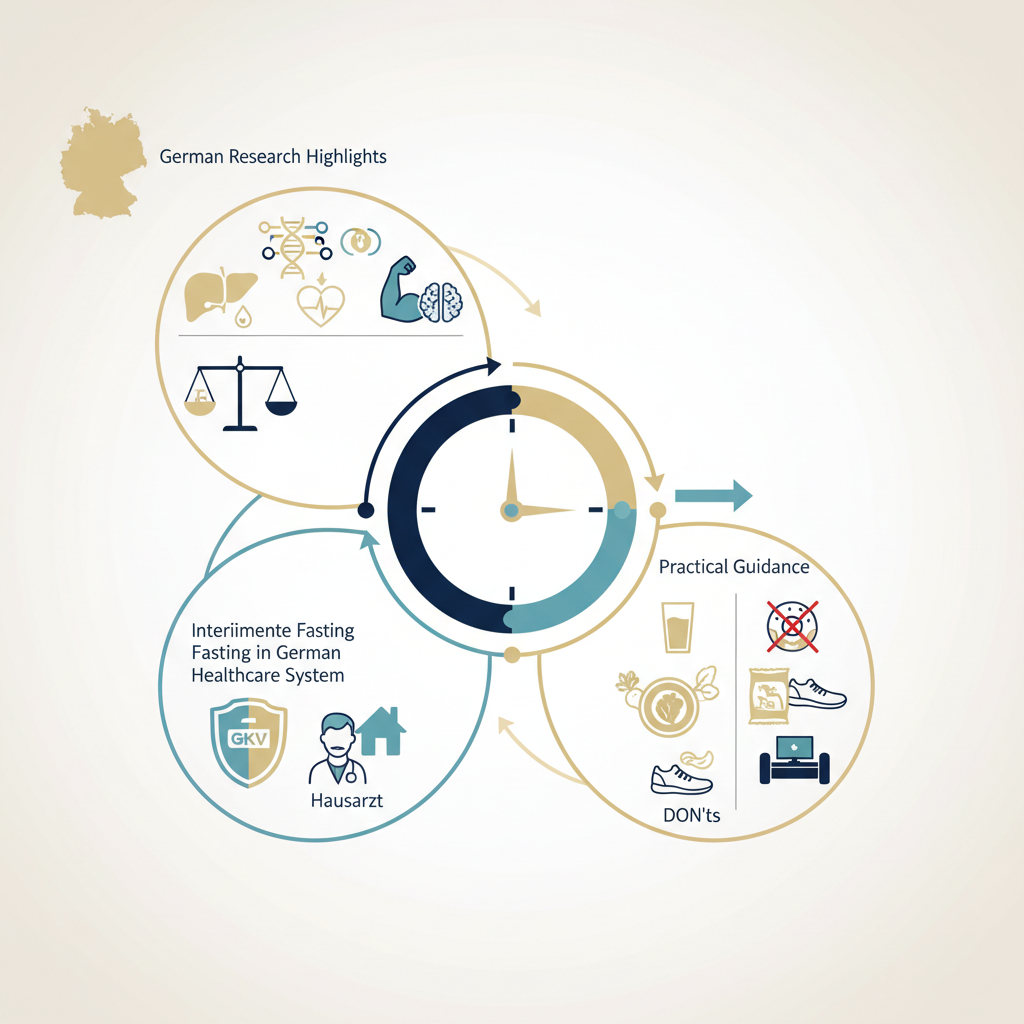
TL;DR
Helmholtz and German partners have expanded our mechanistic and clinical knowledge of intermittent fasting (Intervallfasten). For adults, time‑restricted eating (TRE) can produce modest weight and cardiometabolic changes similar to traditional calorie restriction; for adolescents the animal data signal caution. Discuss options with your Hausarzt and consider evidence‑based, GKV‑compatible programmes. ([pubmed.ncbi.nlm.nih.gov](https://pubmed.ncbi.nlm.nih.gov/39827461/?dopt=Abstract&utm_source=openai))
🇩🇪 Want to take action now? Try Feel Great → | Chat with a coach →
Introduction: why Germany cares — a shocking statistic
The Robert Koch Institute (RKI) reports that nearly half of adult women (≈46.6%) and more than 60% of adult men in Germany report overweight (including obesity) in recent national surveys — a population burden that explains why strategies like Intervallfasten (intermittent fasting, IF) are so widely discussed. ([rki.de](https://www.rki.de/DE/Themen/Nichtuebertragbare-Krankheiten/Koerperliche-Gesundheit/Adipositas-und-Uebergewicht/themenschwerpunkt-adipositas.html?utm_source=openai))
What Helmholtz Centre (Helmholtz Zentrum München) has contributed
Helmholtz Zentrum München (Helmholtz Munich) is a national leader in metabolic and diabetes research. Their group — often collaborating with TUM, LMU, DZD and Heidelberg — has published mechanistic and preclinical work on how fasting patterns affect beta (β)‑cell development, chromatin regulation, circadian biology and metabolic signalling. Key findings include:
- Preclinical data: a 2024/2025 publication from a Helmholtz‑led team showed that chronic intermittent fasting in adolescent mice impaired β‑cell maturation and function — a signal that growing organisms may respond differently to repeated fasting cycles. This is important for anyone advising children or teenagers. ([pubmed.ncbi.nlm.nih.gov](https://pubmed.ncbi.nlm.nih.gov/39827461/?dopt=Abstract&utm_source=openai))
- Molecular insights: Helmholtz labs have mapped how fasting reprograms chromatin and mTOR/RNA Pol I axes, linking nutrient timing to gene regulation. These mechanistic results help explain why timing (when you eat) can shift metabolic outputs beyond calorie counts. ([pubmed.ncbi.nlm.nih.gov](https://pubmed.ncbi.nlm.nih.gov/39300311/?utm_source=openai))
- Translational work: Helmholtz investigators participate in multicentre projects (with DZD, universities and international partners) that test fasting variants (TRE, ADF, 5:2) and fasting‑mimicking diets in humans and disease models. ([helmholtz-munich.de](https://www.helmholtz-munich.de/hdc/news/article/grosser-schritt-auf-dem-weg-zu-fasten-therapien?utm_source=openai))
How German clinical societies interpret the evidence
Deutsche Diabetes Gesellschaft (DDG): the DDG praxis recommendations conclude that Intervallfasten can be used as a tool for weight reduction under medical supervision, but there is no single recommended IF protocol for everyone; safety and individual metabolic status matter. The DDG also highlights that meta‑analyses show no clear superiority of IF over continuous calorie restriction for long‑term weight loss. ([ddg.info](https://www.ddg.info/fileadmin/user_upload/05_Behandlung/01_Leitlinien/Praxisempfehlungen/2023/dus_2023_Praxisempfehlungen_Ausgabe_gesamt.pdf?utm_source=openai))
Deutsche Gesellschaft für Ernährung (DGE): the DGE notes that while short‑term studies show metabolic signals, IF alone often lacks guidance on food quality during non‑fasting days and therefore should not replace balanced dietary change aligned with DGE recommendations. ([dge.de](https://www.dge.de/gesunde-ernaehrung/diaeten-und-fasten/intervallfasten/?utm_source=openai))
What large German trials and collaborations say (Charité / ChronoFast)
Charité – Universitätsmedizin Berlin (in cooperation with DIfE Potsdam‑Rehbrücke) ran the ChronoFast crossover work and related trials that emphasise meal timing: early vs late TRE can change lipid profiles and sleep quality, even when calorie intake is similar. These trials use continuous glucose monitoring and actigraphy to capture 24‑hour metabolic and sleep effects. For clinicians and patients in Germany, this means that not just fasting duration but the placement of the eating window (early vs late) can influence lipid outcomes and sleep. ([dzd-ev.de](https://www.dzd-ev.de/en/article/time-of-eating-changes-lipid-profile-during-intermittent-fasting?utm_source=openai))
International evidence — systematic reviews and randomized trials
High‑quality umbrella reviews and network meta‑analyses (covering RCTs through 2023–2024) find:
- Intermittent fasting methods (TRE, ADF, 5:2, modified ADF) produce modest weight loss and metabolic improvements; differences versus continuous energy restriction are generally small and often not clinically superior. ([pmc.ncbi.nlm.nih.gov](https://pmc.ncbi.nlm.nih.gov/articles/PMC12289860/?utm_source=openai))
- Timing matters: early TRE (front‑loaded eating windows) often shows slightly better effects on weight, waist circumference and some glycemic measures than late TRE. ([pmc.ncbi.nlm.nih.gov](https://pmc.ncbi.nlm.nih.gov/articles/PMC12829361/?utm_source=openai))
- Long‑term RCTs: a 12‑month randomized trial of 8‑hour TRE vs 25% daily calorie restriction vs control in adults with obesity found TRE achieved weight loss but was broadly comparable to calorie restriction for many cardiometabolic outcomes; adherence and individual suitability were key. ([pmc.ncbi.nlm.nih.gov](https://pmc.ncbi.nlm.nih.gov/articles/PMC11192144/?utm_source=openai))
What this means for blood sugar (Blutzucker, Blutglukose) — values in mmol/L
Clinically used glycaemic thresholds (note: check your lab/Hausarzt for assay‑specific ranges): fasting plasma glucose <5.6 mmol/L is considered normoglycaemia; 5.6–6.9 mmol/L is impaired fasting glucose (prediabetes); ≥7.0 mmol/L is diagnostic for diabetes (Diagnose: Diabetes mellitus) — if you are in the prediabetic range, changes in meal timing may affect fasting glucose and fasting insulin, but any plan should be supervised by your Hausarzt or diabetologist. ([diabsurv.rki.de](https://diabsurv.rki.de/Webs/Diabsurv/DE/diabetes-in-deutschland/2-112_Praevalenz_dokumentierter_Diabetes.html?utm_source=openai))
Safety signals and special populations
- Adolescents / children: the Helmholtz animal data show potential harm to developing β‑cells — avoid recommending chronic IF for children and teenagers without specialist oversight. ([pubmed.ncbi.nlm.nih.gov](https://pubmed.ncbi.nlm.nih.gov/39827461/?dopt=Abstract&utm_source=openai))
- People with diabetes (Typ‑1 or insulin‑treated Typ‑2): DDG emphasises medical supervision and glucose monitoring (CGM) because medication dosing must be adapted to fasting. ([ddg.info](https://www.ddg.info/fileadmin/user_upload/05_Behandlung/01_Leitlinien/Praxisempfehlungen/2023/dus_2023_Praxisempfehlungen_Ausgabe_gesamt.pdf?utm_source=openai))
- Pregnancy, eating disorders, frailty and some chronic conditions: IF is generally not recommended without specialist advice. Follow your Hausarzt (GP) and, when necessary, a diabetologist or nutrition‑trained physician (Ernährungsmedizin / Ernährungstherapie). ([dge.de](https://www.dge.de/gesunde-ernaehrung/diaeten-und-fasten/intervallfasten/?utm_source=openai))
Practical comparison: common IF methods (table)
| Method | Typical pattern | Evidence summary | German context |
|---|---|---|---|
| Time‑restricted eating (TRE) | Eating window 6–12 h/day (e.g., 8:00–16:00 or 12:00–20:00) | Modest weight loss vs control; timing (early vs late) influences lipids/sleep. ([pmc.ncbi.nlm.nih.gov](https://pmc.ncbi.nlm.nih.gov/articles/PMC12829361/?utm_source=openai)) | Used in ChronoFast and several German trials; may be offered in structured programmes. ([dzd-ev.de](https://www.dzd-ev.de/en/article/time-of-eating-changes-lipid-profile-during-intermittent-fasting?utm_source=openai)) |
| 5:2 diet | 2 non‑consecutive low‑calorie days/week | Weight loss similar to continuous restriction in many trials; effect on LDL variable. ([onlinelibrary.wiley.com](https://onlinelibrary.wiley.com/doi/10.1155/ije/6658512?utm_source=openai)) | Recognised by DDG as a possible option under supervision. ([ddg.info](https://www.ddg.info/fileadmin/user_upload/05_Behandlung/01_Leitlinien/Praxisempfehlungen/2023/dus_2023_Praxisempfehlungen_Ausgabe_gesamt.pdf?utm_source=openai)) |
| Alternate day fasting (ADF) | Fast or severe restriction every other day | Can produce greater short‑term weight loss but adherence issues; higher variability in outcomes. ([pmc.ncbi.nlm.nih.gov](https://pmc.ncbi.nlm.nih.gov/articles/PMC12289860/?utm_source=openai)) | Requires structured clinical support to be safe/feasible. ([ddg.info](https://www.ddg.info/fileadmin/user_upload/05_Behandlung/01_Leitlinien/Praxisempfehlungen/2023/dus_2023_Praxisempfehlungen_Ausgabe_gesamt.pdf?utm_source=openai)) |
How to talk to your Hausarzt and Krankenkasse (GKV)
If you consider intermittent fasting, discuss with your Hausarzt (general practitioner). In Germany, the Präventionsgesetz and SGB V allow the GKV to fund structured preventive programmes and certified nutritional counselling (Ernährungsberatung / Ernährungstherapie) in many Bundesländer — ask your Krankenkasse about §20 SGB V offers, disease management programmes (DMPs) and possible reimbursement for group or individual nutrition counselling. Delivery of certified programmes is available across all Bundesländer. ([bundesgesundheitsministerium.de](https://www.bundesgesundheitsministerium.de/service/begriffe-von-a-z/p/praeventionsgesetz/seite?utm_source=openai))
How Feel Great Helps (non‑medicinal lifestyle support)
Feel Great is a lifestyle support system (not a medication). When used alongside medical care and under GP guidance it may be considered as part of a broader metabolic health plan. Key elements and how they relate to intermittent fasting research:
- Balance (soluble fibre matrix): a fibre matrix taken during eating windows may help blunt post‑meal glucose excursions and prolong satiety — this aligns with goals in TRE to reduce glycaemic variability. Use language like “may help” rather than therapeutic claims. (Not a substitute for medication.)
- Unimate (yerba mate extract): contains chlorogenic acids that are studied for alertness and metabolic signalling; Unimate may help mental clarity during fasting windows for some people — evidence is supplementary and should be considered supportive.
- 4‑4‑12 intermittent fasting protocol: a practical, structured approach to timing that fits many adult routines and mirrors TRE principles used in clinical trials (structured eating windows, hydration during fasting).
- Evidence base: Feel Great references >50 clinical studies in its product documentation (PDR style listing). Use it as a lifestyle support (may help adherence, energy, and satiety) rather than as a medical therapy.
Always coordinate any supplement or protocol with your Hausarzt, especially if you are on glucose‑lowering medicines or have chronic conditions. Feel Great delivery and coaching services are offered across all Bundesländer and can complement medically supervised nutritional counselling reimbursed or supported by GKV programmes where applicable.
People Also Ask
- Is intermittent fasting safe for adults with prediabetes? — Under GP or specialist supervision, certain IF methods (especially TRE) may be used, but medication and monitoring need adapting. ([ddg.info](https://www.ddg.info/fileadmin/user_upload/05_Behandlung/01_Leitlinien/Praxisempfehlungen/2023/dus_2023_Praxisempfehlungen_Ausgabe_gesamt.pdf?utm_source=openai))
- Does the time of day for eating matter? — Yes: early eating windows often show slightly better metabolic signals for lipids and weight than late eating windows. ([pmc.ncbi.nlm.nih.gov](https://pmc.ncbi.nlm.nih.gov/articles/PMC12829361/?utm_source=openai))
- Can children and teenagers do intermittent fasting? — Current Helmholtz preclinical data raise safety concerns for adolescents; avoid routine IF in growing persons without specialist oversight. ([pubmed.ncbi.nlm.nih.gov](https://pubmed.ncbi.nlm.nih.gov/39827461/?dopt=Abstract&utm_source=openai))
- Will my Krankenkasse pay for IF coaching? — GKV may cover certified nutritional counselling or prevention programmes under §20 SGB V; check with your Krankenkasse and ask your Hausarzt for a referral. ([dge.de](https://www.dge.de/qualifizierung/qualitaetssicherung/wie-qualifiziere-ich-mich-zielsicher-fuer-die-ernaehrungsberatung-und-ernaehrungstherapie/?utm_source=openai))
- Is IF better than continuous calorie restriction? — RCTs and meta‑analyses show similar weight/metabolic effects overall; choice often depends on personal adherence and medical suitability. ([pmc.ncbi.nlm.nih.gov](https://pmc.ncbi.nlm.nih.gov/articles/PMC12289860/?utm_source=openai))
FAQ
- Q: How long until I see changes in fasting glucose (mmol/L)?
A: Some trials report changes within 8–12 weeks; magnitude varies — small average reductions in fasting glucose are reported (often <0.2–0.5 mmol/L depending on weight loss and method). Monitor with your Hausarzt. ([pmc.ncbi.nlm.nih.gov](https://pmc.ncbi.nlm.nih.gov/articles/PMC12289860/?utm_source=openai)) - Q: Can I drink coffee while fasting?
A: Plain black coffee, unsweetened tea and water are typically permitted during fasting windows in TRE studies; avoid caloric beverages. ([pmc.ncbi.nlm.nih.gov](https://pmc.ncbi.nlm.nih.gov/articles/PMC11192144/?utm_source=openai)) - Q: Which IF method has the best evidence?
A: TRE has abundant recent RCT evidence and is easier to integrate into daily life; other methods (5:2, ADF) also work but have different adherence profiles. ([pmc.ncbi.nlm.nih.gov](https://pmc.ncbi.nlm.nih.gov/articles/PMC12289860/?utm_source=openai)) - Q: Will IF improve my cholesterol numbers?
A: Some studies show improvements in LDL/TG and waist circumference, but results depend on timing (early TRE may be better for lipids) and individual response. Discuss testing with your Hausarzt. ([dzd-ev.de](https://www.dzd-ev.de/en/article/time-of-eating-changes-lipid-profile-during-intermittent-fasting?utm_source=openai)) - Q: Can I follow Feel Great with IF?
A: Yes — Feel Great is positioned as a lifestyle support system (not a drug). When combined with a medically supervised IF approach, its components may help satiety and energy; always inform your treating physician.
References & Scientific Sources
- Helmholtz Zentrum München newsroom & research pages (Intermittent fasting insights; adolescent β‑cell study). ([helmholtz.de](https://www.helmholtz.de/newsroom/artikel/was-bringt-intervallfasten/?utm_source=openai))
- Matta L., Weber P., Erener S. et al., Chronic intermittent fasting impairs β‑cell maturation and function in adolescent mice (PubMed entry). ([pubmed.ncbi.nlm.nih.gov](https://pubmed.ncbi.nlm.nih.gov/39827461/?dopt=Abstract&utm_source=openai))
- Helmholtz translational pieces on fasting and ketogenesis / chromatin mechanisms. ([helmholtz-munich.de](https://www.helmholtz-munich.de/hdc/news/article/grosser-schritt-auf-dem-weg-zu-fasten-therapien?utm_source=openai))
- Charité / ChronoFast and related TRE studies (lipid profile & sleep secondary analyses). ([dzd-ev.de](https://www.dzd-ev.de/en/article/time-of-eating-changes-lipid-profile-during-intermittent-fasting?utm_source=openai))
- Robert Koch Institute (RKI) — national statistics on overweight, obesity and diabetes surveillance in Germany. ([rki.de](https://www.rki.de/DE/Themen/Nichtuebertragbare-Krankheiten/Koerperliche-Gesundheit/Adipositas-und-Uebergewicht/themenschwerpunkt-adipositas.html?utm_source=openai))
- Deutsche Diabetes Gesellschaft (DDG) — Praxisempfehlungen and position on intermittent fasting. ([ddg.info](https://www.ddg.info/fileadmin/user_upload/05_Behandlung/01_Leitlinien/Praxisempfehlungen/2023/dus_2023_Praxisempfehlungen_Ausgabe_gesamt.pdf?utm_source=openai))
- Deutsche Gesellschaft für Ernährung (DGE) overview on Intervallfasten and DGE counselling standards. ([dge.de](https://www.dge.de/gesunde-ernaehrung/diaeten-und-fasten/intervallfasten/?utm_source=openai))
- Network meta‑analysis / systematic reviews on intermittent fasting (umbrella reviews, NMAs, 2023–2025). ([pmc.ncbi.nlm.nih.gov](https://pmc.ncbi.nlm.nih.gov/articles/PMC12289860/?utm_source=openai))
- Large randomized trial of TRE vs calorie restriction (12‑month RCT). ([pmc.ncbi.nlm.nih.gov](https://pmc.ncbi.nlm.nih.gov/articles/PMC11192144/?utm_source=openai))
- Systematic reviews & meta‑analyses on timing and metabolic outcomes (TRE timing effects). ([pmc.ncbi.nlm.nih.gov](https://pmc.ncbi.nlm.nih.gov/articles/PMC12829361/?utm_source=openai))
Medical disclaimer
The information in this article is educational and evidence‑based but does NOT replace medical advice. It is not personalised medical guidance. Always consult your Hausarzt (general practitioner) or a specialist (e.g., diabetologist, Ernährungsmedizin) before starting intermittent fasting, especially if you have diabetes (Typ‑1 or insulin‑treated Typ‑2), are pregnant, breastfeeding, under 18 years old, have an eating disorder or take regular medications. For information on covered services (Ernährungsberatung, Präventionskurse) contact your Krankenkasse to check benefits under the GKV and SGB V. ([ddg.info](https://www.ddg.info/fileadmin/user_upload/05_Behandlung/01_Leitlinien/Praxisempfehlungen/2023/dus_2023_Praxisempfehlungen_Ausgabe_gesamt.pdf?utm_source=openai))

Related ATHAR paths
🇩🇪 Ready to Start Your Health Transformation?
Join thousands across Germany who have improved their metabolic health with the Feel Great system. Backed by 50+ clinical studies and listed in the Physicians' Desk Reference (PDR).
✅ Lieferung in alle Bundesländer | 90-Tage-Geld-zurück-Garantie