Obesity Rates Canada 2026: 1 in 4 Adults Affected — Trends Now
Author: Feras Alayed
Published:
Updated:
Category: canadian-health
Reading Time: 10 minutes
Key Takeaways
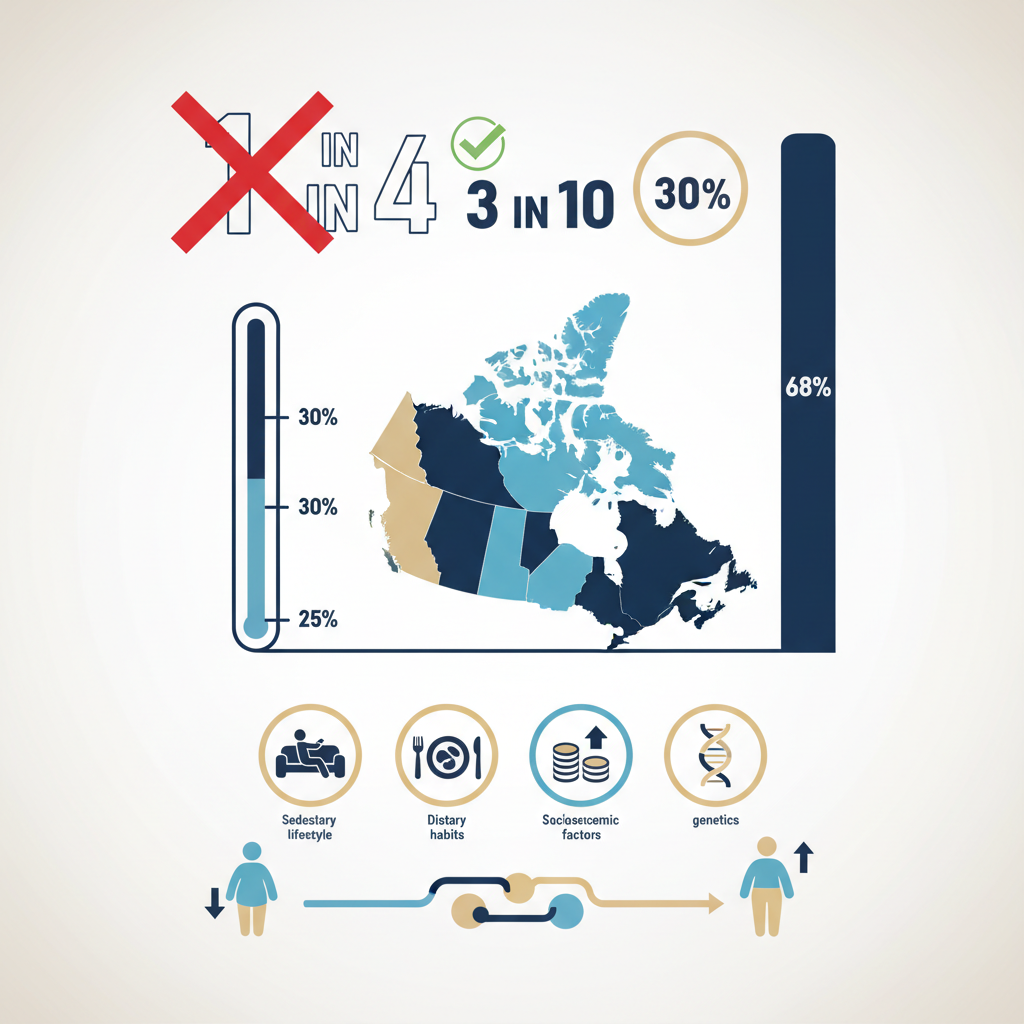
- Historic phrasing "1 in 4 adults" has been used for obesity in Canada, but recent measured data (2022–2024) show higher prevalence — about 30% with obesity and 68% overweight/obesity combined. ([www150.statcan.gc.ca](https://www150.statcan.gc.ca/n1/pub/82-570-x/82-570-x2024001-eng.pdf?utm_source=openai))
- Obesity rates rose after the COVID-19 pandemic; trends between 2016–2019 and 2022–2024 show a meaningful increase. ([www150.statcan.gc.ca](https://www150.statcan.gc.ca/n1/daily-quotidien/251002/dq251002b-eng.htm?HPA=1&utm_source=openai))
- There are clear provincial differences — some Atlantic provinces reported obesity prevalence above 40% in 2023. ([www150.statcan.gc.ca](https://www150.statcan.gc.ca/n1/pub/82-570-x/2024001/section2-eng.htm?kref=PDHQ79dnafoQ&kuid=d2764e67-718a-4ae1-9ab0-df56eaf7fd8b-1762732800&utm_source=openai))
- A multi-pronged approach (policy, environment, clinical care, and individual behaviour) is needed — Canada’s Food Guide and Health Canada’s Healthy Eating Strategy are core public resources. ([canada.ca](https://www.canada.ca/en/health-canada/services/food-nutrition/healthy-eating-strategy.html?utm_source=openai))
- Evidence supports combined lifestyle programmes; newer pharmacotherapies (GLP-1s, tirzepatide) produce substantial weight loss in trials, but coverage, safety, and long-term effects remain policy questions in Canada. ([nejm.org](https://www.nejm.org/doi/full/10.1056/NEJMoa2032183?utm_source=openai))
TL;DR
While older summaries said "1 in 4 adults" had obesity in Canada, current measured data from 2022–2024 show rates nearer ~30% for obesity and 68% overweight/obesity combined. This upward shift (post‑COVID) increases the burden of diabetes and cardiovascular disease and demands coordinated provincial and national action. ([www150.statcan.gc.ca](https://www150.statcan.gc.ca/n1/pub/82-570-x/82-570-x2024001-eng.pdf?utm_source=openai))
🇨🇦 Thousands of Canadians are using Feel Great to support their metabolic health naturally. Learn more & order here →
Obesity in Canada: 1 in 4 Adults Affected — what "obesity rates Canada 2026" really means
Introduction — a shocking Canadian statistic: For years many communications used the phrase "1 in 4 adults" to summarise obesity prevalence in Canada. However, recent measured data paint a sharper picture: the Canadian Health Measures Survey (CHMS) 2022–2024 reports that over two-thirds (68%) of adults aged 18–79 are either overweight or have obesity, and estimated obesity prevalence reached about 30.2% in 2023. Those numbers mean the historical "1 in 4" figure understates the current scale and shows a worrying increase in population-level weight. ([www150.statcan.gc.ca](https://www150.statcan.gc.ca/n1/daily-quotidien/251002/dq251002b-eng.htm?HPA=1&utm_source=openai))
How obesity is defined and measured in Canada
Most surveillance in Canada uses Body Mass Index (BMI): weight (kg) divided by height (m2). BMI ≥30 is commonly used to define obesity. Canadian surveillance uses both self-reported (CCHS) and measured (CHMS) data; measured data are more accurate but less frequent. Health Canada and CIHI caution about BMI limits (doesn't capture distribution of fat, muscle mass, or ethnicity differences) and recommend using complementary measures such as waist circumference and clinical risk profiling. ([canada.ca](https://www.canada.ca/en/public-health/services/publications/healthy-living/obesity-statistics-canada.html?utm_source=openai))
Current numbers: what "obesity rates Canada 2026" is tracking toward
If you're searching for "obesity rates Canada 2026," you're usually looking for the most up-to-date prevalence and trends. The key, date-stamped facts:
- Statistics Canada / CHMS (2022–2024): ~68% of adults aged 18–79 were classified as overweight or having obesity — up from ~60% before the COVID-19 pandemic (2016–2019). ([www150.statcan.gc.ca](https://www150.statcan.gc.ca/n1/daily-quotidien/251002/dq251002b-eng.htm?HPA=1&utm_source=openai))
- Catalogue / statistical releases (2023): obesity prevalence measured around 30.2% (Canada overall, excluding territories), with higher regional hotspots (e.g., some Atlantic provinces ~41% in 2023). ([www150.statcan.gc.ca](https://www150.statcan.gc.ca/n1/pub/82-570-x/82-570-x2024001-eng.pdf?utm_source=openai))
- Health Canada maintains an obesity statistics portal and dashboard for ongoing monitoring; those sources combine survey cycles to provide national and subnational estimates. ([health-infobase.canada.ca](https://health-infobase.canada.ca/health-of-people-in-canada-dashboard/?indicator=Adult+obesity&topic=Health+Status&utm_source=openai))
Why prevalence rose: drivers behind the trend
Multiple intersecting factors explain the rise in overweight and obesity in Canada:
- Pandemic-related lifestyle shifts: reduced incidental activity, changes to working and commuting patterns, and disruptions to routines contributed to population-level weight gain. CHMS comparisons show increases post‑COVID. ([www150.statcan.gc.ca](https://www150.statcan.gc.ca/n1/daily-quotidien/251002/dq251002b-eng.htm?HPA=1&utm_source=openai))
- Food environment and policy gaps: widespread availability of energy-dense processed foods, marketing to children and limited affordability or access to fresh foods in some regions are key upstream determinants. Health Canada’s Healthy Eating Strategy and Canada’s Food Guide target these environmental drivers. ([canada.ca](https://www.canada.ca/en/health-canada/services/food-nutrition/healthy-eating-strategy.html?utm_source=openai))
- Socioeconomic and demographic inequalities: lower-income households and some demographic groups experience higher obesity risk due to food insecurity, limited access to recreational infrastructure, and differential health services access. ([canada.ca](https://www.canada.ca/en/public-health/services/publications/healthy-living/obesity-statistics-canada.html?utm_source=openai))
- Clinical and biological contributors: genetics, age-related metabolic changes, sleep, stress, and certain medications all influence body weight trajectories. ([pmc.ncbi.nlm.nih.gov](https://pmc.ncbi.nlm.nih.gov/articles/PMC6900264/?utm_source=openai))
Regional differences across provinces
Obesity is not evenly distributed. Statistics Canada and CIHI report clear provincial and regional differences — Atlantic provinces often show higher measured obesity prevalence (reports from 2023 cite rates above 40% in some areas), whereas BC frequently reports lower relative rates. These differences demand province-specific strategies (Ontario, BC, Alberta, Quebec each have different health delivery and coverage models). ([www150.statcan.gc.ca](https://www150.statcan.gc.ca/n1/pub/82-570-x/2024001/section2-eng.htm?kref=PDHQ79dnafoQ&kuid=d2764e67-718a-4ae1-9ab0-df56eaf7fd8b-1762732800&utm_source=openai))
Health consequences and system impact
Population-level increases in obesity elevate the number of Canadians at higher risk for type 2 diabetes, cardiovascular disease, hypertension, some cancers, and osteoarthritis. Diabetes Canada uses mmol/L units for glucose management — fasting plasma glucose ≥7.0 mmol/L, 2-hour OGTT ≥11.1 mmol/L, or HbA1c ≥6.5% for diabetes diagnosis — linking excess adiposity to dysglycaemia and metabolic risk. CIHI also highlights the downstream health-system and drug-spending impacts as use of treatments and weight-management medications increases. ([diabetes.ca](https://www.diabetes.ca/health-care-providers/clinical-practice-guidelines/chapter-3?utm_source=openai))
What the evidence says about effective interventions
Evidence hierarchy supports: systematic reviews and meta-analyses showing that multicomponent lifestyle interventions (dietary change, activity, behavioural support) produce clinically meaningful weight loss and improved cardiometabolic outcomes. New pharmacotherapies (GLP‑1 RAs like semaglutide and dual agonists like tirzepatide) have shown much larger weight-loss effects in RCTs and systematic reviews, but long-term data, safety surveillance, cost-effectiveness, and equitable access in the Canadian publicly funded environment remain active policy discussions. ([pmc.ncbi.nlm.nih.gov](https://pmc.ncbi.nlm.nih.gov/articles/PMC11743856/?utm_source=openai))
Key clinical glucose targets (for context in mmol/L)
Diabetes Canada recommends targets commonly used in clinical practice: fasting/preprandial glucose 4.0–7.0 mmol/L and 2‑hour postprandial targets ~5.0–10.0 mmol/L for many people with diabetes; an A1C target often cited is ≤7.0% for many adults. These mmol/L thresholds are important when discussing how obesity links to insulin resistance and diabetes risk screening. ([guidelines.diabetes.ca](https://guidelines.diabetes.ca/cpg/chapter8?utm_source=openai))
Practical advice for Canadians (how to act now)
- Get assessed locally: talk to your family physician or a walk‑in clinic; request BMI, waist circumference, and if indicated, HbA1c or fasting glucose (in mmol/L). Diabetes Canada resources can guide testing thresholds. ([diabetes.ca](https://www.diabetes.ca/health-care-providers/clinical-practice-guidelines/chapter-3?utm_source=openai))
- Use Canada’s Food Guide: adopt plate-based guidance (more vegetables/fruit, whole grains, protein foods) and practical cooking/eating strategies from Health Canada. ([canada.ca](https://www.canada.ca/en/health-canada/services/food-nutrition/healthy-eating-strategy.html?utm_source=openai))
- Seek multi-disciplinary programmes: behaviourally focused weight-management programmes (dietitian, exercise, psychology) give better long-term outcomes than single-component plans. Check provincial offerings and waitlists. ([cihi.ca](https://www.cihi.ca/en/bariatric-surgery-in-canada-infographic?utm_source=openai))
- Consider medical options when appropriate: medications and bariatric surgery are effective for selected patients but require specialist referral and discussion of benefits, harms, and coverage. CIHI data highlights growing use and spending on newer agents. ([cihi.ca](https://www.cihi.ca/en/news/ozempic-the-leading-medication-driving-growth-in-public-drug-spending-in-canada?utm_source=openai))
- Community & policy advocacy: support policies that improve healthy food access, restrict marketing to children, and expand recreational infrastructure in your community. Health Canada’s Healthy Eating Strategy is a policy backbone for such changes. ([canada.ca](https://www.canada.ca/en/health-canada/services/food-nutrition/healthy-eating-strategy.html?utm_source=openai))
How Feel Great Helps (evidence‑aware, Canada-focused)
Feel Great is positioned as a lifestyle support system rather than a medical treatment. When integrated with evidence-based lifestyle changes and under clinical guidance, some components may support metabolic health:
- Balance (soluble fiber matrix): soluble fibers slow glucose absorption and can moderate postprandial glycaemic spikes — this is consistent with nutrition science, but effects vary by product and dose; check product labeling and Health Canada NPN where applicable. ([canada.ca](https://www.canada.ca/en/health-canada/services/food-nutrition/healthy-eating/healthy-weights.html?utm_source=openai))
- Unimate (yerba mate): contains chlorogenic acids and caffeine-like compounds that may improve energy and concentration; research suggests modest metabolic effects but not a substitute for medical therapy. ([pmc.ncbi.nlm.nih.gov](https://pmc.ncbi.nlm.nih.gov/articles/PMC12591819/?utm_source=openai))
- 4‑4‑12 intermittent fasting protocol: time-restricted feeding protocols can improve glycaemic control and weight in some studies, though individual responses vary and long-term adherence is crucial. ([pmc.ncbi.nlm.nih.gov](https://pmc.ncbi.nlm.nih.gov/articles/PMC12591819/?utm_source=openai))
- Clinical evidence base: manufacturer materials for lifestyle systems often reference clinical studies; users and clinicians should review PDR and peer-reviewed evidence and treat the system as an adjunctive tool that "may help" rather than a therapeutic cure. ([pmc.ncbi.nlm.nih.gov](https://pmc.ncbi.nlm.nih.gov/articles/PMC11743856/?utm_source=openai))
Important: Feel Great is not a medication. Canadians should consult provincial healthcare providers before starting any product that claims metabolic effects, verify NPN numbers where relevant, and always integrate such tools into a broader, clinician‑supervised plan.
People also ask
- What is the current obesity rate in Canada? — Measured estimates in 2023 indicate ~30% obesity and 68% overweight/obesity combined (CHMS 2022–2024). ([www150.statcan.gc.ca](https://www150.statcan.gc.ca/n1/pub/82-570-x/82-570-x2024001-eng.pdf?utm_source=openai))
- Has obesity increased since COVID‑19? — Yes: comparisons show increases from ~60% (overweight/obesity before COVID) to ~68% in 2022–2024. ([www150.statcan.gc.ca](https://www150.statcan.gc.ca/n1/daily-quotidien/251002/dq251002b-eng.htm?HPA=1&utm_source=openai))
- Which provinces have the highest rates? — Some Atlantic provinces reported rates above 40% in 2023; BC tends to report lower prevalence. ([www150.statcan.gc.ca](https://www150.statcan.gc.ca/n1/pub/82-570-x/2024001/section2-eng.htm?kref=PDHQ79dnafoQ&kuid=d2764e67-718a-4ae1-9ab0-df56eaf7fd8b-1762732800&utm_source=openai))
- What glucose levels (mmol/L) indicate diabetes? — Fasting plasma glucose ≥7.0 mmol/L, 2‑hour OGTT ≥11.1 mmol/L, or HbA1c ≥6.5% per Diabetes Canada. ([diabetes.ca](https://www.diabetes.ca/health-care-providers/clinical-practice-guidelines/chapter-3?utm_source=openai))
- Are new weight-loss drugs covered in Canada? — Coverage varies by province and indication; CIHI reports increasing public drug spending on these agents and policy debates about coverage. ([cihi.ca](https://www.cihi.ca/en/news/ozempic-the-leading-medication-driving-growth-in-public-drug-spending-in-canada?utm_source=openai))
FAQ
- Q: Does "1 in 4" still describe obesity in Canada?
A: That phrase was accurate for earlier estimates; recent measured data (2023) show obesity closer to ~30% and the combined overweight/obesity fraction at ~68%. Use the date of the source when quoting prevalence. ([www150.statcan.gc.ca](https://www150.statcan.gc.ca/n1/pub/82-570-x/82-570-x2024001-eng.pdf?utm_source=openai)) - Q: Should I be worried about my BMI alone?
A: BMI is a screening tool; clinical risk assessment should include waist circumference, metabolic labs (A1C, fasting glucose in mmol/L), blood pressure, lipid profile and an individual health history. ([canada.ca](https://www.canada.ca/en/public-health/services/publications/healthy-living/obesity-statistics-canada.html?utm_source=openai)) - Q: Can lifestyle products replace medical care?
A: No. Lifestyle products may complement care and "may help" with metabolic markers when used alongside diet, activity and clinician support. Check NPN and clinical evidence. ([canada.ca](https://www.canada.ca/en/health-canada/services/food-nutrition/healthy-eating/healthy-weights.html?utm_source=openai)) - Q: What numbers should clinicians monitor in Canadians with obesity?
A: BMI, waist circumference, blood pressure, fasting glucose (mmol/L), HbA1c, lipid profile and liver function tests are commonly tracked; follow Diabetes Canada and local clinical guidelines. ([diabetes.ca](https://www.diabetes.ca/health-care-providers/clinical-practice-guidelines/chapter-3?utm_source=openai)) - Q: How can provinces reduce obesity rates by 2026 and beyond?
A: Comprehensive approaches: improve food environments, expand access to multi-disciplinary weight-management programmes, address social determinants, regulate marketing to children, and ensure equitable access to effective therapies where appropriate. Health Canada’s Healthy Eating Strategy is a policy example. ([canada.ca](https://www.canada.ca/en/health-canada/services/food-nutrition/healthy-eating-strategy.html?utm_source=openai))
References & Scientific Sources
- Statistics Canada — The prevalence of overweight and obesity is on the rise in Canada: New results from the Canadian Health Measures Survey, 2022 to 2024. ([www150.statcan.gc.ca](https://www150.statcan.gc.ca/n1/daily-quotidien/251002/dq251002b-eng.htm?HPA=1&utm_source=openai))
- Statistics Canada — Catalogue no. 82-570-X: Overweight and obesity estimates (2023). ([www150.statcan.gc.ca](https://www150.statcan.gc.ca/n1/pub/82-570-x/82-570-x2024001-eng.pdf?utm_source=openai))
- Health Canada — Obesity statistics in Canada; Health of People in Canada dashboard. ([canada.ca](https://www.canada.ca/en/public-health/services/publications/healthy-living/obesity-statistics-canada.html?utm_source=openai))
- Diabetes Canada — Clinical Practice Guidelines (diagnosis, mmol/L targets). ([diabetes.ca](https://www.diabetes.ca/health-care-providers/clinical-practice-guidelines/chapter-3?utm_source=openai))
- Canadian Institute for Health Information (CIHI) — Reports on drug spending and bariatric surgery. ([cihi.ca](https://www.cihi.ca/en/news/ozempic-the-leading-medication-driving-growth-in-public-drug-spending-in-canada?utm_source=openai))
- Health Canada — Canada’s Food Guide & Healthy Eating Strategy. ([canada.ca](https://www.canada.ca/en/health-canada/services/food-nutrition/healthy-eating-strategy.html?utm_source=openai))
- NEJM — Once‑Weekly Semaglutide in Adults with Overweight or Obesity (STEP trials). ([nejm.org](https://www.nejm.org/doi/full/10.1056/NEJMoa2032183?utm_source=openai))
- Systematic reviews/meta-analyses on GLP‑1/tirzepatide (PubMed, Obesity Reviews, BMJ). ([pmc.ncbi.nlm.nih.gov](https://pmc.ncbi.nlm.nih.gov/articles/PMC11743856/?utm_source=openai))
Medical disclaimer
This article is for informational purposes only and does not replace medical advice. Always consult your family physician or a qualified health professional before starting or stopping treatments or making significant changes to your health routine. The information above uses Canadian units (mmol/L for blood glucose) and references Canadian federal and provincial contexts; check local resources for province-specific programmes and coverage.

Related ATHAR paths
🇨🇦 Ready to Start Your Health Transformation?
Join thousands of Canadians who have improved their metabolic health with the Feel Great system. Backed by 50+ clinical studies and listed in the Physicians' Desk Reference (PDR).
✅ Ships to all provinces: BC, Alberta, Saskatchewan, Manitoba, Ontario, Quebec, New Brunswick, Nova Scotia, PEI, Newfoundland & Labrador | 90-Day Money-Back Guarantee