Why thin people get fatty liver — fatty liver in thin people causes
Author: Feras Alayed
Published:
Updated:
Category: fatty-liver
Reading Time: 11 minutes
Key takeaways
- Fatty liver can and does occur in thin people — causes include genetics, visceral fat, sarcopenia, gut microbiome, and diet.
- Diagnosis must go beyond BMI; waist circumference, metabolic labs, and imaging are important. ([pubmed.ncbi.nlm.nih.gov](https://pubmed.ncbi.nlm.nih.gov/32626829/?utm_source=openai))
- Management centers on diet changes, resistance exercise to build muscle, and monitoring metabolic/cardiac risks. ([sciencedirect.com](https://www.sciencedirect.com/science/article/pii/S2589555919300904?utm_source=openai))
Introduction: why this matters
When clinicians and patients hear "fatty liver" they often imagine someone with obesity. However, a substantial subset of NAFLD cases occurs in normal-weight or lean individuals. Failing to recognize this leads to delayed diagnosis and missed opportunities to prevent progression. This article focuses on the keyword "fatty liver in thin people causes": what drives liver fat in lean people, how to detect it, and practical management that fits daily life — including culturally relevant advice.
Global reviews and systematic analyses show that lean NAFLD accounts for a significant fraction of NAFLD cases worldwide, with varying prevalence by region and ethnicity. Therefore clinicians must evaluate risk beyond BMI. ([pubmed.ncbi.nlm.nih.gov](https://pubmed.ncbi.nlm.nih.gov/32626829/?utm_source=openai))
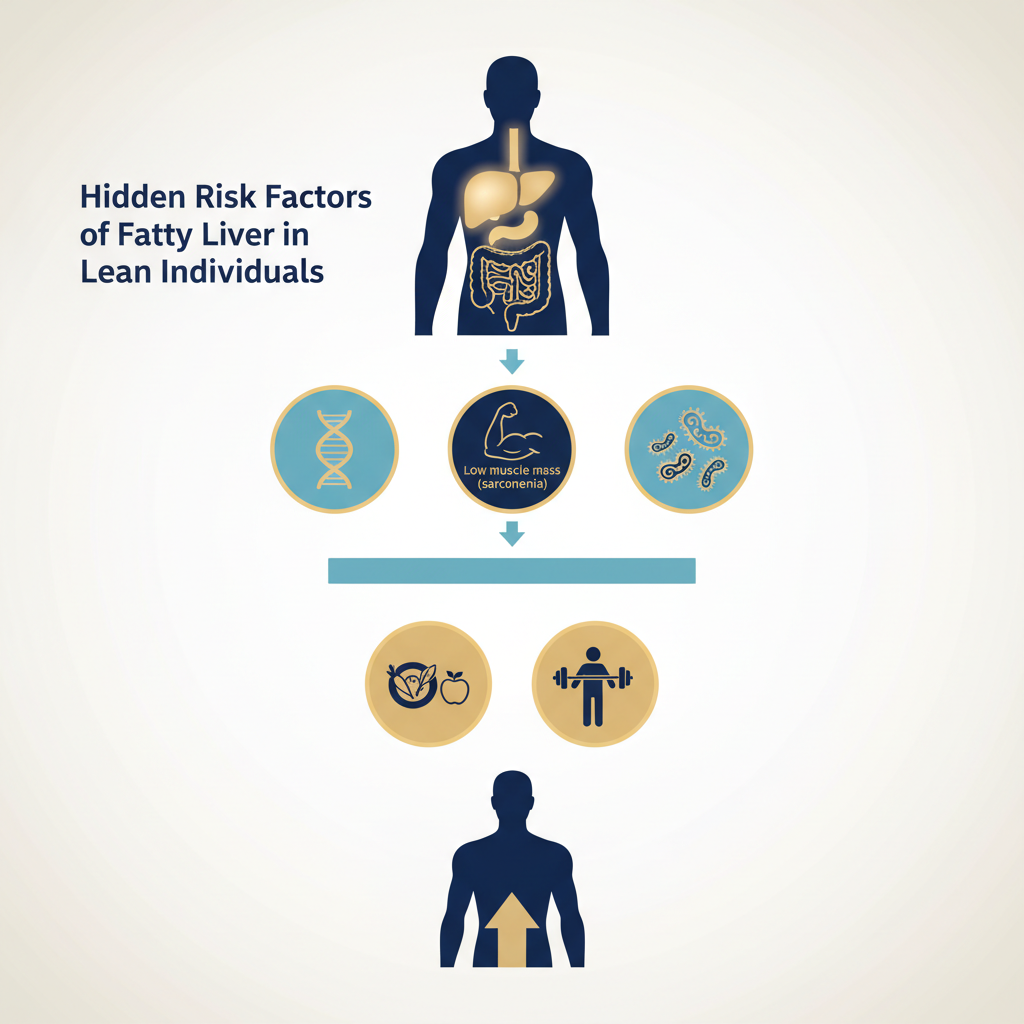
Why thin people develop fatty liver — main causes
There is no single root cause. Think of lean NAFLD as a phenotype driven by interactions among genetics, body fat distribution, muscle mass, gut microbiome, and diet. Below we unpack each major driver with practical implications.
1) Genetics and risk alleles
Certain genetic variants predispose hepatocytes to store fat and to progress to more severe disease. Most notable are PNPLA3 (I148M) and TM6SF2 variants; carriers can accumulate liver fat and have higher risk of inflammation and fibrosis, often independent of BMI. Genetic testing may clarify risk in select patients, especially with family history or unexplained progression. ([pubmed.ncbi.nlm.nih.gov](https://pubmed.ncbi.nlm.nih.gov/32068025/?utm_source=openai))
2) Visceral and ectopic fat
Subcutaneous fat and visceral fat have different metabolic impacts. Visceral adiposity drives insulin resistance and hepatic fat deposition via portal free fatty acids and proinflammatory cytokines. A person can be outwardly thin yet have high visceral fat (the so-called thin–fat phenotype). Waist circumference and waist-to-height ratio often outperform BMI in predicting hepatic steatosis. ([pubmed.ncbi.nlm.nih.gov](https://pubmed.ncbi.nlm.nih.gov/32626829/?utm_source=openai))
3) Sarcopenia (loss of muscle mass)
Muscle is the main sink for glucose disposal. Reduced muscle mass and function contribute to insulin resistance and hepatic lipid accumulation. Studies link sarcopenia with NAFLD severity, making resistance training and protein intake critical components of management. ([pubmed.ncbi.nlm.nih.gov](https://pubmed.ncbi.nlm.nih.gov/32922754/?utm_source=openai))
4) Gut microbiome and intestinal permeability
Dysbiosis may increase gut-derived endotoxins and metabolites (e.g., bacterial ethanol, modified bile acids) that reach the liver and promote steatosis and inflammation. Diets that damage microbiota (highly processed, high sugar) increase this risk. The gut–liver axis is an active research area with translational implications. ([pubmed.ncbi.nlm.nih.gov](https://pubmed.ncbi.nlm.nih.gov/33296678/?utm_source=openai))
5) Diet (fructose, refined carbs), hidden alcohol, and drugs
High dietary fructose (sugary drinks, sweetened juices) promotes hepatic de novo lipogenesis even in lean individuals. Small amounts of alcohol, polypharmacy, or specific hepatotoxic agents can worsen liver fat. Clinicians should take detailed dietary and medication histories. ([sciencedirect.com](https://www.sciencedirect.com/science/article/pii/S2589555919300904?utm_source=openai))
Clinical vignette: A 34-year-old man with normal BMI presents with mildly elevated ALT. His history reveals daily sweetened tea and low physical activity; waist circumference is elevated. Genetic screening shows PNPLA3 variant. The convergence of diet, visceral fat, and genetics explains his fatty liver — a classic example of "fatty liver in thin people causes".
Diagnosis: what to look for and when
Diagnostic workup should begin with clinical suspicion. Relying solely on BMI misses many cases. Key actions: measure waist circumference, order basic metabolic panel and liver enzymes, assess fasting glucose and lipids, and use abdominal ultrasound as first-line imaging. When needed, FibroScan or MRI-PDFF give quantitative assessment of steatosis and fibrosis risk. Genetic testing can be considered where it will influence management or prognosis. ([pubmed.ncbi.nlm.nih.gov](https://pubmed.ncbi.nlm.nih.gov/33649583/?utm_source=openai))
Practical algorithm (quote-ready):
- Screen: waist circumference + routine labs (AST/ALT, fasting glucose, lipids).
- If suspicion: abdominal ultrasound.
- If steatosis suspected or ALT persistently elevated: non-invasive fibrosis scoring (Fib-4, transient elastography).
- Refer hepatology for evidence of advanced fibrosis or diagnostic uncertainty.
Risks and long-term outcomes
Lean NAFLD should not be assumed benign. Reviews and cohort studies show that lean patients can progress to NASH and fibrosis, and may have comparable cardiometabolic risks to obese NAFLD in certain populations. Longitudinal follow-up and cardiovascular risk management are therefore essential components of care. ([pubmed.ncbi.nlm.nih.gov](https://pubmed.ncbi.nlm.nih.gov/33649583/?utm_source=openai))
Stat: systematic reviews estimate variable prevalence but confirm that lean NAFLD is a reproducible phenotype with meaningful clinical consequences. ([pubmed.ncbi.nlm.nih.gov](https://pubmed.ncbi.nlm.nih.gov/32626829/?utm_source=openai))
Management: practical NAFLD diet plan & liver health foods
Treatment pillars: dietary quality, resistance exercise for muscle building, aerobic activity, and surveillance. Weight loss is not always the goal in lean patients — instead focus on body composition (reduce visceral fat, increase muscle mass).
Dietary principles
- Minimize added sugars and fructose-containing beverages.
- Prioritize high-quality protein at each meal (to support muscle synthesis).
- Increase fiber from vegetables, legumes, and whole grains.
- Use extra virgin olive oil and oily fish (omega-3) as preferred fats.
Evidence supports benefits of these changes in reducing hepatic fat even without large weight loss. ([sciencedirect.com](https://www.sciencedirect.com/science/article/pii/S2589555919300904?utm_source=openai))
For evidence-based notes on supplements (omega-3, vitamin E, others) consult Fatty liver supplements that actually work — an evidence‑based practical guide. Supplements can be adjuncts but do not replace lifestyle change.
Exercise prescription
Recommend 2–3 sessions/week of progressive resistance training plus 150 minutes/week of moderate aerobic exercise. Resistance work is crucial in lean NAFLD to reverse sarcopenia and improve insulin sensitivity. ([pubmed.ncbi.nlm.nih.gov](https://pubmed.ncbi.nlm.nih.gov/32922754/?utm_source=openai))
When to refer or consider pharmacotherapy
Patients with NASH and significant fibrosis should be referred to hepatology. Several agents are under investigation; pharmacotherapy is reserved for selected patients and usually in the context of specialty care. ([pmc.ncbi.nlm.nih.gov](https://pmc.ncbi.nlm.nih.gov/articles/PMC8893229/?utm_source=openai))
Daily life tips — practical routine
Actionable steps you can adopt this week:
- Measure waist circumference and keep a monthly log.
- Replace sweetened beverages with water; use fruit whole instead of juiced.
- Schedule three 30–40 minute sessions per week for resistance training (bodyweight, bands, or free weights).
- Ensure 20–30 g protein within 30–60 minutes after resistance workouts to maximize muscle protein synthesis.
- Keep a 7-day food log to identify hidden sugars and high-fructose items.
Patient story: Sara, 29, thin with central fat distribution, adopted a twice-weekly resistance routine and swapped daily fruit smoothies for whole fruit. After 3 months ALT normalized and FibroScan-controlled attenuation parameter (CAP) decreased — underscoring that small lifestyle changes yield measurable hepatic improvement.
Myths vs Facts
- Myth: "Thin means healthy liver". Fact: Thin people can have significant hepatic steatosis and at-risk disease. ([pmc.ncbi.nlm.nih.gov](https://pmc.ncbi.nlm.nih.gov/articles/PMC8893229/?utm_source=openai))
- Myth: "Only losing weight fixes fatty liver". Fact: In lean patients, improving muscle mass and diet quality matters more than losing weight per se. ([sciencedirect.com](https://www.sciencedirect.com/science/article/pii/S2589555919300904?utm_source=openai))
- Myth: "Supplements cure NAFLD". Fact: Some supplements help modestly; evidence varies and they are adjunctive. See our supplements review.
- Myth: "Normal liver enzymes guarantee no disease". Fact: Normal enzymes don’t exclude steatosis or fibrosis; imaging and risk stratification are needed. ([pubmed.ncbi.nlm.nih.gov](https://pubmed.ncbi.nlm.nih.gov/33649583/?utm_source=openai))
- Myth: "Genetics is destiny". Fact: Genetics increases risk but lifestyle interventions can modify disease trajectory. ([pubmed.ncbi.nlm.nih.gov](https://pubmed.ncbi.nlm.nih.gov/32068025/?utm_source=openai))
Expert tips (practical)
- Screen waist circumference in routine checks — it’s fast and informative. ([pubmed.ncbi.nlm.nih.gov](https://pubmed.ncbi.nlm.nih.gov/32626829/?utm_source=openai))
- Prioritize progressive resistance training to counter sarcopenia. ([pubmed.ncbi.nlm.nih.gov](https://pubmed.ncbi.nlm.nih.gov/32922754/?utm_source=openai))
- Use a 7-day food diary to uncover hidden fructose and sugar.
- Discuss genetic testing for unexplained progressive disease or strong family history. ([pubmed.ncbi.nlm.nih.gov](https://pubmed.ncbi.nlm.nih.gov/32068025/?utm_source=openai))
- Manage cardiometabolic risks aggressively — CV disease is a leading cause of mortality in NAFLD. ([pubmed.ncbi.nlm.nih.gov](https://pubmed.ncbi.nlm.nih.gov/36328950/?utm_source=openai))
Common mistakes to avoid
- Relying solely on BMI — measure waist circumference and body composition.
- Recommending calorie-driven weight gain without a resistance program.
- Assuming supplements alone will reverse disease — lifestyle is central.
- Delaying specialist referral when fibrosis is suspected.
- Overlooking the gut microbiome as a modifiable contributor.
FAQ
- Can I reverse fatty liver if I'm thin?
Yes — many patients improve with diet quality, exercise (especially resistance training), and metabolic risk control. ([sciencedirect.com](https://www.sciencedirect.com/science/article/pii/S2589555919300904?utm_source=openai)) - Which tests should I ask for?
AST/ALT, fasting glucose, lipid panel, ultrasound; FibroScan or MRI if indicated. ([pubmed.ncbi.nlm.nih.gov](https://pubmed.ncbi.nlm.nih.gov/33649583/?utm_source=openai)) - Are fruits bad because of fructose?
Whole fruits are generally fine; avoid fruit juices and concentrated sugary drinks. - Is alcohol always excluded?
MAFLD concept focuses on metabolic dysfunction; small alcohol intake still modifies risk and should be discussed honestly. - Should I take omega-3 or vitamin E?
Some evidence supports omega-3 for triglycerides and vitamin E in selected NASH patients, but consult a clinician. See our supplements review. Supplements guide. - When to see a hepatologist?
If non-invasive tests suggest advanced fibrosis or NASH, or if diagnosis uncertain. - Are there approved drugs for NAFLD?
No universally approved drug for all NAFLD patients yet; many agents are in trials and some used in specialist settings. ([pmc.ncbi.nlm.nih.gov](https://pmc.ncbi.nlm.nih.gov/articles/PMC8893229/?utm_source=openai)) - Does exercise alone help?
Exercise reduces liver fat but combining with dietary changes is more effective. Resistance training is particularly valuable for lean patients. ([pubmed.ncbi.nlm.nih.gov](https://pubmed.ncbi.nlm.nih.gov/32922754/?utm_source=openai)) - Can a healthy-looking person have cirrhosis?
Yes — disease can progress silently; appropriate screening and follow-up matter. ([pubmed.ncbi.nlm.nih.gov](https://pubmed.ncbi.nlm.nih.gov/33649583/?utm_source=openai)) - What is the single best immediate change?
Cut sugary drinks and start twice-weekly resistance training — two changes with high impact.
Selected scientific references (2020+)
- Younossi ZM et al., Global prevalence, incidence, and outcomes of non-obese or lean NAFLD: systematic review and meta-analysis. Gut. 2021. ([med.stanford.edu](https://med.stanford.edu/content/dam/sm/nguyenlab/documents/Featuredarticles/26_Ye--Lancet_gastro.pdf?utm_source=openai))
- Vernon G., Prevalence and Profile of NAFLD in Lean Adults: Systematic Review and Meta-Analysis. Clin Gastroenterol Hepatol. 2020. ([pubmed.ncbi.nlm.nih.gov](https://pubmed.ncbi.nlm.nih.gov/32626829/?utm_source=openai))
- Madeo F., Metabolic causes and consequences of NAFLD. Liver Int. 2021. ([pubmed.ncbi.nlm.nih.gov](https://pubmed.ncbi.nlm.nih.gov/34870138/?utm_source=openai))
- Chen J., Lean NAFLD: a distinct entity shaped by differential metabolic adaptation. Hepatology. 2020. ([aasldpubs.onlinelibrary.wiley.com](https://aasldpubs.onlinelibrary.wiley.com/doi/abs/10.1002/hep.30908?utm_source=openai))
- Sookoian S., Genetic pathways in NAFLD: insights from systems biology. Hepatology. 2020. ([pmc.ncbi.nlm.nih.gov](https://pmc.ncbi.nlm.nih.gov/articles/PMC7363530/?utm_source=openai))
- Leung C., Gut microbiome and NAFLD: Cell Metab. 2020. ([pubmed.ncbi.nlm.nih.gov](https://pubmed.ncbi.nlm.nih.gov/33296678/?utm_source=openai))
- Lopez-Miro O., Diet, gut microbiota and NAFLD. Cells. 2020. ([pubmed.ncbi.nlm.nih.gov](https://pubmed.ncbi.nlm.nih.gov/31936799/?utm_source=openai))
- Le Roy T., Gut microbiota and its metabolites: novel targets for NAFLD. Gut. 2020. ([pubmed.ncbi.nlm.nih.gov](https://pubmed.ncbi.nlm.nih.gov/32738185/?utm_source=openai))
- Association of sarcopenia and NAFLD: an overview. J Cachexia Sarcopenia Muscle. 2020. ([pubmed.ncbi.nlm.nih.gov](https://pubmed.ncbi.nlm.nih.gov/32922754/?utm_source=openai))
- Consensus: A new definition for MAFLD (2020). ([sciencedirect.com](https://www.sciencedirect.com/science/article/pii/S0168827820302014?utm_source=openai))
- Additional review: NAFLD in lean subjects — Frontline Gastroenterology/BMJ reviews 2020–2022. ([mashclinical.com](https://www.mashclinical.com/uploads/2/2/2/7/22271200/nafld_in_nonobese_bmj_2020.pdf?utm_source=openai))

Related ATHAR paths
Want a Personalized Plan?
Book a free consultation with Feras Alayed to get a health plan tailored to your condition.
Book Your Free Consultation