Understanding the Difference Between Physical and Emotional Hunger Cues
Author: Feras Alayed
Published:
Updated:
Category: behavioral-nutrition
Reading Time: 8 minutes
Key Takeaways
- Physical hunger develops gradually, while emotional hunger strikes suddenly.
- Observing behavioral patterns is the first step toward building a balanced relationship with food.
- Understanding the food reward system helps explain intense cravings for specific foods.
- Behavioral nutrition focuses on the 'why' and 'how' of eating, not just the 'what'.
- Seeking professional support is essential when facing persistent challenges with eating patterns.
TL;DR
Distinguishing between physical and emotional hunger is a core skill in behavioral nutrition. This article aims to educate you on how to observe your body's signals, understand the drivers behind eating, and apply structured steps to recognize your true needs without judgment.
The Problem: Why Do We Eat When We're Not Hungry?
We often find ourselves searching for something to eat after a long, exhausting day, even if we recently had a full meal. This common human experience highlights the challenge of distinguishing between a biological need for food and a desire driven by emotions or habits. For many, previous attempts to change eating patterns can be hard to sustain because they often focus solely on caloric restriction, ignoring the deep behavioral and psychological drivers.
Understanding the difference between physical and emotional hunger cues is not merely a matter of willpower; it is a process of learning to listen to the body and observing the context in which eating occurs. By adopting a Behavioral Nutrition approach, we can begin to unpack these complex patterns.
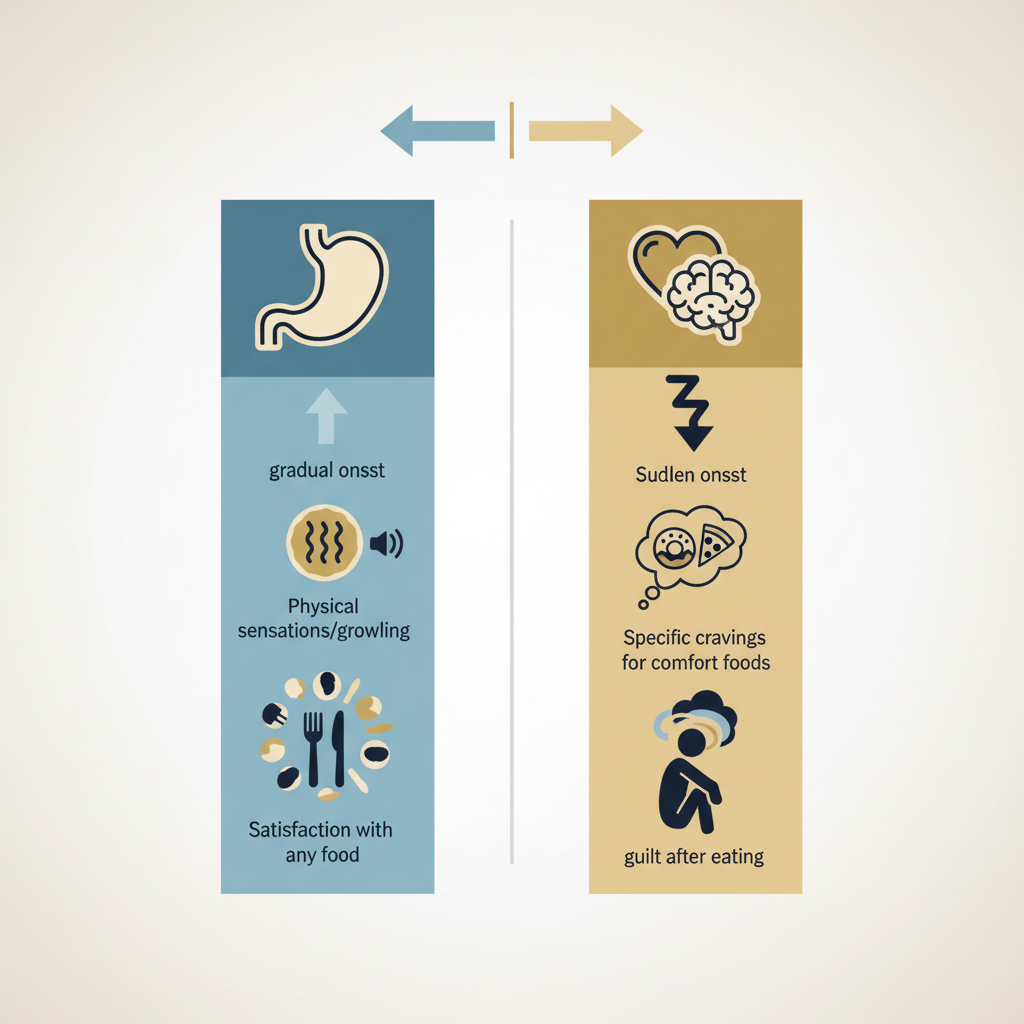
What is the Difference Between Physical and Emotional Hunger Cues?
Simply put, physical hunger is a gradual biological call for energy, whereas emotional hunger is a sudden psychological demand for comfort or distraction. When the body lacks nutrients, it sends clear physiological signals such as a rumbling stomach or a dip in energy levels. These signals build over time and can be satisfied by various types of foods.
On the other hand, emotional hunger is closely tied to understanding the food reward system and how it drives cravings. This type of hunger appears suddenly, is often directed toward specific foods (like sweets or salty snacks), and is driven by external or internal triggers such as stress, boredom, or even joy, rather than a physiological need.
Why Understanding Hunger Cues Matters
Scientific evidence in nutrition and psychology suggests that ignoring the emotional drivers of eating often leads to cycles of restriction and overeating. Understanding these cues helps build deeper self-awareness. When you recognize that your desire to eat stems from an emotional trigger, you can choose a response that is more appropriate for your needs in that moment.
Furthermore, recognizing these differences is a fundamental step in learning how to change your relationship with food. Instead of feeling guilty after eating in response to an emotion, you can use that moment as an opportunity for learning and observation, which can make reflection on eating feel less judgmental over time.
7 Practical Steps to Identify and Respond to Hunger Cues
Here is a structured approach to help you explore your hunger cues:
- Pause and Observe: Before eating, pause for a moment. Ask yourself: 'Am I physically hungry, or is something else triggering me?'
- Check Your Body: Look for physiological signs. Do you feel emptiness in your stomach? Has your concentration dropped?
- Identify the Trigger: If there are no physical cues, try to identify your current emotion or situation. Are you bored? Did you just finish a difficult task?
- Delay the Response (Temporarily): Wait a few minutes. Emotional hunger may gradually subside over time, while physical hunger will continue to grow.
- Apply Mindful Eating Practices: If you decide to eat, do so consciously. Review mindful eating practices to learn how to focus on the flavor and texture of food.
- Observe Post-Eating Feelings: Notice how you feel after finishing. Physical hunger leaves a feeling of satisfaction, while emotional hunger might be followed by regret.
- Document Patterns: Keep a simple journal to note the times and situations when you feel a sudden urge to eat. This helps in recognizing recurring patterns.
Detailed Comparison: Physical vs. Emotional Hunger
| Aspect | Physical Hunger | Emotional Hunger |
|---|---|---|
| Onset | Develops gradually over time | Appears suddenly and urgently |
| Location in Body | Felt in the stomach (rumbling, emptiness) | Felt in the mind (urgent craving) |
| Type of Food Desired | Open to multiple options | Often focuses on specific (comfort) foods |
| Feeling After Eating | Satisfaction and fullness | Often followed by guilt or dissatisfaction |
| Response to Time | Can be postponed slightly | Demands immediate gratification |
5 Common Mistakes When Evaluating Hunger
In the journey of understanding body signals, it is easy to fall into certain traps. Here are the most common mistakes and how to correct them:
- Confusing Thirst with Hunger: Sometimes the body interprets thirst as hunger. Correction: Drink a glass of water and wait a bit before evaluating your hunger again.
- Skipping Main Meals: Ignoring physical hunger for long periods leads to extreme hunger that can mimic emotional hunger in its urgency.
- Moralizing Food: Labeling foods as 'good' or 'bad' increases emotional desire for forbidden foods.
- Ignoring Accumulated Stress: Failing to address daily sources of stress makes it difficult to focus on breaking emotional eating.
- Over-relying on External Metrics: Such as focusing solely on weight or BMI instead of internal cues. (Read more about BMI accuracy and better alternatives).
Real-Life Scenarios for Understanding Eating Patterns
To understand how these concepts manifest in daily life, let's look at some hypothetical scenarios:
Scenario 1: A person returns from work after a day full of difficult meetings. They head straight to the snack cabinet and start eating potato chips mindlessly. Here, the trigger is not a lack of energy, but the need to release stress and transition from a state of work to rest. Recognizing this pattern is the first step to finding alternative ways to relieve stress.
Scenario 2: A person follows an irregular work schedule and skips lunch. By evening, they feel an intense, urgent desire to eat large quantities of food. This might look like emotional hunger due to the urgency, but it is actually accumulated physical hunger resulting from prolonged deprivation.
Expert Perspective: Behavioral Nutrition and Structured Support
From a behavioral nutrition perspective, emotional eating is not treated as a 'disease' to be cured, but as a coping mechanism developed by humans. The goal is not to completely eliminate emotional eating—it is natural to find pleasure and comfort in food occasionally—but the goal is to expand your coping toolkit so that food is not the only tool.
Structured support can provide a framework for observation without judgment. It is important to remember that this article provides general educational information, and in cases of eating disorders or complex health challenges, consulting qualified healthcare professionals is a necessary and essential step.
Frequently Asked Questions
How do I know if I am eating emotionally?
If you turn to food in response to stress, boredom, or sadness, and suddenly crave specific foods, it might be emotional eating.
Is emotional eating always bad?
No, it is natural to associate food with emotions on occasions. It becomes a concern when food is the only way you cope with feelings.
How do I stop intense sugar cravings?
Understanding the food reward system and observing triggers, while ensuring physical needs are met with balanced meals, can help manage these cravings.
Does drinking water reduce hunger?
Drinking water helps ensure you are not just thirsty, as thirst and hunger signals sometimes mix, but it does not replace the need for food if you are physically hungry.
What is behavioral nutrition?
It is an approach that focuses on understanding the psychological, environmental, and behavioral drivers that influence our food choices and eating habits.
How do I start practicing mindful eating?
Begin by eating one meal a day without distractions (like a phone or TV), and focus on chewing the food and noticing its flavors.
Does intermittent fasting affect hunger cues?
Yes, it may help regulate physical hunger cues for some, but it requires awareness to avoid overeating after fasting periods.
When should I seek professional help?
If you feel a loss of control over eating, or if your eating patterns cause significant psychological distress that affects your daily life.
Conclusion & Next Steps
Distinguishing between physical and emotional hunger is an ongoing journey of self-awareness and observation. By understanding the signals your body and mind send, you can begin to make decisions that are more aligned with your true needs. Remember that change takes time, and the goal is progress, not perfection.
Medical Disclaimer: The information provided in this article is for educational purposes only and does not replace professional medical advice, diagnosis, or treatment. Please consult your doctor or a qualified healthcare professional before making any drastic changes to your diet or lifestyle.
Continue learning at Behavioral Nutrition.

Ready to choose a clearer health starting point?
Start with a short educational assessment to explore tools and resources that may fit your goal. It is not a medical diagnosis.
Continue learning at Behavioral Nutrition.