Weight Trend Tracking Myths: Guide to Sustainable Habits
Author: Feras Alayed
Published:
Category: weight-management
Reading Time: 15 minutes
Key Takeaways
- Weight trend tracking focuses on the moving average of your weight over time, not isolated daily numbers.
- Daily fluctuations are normal and often related to water retention, digestion, or hormonal changes.
- Relying solely on the scale can overlook important indicators like waist circumference and energy levels.
- Understanding the facts about weight tracking helps provides prompts for observing stress-related patterns and supports consistency in healthy habits.
- Standardizing environmental variables, such as the time of day and the placement of the scale, is a fundamental requirement for gathering accurate data.
- Observing longitudinal data over several weeks provides a different analytical framework than reacting to acute, 24-hour measurement changes.
TL;DR
Many people struggle to maintain motivation due to daily weight fluctuations. This article uses a 'myth-versus-fact' format to explain how weight trend tracking provides a clearer, more realistic picture of progress. By focusing on weekly or monthly averages instead of daily readings, you can make better decisions, reduce scale-related anxiety, and build sustainable habits that support your overall health. Shifting from a single-data-point mindset to a data-smoothing mindset allows for objective observation of bodily changes, removing the emotional response often associated with standard home weighing routines.
The Daily Struggle: Why the Scale Frustrates Us
Imagine sticking to your healthy routine all week; you choose nutritious foods, move regularly, and manage your stress well. Then you step on the scale the next morning only to find the number has gone up. This familiar scenario is one of the biggest challenges for anyone trying to improve their lifestyle. Over-reliance on a single daily reading often leads to frustration and can be a strong trigger pushing some to abandon positive habits or fall into the trap of emotional eating triggers and solutions. The real problem isn't the number itself, but how we interpret it and our expectation that the path of change should be a straight line downward.
Historically, body weight was measured infrequently, often only during visits to a medical clinic or a specialized facility. In those settings, the time between measurements was long enough that the acute daily fluctuations were absorbed into the larger timeframe. Today, the widespread availability of digital home scales allows for daily or even multiple-times-a-day measurement. While this provides more data, it also introduces a high volume of "noise" into the observation process. This noise consists of the normal, expected physiological shifts in fluid and mass that occur within a 24-hour cycle. When individuals view this acute noise as a definitive measurement of their foundational tissue mass, the resulting interpretation is often mathematically flawed. Recognizing the difference between an acute data point and a longitudinal trend is the first step in organizing a more objective approach to body measurement.
What is Weight Trend Tracking? (Direct Definition)
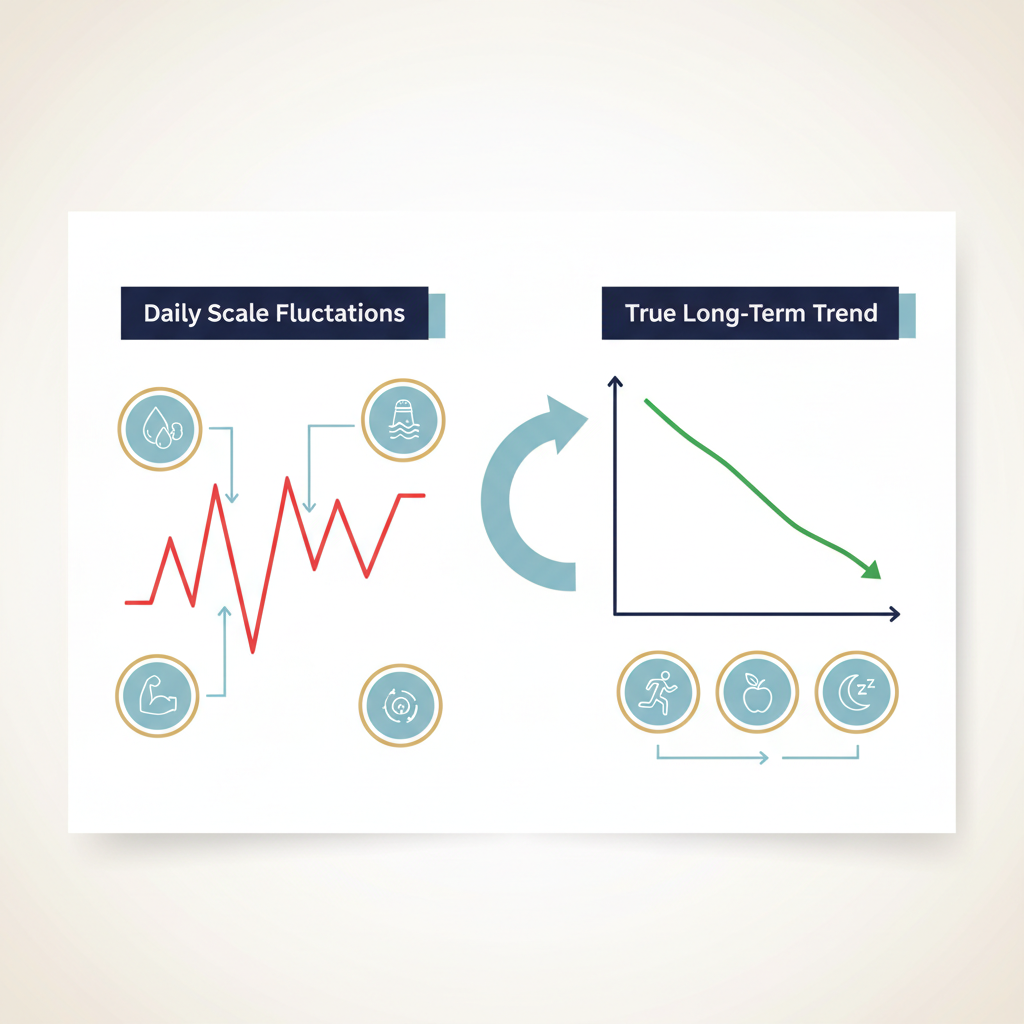
Weight trend tracking is a monitoring method that relies on calculating the moving average of weight readings over a specific period (such as a week or a month), rather than focusing on individual daily readings. This approach helps filter out random fluctuations caused by daily factors like water retention or digestive tract contents, providing a more accurate picture of the body's actual direction of change.
In the terminology of data analysis, this method is often referred to as "data smoothing." When you plot daily weights on a graph, the line will typically look jagged, with sharp peaks and valleys representing the daily variance. A moving average takes a set number of these data points—for example, the last seven days—adds them together, and divides by seven. The next day, the oldest data point is dropped, the newest is added, and the calculation is repeated. This mathematical process flattens the jagged line into a smoother curve, revealing the underlying trajectory of the data. By organizing the numbers in this way, the observer shifts their focus from the variance (the daily jumps) to the slope (the overall direction of the curve over time). This method is widely used in various fields of science and economics to identify true patterns amidst highly variable daily inputs.
Why Understanding Your Weight Trend Matters
Adopting a 'trend' perspective instead of a 'daily number' perspective offers multiple practical and psychological benefits. First, it helps organize your routine by removing the daily stress associated with the scale. Second, it supports consistency; when you realize a temporary spike is a normal part of the process, you are better able to stick to your habits. Third, it makes choices clearer, as you can evaluate the effectiveness of your routine based on reliable data spanning weeks, not emotional responses to daily fluctuations. For more on reading this data, you can check out our Weight Trend Tracking Guide.
Furthermore, understanding the trend framework changes how you categorize information. Instead of categorizing a higher number as a "failure" and a lower number as a "success," you begin to categorize all numbers simply as "data." This shift in terminology and categorization is a hallmark of objective observation. When you view your body as a complex system that requires longitudinal observation to understand, you remove the expectation of immediate, linear correlation between yesterday's choices and today's scale reading. This organizational mindset allows for a more structured approach to habit formation, where routines are evaluated on a monthly or quarterly basis rather than on a 24-hour cycle.
Myths vs. Facts: Debunking Common Misconceptions
Many misconceptions circulate about how the body responds and how to monitor weight. In this section, we will dismantle the most famous weight trend tracking myths using a simplified scientific explanation format.
Myth 1: Daily Weight Gain Means Fat Gain
Fact: Daily changes in weight are rarely related to a change in fat mass. Gaining one kilogram of fat requires a significant energy surplus that does not happen in a single day. A sudden spike on the scale often reflects water retention (due to sodium intake or hormonal changes), increased glycogen stores in muscles (which bind to water), or simply the weight of food in your digestive system.
To expand on the terminology, glycogen is the storage form of carbohydrates in the human body, primarily located in the liver and skeletal muscles. From a physiological standpoint, every gram of glycogen stored in the body binds to approximately three to four grams of water. Therefore, a meal with a higher carbohydrate content can lead to a measurable increase in total body mass the following day simply due to this glycogen-water binding mechanism. Additionally, the physical mass of food and liquids moving through the gastrointestinal tract contributes to the gravitational pull measured by the scale. This transit time can vary from 24 to 72 hours, meaning the scale is often measuring the physical presence of matter that has not yet been processed or eliminated.
Myth 2: You Must Weigh Yourself Daily to See a Trend
Fact: While some prefer daily weighing to calculate a precise weekly average, it is not a requirement. What matters most is consistency in measurement conditions (same time, same clothes, same scale). Weighing once or twice a week can be perfectly sufficient to draw a general trend without causing psychological fatigue, especially when integrated with other indicators within a comprehensive weight management plan.
The frequency of data collection should align with the individual's ability to process the information objectively. For those who utilize spreadsheet software or dedicated tracking applications, daily input might be a simple administrative task. For others, taking a measurement every three to four days provides enough data points to calculate a monthly average without the daily administrative requirement. The mathematical validity of the trend line remains intact as long as the intervals between measurements are relatively consistent and the environmental variables are standardized.
Myth 3: A Flat Trend Means the System is Failing
Fact: A stagnant number on the scale does not necessarily reflect a halt in progress. The body may be undergoing composition changes, such as an increase in muscle mass alongside a decrease in fat mass, keeping the overall weight stable. Therefore, it is essential to use additional metrics like the best 5 ways to reduce waist circumference to evaluate true progress.
In anatomical terms, muscle tissue is denser than adipose (fat) tissue. This means that a specific volume of muscle weighs more than an equal volume of fat. If an individual's physical routine involves activities that stimulate muscle tissue while simultaneously utilizing adipose tissue for energy, the total mass of the body might remain mathematically identical. However, the spatial volume occupied by the body will decrease. This is why a flat trend line on a gravitational scale must be cross-referenced with volumetric measurements, such as circumference tapes or how specific garments fit, to form a complete observational picture.
Myth 4: The Scale is the Only Measure of Health
Fact: Weight is just one data point. Other vital indicators such as energy levels, sleep quality, the ability to perform daily tasks, and blood tests (like assessing insulin resistance symptoms) provide a much broader and more important picture of overall health than just a number on a scale.
An organized approach to body observation involves a multi-metric dashboard. Just as a vehicle's dashboard displays speed, fuel levels, and engine temperature to provide a complete status report, human observation requires multiple data streams. Relying exclusively on gravitational mass ignores the metabolic, cardiovascular, and neurological data points that licensed professionals use to assess systemic function.
Table: Common Belief vs. What Needs Verification
| Common Belief (Myth) | What Needs Verification (Practical Fact) |
|---|---|
| Ideal weight is a fixed number to reach. | Healthy weight is a range that changes over time and is influenced by age and body composition. |
| Body Mass Index (BMI) tells you everything about your health. | BMI is a general screening tool and does not differentiate between muscle and fat. Read more on how to read BMI result. |
| Rapid weight loss is an indicator of success. | Gradual, sustainable loss supports muscle retention and reduces the likelihood of weight regain. |
| Heavy sweating during exercise means fat loss. | Sweating is a cooling mechanism reflecting temporary fluid loss, not fat burning. |
| A digital scale is always 100% accurate and requires no maintenance. | Digital scales utilize strain gauge load cells that require regular calibration, flat surfaces, and fresh batteries to provide standardized data. |
| Evening weight is the most accurate reflection of the body. | Morning weight, recorded after waking and before intake, provides the most standardized baseline due to the fasting and resting state. |
| Water weight is an illusion and does not count as real weight. | Water has physical mass and directly contributes to the total gravitational pull measured by any standard scale. |
Common Information Mistakes and How to Correct Them
When trying to track a weight trend, many fall into methodological errors that make the data misleading. Prominent mistakes include:
- Changing measurement conditions: Weighing at different times of the day, or using different scales, invalidates the comparison. Correction: Standardize the variables (morning, after using the restroom, in light clothing).
- Focusing on peaks and valleys: Getting upset over the highest reading of the week or only celebrating the lowest. Correction: Look at the overall trend line connecting the weekly averages.
- Comparing your trend to someone else's: Bodies respond differently based on genetics, health history, and age. Correction: Make your only comparison with your own past data.
- Ignoring environmental factors: Placing the scale on an uneven surface, such as a carpet or a bathroom mat, can alter the mechanical distribution of weight on the scale's sensors. Correction: Always place the scale on a hard, completely flat surface, such as tile or hardwood, and ensure it is placed in the exact same location for every measurement.
- Failing to calibrate the equipment: Moving a digital scale from one room to another or storing it vertically can disrupt the internal load cells. Correction: If the scale is moved, step on it briefly to activate the screen, step off, let it return to zero, and then step back on to record the official measurement. This process resets the baseline calibration.
Hypothetical Scenario: Reading Data Clearly
Let's take a hypothetical example to illustrate the concept. Suppose 'Sarah' started monitoring her habits. In the first week, she recorded her daily weights, which fluctuated between 70 and 71.5 kg. On Thursday, her weight spiked to 71.5 kg after a sodium-rich meal the night before. If Sarah relied solely on Thursday's reading, she would feel frustrated. However, by calculating the first week's average, she found it was 70.6 kg. In the second week, daily fluctuations continued, but the weekly average dropped to 70.3 kg. By tracking the trend, Sarah realized her routine was working effectively, encouraging her to continue without being distracted by annoying daily fluctuations.
To examine Sarah's data collection more closely, we can look at the specific numbers she logged in her spreadsheet. During Week 1, her daily entries were: Monday (70.1 kg), Tuesday (70.4 kg), Wednesday (70.2 kg), Thursday (71.5 kg), Friday (71.0 kg), Saturday (70.5 kg), and Sunday (70.5 kg). The sum of these seven data points is 494.2 kg. Dividing this sum by seven yields the moving average of 70.6 kg.
During Week 2, her daily entries were: Monday (70.4 kg), Tuesday (70.2 kg), Wednesday (70.1 kg), Thursday (70.6 kg), Friday (70.3 kg), Saturday (70.2 kg), and Sunday (70.3 kg). The sum of these seven data points is 492.1 kg. Dividing this sum by seven yields the moving average of 70.3 kg.
When Sarah plotted these two averages on a graph, the line connecting 70.6 kg to 70.3 kg showed a clear downward slope. By organizing her data mathematically, the acute spike of 71.5 kg on the first Thursday became a statistical outlier rather than a defining metric. This hypothetical scenario demonstrates how the application of basic data smoothing techniques transforms chaotic daily variance into a clear, readable trajectory.
Checklist: Preparing for a Conversation with Your Specialist
If you are tracking your weight trend and habits and wish to discuss them with your doctor or licensed dietitian, organizing your notes makes the visit more productive. Use this checklist to prepare:
- Could any medications I am currently taking contribute to fluid retention or weight fluctuations?
- Based on my health history, what is a realistic and sustainable weight range for me?
- How can I integrate other measurements (like waist circumference or blood pressure) with weight tracking to assess my overall health?
- Are there specific tests you recommend to better understand how my body responds?
- What is the expected variance in my daily weight based on my current physiological baseline?
- How should I document my observations to provide you with the most useful information during our visits?
- Are there specific times of the month where fluid shifts are expected to alter the data significantly?
Frequently Asked Questions
Is daily weight tracking suitable for everyone?
No. For some individuals, daily weighing can increase anxiety or trigger unhealthy behaviors. In these cases, it is preferable to track weight weekly or monthly, or focus on other metrics like clothing fit.
Why does my weight go up the day after a strenuous workout?
This is often due to minor localized inflammation in the muscles (which is part of the recovery and building process), leading to temporary fluid retention in the muscle tissues.
When should I stop tracking my weight?
If you notice the scale is controlling your daily mood, defining your self-worth, or pushing you to overly restrict your food, it is wise to take a break from the scale and focus on foundational healthy habits.
Can a weight trend change without changing habits?
Yes, changes in stress levels, sleep quality, or natural hormonal shifts can affect the weight trend even if dietary and movement habits remain constant.
Does the type of scale matter for trend tracking?
Whether using an analog mechanical scale or a digital scale, the most important factor is consistency rather than absolute precision. Analog scales use springs that can wear out over time, while digital scales use electronic sensors. As long as the same device is used under the same standardized conditions, the trend line will reflect accurate relative changes, even if the absolute number differs slightly from a calibrated medical scale.
How do environmental factors like humidity or temperature affect the scale reading?
Extreme changes in temperature or humidity can affect the mechanical components of a scale, potentially causing slight expansions or contractions in the materials. Additionally, human physiology responds to heat and humidity through fluid shifts, such as increased sweating or altered blood volume distribution. Keeping the scale in a climate-controlled environment and measuring at a consistent time of day helps mitigate these environmental variables.
Your Next Step
Understanding weight trend tracking myths is the first step toward building a healthy relationship with the scale and your body. Remember that numbers are just data to help guide your decisions, not a judgment of your commitment or worth. By shifting the focus from acute daily reactions to longitudinal observation, individuals can organize their routines based on clear, mathematical realities rather than emotional responses to normal physiological variance. Disclaimer: The information in this article is for educational purposes only and does not replace professional medical advice. If you are ready to organize your routine and understand the full picture of your health, اعرف الخطوة المناسبة لهدفك (know the right step for your goal) by exploring our available assessment guides.
Ready to choose a clearer health starting point?
Start with a short educational assessment to explore tools and resources that may fit your goal. It is not a medical diagnosis.
Continue learning at Weight Management.