Building Family Health Literacy: A Guide to Essential Knowledge Skills
Author: Feras Alayed
Published:
Category: family-health-literacy
Reading Time: 9 minutes
Building Family Health Literacy: A Guide to Essential Cognitive Skills
Health literacy is the cornerstone of building a conscious society capable of facing contemporary health challenges. In the Gulf context, where traditional social values intersect with modern lifestyles, there is an urgent need to empower families with cognitive skills that go beyond basic reading and writing. It involves the ability to analyze health information and make decisions based on solid scientific foundations.
1. The Concept of Health Literacy and Its Importance in the Gulf Family Context
Health literacy is defined as the ability to obtain, understand, process, and use basic health information to make appropriate health decisions. This literacy is not limited to the individual alone but extends to the family as an integrated unit. In Gulf societies, the extended family plays a pivotal role in guiding health behaviors, where there is often an informal "health manager" in the family—the person everyone turns to for advice on medical or nutritional matters.
The importance of health literacy lies in its ability to bridge the gap between specialist recommendations and their actual application at home. When family members possess sufficient awareness, they become better equipped to manage chronic health conditions, understand the importance of prevention, and consciously navigate the nutritional shifts the region has experienced. Enhancing this literacy contributes to creating a home environment that supports healthy choices, where healthy eating or physical activity is not just a temporary "diet" but an inherent part of the family identity.
Furthermore, health literacy helps protect the family from misinformation that spreads rapidly through social media. By developing critical thinking skills, family members can distinguish between reliable medical advice and persuasive commercial advertisements or inherited myths that may not be based on scientific evidence. The ultimate goal is to transform the family from a passive recipient of health services into an active partner in the care process.
2. Deciphering Common Medical Terms: How to Understand Specialist Language?
Patients in health centers often feel confused when hearing complex medical terms, which can lead to a misunderstanding of the diagnosis or treatment plan. Health literacy begins with learning basic "medical language" and simplifying it. For example, it is essential to distinguish between "Acute" conditions, which appear suddenly and last for a short period, and "Chronic" conditions, which require long-term management.
It is also vital to understand terms related to metabolism, such as "Insulin Resistance," which means the body's cells do not respond effectively to this hormone, or "Triglycerides" and "LDL/HDL Cholesterol." Understanding these terms helps the family realize the importance of periodic check-ups and what laboratory results signify. Attention should also be paid to medical suffixes; a word ending in "-itis" usually indicates inflammation (e.g., Arthritis), while "hyper-" refers to an increase or elevation (e.g., Hypertension), and "hypo-" refers to a decrease or low level.
To improve communication with the medical team, it is always recommended to ask for clarification in simple words. There is no shame in saying, "Can you explain this term in non-medical language?" or "What does this diagnosis mean for our daily lives?" Possessing this simple linguistic vocabulary breaks the barrier of fear and enhances trust between the patient and their doctor, ensuring better adherence to the treatment plan and a deeper understanding of the family's overall health status.
3. The Family Guide to Smartly Reading Food Labels and Nutrition Facts
Reading food labels is a vital skill in the era of processed foods. A nutrition label is not just a set of numbers; it is a map of what enters our bodies. The first thing to look at is the "Serving Size," as many of the listed data points refer to a single serving, not the entire package. A small package may contain two or three servings, meaning doubling the calories and sugars consumed.
Focus should be placed on the ingredients list, where ingredients are listed in descending order by weight. If sugar or one of its derivatives (such as high fructose corn syrup, maltodextrin, or sucrose) appears in the first three ingredients, this is an indicator that the product is high in sugar. One should also watch for "Trans Fats" and strive to avoid them entirely, while looking for dietary fiber that promotes digestive health and satiety.
Use the "5/20" rule as a quick guide: if the Daily Value (DV) for a nutrient is 5% or less, it is considered low; if it is 20% or more, it is considered high. We always aim for low percentages in sodium, added sugars, and saturated fats, and high percentages in fiber, vitamins, and minerals. Training children and youth in the family to read these labels while shopping turns the purchasing process into a continuous learning experience that builds smart consumption habits for life.
4. The Importance of Tracking Daily Habits: How to Build an Accurate Family Health Record?
Data is the most powerful tool in the hands of a health-conscious family. Relying on memory when visiting a doctor can lead to overlooking important details. Tracking daily habits, such as food quality, physical activity levels, sleep hours, and even mood, provides a clear picture of lifestyle and helps connect causes to effects. For instance, a person might notice a link between a specific type of food and feeling lethargic or having a headache the next day.
A family health record should also include documentation of symptoms when they appear: When did they start? What makes them worse? What relieves them? This type of precise observation helps doctors reach a more accurate diagnosis faster. Smartphone apps or a simple dedicated notebook can be used for this purpose. The important thing is consistency and accuracy.
Additionally, tracking habits helps monitor progress toward health goals. When the family sees documentation of an increase in weekly steps or an improvement in sleep quality, it acts as a positive motivator to continue. Over time, this record becomes a "historical reference" for the family, which can be consulted to understand hereditary or environmental health patterns, contributing to a sense of individual responsibility toward public health.
5. Medical Appointment Preparation Skills: Essential Questions for the Care Provider
Medical appointment times are often limited, so preparation is key to maximizing the benefit. Family members should write a list of questions and concerns before going to the clinic. A good practice is to start with the most important question: "What is the main problem I am having?" then move to "What do I need to do?" and "Why is it important for me to do this?".
Essential questions also include inquiring about required tests: "What will this test show?" and "Are there other alternatives?". If a new medication is prescribed, ask about its potential side effects and how it interacts with other medications or foods. Do not hesitate to take notes during the session or ask for permission to record audio explanations if allowed, to ensure information is accurately conveyed to the rest of the family.
Furthermore, it is important to inform the doctor about any nutritional supplements or lifestyle changes being made, as this information may affect medical decisions. Shifting from the role of a "listener" to a "communicator" makes the medical appointment a collaborative process aimed at achieving the best health outcomes and reduces the likelihood of errors resulting from poor communication.
6. Evaluating Online Health Information: Reliability Criteria and Official Sources
In the age of information explosion, the internet has become the primary source for health information, but it is also a fertile ground for rumors. To evaluate the reliability of any information, strict criteria must be applied. First, check the source: Is it a government site (.gov), an academic site (.edu), or a reputable international organization like the World Health Organization (WHO)? Sites ending in (.com) may be commercial and aimed at selling a specific product, so be cautious.
Second, look for the publication date; medical information evolves rapidly, and what was considered a fact five years ago may have changed today. Third, look for scientific references: Is the article based on clinical studies published in peer-reviewed journals? Beware of "Clickbait" headlines that promise "magic cures" or "instant results," as real science is characterized by realism and gradual progress.
It is also essential to distinguish between "personal experience" and "scientific fact." Just because someone felt better after following a certain tip does not mean it is suitable for everyone. Encourage your family members to consult the official platforms of local health ministries in the Gulf countries, as they provide information tailored to the local environment and culture and are subject to strict medical oversight. Developing a sense of digital critical thinking protects the family from falling into the trap of health misinformation.
7. Practical Steps to Enhance Sustainable Health Awareness at Home
Health awareness is not just information; it is a daily practice. The first step begins by making health an open and enjoyable topic of discussion within the family. A "weekly health meeting" can be dedicated to discussing the next week's menu or planning a group physical activity. This participatory approach reduces resistance to change and makes everyone feel like they are part of the decision.
The second step is to prepare the home environment to facilitate healthy choices. Placing fruits and vegetables in a prominent place, providing simple exercise tools in the living room, and reducing screen time before bed are all simple structural changes that support health awareness without much effort. A small "health library" can also be created, containing reliable books or links to approved digital sources that are easily accessible.
Finally, adults must be role models for children. Children cannot be convinced of the importance of drinking water or reading labels if the parents do not do so themselves. Investing in the family's health literacy is a long-term investment, the results of which appear not only in improved vital signs but in building a generation that possesses the skills necessary to maintain their most precious asset: their health. Through these steps, the family turns into a fortress against diseases and a center of awareness in their community.
Family Health Literacy Checklist:
- Do we have an updated medical history record for all family members?
- Do we check the ingredients list before buying any new food product?
- Do we prepare a written list of questions before every medical appointment?
- Do we rely on official sources (.gov, .edu) when searching for health information?
- Do we dedicate weekly time to discuss and develop healthy habits?
| Medical Term | Simplified Meaning |
|---|---|
| Insulin Resistance | A condition where cells have difficulty absorbing sugar from the blood effectively. |
| Saturated Fats | Fats often found in animal sources; reducing them is recommended. |
| Non-Communicable Diseases | Chronic diseases that are not infectious, such as diabetes and hypertension. |
| Body Mass Index (BMI) | A measure used to determine if weight is proportionate to height. |
| Dietary Fiber | Parts of plants that are not digested, helping regulate digestion and sugar. |

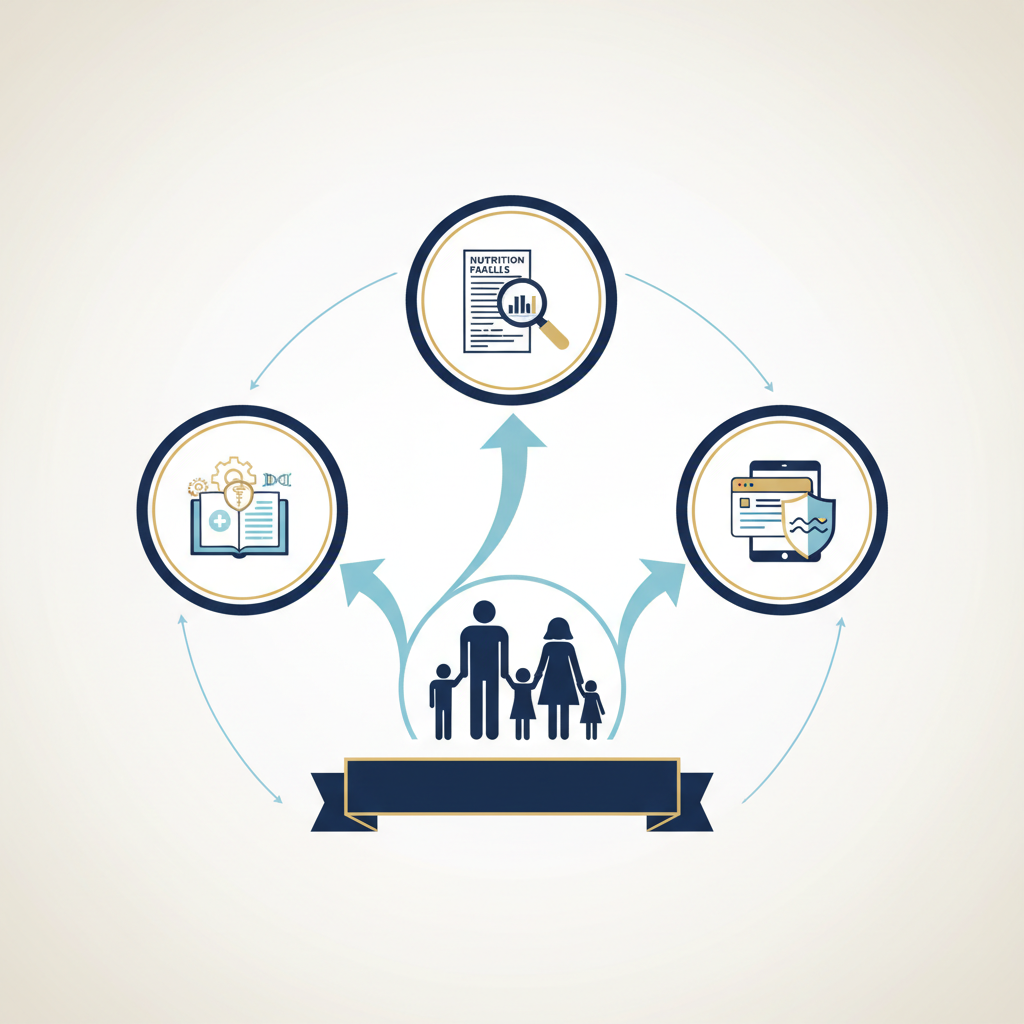
Explore health education step by step
Use the educational guides and practical tools to choose your next learning step.