Guide to Reading Food Labels in Saudi Arabia: Mindful Shopping Skills
Author: Feras Alayed
Published:
Updated:
Category: food-labels-saudi
Reading Time: 9 minutes
Introduction to Food Labeling Standards in Saudi Arabia and the SFDA Role
Reading food labels is an essential skill in the modern era, as processed products make up a significant portion of the daily shopping basket. In the Kingdom of Saudi Arabia, the Saudi Food and Drug Authority (SFDA) plays a pivotal role in regulating and ensuring the transparency of information provided to consumers. The primary goal of these standards is not just to place numbers on packages, but to empower citizens and residents to make informed decisions based on accurate knowledge of food contents. The SFDA operates according to unified Gulf technical regulations that ensure every food product, whether local or imported, carries a clear nutritional label containing all necessary details. These standards include the mandatory declaration of calories in restaurants and food establishments, reflecting the Kingdom's commitment to raising public health awareness. Understanding the role of the SFDA helps consumers trust that the data on the label are not mere marketing claims, but facts subject to regular monitoring and auditing. At ATHAR Center, we believe that knowledge is the first step toward improving quality of life, and this knowledge begins with understanding what the foods we consume daily contain. Saudi regulations include precise details on how ingredients are displayed, allergy warnings, and clarification of trans fat percentages, making the Saudi market one of the most regulated in this field. Compliance with these standards helps reduce the ambiguity consumers may face when comparing two different products, as the nutritional label provides a unified language for understanding and comparison.
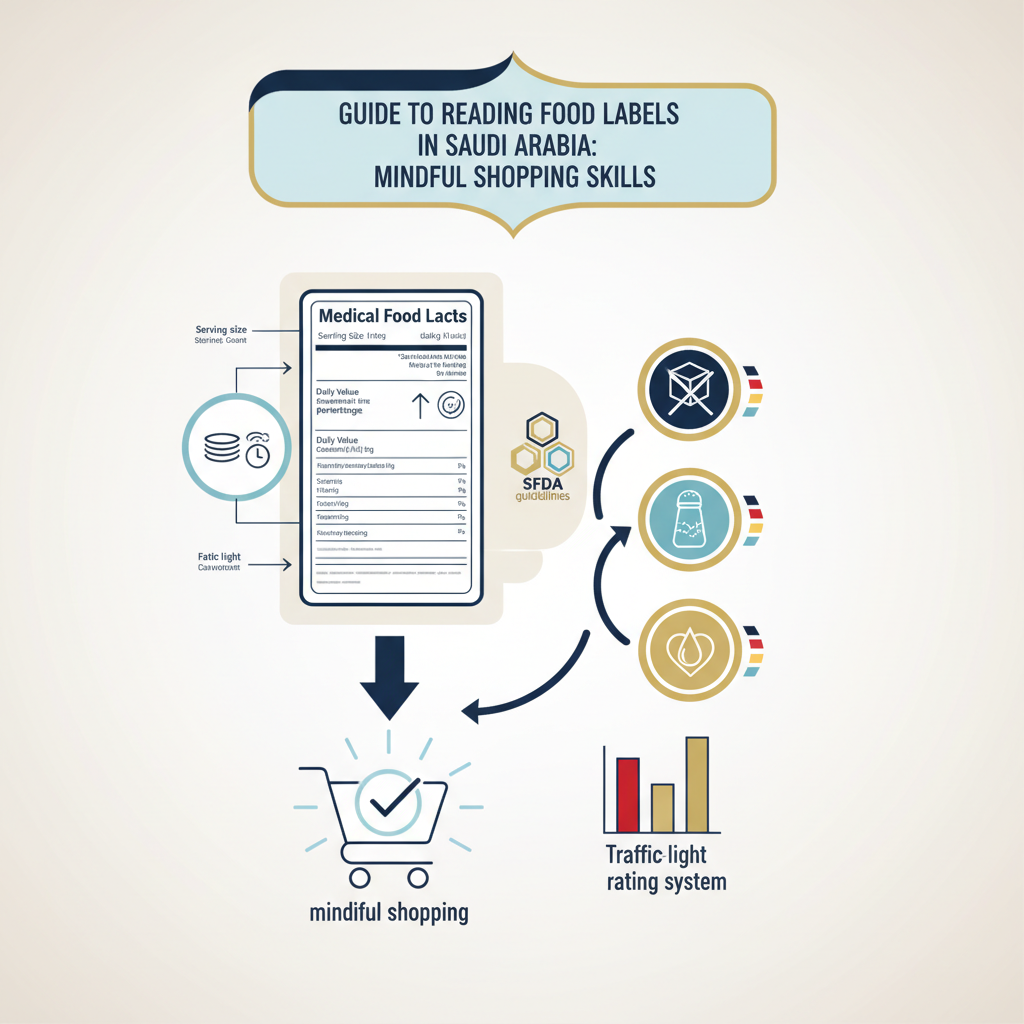
Understanding the Nutrition Facts Table: Key Terminology and Definitions
The Nutrition Facts Table is the heart of the food label, providing a quantitative breakdown of nutrients. The first thing to look at is the Serving Size, a term that is often misunderstood. The serving size is not necessarily the amount you should eat, but rather the standardized unit on which all the numbers in the table are based. If a package contains two servings and you eat the entire package, you have consumed double the numbers listed. Next come Calories, a measure of the energy the food provides. It is also important to understand the % Daily Value (% DV), a percentage that helps you know how much a single serving of food contributes to your total daily needs based on a general diet. Key elements to monitor include total fats, which are divided into saturated and trans fats. Cholesterol, sodium (salt), and total carbohydrates—which include dietary fiber, total sugars, and added sugars—are also listed. Protein is another essential element mentioned in grams. Understanding these terms enables consumers to distinguish between foods rich in beneficial elements and those that may contain high amounts of elements they prefer to reduce. It should be noted that some products may use different units of measurement, such as milliliters for liquids or grams for solids, requiring accuracy in calculation when wanting to know the total consumed.
Decoding the Ingredients List: Understanding Descending Order and Naming
The ingredients list is where the full truth of the product appears, away from abstract numbers. The golden rule in reading the ingredients list is that ingredients are listed in descending order by weight. This means the first ingredient on the list is the one that makes up the largest proportion of the product, while the last ingredient is the least present. If you find that sugar or hydrogenated oils are at the beginning of the list, this gives you a clear indication of the product's basic nature. Additionally, attention must be paid to ingredient naming; many substances may appear under scientific or technical names that may not be familiar to everyone. For example, salt may be referred to as "sodium chloride," and some types of fats may be referred to as "partially hydrogenated vegetable oils." The list also includes allergy alerts, which are vital information for individuals with reactions to certain ingredients such as gluten, soy, nuts, or milk. Reading the ingredients list requires patience and focus, as companies sometimes use multiple names for the same substance to separate them in the list and make them appear in later positions. For instance, instead of writing a large amount of sugar, it may be divided into cane sugar, maltodextrin, and corn syrup, making each appear in a smaller amount in the descending order, while the total sum remains high. Therefore, awareness of these tactics helps in forming a more comprehensive picture of food product quality.
Identifying Technical Terms for Common Components and Sweeteners
In the world of food manufacturing, a wide range of technical terms are used that may seem complex to the average consumer. Sweeteners, for example, are not limited to the word "sugar." There are dozens of names for added sugar, such as dextrose, fructose, sucrose, maltose, and brown rice syrup. There are also artificial or alternative sweeteners like aspartame, sucralose, and stevia, each with its own characteristics and uses. In addition to sweeteners, there are preservatives and enhancers sometimes referred to by E-numbers in some systems, or by their scientific names like sodium benzoate or monosodium glutamate (MSG). It is also important to recognize types of fats; the term "vegetable oils" can be vague, and it is better to look for the specific type of oil, such as palm oil or sunflower oil. Additives like emulsifiers (such as soy lecithin) and stabilizers (such as xanthan gum) are used to improve texture and extend product shelf life. Familiarity with these technical terms does not necessarily mean avoiding them, but rather understanding the role of each substance in the product. We encourage consumers to use available educational resources to learn these terms, reducing confusion when standing in front of store shelves. Distinguishing between natural ingredients and chemical additives helps in making decisions that align with personal health goals and makes the shopping process more efficient and conscious.
How to Use a Habit Journal to Track Label Observations and Daily Choices
Note-taking is a powerful tool for transforming theoretical knowledge into practical behavior. Using a "Habit Journal" helps consumers link what they read on labels to what they actually consume. One can start by dedicating a section in the journal to record products purchased regularly, noting the first three ingredients and the amount of sugar or sodium per serving. Over time, the consumer will begin to notice certain patterns; they may discover that most of their snacks contain high amounts of sodium without realizing it, or that added sugar is present in products they thought were "healthy." This tracking helps build a "nutritional memory" that makes future shopping faster, as the consumer becomes able to recognize good products at a glance. Additionally, the journal can be used to record the body's reactions to certain ingredients, helping to identify hidden sensitivities or intolerances to some additives. The goal of the journal is not the exact calculation of every calorie, but rather the cultivation of awareness and mindfulness toward food choices. When we write what we eat and analyze its labels, we move from automatic consumption to conscious consumption. This practice enhances a sense of responsibility toward personal health and makes the individual more capable of resisting marketing temptations that rely on attractive packaging rather than good nutritional content.
Preparing Specific Questions for Health Professionals Regarding Label Data
Consumers should not be alone in the journey of understanding food labels; health professionals such as dietitians and doctors are essential partners. To maximize the benefit of medical visits, specific questions regarding the data on labels should be prepared. Instead of the general question "What should I eat?", more precise questions can be asked, such as: "How can I read the fiber percentage in bread to choose the most suitable type for my condition?" or "What are the alternative names for sodium that I should avoid if I have high blood pressure?". The consumer can also bring photos of the food labels of products they consume regularly and discuss them with the specialist. Other useful questions might include: "What is the maximum daily limit of added sugars allowed for me based on my physical activity?" or "How do I differentiate between saturated and trans fats in the nutrition facts table?". These interactions turn the medical consultation into a practical educational session that empowers the individual to manage their own diet. Asking the specialist about "nutritional claims" such as "low fat" or "sugar-free" also helps in understanding the legal meaning of these terms and how they affect health. Preparing these questions reflects consumer awareness and a serious desire to improve choices, allowing the specialist to provide customized advice tailored to each person's unique needs.
Evaluating Information: Distinguishing Between Marketing Claims and Mandatory Facts
Food packaging is often covered with attractive phrases like "100% Natural," "Organic," "Light," or "Fortified with Vitamins." It is crucial to distinguish between these marketing claims and mandatory nutritional facts. Marketing claims are designed to grab attention and give a positive impression of the product, but they may not tell the whole story. For example, a product labeled "low fat" may contain double the amount of sugar to compensate for flavor, and a "no added sugar" product may be rich in artificial sweeteners or high-calorie natural sugars. The SFDA in Saudi Arabia sets strict controls for these claims, but it remains the consumer's role to check the facts table and ingredients list to verify the marketing impression. Mandatory facts are the numbers and ingredients required by law, and they are the reliable source of information. One must beware of the "Health Halo," where a consumer assumes a product is entirely healthy just because the word "organic" is on it. Conscious evaluation requires looking at the whole picture: Are the ingredients simple and known? Are the sugar and sodium percentages reasonable? Is the serving size realistic? By developing this critical eye, the consumer becomes immune to deception and can choose foods that support their true health goals. At ATHAR Center, we always encourage returning to basics and relying on numerical data and actual ingredients as the first and final reference when making a purchase decision.
Educational Checklist for Conscious Shopping
| Item | What to Check | Educational Notes |
|---|---|---|
| Serving Size | Compare serving size to the amount you will actually eat | If you eat double the serving, double all nutritional values |
| Ingredient Order | The first 3 ingredients in the list | They represent the bulk of the product's content |
| Added Sugars | Look for terms like (syrup, dextrose, maltose) | Different from natural sugars found in fruit or milk |
| Dietary Fiber | Prefer choosing products with high fiber | Helps with satiety and improving digestion |
| Trans Fats | Should be as close to zero as possible | Often found in partially hydrogenated oils |

Explore health education step by step
Use the educational guides and practical tools to choose your next learning step.