Health Literacy Guide for Eastern Province Readers: Information Skills
Author: Feras Alayed
Published:
Updated:
Category: eastern-province-health-literacy
Reading Time: 8 minutes
Health Literacy Guide for Eastern Province Readers: Information Evaluation Skills
Health literacy is the cornerstone of building a conscious society capable of effectively managing its quality of life. In the context of the health transformation currently underway in Saudi Arabia, particularly in the Eastern Province, it has become essential for individuals to possess the cognitive tools to understand complex health information and translate it into sound daily decisions. This guide aims to provide readers with fundamental skills to decode medical terminology, evaluate information sources, and enhance communication with healthcare providers.
1. The Concept of Health Literacy and Its Importance in Modern Saudi Society
Health literacy is not merely the ability to read and write in a medical context; it is the capacity to access, understand, appraise, and apply health information in ways that maintain and promote health. In our contemporary society, we face a massive influx of information via social media and digital platforms, making the distinction between fact and rumor a daily challenge. The importance of health literacy lies in its ability to empower individuals to move from being "passive recipients" of health services to becoming "active partners" in their preventive and therapeutic plans.
Health literacy encompasses several dimensions, including visual literacy (understanding graphs and tables), digital literacy (using health apps and credible websites), and numeracy (understanding dosages and percentages in lab results). For residents of the Eastern Province, where lifestyles vary between urban and industrial environments, health literacy contributes to understanding how environmental and nutritional factors impact public health. This supports the goals of Saudi Vision 2030 in improving quality of life and promoting healthy longevity.
2. Decoding Medical Terms: How to Understand Specialist Language
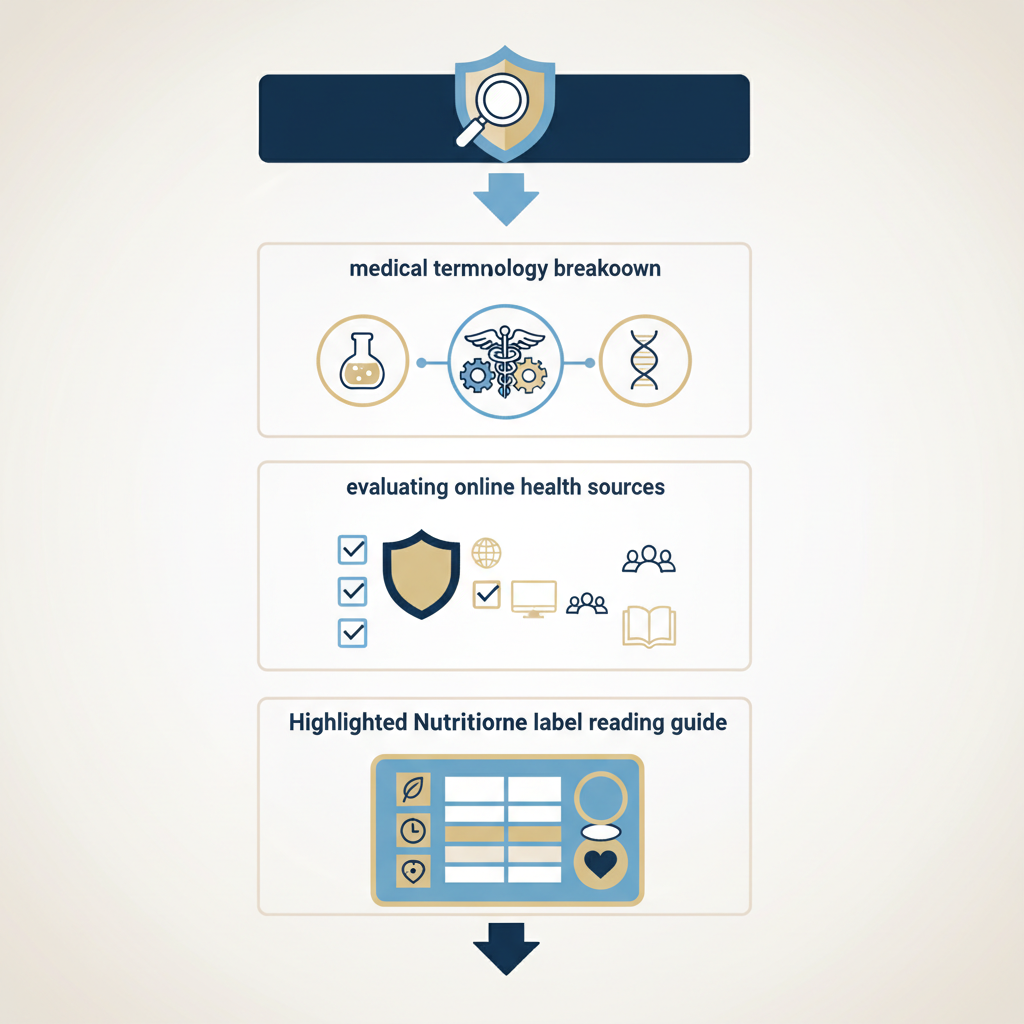
Medical language often sounds like a foreign tongue due to its Latin and Greek roots. However, most medical terms are built logically, much like "building blocks." A medical word typically consists of three parts: the Prefix, the Root, and the Suffix. Understanding these components gives you the ability to infer the meaning of a word without needing to memorize thousands of terms.
- Prefix: Usually indicates location, time, or number. Example: (Hyper) means excessive or high, while (Hypo) means deficient or low.
- Root: Refers to the organ or system involved. Example: (Cardio) for the heart, (Gastro) for the stomach, and (Nephro) for the kidneys.
- Suffix: Describes a condition or procedure. Example: (itis) means inflammation, and (ectomy) means surgical removal.
When you hear a term like "Gastritis," you can now break it down into (Gastro = stomach) and (itis = inflammation) to know it means inflammation of the stomach. It is always important to ask your doctor for "plain language" or simplification, such as asking: "What does this term mean in simple words?" or "How does this affect my daily body functions?". Never hesitate to ask for clarification; terminology exists for professional precision among specialists, but your right as an individual is full comprehension of your condition.
3. Label Reading Guide: Beyond the Written Data on Products
The Nutrition Facts label is the most powerful tool in a consumer's hand for making informed dietary choices. Proper reading always begins with the Serving Size, which is where many people make estimation errors. If a package contains two servings and you eat the whole thing, you must double all the figures listed (calories, fats, sugar).
The golden rule for evaluating nutrients is the 5/20 Rule regarding the Percent Daily Value (%DV):
- If the percentage is 5% or less, the product is "low" in that nutrient. (Preferable for saturated fats, sodium, and added sugars).
- If the percentage is 20% or more, the product is "high" in that nutrient. (Preferable for fiber, vitamins, and minerals).
In addition to the table, always look at the Ingredients List. Ingredients are listed in descending order by weight; meaning the first ingredient is the one present in the largest amount. If sugar or hydrogenated oils are at the top of the list, this is an indicator of the product's quality. Be aware of alternative names for sugar, such as (corn syrup, maltodextrin, sucrose), as they all contribute to the total sugar content without necessarily appearing as the word "sugar."
4. Habit Tracking Methodology: How to Create a Daily Health Diary
Health tracking is the process of converting subjective feelings into objective data that can be analyzed. Keeping a health diary helps you discover patterns that you might not notice in your daily memory. An effective tracking methodology includes four main pillars: Inputs, Outputs, Mood, and Physical Symptoms.
"What cannot be measured, cannot be managed." Health tracking is the bridge between how you feel and what the doctor sees in clinical tests.
Start by recording your wake-up time and sleep quality (was it continuous or interrupted?). Record meals not just by type, but also by timing and hunger levels before and after eating. It is crucial to link this data to symptoms; for example, do you feel lethargic after a specific meal? Do headaches increase on days when water intake is low? Use a scale of 1 to 10 to rate energy and stress levels daily. After two weeks of consistent tracking, a "health map" will emerge, highlighting the triggers and habits that support your vitality or those that cause fatigue, making your discussions with nutritionists or doctors much more precise and useful.
5. Preparing for a Medical Appointment: Essential Questions for the Provider
Medical appointment times are often limited, so advanced preparation is key to gaining the maximum benefit. Start by writing down your top three concerns or symptoms and place them at the beginning of your conversation. Use the "Ask Me 3" framework, a global model for promoting health understanding that involves asking three questions at every visit:
- What is my main problem? (Diagnosis)
- What do I need to do? (Action Plan)
- Why is it important for me to do this? (Goals and expected outcomes)
Additionally, if a new medication is prescribed, ask about common side effects and what to do if a dose is missed. If a lab test is requested, ask: "How will the result of this test change my treatment plan?". Remember to bring a list of all supplements and medications you are currently taking. Do not hesitate to request copies of your medical reports or lab results, and take notes during the session. Good preparation transforms the visit from a routine check-up into an educational session that empowers you to manage your health with confidence.
6. Criteria for Distinguishing Reliable Information from Online Rumors
In the digital information age, everyone has become a source of information, but not every piece of information is a scientific fact. To evaluate any health content you encounter online, use the simple CRAAP test:
- Currency: When was the information published? Science evolves rapidly, and info older than 5 years may be outdated.
- Relevance: Is the information intended for the general public or specific cases?
- Authority: Who is the author? Are they a specialized doctor or just an influencer? Does the site end in (.gov), (.edu), or (.org)?
- Accuracy: Is the information supported by scientific references? Does it align with other reliable sources?
- Purpose: Is the goal to educate or to sell a specific product? Beware of clickbait headlines promising "miracle" or instant results.
Avoid relying on individual personal experiences as a scientific rule; what suits one person may harm another. If you find information that worries you or seems strange, look for it on official websites like the Saudi Ministry of Health portal or international health organizations before sharing or applying it.
7. Effective Communication Tools to Enhance Mutual Understanding in Health Settings
Effective communication is a two-way process. One of the most powerful tools you can use as a healthcare consumer is the Teach-Back Method. Instead of nodding in agreement when a doctor asks, "Do you understand?", say: "I want to make sure I've understood the instructions correctly. Can I explain what I understood so you can correct me?". This method ensures there is no gap between what the doctor said and what you comprehended.
Furthermore, use Active Listening; focus on what is being said without interrupting, then summarize the key points at the end of the conversation. If there are language barriers or difficult technical terms, request the use of visual aids or written pamphlets. Good communication also involves complete honesty with the provider about your dietary habits or medication adherence; the doctor is not there to judge you but needs the truth to help you. By building a bridge of trust and clarity, the relationship with the medical team transforms into a partnership aimed at achieving the best possible health outcomes.
Health Literacy Checklist
| Skill | Have you done this? | Notes |
|---|---|---|
| Decoding Terms | Did you identify the prefix, root, and suffix? | Use a simplified medical dictionary when needed. |
| Reading Food Labels | Did you check the serving size and the 5/20 rule? | Compare two products before purchasing. |
| Appointment Prep | Did you write down the "Ask Me 3" questions? | Note the answers immediately. |
| Digital Source Evaluation | Did you verify the author's identity and publication date? | Avoid sites promoting unknown products. |
| Teach-Back Technique | Did you explain the treatment plan back to the doctor? | Ensure you understand exactly how to take medication. |

Explore health education step by step
Use the educational guides and practical tools to choose your next learning step.