Metabolic Health Terminology: A Guide for Arabic-Speaking Readers
Author: Feras Alayed
Published:
Updated:
Category: metabolic-terms-arabic
Reading Time: 10 minutes
Metabolic Health Terms Guide: Understanding Core Concepts for the Arabic Reader
1. Introduction to Health Literacy and Basic Metabolic Concepts
Health literacy is the cornerstone of building a conscious society capable of proactively managing its well-being. At ATHAR Center, we believe that empowerment begins with knowledge, especially regarding metabolic health. Metabolic health is not merely the absence of disease; it is a state of biochemical balance where the body efficiently processes energy from food. Understanding how our bodies convert fuel into energy and how that energy is stored is key to comprehending many contemporary health challenges. Health literacy means the ability to obtain, understand, and use health information to make informed decisions. For audiences in the Gulf region, where traditional habits intersect with modern lifestyles, it becomes essential to translate and understand scientific terms that may initially seem complex. Metabolic health encompasses five key markers: blood sugar levels, blood pressure, waist circumference, and levels of triglycerides and high-density lipoprotein (HDL) cholesterol. When these markers are within optimal ranges, an individual is considered metabolically healthy. However, the journey toward this balance starts with decoding the language used in clinics and scientific articles. The goal of this guide is to bridge the gap between dry medical terminology and simple everyday understanding, allowing individuals to shift from passive recipients of information to active participants in their health journey. Metabolic awareness goes beyond just counting calories; it is about understanding hormonal responses to food, the impact of sleep on fat burning, and how cells respond to insulin. By enhancing health literacy, we can reduce the anxiety associated with medical diagnoses and empower individuals to ask the right questions and seek science-based solutions.
2. Metabolic Glossary: Explaining Scientific Meanings in Arabic and English
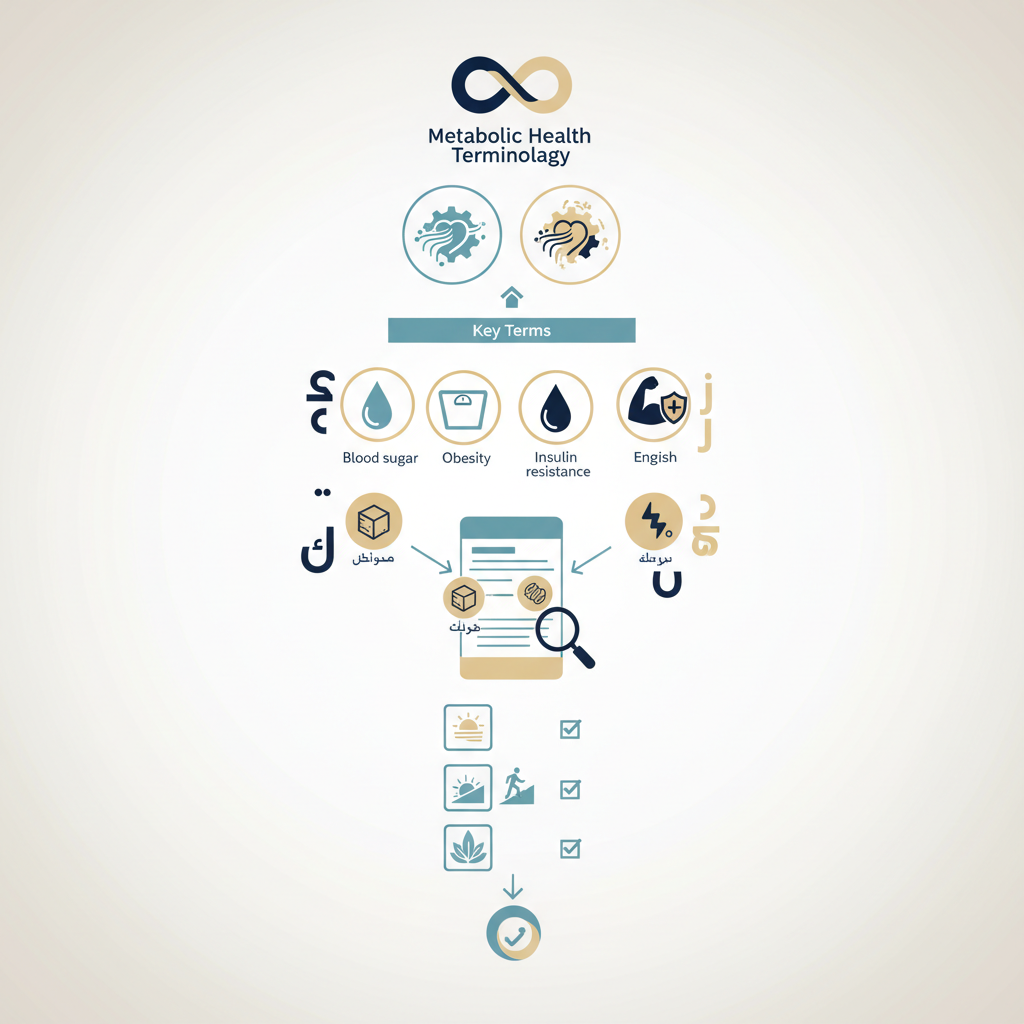
To understand metabolic health, one must first master its vocabulary. Here is a list of the most important terms that form the basis of metabolic understanding: Metabolism: The sum of chemical processes that occur within a living organism to maintain life, including converting food into energy and building tissues. Insulin Resistance: A condition in which the body's cells become less responsive to the hormone insulin, leading to difficulty absorbing glucose from the blood and its accumulation, which prompts the pancreas to secrete more insulin. Glucose: The simple sugar that is the primary source of energy for the body's cells, coming mainly from carbohydrates. Metabolic Flexibility: The body's ability to efficiently switch between using carbohydrates and using fats as an energy source based on availability and need. Triglycerides: A type of fat found in the blood; when we eat, the body converts excess calories it doesn't need right away into triglycerides stored in fat cells. HDL Cholesterol: Known as high-density lipoprotein, it acts as a scavenger for blood vessels by transporting excess cholesterol to the liver for disposal. LDL Cholesterol: Low-density lipoprotein, the buildup of which in the arteries can lead to health issues. Body Mass Index (BMI): A measure of body fat based on height and weight, though it does not distinguish between muscle and fat, so it is best used alongside waist circumference measurements. Metabolic Syndrome: A cluster of factors that increase the risk of chronic health problems, including high blood pressure, high blood sugar, and excess fat around the waist. Understanding these terms helps in reading laboratory reports with greater awareness and makes dialogue with specialists more productive.
3. Food Label Reading Skills: Understanding Ingredient and Additive Terms
The nutrition facts label is the most important tool in the hands of a conscious consumer. However, these labels are often designed in a way that can be misleading if we don't know what to look for. First, pay attention to Serving Size: Many products contain more than one serving per package, meaning the numbers listed for calories and sugars must be multiplied if the entire package is consumed. Second, Total Carbohydrates vs. Fiber: To understand the metabolic impact, subtract fiber from total carbohydrates to get "net carbs," which is what actually affects blood sugar. Third, Added Sugars: Look for aliases for sugar such as maltodextrin, high fructose corn syrup, sucrose, and dextrose. All these names mean sugars that can raise insulin levels quickly. Fourth, Trans Fats: Look for the words "partially hydrogenated oils" in the ingredient list, even if the package says "zero trans fats," as regulations allow this if the amount is below a certain percentage per serving. Fifth, Sodium: Excess salt can affect blood pressure, a key metabolic marker. Sixth, Ingredient Order: Ingredients are listed in descending order by weight; if sugar or hydrogenated oils are at the top of the list, it means they are the primary component. Learning to read beyond marketing headlines like "natural," "organic," or "low fat" is a vital skill. Often, fat reduction is compensated for by adding sugars to improve taste, making the product more metabolically harmful. Arming yourself with this skill transforms shopping from just buying food into a precise process of choosing the fuel that enters our bodies.
4. The Importance of Logging Daily Habits in a Personal Tracking Journal
What cannot be measured cannot be managed. Logging daily habits is a powerful tool for achieving self-awareness and understanding the correlations between behavior and health outcomes. A personal tracking journal is not just about logging food; it should include four main pillars: Nutrition: Not just what you eat, but when you eat. Logging meal timing helps in understanding emotional eating patterns and the impact of intermittent fasting or meal spacing on energy levels. Physical Activity: Recording the type, duration, and intensity of movement. Did you feel energized after walking or tired? Sleep: The number of hours and the quality of sleep. Insufficient sleep is a hidden enemy of metabolic health, raising cortisol levels and increasing insulin resistance the next day. Mood and Stress: Psychological stress leads to real metabolic responses, such as raising blood sugar. By logging these factors, an individual begins to notice certain patterns; for example, they might discover that eating a certain meal late leads to restless sleep and increased hunger levels the following morning. This type of personal "bio-feedback" is what transforms theoretical knowledge into practical practice. Using smartphone apps or even a simple notebook can provide valuable data for discussion with a healthcare provider. It is a process of turning subjective experience into objective data, reducing reliance on memory, which can be selective or inaccurate. Regular logging also enhances commitment, as the log acts as a mirror reflecting progress and identifying areas needing improvement, making the health journey a continuous process of learning and adaptation.
5. How to Prepare an Effective List of Questions for Your Healthcare Provider
Patients often feel confused or rushed during a doctor's visit, leading them to leave without a full understanding of their metabolic state. Advance preparation is the key to turning the visit into a collaborative dialogue. Start by formulating specific questions about your vital markers. Instead of the general question "Am I okay?", try asking questions like: "What does my fasting blood sugar result mean for my risk of insulin resistance?" or "How do you evaluate the ratio between triglycerides and HDL cholesterol in my recent analysis?". Ask about the impact of lifestyle: "Are there specific modifications in food quality or meal timing you recommend based on my results?". It is also important to ask about long-term goals: "What target values should we strive to reach by the next visit?". Do not hesitate to ask for an explanation of terms you do not understand; as a healthcare recipient, you have the right to understand the language of your body. If the doctor suggests a specific intervention, ask about available alternatives and how lifestyle can support this intervention. Suggested Checklist for the Next Visit:
- What is my fasting insulin level (if measured)?
- How does my current blood pressure affect my overall metabolic health?
- Does my waist circumference indicate concerning visceral fat?
- What are the practical steps to improve my metabolic flexibility?
6. Criteria for Evaluating the Quality of Online Health Information
In the age of information explosion, it has become easy to access health advice but difficult to ensure its accuracy. To evaluate the quality of online metabolic health information, strict criteria must be followed. First, Source: Is the information from academic institutions, accredited research centers, or licensed specialists? Check the "About Us" section to verify the identity of the publishers. Second, Currency: Metabolic science is evolving rapidly; check the date of publication or update. Information more than five years old may be outdated in light of new discoveries about insulin and the microbiome. Third, Objectivity: Is the article trying to sell a specific product or promote a "magic bullet" quick fix? Reliable health information is realistic, mentions potential benefits and risks, and does not promise illogical immediate results. Fourth, Evidence-Based: Are there references to peer-reviewed clinical studies? Articles that use phrases like "studies have shown" without citing their source should be treated with caution. Fifth, Balance: Avoid sites that take extreme positions or exclude other scientific opinions without justification. Sixth, Language: Reliable information uses precise but understandable scientific language and stays away from exaggeration or using emotions to influence the reader. Remember that "personal experiences" or individual success stories on social media are not considered scientific evidence, as what works for one person may not suit another due to genetic and environmental differences. Developing a critical sense toward what we read protects us from falling into the trap of misleading information that may harm our metabolic health instead of improving it.
7. Practical Steps to Enhance Metabolic Health Awareness in the Gulf Environment
The Gulf region has a cultural and environmental specificity that requires innovative solutions to enhance metabolic health. The first step is Adapting Traditional Dietary Habits: Improving health does not mean giving up traditional dishes, but rather modifying preparation methods, such as reducing refined oils and replacing them with healthy fats, and increasing the amount of vegetables and fiber in main meals. Second, Dealing with Climatic Challenges: Given the high temperatures, alternatives for movement must be sought, such as walking in indoor spaces (malls) or practicing home exercises, while ensuring adequate water intake to boost metabolic processes. Third, Social Awareness in Majlises and Banquets: A culture of "conscious choice" can be promoted instead of total abstinence, by starting with salads and protein before carbohydrates to reduce sudden spikes in blood sugar. Fourth, Using Technology: Taking advantage of apps and wearable devices that track activity and sleep, which have become widely available in the region. Fifth, Family Education: Metabolic health starts at home; involving children and youth in understanding food labels and choosing healthy alternatives creates a conscious generation. Sixth, Community Engagement: Joining support groups or local health initiatives that encourage an active lifestyle. Seventh, Periodic Checkups: Utilizing the advanced health infrastructure in Gulf countries to conduct periodic checks of the five metabolic markers. Integrating these steps into the fabric of daily Gulf life makes metabolic health a sustainable lifestyle rather than just a temporary system. Awareness is the first step, and consistent action is what makes a long-term difference in quality of life.
Educational Note: This guide is for educational purposes only. Always consult a qualified healthcare provider before making significant changes to your diet or lifestyle, especially if you have existing health conditions.
| Term in Arabic | Term in English | Simplified Educational Description |
|---|---|---|
| سكر الدم الصائم | Fasting Blood Glucose | Blood sugar level after abstaining from food for at least 8 hours. |
| محيط الخصر | Waist Circumference | A measurement that determines the amount of fat accumulated around the abdominal area (visceral fat). |
| الدهون الثلاثية | Triglycerides | A type of fat the body stores to use as energy later. |
| ضغط الدم | Blood Pressure | The force of blood pushing against artery walls as the heart pumps. |
| الألياف الغذائية | Dietary Fiber | Part of plants the body does not digest, helping to regulate sugar absorption. |

Explore health education step by step
Use the educational guides and practical tools to choose your next learning step.