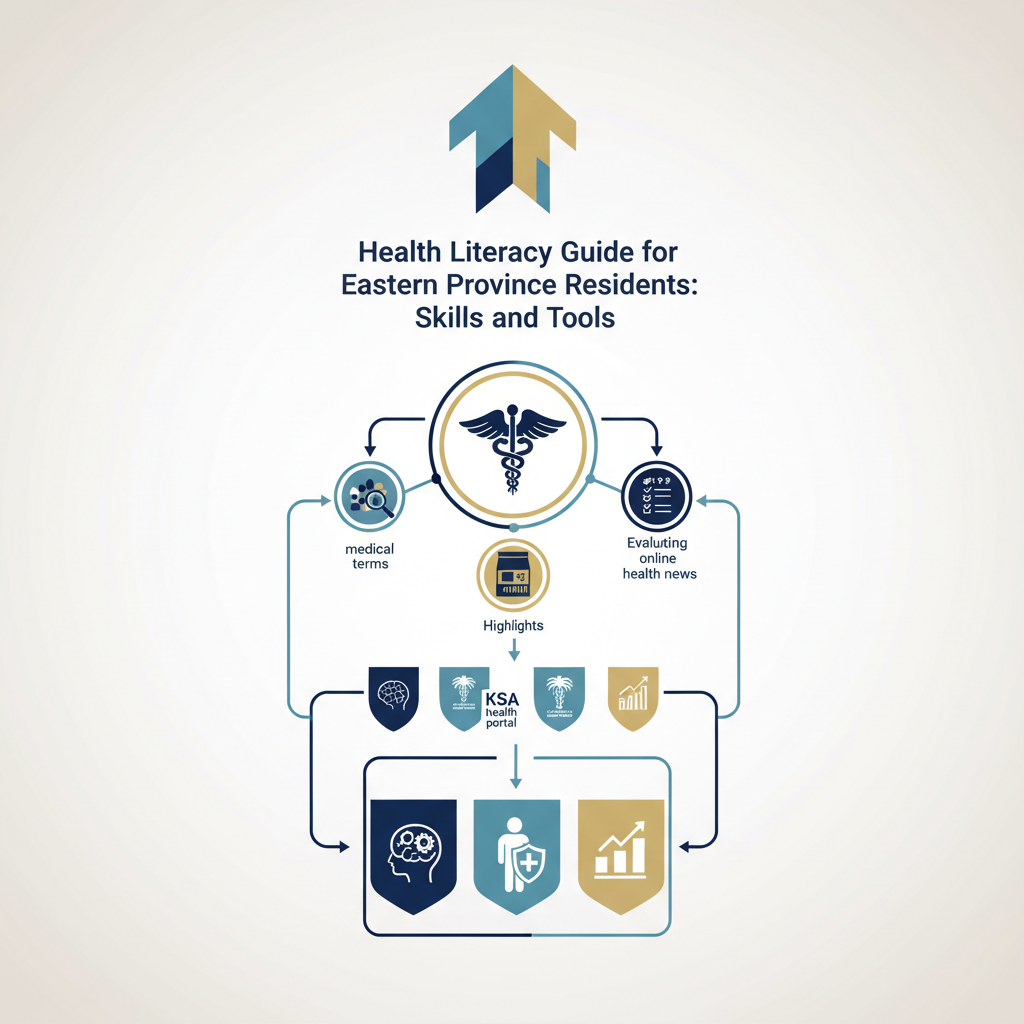
Health Literacy Guide for Eastern Province Residents: Skills and Tools
Author: Feras Alayed
Published:
Updated:
Category: eastern-province-health-literacy
Reading Time: 8 minutes
Health Literacy Guide for Eastern Province Residents: Skills and Tools
1. Introduction: The Concept of Health Literacy and Its Importance in Modern Saudi Society
Health literacy is the cornerstone of building a vibrant and prosperous society. It goes beyond basic reading and writing to encompass the ability to seek, understand, evaluate, and apply health information in daily life. In the context of the national transformation witnessed by the Kingdom of Saudi Arabia, particularly in the Eastern Province—characterized by its demographic diversity and rapid growth—there is an urgent need to empower individuals with health knowledge tools. Health literacy does not merely mean knowing the names of diseases or medications; it is a vital skill that enables individuals to make informed decisions about their lifestyle, understand health risks before they occur, and actively participate in treatment plans. When residents of the Eastern Province possess high levels of health awareness, they become more capable of distinguishing between reliable scientific information and rumors that may spread on social media. The goal of this guide is to transform the individual from a passive recipient of healthcare services into an active partner in their therapeutic and preventive journey. Health awareness reduces the gap between the patient and the provider, contributing to an overall improvement in quality of life through the adoption of preventive behaviors based on solid scientific foundations. We live in an era where information flows abundantly, making the skill of filtering and critically analyzing health information an indispensable necessity for every citizen and resident in our dear region.
2. Understanding Medical Language: A Simplified Guide to Common Terms in Local Clinics
Patients in health centers across the Eastern Province often feel a sense of confusion when hearing medical jargon used by physicians. Understanding these terms is the first step toward effective communication. For instance, when a doctor describes a condition as Acute, they mean it started suddenly and is short-term, whereas the term Chronic indicates that the condition is long-lasting and requires sustained management. Another common term is Metabolism, which refers to the chemical processes occurring within the body to convert food into energy. The term Resistance is also frequently mentioned, whether it relates to insulin resistance or antibiotic resistance, meaning the body's cells or bacteria are not responding normally to the influencing factor. Here is a simplified table of some common terms:
| Medical Term | Simplified Meaning |
|---|---|
| Inflammation | The body's natural reaction to injury or infection |
| Systemic | Affecting the entire body rather than a single organ |
| Benign | Non-cancerous and does not spread to other parts |
| Genetic | Related to genes and passed from parents to children |
| Acquired | A condition developed during a person's life, not present at birth |
Recognizing these differences helps the patient accurately understand their health status and reduces anxiety resulting from misunderstandings. We always recommend asking the doctor for clarification when hearing any unfamiliar term; it is the patient's right to receive an explanation in simple, understandable language.
3. Label Reading Skills: How to Analyze Nutritional Data in Eastern Province Markets
The markets of the Eastern Province are rich with diverse food products, placing the consumer before the challenge of choosing what is best for their health. The skill of reading a nutritional label is the most important tool for controlling what enters our bodies. Always start with the Serving Size; all data on the label is based on this size, and if you consume double the serving, you are consuming double the calories, fats, and sugar. Second, pay attention to Dietary Fiber; it is preferable to choose products high in fiber to support digestive health. Third, Added Sugars; these differ from natural sugars found in fruits and should be limited as much as possible. Fourth, Trans Fats; which are recommended to be zero in any healthy product. Educational Tip: Do not be misled by phrases like natural or organic on the front of the product; instead, turn the package over and read the Nutrition Facts table and the ingredients list. Ingredients are listed in descending order by weight, so if sugar or oil is at the top of the list, it means it is the primary component. Learning this skill transforms shopping from a random purchase into a calculated health decision that contributes to preventing many health challenges associated with unbalanced nutrition.
4. Developing Self-Awareness: Using Habit Trackers to Monitor Lifestyle Patterns
Self-awareness is the ability to monitor our daily behaviors and understand their impact on our health. One of the most effective tools in this regard is the Habit Tracker. The aim of tracking is not to obsess over numbers but to discover patterns. For example, a person might notice through logging their sleep hours that they feel less fatigued on days when they engage in light physical activity. Habit tracking includes: physical activity levels, water intake, sleep quality, and mood.
What gets measured, gets managed and improved.Starting with a simple journal can reveal much about the causes of lethargy or stress. In the Eastern Province, with changing weather between seasons, habit tracking can help adjust lifestyle patterns to suit external conditions. One can use smartphone applications or simply a paper notebook. The goal is to build a clear picture of the daily routine, making it easier for the healthcare provider to understand the context of the patient's life when discussing any health symptoms. This self-awareness enhances the individual's ability to make gradual, sustainable changes rather than random attempts that may not lead to long-term results.
5. Preparing for Medical Appointments: How to Formulate Effective Questions for Healthcare Providers
Medical appointment times are often limited, so prior preparation ensures the patient gains the maximum benefit. Health literacy here begins with writing a list of symptoms and their onset dates, along with any medications or supplements currently being taken. It is important to formulate specific and clear questions. Here is a checklist of questions to ask:
- What is the potential diagnosis for my condition and what are the causes?
- Are there different treatment options, and what are the pros and cons of each?
- What lifestyle changes (nutrition, activity, sleep) might support the treatment plan?
- What are the potential side effects of the prescribed medications and how should I handle them?
- When should I expect improvement, and what signs require contacting the clinic immediately?
Writing these questions in advance prevents forgetting and makes the dialogue with the doctor more focused. It is also preferable to take notes during the appointment or request a written summary of the treatment plan. Remember that the doctor is your partner, and the more clear and organized you are in presenting your information and asking your questions, the better the doctor can provide accurate care tailored to your specific needs.
6. Navigating the Digital Space: Criteria for Evaluating Online Health Information Sources
In the digital information age, the internet has become the primary source for seeking health information for Eastern Province residents. However, not all published information is correct or based on scientific evidence. To evaluate any health source online, strict criteria must be applied: Authority: Does the site belong to a government entity (like the Ministry of Health), a recognized international organization, or a reputable university? Currency: When was the information published? Medical science evolves rapidly, and old information can be misleading. Objectivity: Is the site trying to sell a specific product or providing neutral educational information? Evidence: Are there references to documented scientific studies? Extreme caution should be exercised regarding personal stories or individual experiences generalized as medical facts. Warning: Social media is not a place for diagnosis or treatment. The role of digital information is general education and preparing the individual for discussion with their doctor, not replacing specialized medical consultation. Digital health literacy means being critical of everything you read and not following any medical advice online without verifying its reliability from official and accredited sources in the Kingdom.
7. Building Communication Bridges: Enhancing Patient-Doctor Dialogue in Regional Care Centers
Effective communication is the essence of successful healthcare. In the Eastern Province, we enjoy a culture of mutual appreciation and respect, and these values should be invested in enhancing dialogue within the clinic. Communication is not limited to words; it includes body language and honesty in presenting information. The patient should feel comfortable sharing their concerns even if they seem minor, and the doctor should listen attentively. To build this bridge, a Shared Decision Making approach should be followed, where the doctor presents scientific options and the patient shares their personal preferences and values. Honesty regarding dietary habits or non-adherence to medication schedules is crucial; the doctor does not judge the patient but tries to help them, and inaccurate information can lead to ineffective treatment plans. Furthermore, understanding the patient's cultural and social background helps the doctor provide realistic and applicable advice. Enhancing health literacy in this aspect means recognizing that the relationship between the patient and the doctor is a strategic partnership aimed at achieving the best possible health outcomes—a continuous journey of mutual learning and trust built over time through transparent and ongoing communication.

Explore health education step by step
Use the educational guides and practical tools to choose your next learning step.