The Ultimate Hawker Meal Comparison Singapore: A Practical Checklist for Healthier Choices
Author: Feras Alayed
Published:
Category: nutrition
Reading Time: 8 minutes
The Hawker Dilemma: Why Balancing Local Flavors and Health Feels Like a Tug-of-War
In Singapore, the hawker centre is the heartbeat of our community. From the aromatic steam of a fresh bowl of Laksa to the comforting fragrance of Hainanese Chicken Rice, these spaces are more than just food courts; they are cultural landmarks. However, for many Singaporeans trying to manage their weight, energy levels, or metabolic health, the hawker centre can feel like a nutritional minefield. You want to enjoy the food you love with your colleagues and family, but you also want to avoid the post-lunch lethargy and long-term health risks associated with high-sodium, high-refined-carb meals.
Many people attempt to solve this by going on restrictive diets, cutting out all rice or noodles entirely. While this might work for a few days, it is rarely sustainable in a society where food is a primary social glue. The frustration often leads to a cycle of restriction followed by overindulgence. The goal isn't to stop eating hawker food; it's to develop the health literacy needed to make informed choices. By using a structured hawker meal comparison Singapore checklist, you can navigate these menus with clarity rather than confusion.
Q&A: Decoding the Hawker Menu
Q: Why is it so difficult to find 'healthy' options at a hawker centre?
The challenge isn't necessarily a lack of healthy ingredients, but rather the proportions and preparation methods. Traditional hawker dishes were often designed to provide high energy for manual laborers. Today, most of us have more sedentary lifestyles, yet the portions of refined carbohydrates (white rice and noodles) remain large. Additionally, many sauces are high in hidden sugars and sodium, and cooking oils are often reused or high in saturated fats.
To navigate this, you need to look at the 'nutrient density' of a meal. A hawker meal comparison Singapore approach involves looking past the calories and evaluating the balance of protein, fiber, and healthy fats. For example, a bowl of Fish Soup might seem healthy, but if the fish is fried and the soup is enriched with evaporated milk, the nutritional profile changes significantly compared to a clear sliced fish soup.
Q: How do common hawker staples compare when looking at blood sugar impact?
In Singapore, monitoring blood sugar is a priority for many, with a focus on maintaining levels within a healthy range (typically between 4.0 and 7.8 mmol/L for most healthy individuals post-meal, though you should verify your specific targets with a doctor). High-glycemic meals like Char Kway Teow or Mee Siam can cause rapid spikes in blood glucose.
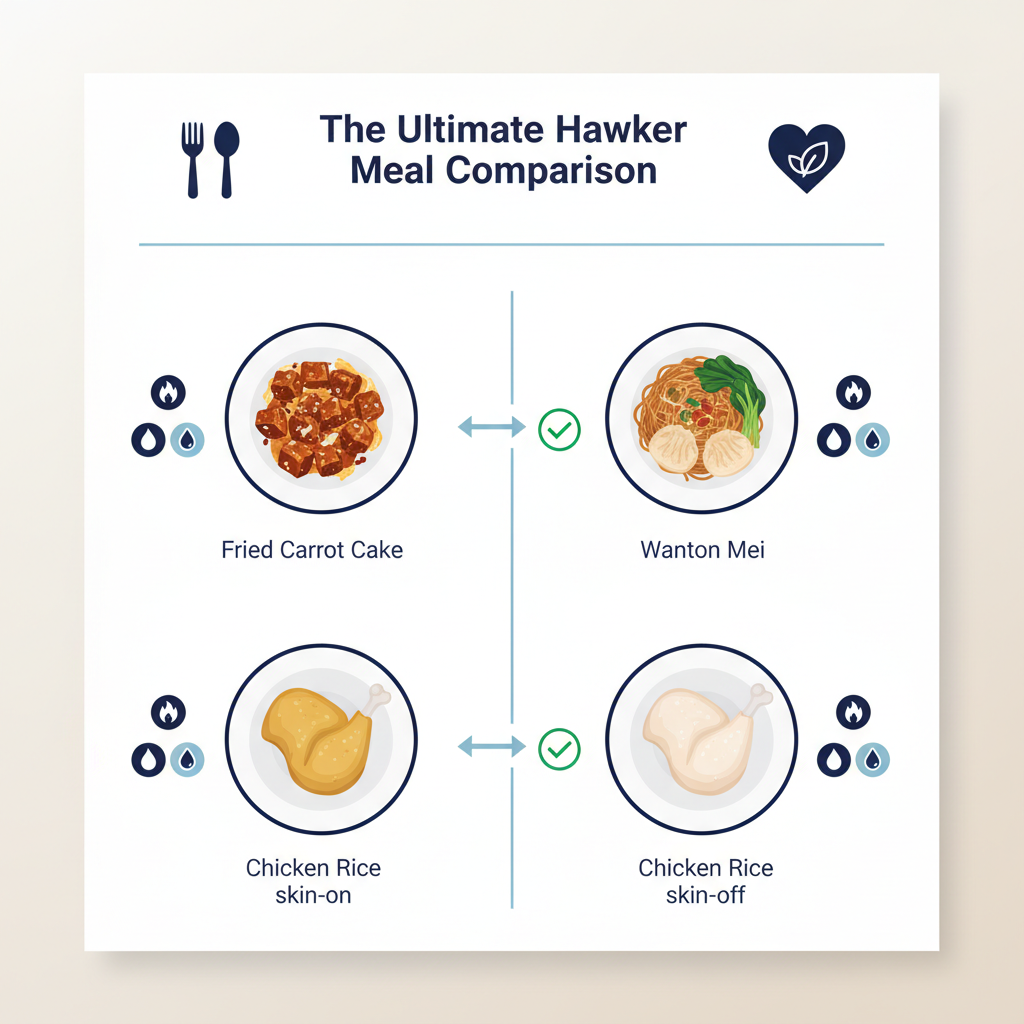
When performing a hawker meal comparison Singapore, consider these common matchups:
- Chicken Rice vs. Duck Rice: While both feature rice cooked in broth, duck rice often comes with a thicker, starch-based gravy that adds extra sugar. Choosing steamed chicken over roasted chicken and asking for less rice can significantly lower the glycemic load.
- Laksa vs. Mee Rebus: Laksa is rich in saturated fat from coconut milk, while Mee Rebus has a thick, sweet gravy made from sweet potatoes and flour. Both are high in refined carbs. A better alternative in the noodle category might be Bak Chor Mee (minced meat noodles) with extra bean sprouts and vinegar, which provides more protein and less sugar in the base sauce.
- Economic Rice (Cai Fan): This is often the best arena for a healthy meal, provided you choose two portions of green vegetables and one portion of lean protein (like steamed egg or stir-fried chicken) while limiting the rice to a small portion.
The Hawker Meal Comparison Checklist
To make better choices on the go, use this simple checklist before you place your order. This tool helps you move away from 'good vs. bad' thinking and toward 'better vs. best' choices.
| Checklist Item | The 'Better' Choice | Why It Matters |
|---|---|---|
| The Base | Brown rice or half-portion white rice/noodles. | Reduces the glycemic load and supports steadier energy. |
| The Protein | Steamed, boiled, or grilled (e.g., sliced fish, steamed chicken). | Avoids excess saturated fats and oxidized oils from deep-frying. |
| The Veggies | At least two servings of non-starchy greens. | Fiber slows down the absorption of sugar into the bloodstream. |
| The Sauce | Asked for 'separately' or 'less sauce/gravy'. | Reduces hidden sugars, sodium, and thickeners. |
| The Drink | Kopi-O Kosong, Teh-O Kosong, or plain water. | Eliminates liquid calories and sugar spikes. |
Q&A: Practical Tips for Social Dining
Q: I often eat out with colleagues. How can I stay healthy without being 'that person' who is too picky?
Social pressure is a real factor in Singapore's food culture. You don't have to order a salad while everyone else eats Hokkien Mee. Instead, focus on 'crowding out' the less nutritious elements. Order your favorite dish but add a side of blanched vegetables from the economic rice stall. If you are sharing dishes (Zi Char style), be the one to suggest a steamed fish and a tofu dish alongside the heavier meat options.
Improving your health literacy allows you to make these adjustments subtly. Understanding how to read the 'environment' of a hawker centre is just as important as reading a food label. For more on building these skills, see our guide on essential health literacy skills.
Q: What should I look for in terms of government health indicators?
The Singapore Health Promotion Board (HPB) has made it easier with the 'Healthier Choice' symbol. Many hawker stalls now display this symbol if they offer options with lower sodium, healthier oils, or whole grains. Additionally, the Singapore Food Agency (SFA) ensures food safety standards. While these symbols are helpful guides, they don't replace the need for personal portion control and balance. Always look for stalls that allow for customization, such as 'no lard' or 'extra veg.'
Building a Sustainable Routine: The Role of Structured Support
By starting your day with a focus on metabolic flexibility and using fiber to manage the glucose response of your lunch, you create a buffer. This reduces the 'all or nothing' mentality that often leads to giving up on health goals. Consistency in these small habits—like tracking your energy levels or keeping a sleep journal to see how late-night hawker runs affect your rest—is the key to long-term success.

Summary Checklist for Your Next Hawker Visit
- Scan the Stalls: Look for the 'Healthier Choice' logo or stalls offering steamed options.
- Prioritize Fiber: Can you add a side of broccoli or bok choy?
- Mind the Liquid: Is the soup base creamy or clear? Is the drink sugar-free?
- Portion the Carbs: Do you really need the full mound of rice, or will half suffice?
- Listen to Hunger: Stop when you are satisfied, not when the plate is empty.
Navigating the hawker centre doesn't have to be a source of stress. With the right hawker meal comparison Singapore tools and a supportive framework, you can enjoy the best of Singapore’s culinary heritage while staying on track with your wellness journey.
Medical Disclaimer
Frequently Asked Questions
What is the scope of this guide?
This guide is educational and helps readers organize questions and observations for further learning.
How should I use the information?
Use it to review terminology, note personal questions, and identify sources that require verification.
When should I seek professional guidance?
Discuss personal symptoms, medicines, diagnoses, or treatment decisions with a licensed professional.
Further Education
- Explore the metabolic health education hub
- Learn how to read research summaries
- Use the educational health assessment
Explore health education with care
Use ATHAR’s educational guides and practical tools to choose your next learning step.