Health Literacy Guide for Al-Ahsa: Enhancing Knowledge and Skills
Author: Feras Alayed
Published:
Updated:
Category: al-ahsa-health-literacy
Reading Time: 12 minutes
Introduction to Health Literacy and Its Importance in Al-Ahsa
Health literacy is the cornerstone of building a conscious society capable of facing contemporary health challenges. In the Al-Ahsa oasis, characterized by a closely-knit social fabric and a rich cultural history, the concept of health literacy goes beyond mere reading and writing. It encompasses the ability to obtain, process, understand, and apply health information to make informed decisions regarding healthcare. An individual with a high level of health literacy is better equipped to manage their health conditions, communicate effectively with care providers, and understand medication instructions, thereby reducing the likelihood of medical errors or misinterpreted preventive advice.
The importance of fostering this awareness in our local community lies in transforming knowledge from theoretical information into daily practices. Health literacy enables the residents of Al-Ahsa to distinguish between traditional practices that may be beneficial and those that lack a scientific basis. Furthermore, it contributes to reducing the burden on the healthcare system by promoting primary prevention. When an individual understands the factors affecting their health, they become an active partner in the therapeutic process rather than a passive recipient of service. This cognitive shift requires continuous effort in learning and consulting reliable sources, understanding that health is a complex interaction of personal behaviors, environment, and genetics.
Dimensions of Health Literacy in the Social Fabric
Health literacy consists of several dimensions, including functional literacy (basic reading and writing skills in a health context), interactive literacy (the ability to extract information from various communication channels), and critical literacy (the ability to analyze information deeply). In Al-Ahsa, family councils and social gatherings play a significant role in circulating health information. This highlights the importance of critical health literacy to ensure that misinformation does not spread. The goal is to build a society that possesses "cognitive immunity," where every piece of information is scrutinized before being adopted or shared, creating a safe health environment for all.
Decoding Common Medical Terms in Local Facilities
When visiting health centers or hospitals in the Eastern Province, patients may encounter medical terms that seem complex or unfamiliar. Understanding these terms is the first step toward health empowerment. For instance, the term "Metabolism" refers to the chemical processes occurring within the body to convert food into energy. Understanding this helps individuals grasp how their dietary choices and physical activity affect their vital functions. Similarly, "Body Mass Index" (BMI) is an evaluative tool used to estimate weight-to-height proportionality; it is not a definitive measure of health but a preliminary indicator that requires discussion with a specialist.
Common terms also include the "Lipid Profile," a test that measures levels of cholesterol and triglycerides in the blood. It is essential for an individual to recognize the difference between High-Density Lipoprotein (often described as good cholesterol) and Low-Density Lipoprotein. Additionally, "Hemoglobin A1c" (HbA1c) is a test that provides a picture of average blood sugar levels over the past three months, differing significantly from a daily random sugar test. Familiarity with these nuances reduces anxiety stemming from misunderstanding and prepares the patient for a productive dialogue with the doctor regarding their test results.
Educational Glossary of Terms
| Term | Simplified Meaning | Educational Importance |
|---|---|---|
| Chronic | A condition that lasts for a long time and requires ongoing management | Helps in understanding the nature of long-term follow-up |
| Acute | A condition that appears suddenly and lasts for a short time | Distinguishing between emergency and incidental cases |
| Preventive | Measures taken to prevent disease before it occurs | Focusing on periodic check-ups and vaccinations |
| Physiological | Relating to the normal functions of body organs and systems | Understanding how the body works in its natural state |
Furthermore, it is important to understand the difference between a "symptom" and a "sign." A symptom is what the patient feels (such as pain or a headache), while a sign is what the doctor observes or measures (such as high blood pressure or a rash). Documenting these details accurately contributes to a more precise and rapid diagnosis.
A Practical Guide to Reading and Understanding Food Labels
The nutrition facts label found on products in Al-Ahsa markets is a vital tool for making healthy dietary decisions, but it can be confusing if we don't know where to look. The first thing to notice is the "Serving Size." Often, a single package contains more than one serving, and all the nutritional values listed in the table pertain to only one serving, not the entire package. If you consume the whole package, you must multiply the nutritional values by the number of servings present. This point is the most common misunderstanding in nutritional data, as some believe the calories mentioned are for the entire container.
The second point is the "% Daily Value" (% DV). This percentage tells you how much a serving of this food contributes to your total daily requirement of a specific nutrient. As a general educational rule, if the percentage is 5% or less, it is considered low, and if it is 20% or more, it is considered high. One should strive to choose foods high in fiber, vitamins, and minerals, and low in saturated fats, added sugars, and sodium. Reading the ingredient list is equally important; ingredients are listed in descending order by weight, meaning the first ingredient is what the product contains the most of.
Food Label Checklist
- Check Serving Size: Will you consume one serving or more?
- Monitor Added Sugars: Look for other names for sugar like corn syrup, maltose, or sucrose.
- Watch Sodium: Especially in canned and ready-to-eat foods; choose low-sodium products.
- Dietary Fiber: Look for products that provide a good amount of fiber to support digestive health.
- Trans Fats: Ideally, this value should be zero to maintain heart health.
By practicing this skill regularly, shopping becomes a conscious process aimed at supporting the overall health of the family. It is also advised to stay away from flashy marketing claims on the front of the package, such as "natural" or "light," and rely solely on the nutrition facts table and the ingredient list on the back, as they are the only source of accurate and scientifically documented information.
The Importance of Health Journaling for Tracking Daily Habits
Health journaling is an educational practice aimed at increasing self-awareness of behavioral and physical patterns. In a fast-paced lifestyle, we might forget when a certain feeling started or what circumstances led to an improvement or decline in our energy levels. Journaling acts as a mirror reflecting our health reality away from random estimates. Journaling is not limited to recording meals; it extends to include sleep hours, physical activity levels, mood, and water intake. This data, when collected over a week or a month, reveals patterns that might not be apparent in a single day.
When an individual possesses a documented record, they become more capable of providing accurate information to the doctor. Instead of saying "I feel tired sometimes," they can say "I noticed a drop in my energy on specific days after eating certain meals or after a night where I only slept 5 hours." This type of precision helps specialists provide more personalized and effective advice. Health journaling also reinforces the principle of personal responsibility toward health; when we see our behaviors written before us, it becomes easier to identify areas that need improvement and set realistic, measurable goals.
How to Start Effective Health Journaling
"What gets measured, gets managed and improved." - A fundamental rule in personal health management.
To start, you don't need complex tools; a simple notebook or a smartphone app will suffice. Dedicate a few minutes at the end of each day to record basic observations. Focus on quality rather than quantity; record what you find truly impactful on your day. Over time, you will notice interesting correlations, such as the effect of morning physical activity on your sleep quality at night, or the effect of drinking enough water on your mental focus. This awareness is the first step toward sustainable habit change based on real observations specific to your own body.
Effective Communication Skills: Preparing a List of Questions for Specialists
Effective communication with the medical team is an essential skill that ensures you receive the best possible care. Patients often feel confused or rushed during a medical appointment, leading to forgetting essential questions. The solution lies in prior preparation. Before the appointment, write a list of questions that concern you and arrange them by importance. Start with the most urgent questions to ensure they are covered if time is limited. Being a conscious patient means you participate in health decision-making, which requires clarity in posing inquiries and a deep understanding of the answers provided.
Use the "Ask Me 3" technique, a global educational strategy that encourages patients to ask three main questions at every medical visit: 1. What is my main problem? 2. What do I need to do? 3. Why is it important for me to do this? These simple questions ensure your understanding of the diagnosis, the plan of action, and the reasoning behind the medical recommendations. Do not hesitate to ask for clarification of any medical term you did not understand, or request that instructions be written down instead of relying on memory alone. Remember that the doctor is there to help you, and clarity of information is your inherent right to ensure your safety and quality of treatment.
Tips for Improving Dialogue with the Doctor
- Be Honest and Precise: Provide complete information about your health history and any medications or supplements you take.
- Take Notes: Bring a notebook to jot down the key points the doctor mentions.
- Ask for Additional Sources: Ask the doctor for reliable websites or brochures for further reading about your condition.
- Summarize What You Understood: At the end of the appointment, say "To make sure I understood correctly, what is required of me is..." This prevents misunderstanding.
- Bring a Companion: If you feel anxious, having a relative or friend can help in remembering details and asking questions.
Building a relationship based on trust and transparency with specialists reduces the knowledge gap and leads to better health outcomes. Communication is not just the transfer of information; it is an interactive process aimed at empowering you to manage your health with confidence and competence.
Evaluating Online Health Information: Distinguishing Reliable from Unreliable Sources
In the age of information explosion, the internet has become the primary source for health information for residents of Al-Ahsa and the Eastern Province. However, the web is full of misleading or inaccurate information that could pose a health risk. Digital health literacy requires us to be "investigators" before we are "consumers" of information. The first rule is to check the source; does the site belong to a government entity (like the Ministry of Health), an international organization (like the WHO), or a reputable academic institution? Sites ending in .gov, .edu, or .org are often more reliable than commercial sites ending in .com, which may have marketing objectives.
One must also consider the publication date; medical science evolves rapidly, and information considered accurate five years ago may have changed today. Look for the author's name and qualifications, and check if the information is supported by clear scientific references. Beware of sites that offer "magic solutions" or "instant results," or those that rely primarily on personal stories and anecdotes rather than rigorous scientific studies. Individual experiences cannot be generalized; what worked for one person may not suit another and could even be harmful.
Criteria for Evaluating Digital Health Content
- Credibility: Who is responsible for the content? Is there a medical board reviewing it?
- Currency: When was this information last updated?
- Objectivity: Is the information balanced, presenting both benefits and risks, or is it promoting a specific product?
- Privacy: Does the site respect your data privacy and not ask for unnecessary personal information?
- Relevance to Reality: Does the information align with what your specialist tells you?
Always remember that the internet is a tool for education, not diagnosis. You should never change a medication dose or start a treatment regimen based on what you read online without direct medical consultation. Use digital information to prepare questions for discussion with your doctor, not to replace them.
Building a Sustainable Knowledge Base for the Individual and Family in the Eastern Province
The ultimate goal of health literacy is to create cognitive sustainability that transfers from individuals to families and then to the community at large. In Al-Ahsa, where family ties are strong, every individual can be a health ambassador in their home. Building this knowledge base starts by dedicating a corner in the home for reliable health information and maintaining a family health record that includes medical history, allergies, and vaccinations for all family members. This record is not just papers; it is a health legacy that helps future generations understand their genetic and health background.
Sustainability also requires integrating health literacy into the daily upbringing of children. Teaching children how to choose their meals, the importance of physical activity, and how to express their pain clearly builds a generation that possesses self-management skills for health from an early age. Furthermore, community events and health centers in the Eastern Province can be utilized to attend seminars and workshops that reinforce these skills. Health literacy is not a destination we reach, but a continuous journey of learning and adapting to scientific developments in a way that aligns with our values and local environment.
Steps Toward a More Conscious Al-Ahsa Community
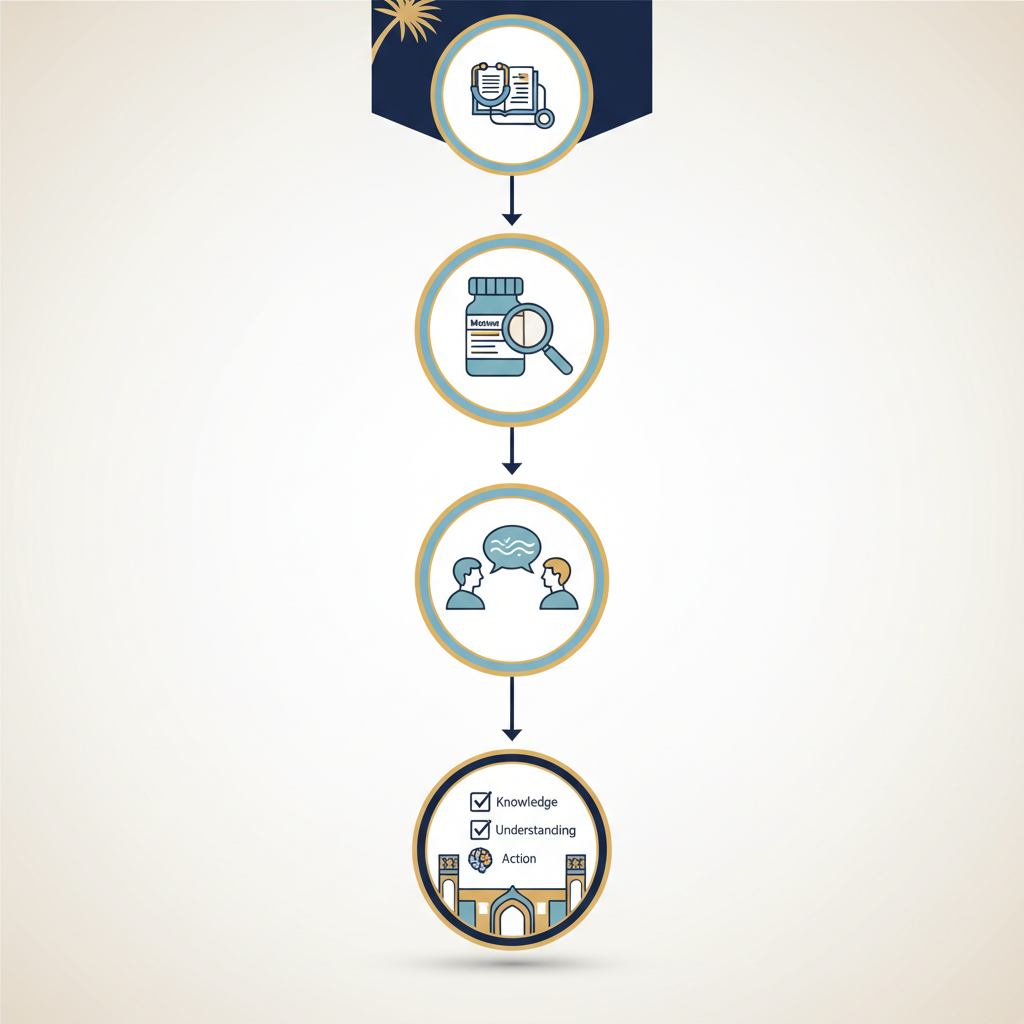
To achieve sustainable awareness, we must move from the stage of "knowledge" to the stage of "application." Sharing correct information in family groups and gently correcting misconceptions with scientific evidence contributes to purifying the community's information space. Additionally, supporting local initiatives aimed at spreading health awareness strengthens the social fabric. A health-literate individual is an empowered individual, capable of protecting themselves and their family, and contributing to building a vibrant and prosperous society that aligns with the Kingdom's ambitious vision for a better health future for all.
In conclusion, the journey of health education begins with a simple question and ends with a radical change in the quality of life. Through understanding terms, reading labels, journaling, effective communication, and critical evaluation of information, we lay the foundation for a healthier and more prosperous future for the residents of Al-Ahsa and the entire Eastern Province.

Explore health education step by step
Use the educational guides and practical tools to choose your next learning step.
Continue your next step with ATHAR
Explore the official Feel Great member path, or learn about the creator partnership route if you are interested in sharing wellness education with your audience.
Explore Feel Great · Explore the Creator Affiliate gateway · Ask a question on WhatsApp