Guide to Metabolic Health Terms: Enhancing Health Literacy in the Gulf
Author: Feras Alayed
Published:
Updated:
Category: metabolic-terms-arabic
Reading Time: 12 minutes
Introduction to Metabolic Health Literacy: Why Terminology Matters
Health literacy is the cornerstone of building a conscious society capable of facing contemporary health challenges. In the Gulf region, where the pace of life is accelerating and dietary patterns and physical activity are changing significantly, understanding "metabolic health" becomes an indispensable necessity. The scientific terms we hear in clinics or read in medical reports are not just complex words; they are keys to understanding how our bodies function from within. When we talk about metabolism, we are talking about the vital engine that converts food and oxygen into energy that supports every cell in the body. The absence of an accurate understanding of these terms can lead to misinterpretation of health information, which may result in inaccurate decisions regarding nutrition or lifestyle.
The goal of enhancing metabolic health literacy is to empower individuals to be active partners in their health journey, rather than just recipients of information. When an individual understands the meaning of "metabolic flexibility" or "insulin sensitivity," they become more capable of evaluating the options available to them in the supermarket or at a restaurant. Furthermore, understanding these terms reduces anxiety resulting from medical ambiguity, as it facilitates communication between the patient and the doctor, making the language of dialogue based on clear scientific foundations. At ATHAR Center, we believe that knowledge is the first step toward sustainable change and that simplifying science without compromising its accuracy is the best way to raise the quality of life in our communities.
Moreover, understanding metabolic terms helps protect the community from misinformation that may spread through social media platforms. A conscious consumer can distinguish between hollow marketing claims and proven scientific facts. This introduction opens the door to an educational journey aimed at deconstructing complex terms and transforming them into practical tools that can be used daily to improve general health awareness, contributing to building a healthier future for future generations in the region.
Dictionary of Basic Concepts: A Simplified Explanation of Metabolism, Anabolism, and Catabolism
To understand metabolic health, one must first deconstruct the concept of "metabolism" itself. Metabolism is not just the speed of burning calories as commonly thought; it is the sum of biochemical processes that occur within a living organism to maintain life. These processes are divided into two main complementary pathways: anabolism and catabolism. Anabolism is the aspect where energy is used to synthesize complex molecules from simple ones, such as building proteins to repair muscles or storing energy in tissues. In contrast, Catabolism is defined as the breakdown of large molecules (such as carbohydrates and fats) to release the energy the body needs for its vital functions like breathing and movement.
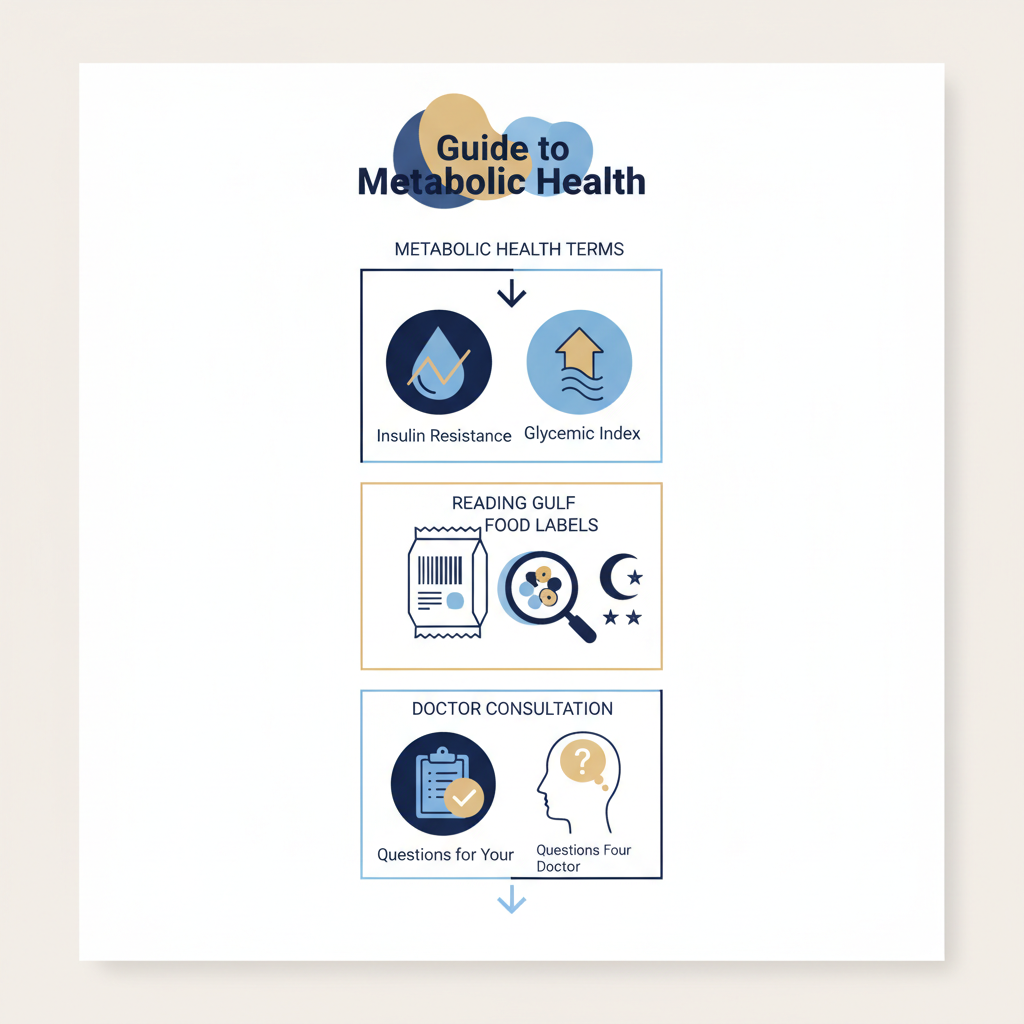
Another fundamental term is "Insulin Resistance," a condition where the body's cells stop responding effectively to the hormone responsible for ushering sugar into the cells. Understanding this term helps in grasping how lifestyle can affect the efficiency of energy distribution. Related to this is the "Glycemic Index" (GI), a scale that shows how quickly a certain type of food raises blood sugar levels. Low-GI foods release energy slowly, supporting stable metabolic processes, while high-GI foods lead to rapid fluctuations that may affect activity and concentration levels.
Additionally, the term "Metabolic Flexibility" stands out, which is the body's ability to efficiently switch between using carbohydrates and fats as energy sources based on availability and need. A person with high metabolic flexibility can adapt to periods of fasting or intense physical exertion without feeling extreme fatigue. Grasping these concepts transforms our view of food from mere "calorie numbers" to "chemical messages" that affect our biological balance. Understanding this dynamic between anabolism and catabolism, and how to manage energy sources, represents the basic foundation upon which any successful and scientifically sound health program is built.
Food Label Reading Skills (SFDA Standards)
The Saudi Food and Drug Authority (SFDA), and similar entities in the Gulf countries, are the primary reference for ensuring the safety and quality of food products. Mastering the skill of reading the "Nutrition Facts Label" is a daily practical tool for improving metabolic health. Correct reading begins by looking at the "Serving Size," as all the information mentioned in the table applies to this serving only, and not necessarily to the entire package. Many consumers fall into the trap of consuming the entire package believing that the calories mentioned are for the product as a whole, while the package may contain two or more servings.
Particular focus should be placed on "Added Sugars," a category that the SFDA has mandated companies to clarify separately from total sugars. Added sugars are those that are not naturally present in the food item, and understanding this difference is essential for maintaining stable energy levels. Attention should also be paid to "Trans Fats," as Gulf standards seek to limit them as much as possible due to their direct impact on metabolic markers. Reading the ingredients list is equally important; ingredients are listed in descending order by weight, so if sugar or hydrogenated oils are at the top of the list, this is an indicator of the product's nutritional quality.
In addition, one must understand the "Percent Daily Value" (%DV), which helps in knowing whether a single serving contributes significantly or slightly to your daily requirement of a particular nutrient. A general rule indicates that 5% or less is considered low, while 20% or more is considered high. For those interested in metabolic health, it is preferable to look for products with high percentages of dietary fiber and low percentages of sodium and added sugars. Turning this reading into a habit when shopping contributes to making smart purchasing decisions that support long-term health goals and align with national recommendations for the prevention of chronic diseases.
Developing a Daily Habit Diary: How to Effectively Document Physical Activity and Dietary Patterns
A daily habit diary is a bridge between theoretical knowledge and practical application. Documenting what we do provides objective data away from personal estimates that are often inaccurate. To develop an effective diary, it is not enough to record types of food only; one must record "Meal Timing" and "Hunger and Satiety Levels" before and after eating. This helps in understanding the relationship between the quality of food and the body's biological response, such as feeling lethargic after a certain meal or feeling sustained energy after another. Conscious documentation helps in discovering recurring patterns that may affect metabolic efficiency.
Regarding physical activity, the diary should include details about the "Type of Activity," "Duration," and "Intensity." Instead of just writing "walked today," it is preferable to write "brisk walking for 30 minutes." Also, recording "Sleep Quality" and "Stress Levels" is an integral part of a metabolic health diary, as hormones associated with stress and sleep have a direct impact on how the body processes sugar and fat. Mobile applications or traditional paper diaries can be used; the point is not the means but the consistency and accuracy in monitoring daily observations.
"What gets measured, gets managed and improved." This rule applies perfectly to metabolic health. When you review your diary at the end of the week, you will be able to see the links between your habits and your health outcomes.
For example, you may notice that a lack of sleep on a particular night led to an increased desire for sugars the next day, an insight that cannot be reached without documentation. The goal of the diary is not self-flagellation or obsession with numbers, but rather building a deep self-awareness that makes the individual an expert in their own body's needs. This diary also becomes a very valuable tool when visiting a doctor or nutritionist, as it provides them with a clear and comprehensive picture of your lifestyle, making it easier for them to provide specific and accurate advice that suits your daily reality.
Preparing for a Medical Appointment: A List of Suggested Questions About Metabolic Markers
A medical visit is a precious opportunity to obtain an accurate scientific assessment of one's health status, but maximizing its benefit requires prior preparation. Instead of waiting just to hear results, an individual should ask specific questions related to their metabolic markers. Among the most important questions to start with are: "What do my lipid panel results mean for my overall metabolic health?" and "How do you evaluate my fasting blood sugar level compared to ideal health standards?" These questions push the dialogue toward understanding the biological roots of health rather than focusing only on treating visible symptoms.
It is also recommended to ask about "Waist Circumference" and its relationship to visceral fat, as this indicator is sometimes more accurate than Body Mass Index (BMI) in assessing metabolic risks. Another important question is: "Are there indicators of low-grade chronic inflammation in the body?" Understanding these details helps in drawing a complete picture of the efficiency of vital organs. One should also inquire about the impact of the current lifestyle on these markers, such as: "Based on my results, what qualitative changes in physical activity do you recommend to improve my metabolic flexibility?"
It is also important to write down the answers and discuss any medications or supplements being taken and their potential impact on metabolism. Preparing for a medical appointment reduces confusion and ensures that no essential point is forgotten. Remember that the doctor is your health consultant, and the more familiar you are with your metabolic terms, the deeper and more useful the consultation will be. Having a ready list of questions reflects an individual's seriousness in maintaining their health and transforms the relationship with the medical team into a partnership based on cooperation and transparency, ensuring a clear action plan based on your accurate personal data.
Criteria for Evaluating Health Information on Social Media in the Gulf
In the era of information explosion, social media platforms have become a primary source of health information, but unfortunately, they are also full of myths and unscientific claims. To evaluate any health information, one must first look at the "Source of Information"; is it a specialized doctor, a government entity like the Ministry of Health, or a recognized research center? In the Gulf countries, official authorities exert great efforts to provide reliable content, so they should be the first reference. One must be wary of accounts that promote quick results and medical miracles, as metabolic health is a cumulative process and there are no immediate magic solutions.
The second criterion is "Reliance on Scientific Evidence." Reliable information depends on controlled clinical studies rather than individual personal experiences (Anecdotal Evidence). If the information includes phrases like "a secret doctors hide" or "a final cure for all diseases," these are red flags indicating a lack of credibility. Attention should also be paid to "Conflict of Interest"; is the person providing the information trying to sell a specific product? A direct link between health information and the necessity of purchasing a private product often weakens the neutrality and scientific value of the information.
Finally, "Cultural and Environmental Context" must be considered. Some health tips may be based on studies in environments completely different from our Gulf environment in terms of climate, the nature of available food, and genetic patterns. Therefore, consulting local specialists who understand these factors is essential. Developing a critical sense in an individual makes them immune to misinformation and contributes to spreading correct health awareness within the family and community. Strong knowledge of basic metabolic terms, as discussed in previous sections, is the best way to filter out misleading information and stick to what is beneficial and scientifically proven.
Conclusion: The Role of Knowledge in Making Conscious and Informed Health Decisions
Our journey in understanding metabolic health terms ends at one truth: knowledge is the power that gives us control over our health future. Transitioning from a state of passive reception to a state of active awareness changes every detail of our daily lives, from choosing breakfast to how we spend our free time. Metabolic health is not just the absence of disease, but a state of vitality and efficiency that allows a person to perform their tasks in the best possible way. By understanding the processes of anabolism and catabolism, mastering food label reading, and tracking habits, we set ourselves on the right path toward a long and healthy life.
The Gulf community today possesses all the tools to elevate its health awareness, with the presence of advanced medical infrastructure and strict regulatory bodies like the Food and Drug Authority. The individual's role is to invest in these resources and apply knowledge practically. We must not stop at learning terms; we must turn them into behaviors. Making a conscious decision to reduce added sugars based on understanding their impact on insulin is a small victory that leads to big results over time. Health knowledge is a long-term investment, and its results appear not only in medical tests but in the quality of daily life, energy levels, and the ability to produce and innovate.
In conclusion, we at ATHAR Center emphasize that health education is a continuous process. The scientific world is constantly evolving, and staying informed about the latest reliable concepts is an individual and collective responsibility. We hope that this guide will be a starting point for further research and questioning, and a motivation to adopt a lifestyle that respects the biological laws of our bodies. Awareness is the light that dispels the darkness of health ignorance, and through science and action, we can all achieve a metabolic balance that supports our ambitions and preserves our health and the health of our future generations.
Educational Glossary of Terms
| Term in Arabic | Term in English | Simplified Explanation |
|---|---|---|
| الأيض (التمثيل الغذائي) | Metabolism | Converting food into energy and vital processes. |
| مقاومة الأنسولين | Insulin Resistance | Decreased cell response to the hormone insulin. |
| المؤشر الجلايسيمي | Glycemic Index | The speed at which food raises blood sugar levels. |
| المرونة الأيضية | Metabolic Flexibility | The body's ability to switch between burning sugar and fat. |
| الدهون المتحولة | Trans Fats | Industrially processed oils that harm metabolic health. |

Related ATHAR paths
Explore health education step by step
Use the educational guides and practical tools to choose your next learning step.