Navigating the Digital Health Maze: How to Read US Health Guidance Online
Author: Feras Alayed
Published:
Updated:
Category: health-literacy
Reading Time: 7 minutes
Navigating the Digital Health Maze: How to Read US Health Guidance Online
We have all been there: a late-night search for a nagging symptom or a new diet trend that leads down a rabbit hole of conflicting advice. One website claims a specific fruit is a miracle cure, while another warns it should be avoided at all costs. For many Americans, the desire to take control of their health is often met with a wall of confusing terminology, sponsored content, and contradictory studies. The problem isn't a lack of information; it is the difficulty of discerning what is credible, what is applicable, and what is simply noise. Sustainable health habits are built on a foundation of clarity, yet finding that clarity can feel like a full-time job.
The Information Paradox: Why Credibility Matters
When you search for health advice, you are likely looking for a specific outcome: more energy, better sleep, or perhaps managing a specific metric like blood sugar. In the United States, blood sugar is typically measured in milligrams per deciliter (mg/dL), and understanding these units is just the first step in health literacy. The challenge is that previous attempts to follow online advice often fail because the advice was either too generalized, lacked scientific backing, or was designed for clicks rather than clinical accuracy. To move forward, we must compare the two primary ways we consume health information today: institutional guidance and anecdotal trends.
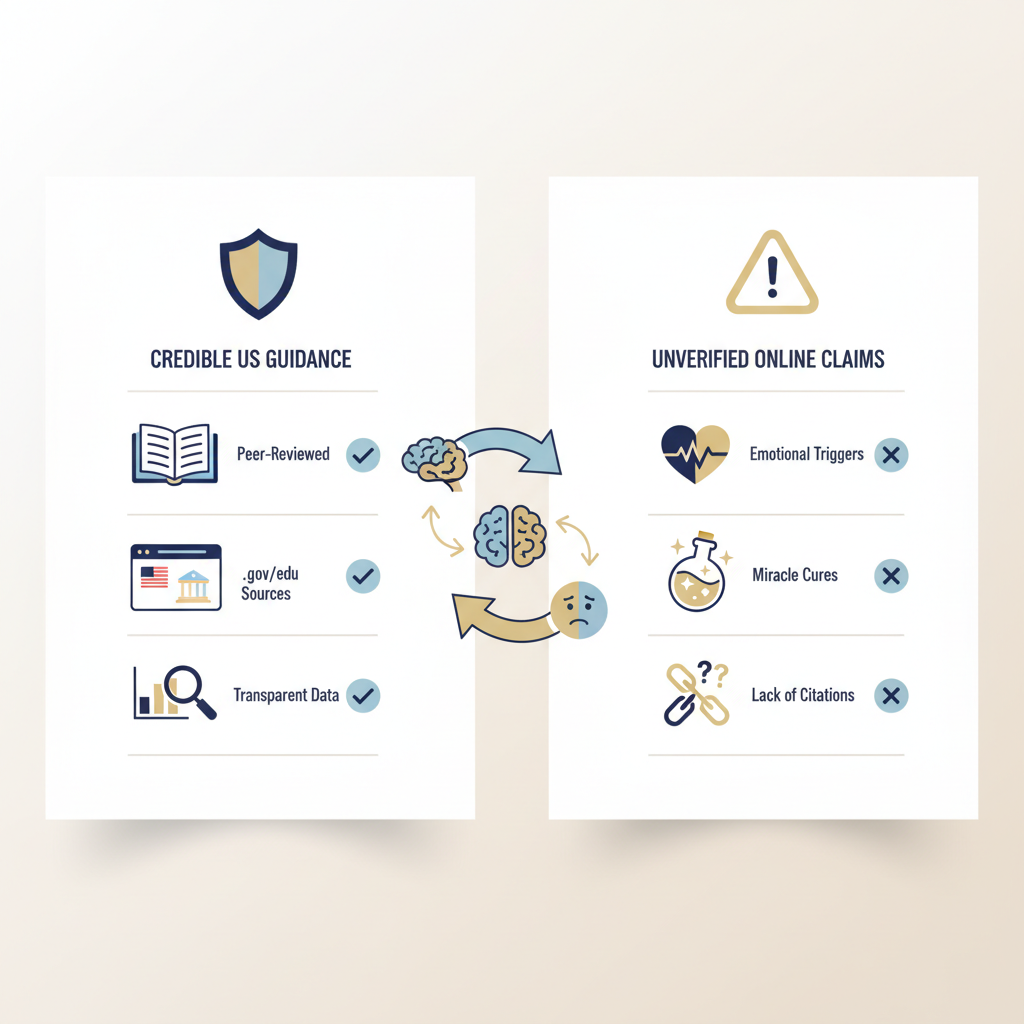
Comparison: Institutional Guidance vs. Social Media Trends
To understand how to read US health guidance online, it is helpful to compare the two most common sources of information. Understanding these differences helps you decide which source to trust for medical decisions and which to view with healthy skepticism.
1. Source Authority and Intent
Institutional Guidance: Organizations like the Centers for Disease Control and Prevention (CDC), the National Institutes of Health (NIH), and the Food and Drug Administration (FDA) operate under strict mandates to provide evidence-based information for public safety. Their intent is to inform the public based on the best available science. Similarly, academic centers like Harvard Health or the Mayo Clinic provide peer-reviewed insights aimed at patient education.
Social Media Trends: Influencers and wellness blogs often prioritize engagement, storytelling, and personal anecdotes. While their intent may be helpful, their primary metric is often reach or product sales. This can lead to the promotion of 'quick fixes' that lack long-term evidence.
2. The Nature of Evidence
Institutional Guidance: These sources rely on meta-analyses, randomized controlled trials (RCTs), and years of longitudinal data. When the American Heart Association (AHA) or the American Diabetes Association (ADA) issues a recommendation, it has been vetted by panels of experts who have reviewed thousands of pages of data.
Social Media Trends: Evidence is often anecdotal ('It worked for me!') or based on a single, small-scale study that has not been replicated. While personal stories are powerful, they do not account for individual biological differences or potential long-term risks.
3. Specificity and Nuance
Institutional Guidance: You will often see nuanced language such as 'may help,' 'associated with,' or 'consult your physician.' This reflect the reality of science—it is rarely black and white. For example, guidance on intermittent fasting often includes caveats for specific populations, which is why evaluating common claims about intermittent fasting requires a critical eye.
Social Media Trends: Trends often use absolute language like 'always,' 'never,' or 'guaranteed.' This lack of nuance is a red flag in health communication.
Understanding the Major US Health Players
Knowing where to look is half the battle. Here is how to navigate the most reliable US-based health organizations:
- CDC (Centers for Disease Control and Prevention): The go-to source for infectious diseases, immunization schedules, and public health statistics. If you are looking for community-level health data, the CDC is the gold standard.
- NIH (National Institutes of Health): This is the primary agency for medical research. If you want to dive deep into the science of a specific condition, the NIH's 'Health Information' portal provides summaries of the latest research.
- FDA (Food and Drug Administration): Use the FDA website to check for food recalls, medication safety alerts, and the status of new medical devices.
- ADA and AHA: These non-profits (American Diabetes Association and American Heart Association) provide specific guidelines for chronic condition management, such as target blood sugar ranges (mg/dL) and blood pressure goals.
Learning to navigate these sites is a core part of improving your health literacy, regardless of where you live.
The Role of Structured Support: The structured reflection approach
Practical Checklist: How to Evaluate a Health Website in 5 Minutes
Before you trust a new piece of health advice, run it through this quick checklist:
- Who wrote it? Look for credentials (MD, PhD, RD) and check if the article was reviewed by a medical board.
- When was it published? Health science moves fast. Information older than 3-5 years may be outdated.
- Are there citations? Credible articles will link directly to peer-reviewed studies or government reports.
- Is there a 'Sales First' vibe? If the article claims that the only way to get healthy is to buy their specific supplement, proceed with extreme caution.
- Does it sound too good to be true? If it promises a 'cure' for a chronic condition, it likely is.
Keeping a personal health information log can also help you track which advice actually results in positive feelings and which does not, helping you become your own best advocate.
When to Seek Professional Medical Care
Online guidance is a tool for education, not a replacement for a doctor. You should always consult a healthcare professional if you experience:
- Sudden or severe symptoms.
- Persistent changes in mood or physical function.
- Conflicting advice regarding your current medications.
- Questions about specific lab results, such as blood sugar readings in mg/dL.
Frequently Asked Questions
How do I know if a study cited online is reliable?
Look for studies published in reputable journals like The Lancet, JAMA, or the New England Journal of Medicine. Ensure the study was conducted on humans and has a significant sample size, rather than being a preliminary animal study.
What does mg/dL mean in my blood tests?
In the United States, mg/dL stands for milligrams per deciliter. It is a unit of measure that shows the concentration of a substance, like glucose (sugar) or cholesterol, in your blood. Institutional guidelines from the ADA provide target ranges for these numbers.
Can the structured reflection approach replace my medication?
No. The structured reflection approach is a lifestyle support framework designed to help organize healthy habits. It is not a medical treatment or a replacement for any medication prescribed by your doctor. Always consult your physician before making changes to your medical regimen.
Why does the CDC change its guidance sometimes?
Science is an evolving process. As new data emerges from ongoing research, organizations like the CDC update their recommendations to reflect the most current understanding of human health and safety.
Are university health blogs reliable?
Generally, yes. Blogs from institutions like Harvard Health, Johns Hopkins, and Stanford Medicine are written by experts and are based on clinical evidence, making them excellent sources for understanding complex health topics.
Further Education
- Explore the metabolic health education hub
- Learn how to read research summaries
- Use the educational health assessment
Explore health education with care
Use ATHAR’s educational guides and practical tools to choose your next learning step.