Understanding Metabolic Health Terms: A Guide for Gulf Readers
Author: Feras Alayed
Published:
Updated:
Category: metabolic-terms-arabic
Reading Time: 11 minutes
1. Introduction to Health Literacy and the Importance of Metabolic Terms
Health literacy is the cornerstone of building a conscious society capable of facing contemporary health challenges, especially in the Arabian Gulf region, which has witnessed rapid socio-economic shifts affecting lifestyles directly. Understanding health terms, particularly those related to metabolic health, is not merely an intellectual luxury but an empowerment tool that allows individuals to make informed decisions regarding their nutrition and physical activity. When we speak of metabolic health, we refer to the efficiency with which the body converts food into energy and how it manages the biochemical processes that maintain organ function. The knowledge gap between complex medical jargon and public understanding can lead to misinterpretation of health information, potentially resulting in the adoption of inaccurate practices. Therefore, ATHAR Center aims through this guide to simplify these concepts and present them in professional yet accessible language, enabling Gulf citizens to understand their body's signals and the language of healthcare providers alike. Health education begins with defining terms; for instance, the word 'metabolism' might seem vague to some, but it actually represents the internal engine that determines energy levels, weight, mood, and the ability to prevent long-term health disturbances. By fostering health literacy, we move from a stage of passive information reception to active participation in personal health management, where the individual becomes a partner to the healthcare provider rather than just a recipient of treatment. In this context, there is an urgent need to unify terms and understand their implications within the local environment, taking into account the specific dietary habits and environmental conditions of the region, thereby contributing to a solid foundation for sustainable health awareness passed down through generations.
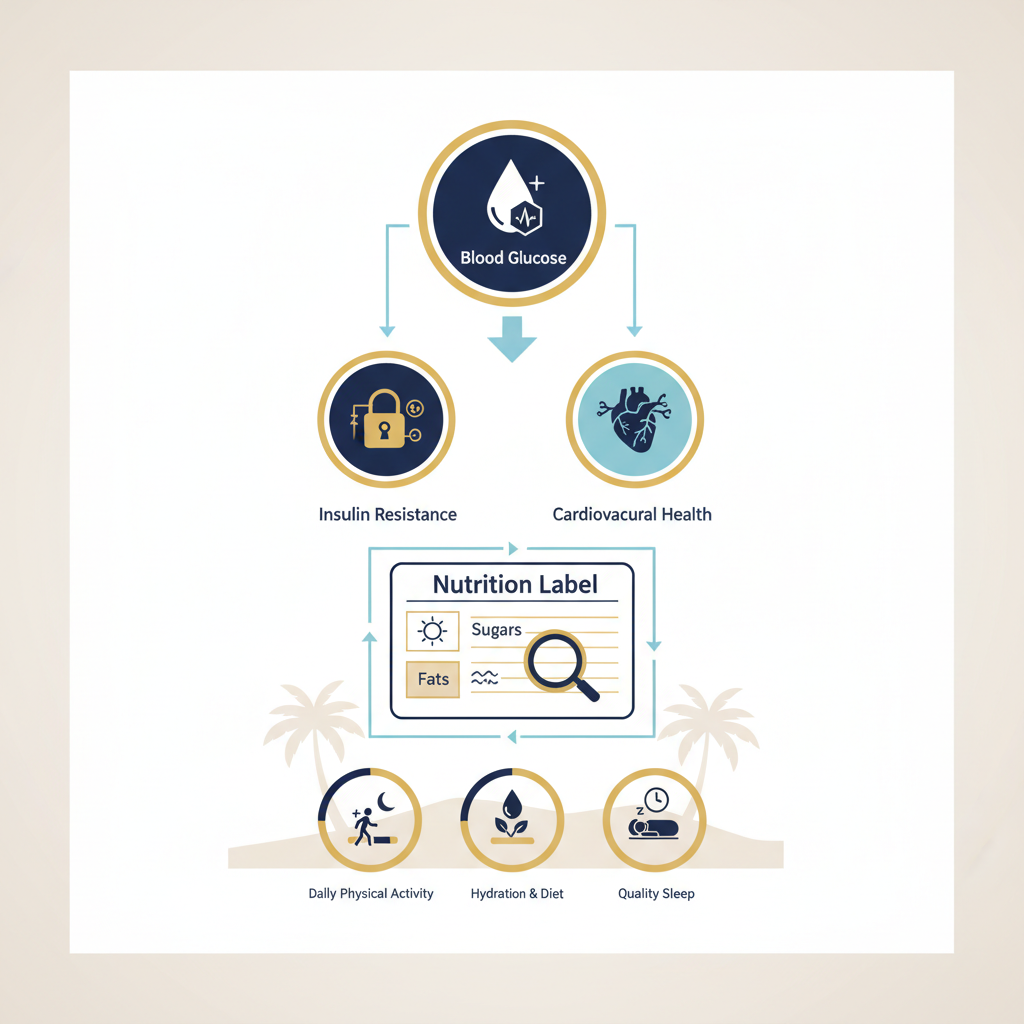
2. Basic Terms Explained: Metabolism and Energy Balance in a Regional Context
The term 'Metabolism' is one of the most frequently used yet least deeply understood concepts. Simply put, it is the sum of chemical processes occurring within body cells to convert food and drink into energy. These processes are divided into two main pathways: Catabolism, which is the breakdown of large molecules like carbohydrates and fats to produce energy, and Anabolism, which is the use of that energy to build tissues and repair cells. In the Gulf context, where meals are often calorie-dense, understanding 'Energy Balance' becomes vital. Energy balance is the relationship between energy entering the body (calories from food) and energy consumed by the body for vital functions and physical activity. Another crucial concept is the Basal Metabolic Rate (BMR), which is the amount of energy your body needs to stay alive at complete rest, such as for breathing and blood circulation. This rate is influenced by several factors, including age, gender, and muscle mass. One concept that also needs clarification is Metabolic Flexibility, which is the body's ability to efficiently switch between using carbohydrates and fats as fuel sources based on availability and demand. Understanding these terms helps an individual realize that metabolic health is not just a number on a scale, but internal efficiency in managing energy resources. Instead of focusing solely on reducing food intake, the goal becomes improving the quality of metabolic processes through smart choices that support building and reduce oxidative stress resulting from imbalanced catabolic processes. Grasping these scientific concepts grants the individual the ability to interpret their body's various responses to food and physical effort, enhancing their ability to adapt to daily life requirements in a healthy and scientific manner.
3. Label Reading Skills: Decoding Sugars, Fiber, and Fats in the Gulf Market
The nutrition facts panel found on food products in Gulf markets is a vital guide for the consumer, but it requires skill in reading and analysis. The first thing to notice is the Serving Size; many people read the calories believing they apply to the entire package, while they are actually for a small portion of it. When looking at carbohydrates, one must distinguish between Total Carbohydrates, Dietary Fiber, and Added Sugars. Fiber is the indigestible part of carbohydrates and plays a fundamental role in slowing sugar absorption into the blood, supporting metabolic health. Added sugars are those put in during manufacturing and should be approached with caution as they cause sharp spikes in energy levels followed by rapid crashes. Regarding fats, a distinction must be made between Saturated Fats, Trans Fats, and Unsaturated Fats. Trans fats are the most dangerous to metabolic health and are often found in processed foods and commercial baked goods, while unsaturated fats (like those in olive oil and nuts) are considered heart and metabolism-friendly. Another important term is Sodium, which is linked to fluid balance and blood pressure. In the Gulf market, we may find terms like 'Sugar-Free' or 'Low Fat'; here, we must be aware that 'Sugar-Free' does not necessarily mean calorie-free, and it may contain sugar substitutes or starches that affect metabolism. Learning how to read the ingredients list, where ingredients are listed in descending order by weight, helps uncover hidden components. If sugar or hydrogenated oils are at the top of the list, this is an indicator of the product's nutritional quality. Mastering this skill transforms shopping from a random purchase into a precise selection process that supports long-term health goals.
4. The Importance of Tracking Daily Habits in a Personal Log
A personal tracking log is one of the most powerful tools for improving metabolic health, acting as a mirror that reflects the actual reality of daily habits away from random estimates. Recording what we eat, the amount of physical activity, sleep hours, and even stress levels provides valuable data that can be analyzed to discover patterns that might hinder health progress. For example, a person might discover through logging that their afternoon lethargy is linked to a specific type of morning meal, or that their sleep quality is affected by late-night eating. Logging is not limited to calories; it extends to Mindful Eating, which means recording the emotional state when eating. Do we eat because we are truly hungry, or in response to stress or boredom? In the Gulf environment, where social occasions centered around food are frequent, a log helps maintain balance without feeling deprived. Recording Physical Activity Levels, whether walking or resistance training, also helps monitor the development of strength and endurance. Additionally, Sleep is a vital element in metabolic health; lack of sleep affects hormones responsible for hunger and satiety (leptin and ghrelin). By logging sleep hours and quality, an individual can link that to their craving for sugars the next day. A personal log is not a tool for harsh self-accountability but a means for self-learning and growth. It helps prepare accurate information for discussion with a healthcare provider, making medical consultations more effective and based on concrete facts rather than selective memory. Starting with a simple log, whether on paper or via phone apps, is a practical step toward sustainable change, where small observations turn into comprehensive insights leading to a healthier and more vibrant life.
5. How to Prepare Effective and Specific Questions for Healthcare Providers
A medical visit is a precious opportunity to enhance health understanding, but time constraints can sometimes prevent obtaining all required information. Therefore, preparing questions in advance is a necessary skill for anyone seeking to improve their metabolic health. Instead of asking general questions like 'How is my health?', it is preferable to use specific questions targeting certain aspects. For instance, one could ask about Fasting Blood Sugar levels and what they mean for future risks, or ask about Insulin Resistance and how to improve the body's sensitivity to insulin through lifestyle changes. It is also important to inquire about the Lipid Profile, understanding the difference between good cholesterol (HDL), bad cholesterol (LDL), and triglycerides, and how these numbers affect overall metabolic health. If a doctor prescribes a certain test, the patient has the right to ask: 'What is the purpose of this test? And how will the result affect my treatment or nutritional plan?'. One can also ask about the impact of prescribed medications on metabolism. In the Gulf context, it might be useful to ask the doctor how to adapt health advice to local customs, such as fasting or traditional meals. Writing these questions down on paper or a phone before the appointment ensures no important point is forgotten. Furthermore, one should not hesitate to ask for an explanation of medical terms that may seem obscure; the healthcare provider is there to be a partner in your health journey. Active and effective dialogue builds a bridge of trust and ensures that medical recommendations are understood and applicable in daily reality, increasing adherence to the health plan and achieving desired results.
6. Evaluating Health Information Online: Distinguishing Reliable from Unreliable Sources
In the age of the digital information explosion, the internet has become the primary source for seeking health information, but this space is also filled with misinformation and unscientific claims. To evaluate any health information related to metabolism or nutrition, a critical methodology must be followed. First, check the Source of Information; is it issued by government health entities, reputable universities, or recognized research centers? Sources ending in domains like (.gov), (.edu), or (.org) are generally more reliable. Second, beware of Exaggerated Promises or 'magic solutions' claiming to cure everything in record time; metabolic science is complex and requires time and gradual changes. Third, look for Scientific Evidence; is the information based on controlled clinical studies or on personal anecdotes and individual stories? Personal experiences cannot be generalized as scientific rules. Fourth, pay attention to the Publication Date; medical information evolves rapidly, and what was thought to be true ten years ago might have been updated by now. In the Arab region, many folk remedies spread through social media, and here one must ensure they do not conflict with scientific facts or negatively affect prescribed medications. Also, be cautious of content aimed at promoting specific products under the guise of medical advice. Using tools like 'reverse searching' for information or consulting specialists before adopting any advice from the internet is a conscious behavior that protects the individual from falling into the trap of misinformation. Digital health literacy means being smart consumers of information, filtering what we read and weighing it against logic and science to ensure that what we apply to our bodies is built on solid and safe foundations.
7. Conclusion: Building a Solid Foundation for Long-Term Health Awareness
The journey of metabolic health awareness is not a short sprint but a marathon that requires patience, consistency, and continuous learning. By understanding basic terms, mastering label reading, committing to habit logging, communicating effectively with doctors, and accurately evaluating information, an individual builds a protective shield that guards against health disturbances and improves quality of life. The ultimate goal of this guide is to transform knowledge into automatic daily behavior. Metabolic health is a reflection of our small and repeated choices; the type of food we choose, the amount of movement we practice, and how we handle stress. In our Gulf society, we have a great opportunity to integrate our cultural heritage with modern science to create a balanced lifestyle. Investing in health literacy is the best investment for the future, as it reduces health burdens on the individual and society and creates a conscious generation that values wellness. Always remember that your body is a trust, and understanding it is the first step in preserving it. Do not stop reading, asking, and searching in reliable sources, and make 'metabolic health' a way of life rather than just a temporary goal. ATHAR Center is committed to providing continuous knowledge support, believing that awareness is the true key to change. Let us start today by applying what we have learned, and let our understanding of these terms be the beginning of a more vibrant and bright life for us and our families.
Educational Glossary Table
| Term in English | Term in Arabic | Simplified Explanation |
|---|---|---|
| Metabolism | التمثيل الغذائي (الأيض) | The chemical process of converting food into energy. |
| Basal Metabolic Rate (BMR) | معدل الأيض الأساسي | The energy the body burns at complete rest. |
| Insulin Resistance | مقاومة الأنسولين | Weakened cell response to insulin for processing sugar. |
| Dietary Fiber | الألياف الغذائية | Plant parts that aren't digested, helping regulate sugar and digestion. |
| Metabolic Flexibility | المرونة الأيضية | The body's ability to switch between burning fats and carbs. |
| Trans Fats | الدهون المتحولة | Industrially hydrogenated oils that harm metabolic health. |
| Body Mass Index (BMI) | مؤشر كتلة الجسم | A measure based on height and weight to assess body composition. |

Related ATHAR paths
Explore health education step by step
Use the educational guides and practical tools to choose your next learning step.