7-Day Reflection Challenge: Organizing Daily Routine Tracking Basics
Author: Feras Alayed
Published:
Updated:
Category: diabetes
Reading Time: 13 minutes
Key Takeaways
- Daily routine tracking is not about perfection; it is a tool for understanding your behavioral patterns.
- The 7-day challenge focuses on observation first, before making any drastic changes.
- Flexibility is the key to sustainability; rigid schedules often lead to frustration.
- Linking new habits to existing daily triggers makes them much easier to maintain.
TL;DR
Building sustainable habits starts with understanding your current reality. Through a 7-day reflection challenge, you will learn how to organize daily routine tracking basics mindfully. This approach focuses on observation, identifying triggers, and making gradual, flexible changes that fit your life, rather than chasing unrealistic, perfect schedules.
The Struggle: Why is Sticking to a Routine So Hard?
We often start with immense enthusiasm to change our lifestyle. We buy planners, download tracking apps, and create meticulous hour-by-hour schedules. Yet, a few days later, we find ourselves slipping back into old habits, feeling frustrated that we couldn't maintain the momentum. Why does this happen? The real issue is that we try to force a perfect system onto an inherently unpredictable life. We focus purely on the end outcome while ignoring the underlying patterns that drive our current behavior.
Previous attempts can be hard to sustain because they rely heavily on willpower, which is a finite resource. This is where the structured reflection approach comes in as one possible form of structured support within a broader lifestyle approach. It does not claim to be a magic cure or guarantee specific outcomes; rather, it provides a practical framework to help you organize your day with awareness and flexibility. This makes it easier to make choices that support your overall wellness, such as those needed in diabetes management or general lifestyle improvement.
What Are Daily Routine Tracking Basics?
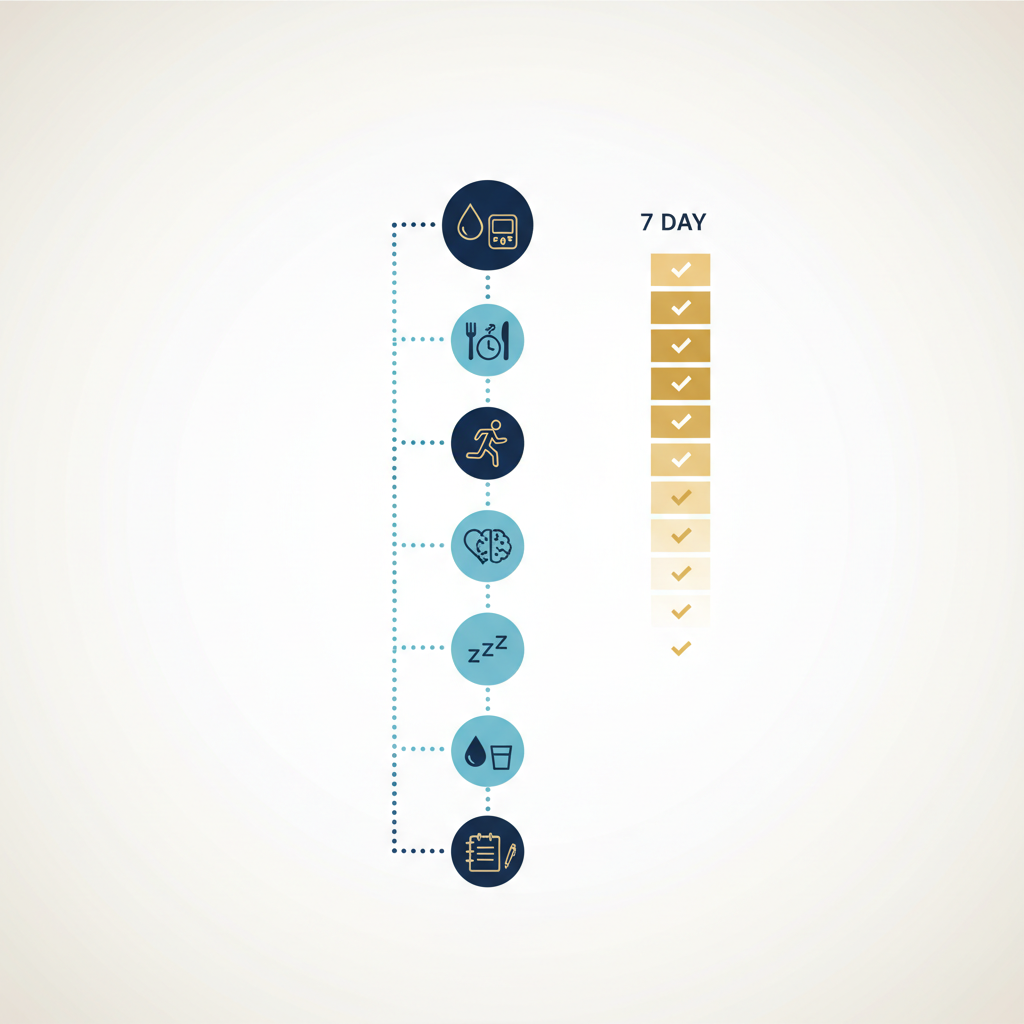
Daily routine tracking basics are a set of simple, sustainable practices aimed at recording and monitoring everyday activities (like meal times, movement, and rest periods) to increase self-awareness, identify behavioral patterns, and facilitate gradual adjustments that align with an individual's natural rhythm.
The goal is not to log every single minute, but to capture the big picture. When you understand when you feel energized and when you tend to lose focus, it becomes much easier to design your day in a way that supports you rather than exhausts you.
The 7-Day Reflection Challenge: Step-by-Step
This challenge is designed to help you master daily routine tracking basics through sequential steps. Each step focuses on just one aspect to prevent you from feeling overwhelmed.
Step 1: Preparation & Defining Your Intent (Pre-Challenge)
Before you begin, you need to define why you want to track your routine. Is it to organize your time? Or perhaps to better understand your dietary habits in preparation for a doctor's visit, similar to understanding A1C terminology in Canada or your local region?
- Educational Tool: A simple notebook or a notes app on your phone.
- Check Question: What is the one area of my day that I feel needs more organization?
Step 2: Day 1 - Pure Observation
On this day, do not change anything. Just observe what you do and record it. When do you wake up? When do you eat? When do you feel tired? The goal is to gather data without judgment.
- Educational Tool: A simple time log (Morning, Afternoon, Evening).
- Check Question: Did I record my day as it actually happened, or as I wish it had happened?
Step 3: Day 2 - Identifying Triggers
Every habit has a trigger. Observe what precedes your actions. Do you grab a snack because you are hungry, or because you are bored? Do you scroll through your phone before bed out of sheer habit?
- Educational Tool: Trigger mapping (Event -> Feeling -> Action).
- Check Question: What was the most frequent trigger I noticed today?
Step 4: Day 3 - Introducing One Micro-Change
Choose one very small habit you want to add, like drinking a glass of water upon waking, or slightly delaying breakfast if you are exploring an intermittent fasting beginner's guide. Link this new habit to an existing one (a trigger).
- Educational Tool: The "If/Then" rule (If I wake up, Then I will drink water).
- Check Question: Is the change I chose small enough that it requires almost zero effort?
Step 5: Day 4 - Energy Mapping
Your routine should respect your natural energy rhythms. Log your energy levels (High, Medium, Low) every few hours. This helps identify the best times for tasks that require deep focus.
- Educational Tool: A 1-to-5 energy scale.
- Check Question: At what time of day did I feel the highest level of energy?
Step 6: Day 5 - Testing Flexibility
What happens when your day doesn't go as planned? Today, intentionally change a part of your routine or observe how you handle an unexpected disruption. Flexibility is what makes a routine sustainable.
- Educational Tool: Contingency planning (Plan B).
- Check Question: How did I respond when a part of my routine was disrupted today?
Step 7: Day 6 - Environmental Assessment
Your environment plays a massive role in the success of your routine. If you are trying to improve your dietary choices to support gut health foundations for wellness, is your kitchen set up to facilitate that?
- Educational Tool: Environmental scan (What makes good habits easy and bad habits hard?).
- Check Question: What is one simple change I can make in my environment to support my routine?
Step 8: Day 7 - Review and Reflection
Look back at your notes from the past six days. What patterns emerged? What worked well, and what didn't?
- Educational Tool: A 15-minute reflection session.
- Check Question: What is the one habit I feel confident I can maintain next week?
Step 9: Post-Challenge - Building the Sustainable System
Now that you understand your daily routine tracking basics, you can start building a flexible system based on the observations you gathered, rather than relying on generic templates.
- Educational Tool: A flexible routine template based on time blocks (Morning, Afternoon, Evening) rather than exact hours.
- Check Question: Does this system support my current lifestyle, or does it add extra stress?
Common Mistakes in Routine Tracking
When trying to organize daily routine tracking basics, it is easy to fall into a few traps. Here are the most common ones and how to calmly correct them:
- Over-tracking: Trying to log every tiny detail of your day leads to burnout. Correction: Focus on tracking just 2-3 key habits initially.
- Chasing Perfection: Feeling guilty when you miss a day. Correction: Remember that consistency does not mean perfection. A missed day is just data, not a failure.
- Copying Others' Routines: What works for someone else might not work for you. Correction: Use the reflection challenge to discover what fits your unique rhythm.
- Ignoring Body Signals: Sticking to a rigid schedule even when you are exhausted. Correction: Learn to listen to your body; rest is a fundamental part of any healthy routine.
Building a Flexible Routine Without Rigid Schedules
An effective routine does not require a strict timetable that dictates every minute. Instead, adopt a "time-blocking" or "event-based routine" approach. For example, instead of saying "I will go for a walk at 7:00 AM," you can say "I will go for a walk after I finish my morning coffee." This approach provides prompts for observing stress-related patterns and increases the likelihood of adherence because it links the habit to a consistent daily event, regardless of the exact time it occurs.
Daily Decision-Making Scenarios
Here are some hypothetical scenarios and how to handle them using daily routine tracking basics flexibly:
- Scenario 1: You missed tracking your habits for two days due to work stress. Decision: Instead of trying to overcompensate or giving up, start the new day as a blank slate. Make a simple note that work stress was the trigger for stopping, and resume tracking only the easiest habit.
- Scenario 2: Your daily schedule suddenly changes due to travel or a family commitment. Decision: Switch to "minimum viable mode." Choose just one habit (like drinking enough water) to focus on, and temporarily let go of the rest of the routine without any guilt.
- Scenario 3: You experience a sudden mid-day energy crash. Decision: Review your energy tracking log. Did you eat a heavy meal? Did you sleep poorly? Use this data to make an informed decision to adjust your next meal or take a short break, rather than forcing yourself to work through low focus.
Quick-Start Checklist
Use this checklist to ensure you are ready to start tracking your routine effectively:
- [ ] I have chosen a simple tracking tool (notebook, notes app).
- [ ] I have set one clear goal for tracking (e.g., understanding hunger cues).
- [ ] I have let go of the expectation of 100% perfection.
- [ ] I have identified a consistent daily trigger to link my new habit to.
- [ ] I have dedicated 5 minutes each evening to review my day without judgment.
When to Seek Professional Help
Daily routine tracking is a tool for self-organization, but it does not replace professional medical care. You should consult a doctor or healthcare professional if:
- Tracking your habits (especially related to food or movement) causes you severe anxiety or obsessive thoughts.
- You notice persistent physical symptoms that affect your daily energy, such as those associated with insulin resistance symptoms, which do not improve with simple lifestyle adjustments.
- You need precise guidance on how to track specific health markers. In this case, reviewing questions to ask your doctor about diabetes terminology can help ensure effective communication with your medical team.
Medical Disclaimer: The information provided in this article is for educational and informational purposes only and does not constitute professional medical advice, diagnosis, or treatment. Always consult your physician before making any significant changes to your lifestyle or health routine.
Your Next Step
You now understand daily routine tracking basics and how to use the 7-day challenge to observe your behavioral patterns with flexibility and awareness. Remember that building habits is an ongoing journey of learning and adapting, not a final destination reached through rigid steps. To begin applying these concepts practically in a way that suits your personal goals, start your internal health assessment to discover the most appropriate next step for you.
Frequently Asked Questions
What is the scope of this guide?
This guide is educational and helps readers organize questions and observations for further learning.
How should I use the information?
Use it to review terminology, note personal questions, and identify sources that require verification.
When should I seek professional guidance?
Discuss personal symptoms, medicines, diagnoses, or treatment decisions with a licensed professional.
Further Education
- Explore the metabolic health education hub
- Learn how to read research summaries
- Use the educational health assessment

Ready to choose a clearer health starting point?
Start with a short educational assessment to explore tools and resources that may fit your goal. It is not a medical diagnosis.
Continue learning at Diabetes Management.