NAD+ and aging science explained — Practical guide to NAD+ and aging
Author: Feras Alayed
Published:
Updated:
Category: longevity
Reading Time: 12 minutes
Key takeaways
- NAD+ is a central metabolic cofactor and substrate whose levels tend to decline with age. ([pubmed.ncbi.nlm.nih.gov](https://pubmed.ncbi.nlm.nih.gov/32097708/?utm_source=openai))
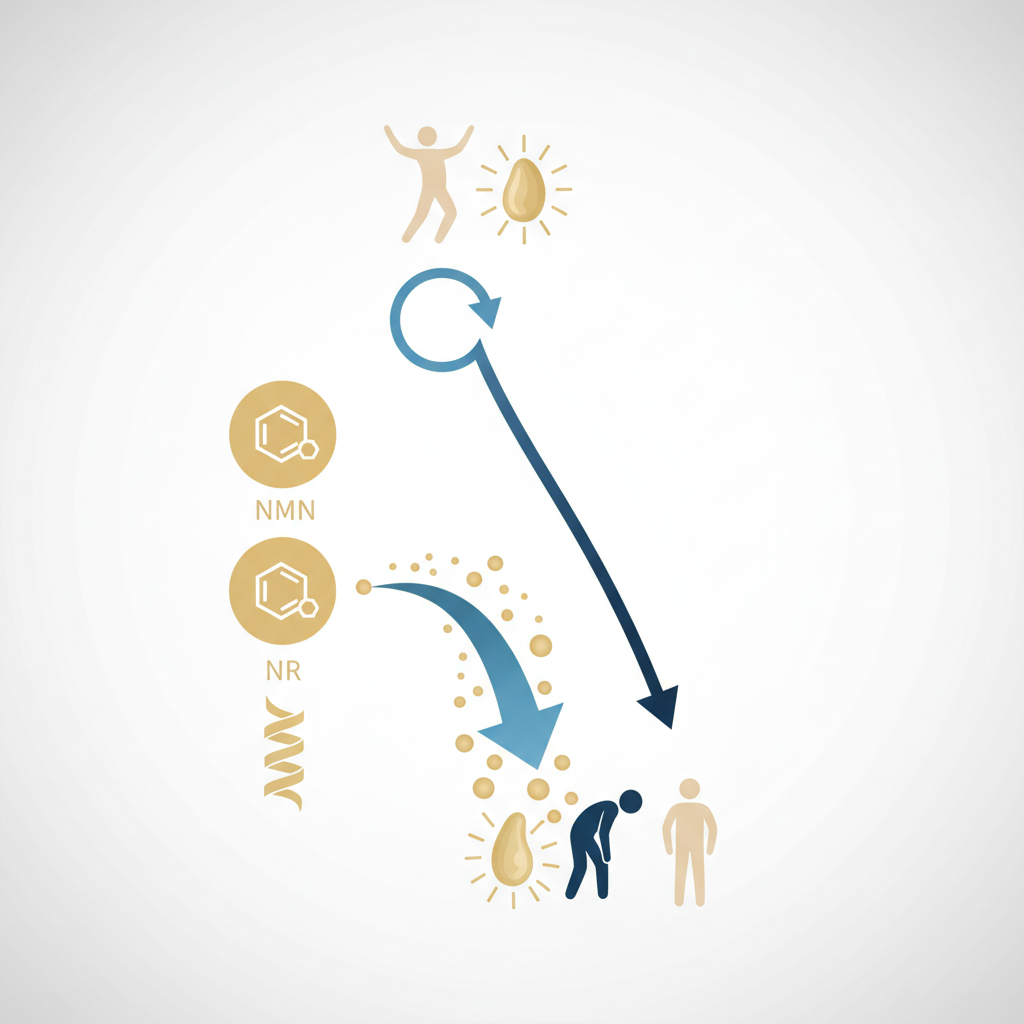
- Raising NAD+ with precursors (NR, NMN) increases NAD+ in humans and shows promising signals, but clinical outcomes are heterogeneous. ([pubmed.ncbi.nlm.nih.gov](https://pubmed.ncbi.nlm.nih.gov/35479740/?utm_source=openai))
- NAD+-linked pathways (sirtuins, PARPs, CD38) connect metabolism, DNA repair, and longevity mechanisms. ([pubmed.ncbi.nlm.nih.gov](https://pubmed.ncbi.nlm.nih.gov/33353981/?creative=733428005419&device=c&loc_physical_ms=9011490&matchtype=e&nb_kwd=eden&nb_mt=e&nb_ti=kwd-15078982&nbt=nb%3Aadwords%3Ag%3A20670662810%3A154297085883%3A733428005419&network=g&utm_source=openai))
- Functional nutrition strategies (exercise, intermittent fasting, blue-zones style diet) can support NAD+ physiology naturally.
- Short-term safety for NR/NMN looks acceptable; long-term benefits and optimal dosing remain under investigation. ([pmc.ncbi.nlm.nih.gov](https://pmc.ncbi.nlm.nih.gov/articles/PMC10684646/?utm_source=openai))
Introduction
This supporting cluster article within the Longevity & Functional Nutrition pillar explains "NAD+ and aging science explained" in practical terms. You will get: a concise definition of NAD+, a summary of human and animal evidence (2020+), a clear comparison of precursors (NR vs NMN), and actionable nutrition and lifestyle steps to support NAD+ in everyday life. I’ll include anonymized patient vignettes and link to related practical guides in the pillar. The goal is scientific clarity with clinical pragmatism.
What is NAD+? A short functional definition
NAD+ (nicotinamide adenine dinucleotide) can be defined simply: "NAD+ is an electron carrier and an enzymatic substrate used by repair and signaling enzymes." It plays two main roles:
- As a redox carrier in metabolic pathways (glycolysis, TCA, oxidative phosphorylation).
- As a substrate for enzymes such as sirtuins, PARPs, and CD38 that regulate gene expression, DNA repair, and calcium signaling.
How NAD+ changes with age — evidence and quantitative notes
Multiple lines of evidence from animal models and human tissue studies show a trend of NAD+ decline with age. Mechanisms include increased consumption (e.g., PARP activation in response to DNA damage, elevated CD38 activity with inflammation) and decreased salvage synthesis (e.g., reduced NAMPT activity). Reviews published since 2020 synthesize these findings and discuss tissue-specific variability. ([pubmed.ncbi.nlm.nih.gov](https://pubmed.ncbi.nlm.nih.gov/32097708/?utm_source=openai))
Quantitative perspective: measured declines vary by tissue and method; some studies report ~20–50% reductions in aged tissues compared to young controls. Variation depends on analytical technique, species, and sampled tissue. Hence, the important point is the consistent directionality of decline rather than a single universal number. ([pubmed.ncbi.nlm.nih.gov](https://pubmed.ncbi.nlm.nih.gov/32097708/?utm_source=openai))
Clinical vignette: a 62-year-old man presented with reduced exercise tolerance and persistent fatigue. After lifestyle interventions and baseline labs, we discussed how age-linked NAD+ decline may contribute to mitochondrial inefficiency. This demonstrates how NAD+ is part of a multi-factorial clinical picture rather than a single-cause explanation.
Why NAD+ matters for longevity — sirtuins, PARPs, CD38 and mitophagy
The connection between NAD+ and longevity hinges on several conserved pathways:
- Sirtuins: NAD+-dependent deacetylases that regulate metabolism, stress responses, and mitochondrial function. Sirtuin activation is linked to increased stress resistance and metabolic efficiency. ([pubmed.ncbi.nlm.nih.gov](https://pubmed.ncbi.nlm.nih.gov/33353981/?creative=733428005419&device=c&loc_physical_ms=9011490&matchtype=e&nb_kwd=eden&nb_mt=e&nb_ti=kwd-15078982&nbt=nb%3Aadwords%3Ag%3A20670662810%3A154297085883%3A733428005419&network=g&utm_source=openai))
- PARPs: DNA-repair enzymes that consume NAD+ when activated. High PARP activity can deplete NAD+ pools, creating a trade-off between repair and metabolic signaling. ([pubmed.ncbi.nlm.nih.gov](https://pubmed.ncbi.nlm.nih.gov/33353981/?creative=733428005419&device=c&loc_physical_ms=9011490&matchtype=e&nb_kwd=eden&nb_mt=e&nb_ti=kwd-15078982&nbt=nb%3Aadwords%3Ag%3A20670662810%3A154297085883%3A733428005419&network=g&utm_source=openai))
- CD38: an NAD+ hydrolase whose activity tends to increase with age and inflammation, reducing NAD+ availability. Targeting CD38 or lowering chronic inflammation could help preserve NAD+. ([nature.com](https://www.nature.com/articles/s41392-020-00354-w?utm_source=openai))
- Mitophagy and mitochondrial quality control: NAD+ supports sirtuin-mediated mitochondrial maintenance and biogenesis; thus NAD+ status affects energy production and cellular turnover. ([nature.com](https://www.nature.com/articles/s42255-021-00483-8?utm_source=openai))
Therefore, interventions that restore NAD+ can potentially influence multiple aging-related processes at once. However, tissue context matters and systemic elevation of NAD+ may have complex effects in disease states (e.g., cancer metabolism), which is why clinical validation is important. ([nature.com](https://www.nature.com/articles/s41392-020-00354-w?utm_source=openai))
NAD+ precursors: NR, NMN and practical distinctions
Three commonly discussed approaches to raise NAD+ are: (1) precursors (NR, NMN, niacin/NA, nicotinamide/NAM), (2) inhibiting NAD+ consumers (e.g., CD38), and (3) increasing endogenous synthesis. NR (nicotinamide riboside) and NMN (nicotinamide mononucleotide) are the best-studied precursors in recent human research.
- NR: Widely studied in human trials, increases whole-blood NAD+ and shows variable clinical effects. Reviews summarize ~25 human studies with consistent NAD+ increases but heterogeneous clinical endpoints. ([pmc.ncbi.nlm.nih.gov](https://pmc.ncbi.nlm.nih.gov/articles/PMC10361580/?utm_source=openai))
- NMN: Several randomized trials show increases in circulating NAD+ and improvements in certain functional measures; safety data in small trials show good tolerability. ([pubmed.ncbi.nlm.nih.gov](https://pubmed.ncbi.nlm.nih.gov/35479740/?utm_source=openai))
- NA/NAM: historical use; NA affects lipids but causes flushing; NAM in high doses may inhibit sirtuins and thus is not always desirable for longevity aims.
Practical takeaway: both NR and NMN can raise NAD+; product choice should consider clinical context, manufacturing quality, and cost. Monitoring and clinician oversight are recommended.
Human trials: what the clinical evidence shows (highlights 2020–2024)
Key patterns from recent human trials:
- Safety: High-dose NR trials (NR-SAFE) showed acceptable short-term safety in Parkinson’s patients at doses up to 3 g/day. ([pmc.ncbi.nlm.nih.gov](https://pmc.ncbi.nlm.nih.gov/articles/PMC10684646/?utm_source=openai))
- Condition-specific benefits: Some trials report functional improvements—NR in peripheral artery disease (NICE) improved 6-minute walk distance; NRPT showed hepatic inflammation marker reductions in NAFLD cohorts. ([pmc.ncbi.nlm.nih.gov](https://pmc.ncbi.nlm.nih.gov/articles/PMC11176364/?utm_source=openai))
- Athletic performance: An NMN study in recreational runners reported improved aerobic capacity. ([pubmed.ncbi.nlm.nih.gov](https://pubmed.ncbi.nlm.nih.gov/34238308/?utm_source=openai))
- Cognition: Trials in mild cognitive impairment produced mixed results without definitive cognitive benefits but noted safety signals. ([pmc.ncbi.nlm.nih.gov](https://pmc.ncbi.nlm.nih.gov/articles/PMC10828186/?utm_source=openai))
Systematic and narrative reviews caution that while increases in NAD+ are robust, translation to broad clinical endpoints (e.g., lifespan, major disease prevention) is not yet established. Targeted use in specific conditions looks more promising. ([pmc.ncbi.nlm.nih.gov](https://pmc.ncbi.nlm.nih.gov/articles/PMC10361580/?utm_source=openai))
Nutrition and lifestyle: practical steps to support NAD+ (longevity diet and Blue Zones principles)
Evidence-based, practical strategies to support NAD+ physiology include:
- Adopt a diet high in whole plant foods and legumes (Blue Zones-style). Reduces chronic inflammation that drives CD38.
- Intermittent fasting or time-restricted eating (e.g., 12–16 hour nightly fast) can activate NAD+-dependent pathways and sirtuins. ([pubmed.ncbi.nlm.nih.gov](https://pubmed.ncbi.nlm.nih.gov/33353981/?creative=733428005419&device=c&loc_physical_ms=9011490&matchtype=e&nb_kwd=eden&nb_mt=e&nb_ti=kwd-15078982&nbt=nb%3Aadwords%3Ag%3A20670662810%3A154297085883%3A733428005419&network=g&utm_source=openai))
- Regular aerobic and resistance exercise maintains mitochondrial health and NAD+ salvage capacity. ([nature.com](https://www.nature.com/articles/s42255-021-00483-8?utm_source=openai))
- Limit chronic overnutrition and added sugars — metabolic stress increases NAD+ consumption via PARP activation.
Practical Arabic-context tips: include lentils and chickpeas 3–4x/week, cook with olive oil and seasonal vegetables, walk daily (30–45 min) and practice community-based activities (social connection is a Blue Zones pillar correlated with longevity).
Myths vs facts (quick list)
- Myth: "NAD+ supplements will definitely increase lifespan in humans." Fact: Animal data are promising; human lifespan evidence is absent. ([pubmed.ncbi.nlm.nih.gov](https://pubmed.ncbi.nlm.nih.gov/31917996/?utm_source=openai))
- Myth: "All NAD+ precursors are identical." Fact: They differ in metabolism, dosing, and evidence base (NR and NMN have the strongest human data). ([pmc.ncbi.nlm.nih.gov](https://pmc.ncbi.nlm.nih.gov/articles/PMC10361580/?utm_source=openai))
- Myth: "Higher dose equals better effect." Fact: Dose-response varies and higher dose can raise safety questions; individual responses vary. ([pmc.ncbi.nlm.nih.gov](https://pmc.ncbi.nlm.nih.gov/articles/PMC10684646/?utm_source=openai))
- Myth: "Diet doesn't matter if you take supplements." Fact: Diet and lifestyle shape the inflammatory and metabolic context that determines utility of supplementation.
- Myth: "It’s risk-free for everyone." Fact: Pregnant women, certain cancer patients, and others need to avoid or consult their physician. ([nature.com](https://www.nature.com/articles/s41392-020-00354-w?utm_source=openai))
Expert tips, common mistakes and a 4-step plan
Expert tips:
- Prioritize lifestyle measures (diet, sleep, exercise), then consider supplements if needed.
- Use clinically-studied products from reputable manufacturers and check third-party testing.
- Document baseline labs and functional measures before starting supplementation.
- Follow up clinically at 8–12 weeks to assess response and safety.
- Consider clinical trials for access to monitored interventions and contribute to knowledge. ([cdn.clinicaltrials.gov](https://cdn.clinicaltrials.gov/large-docs/74/NCT04809974/Prot_SAP_000.pdf?utm_source=openai))
Common mistakes:
- Assuming a single supplement is a cure-all.
- Skipping medical review for complex conditions or polypharmacy.
- Using untested products or unclear labeling.
- Neglecting to measure outcomes or side effects.
- Expecting immediate major improvements—some benefits are subtle and time-dependent. ([pmc.ncbi.nlm.nih.gov](https://pmc.ncbi.nlm.nih.gov/articles/PMC10361580/?utm_source=openai))
Selected scientific references (2020+)
- NAD+ metabolism and its roles in cellular processes during ageing. Nat Rev Mol Cell Biol (2021). ([pubmed.ncbi.nlm.nih.gov](https://pubmed.ncbi.nlm.nih.gov/33353981/?creative=733428005419&device=c&loc_physical_ms=9011490&matchtype=e&nb_kwd=eden&nb_mt=e&nb_ti=kwd-15078982&nbt=nb%3Aadwords%3Ag%3A20670662810%3A154297085883%3A733428005419&network=g&utm_source=openai))
- Age-related NAD+ decline — review (2020). ([pubmed.ncbi.nlm.nih.gov](https://pubmed.ncbi.nlm.nih.gov/32097708/?utm_source=openai))
- NAD+ therapy in age-related degenerative disorders: benefit/risk analysis (2020). ([pubmed.ncbi.nlm.nih.gov](https://pubmed.ncbi.nlm.nih.gov/31917996/?utm_source=openai))
- The efficacy and safety of β-NMN supplementation in healthy middle-aged adults: randomized trial (2023). ([pubmed.ncbi.nlm.nih.gov](https://pubmed.ncbi.nlm.nih.gov/36482258/?dopt=Abstract&utm_source=openai))
- Oral NMN increases blood NAD+ in healthy subjects (2022). ([pubmed.ncbi.nlm.nih.gov](https://pubmed.ncbi.nlm.nih.gov/35479740/?utm_source=openai))
- What is really known about nicotinamide riboside supplementation in humans (Sci Adv, 2023). ([pmc.ncbi.nlm.nih.gov](https://pmc.ncbi.nlm.nih.gov/articles/PMC10361580/?utm_source=openai))
- NR-SAFE: high-dose NR safety trial in Parkinson’s (2023). ([pmc.ncbi.nlm.nih.gov](https://pmc.ncbi.nlm.nih.gov/articles/PMC10684646/?utm_source=openai))
- NICE trial: NR in peripheral artery disease (2023). ([pmc.ncbi.nlm.nih.gov](https://pmc.ncbi.nlm.nih.gov/articles/PMC11176364/?utm_source=openai))
- NRPT reduces hepatic inflammation markers in NAFLD (Hepatology, 2022). ([onlinelibrary.wiley.com](https://onlinelibrary.wiley.com/doi/full/10.1002/hep.32778?utm_source=openai))
- Safety evaluation of oral NMN in healthy adults (2022). ([pubmed.ncbi.nlm.nih.gov](https://pubmed.ncbi.nlm.nih.gov/36002548/?utm_source=openai))
- NMN enhances aerobic capacity in amateur runners (2021). ([pubmed.ncbi.nlm.nih.gov](https://pubmed.ncbi.nlm.nih.gov/34238308/?utm_source=openai))
- Randomized NR in older adults with MCI (2023). ([pmc.ncbi.nlm.nih.gov](https://pmc.ncbi.nlm.nih.gov/articles/PMC10828186/?utm_source=openai))
Related articles
- Longevity Diet: Practical Guide
- Blue Zones Nutrition Principles
- Anti-aging Foods: Evidence-based Choices
- Functional Nutrition Essentials
- Pillar: Longevity & Functional Nutrition
Frequently asked questions
- Can NAD+ supplements extend human lifespan? No conclusive human evidence yet; animal data promising. ([pubmed.ncbi.nlm.nih.gov](https://pubmed.ncbi.nlm.nih.gov/31917996/?utm_source=openai))
- Which is better NR or NMN? Both raise NAD+—choice depends on product, context, and monitoring. ([pmc.ncbi.nlm.nih.gov](https://pmc.ncbi.nlm.nih.gov/articles/PMC10361580/?utm_source=openai))
- Are there side effects? Mostly mild in short-term trials; long-term safety under study. ([pmc.ncbi.nlm.nih.gov](https://pmc.ncbi.nlm.nih.gov/articles/PMC10684646/?utm_source=openai))
- Should I test NAD+ levels? Routine clinical NAD+ testing is not standardized; track functional and metabolic markers instead.
- Can diet alone maintain NAD+? Diet and lifestyle significantly influence NAD+ physiology and are first-line interventions. ([pubmed.ncbi.nlm.nih.gov](https://pubmed.ncbi.nlm.nih.gov/33353981/?creative=733428005419&device=c&loc_physical_ms=9011490&matchtype=e&nb_kwd=eden&nb_mt=e&nb_ti=kwd-15078982&nbt=nb%3Aadwords%3Ag%3A20670662810%3A154297085883%3A733428005419&network=g&utm_source=openai))
- Who should avoid these supplements? Pregnant, breastfeeding, active cancer patients—consult your clinician. ([nature.com](https://www.nature.com/articles/s41392-020-00354-w?utm_source=openai))
- How quickly do NAD+ levels change with supplements? Increases often observable within weeks; functional changes may take longer. ([pmc.ncbi.nlm.nih.gov](https://pmc.ncbi.nlm.nih.gov/articles/PMC10361580/?utm_source=openai))
- Are there clinical trials I can join? Trials are ongoing—check local centers or ClinicalTrials.gov for NR/NMN studies. ([cdn.clinicaltrials.gov](https://cdn.clinicaltrials.gov/large-docs/74/NCT04809974/Prot_SAP_000.pdf?utm_source=openai))
Medical disclaimer
This article is educational and not a substitute for individualized medical advice. Consult your healthcare provider before starting supplements or major lifestyle changes.

Related ATHAR paths
Want a Personalized Plan?
Book a free consultation with Feras Alayed to get a health plan tailored to your condition.
Book Your Free Consultation