How to Read a Liver Health Report: A Comprehensive Guide to Understanding Markers and Decoding Results
Author: Feras Alayed
Published:
Updated:
Category: fatty-liver
Reading Time: 9 minutes
- Single results are not a diagnosis; temporal trends are what matter most.
- Liver enzymes can appear normal even in advanced stages of fatty liver.
- Understanding reference ranges helps in asking more precise questions to professionals.
- Reading food labels is integral to improving your next report's results.
Basics of a Liver Health Report: What Are You Actually Looking At?
When you receive a liver health report, you are looking at a biochemical map reflecting the state of the largest factory in your body. The report usually consists of several sections including Liver Function Tests (LFTs), a metabolic panel, and sometimes imaging results. It is essential to realize that these numbers are not just statistics but a reflection of hepatocyte (liver cell) activity. In the context of liver health education, we always start by clarifying that the liver performs over 500 functions, so the report attempts to summarize these into key indicators. The reference range you see next to your result is a statistical average taken from a population sample, but what is considered 'normal' may not be 'optimal' for you. For instance, your result might be within the range but near the upper limit, which could warrant attention. Understanding these basics is the first step toward health literacy, making you an active partner in managing your wellness rather than just a recipient of information. Remember, the report is a single snapshot in time; what matters most is how these numbers change over time with lifestyle modifications.
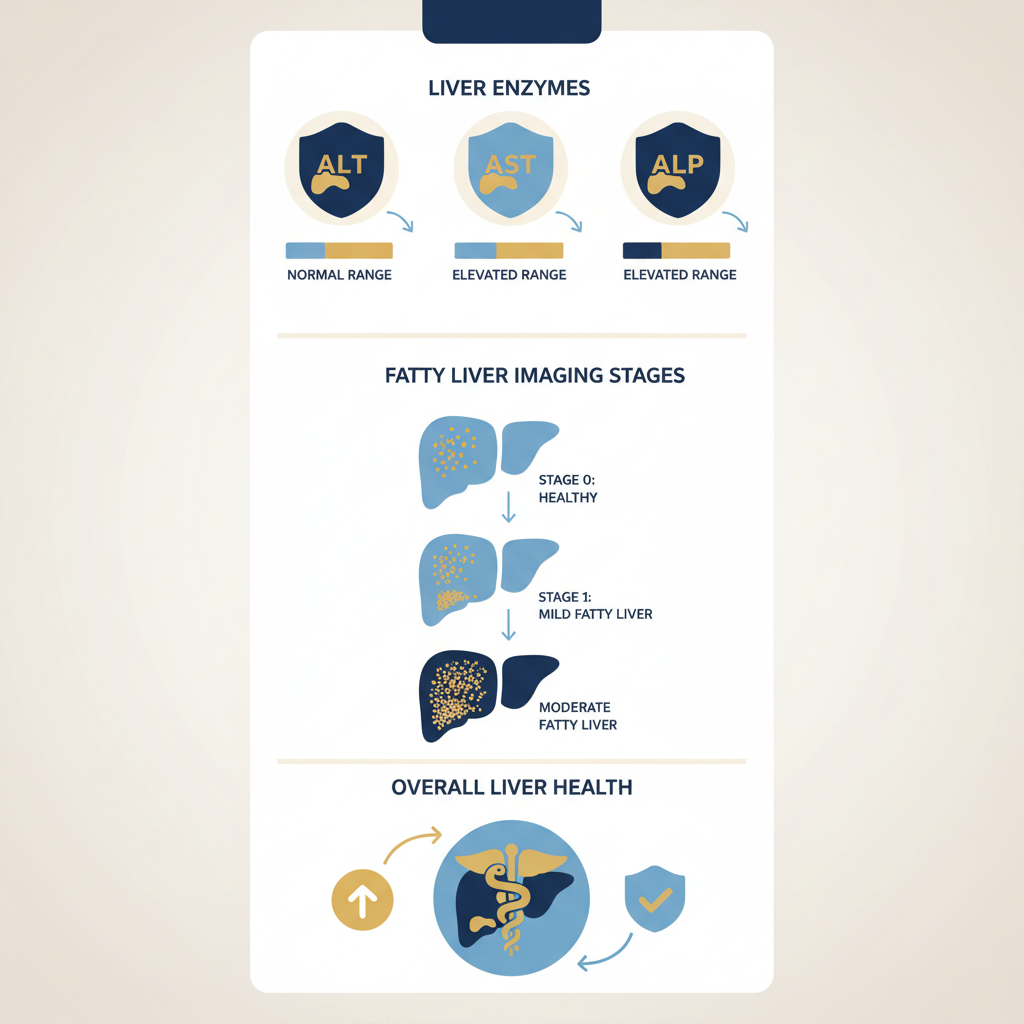
Decoding Liver Enzymes: What Do ALT, AST, and ALP Levels Mean?
Enzymes are the most common indicators in any liver report. Alanine Aminotransferase (ALT) is the most liver-specific enzyme; it is primarily found within liver cells, and its leakage into the blood often indicates inflammation or damage to these cells. Aspartate Aminotransferase (AST) is found in the liver but also in muscles and the heart, so its elevation alone doesn't always mean a liver problem. The ratio between AST and ALT is a tool professionals use to assess the type of damage. For example, in non-alcoholic fatty liver disease (NAFLD), ALT is often higher than AST. It is important to note that some people may show perfectly normal enzyme levels despite having fat on the liver, which explains why thin people get fatty liver and how tests can sometimes be deceptive. Alkaline Phosphatase (ALP) is an enzyme associated with the bile ducts, and its elevation may indicate a blockage or slow flow of bile. Understanding these enzymes helps you identify whether the challenge your liver faces relates to the cells themselves or the biliary drainage system.
Beyond Enzymes: Understanding Bilirubin, Albumin, and Platelets
While enzymes tell us about 'damage,' other markers tell us about 'function.' Albumin is the main protein made by the liver, and low levels may indicate a decline in the liver's synthetic capacity. Bilirubin is a byproduct of red blood cell breakdown, processed by the liver; thus, its elevation can cause jaundice (yellowing of the eyes and skin) and indicates a processing or drainage defect. A marker often overlooked is the platelet count; a healthy liver produces a hormone that regulates platelet production, and enlarged spleen associated with advanced liver issues can lead to low platelets. If your report shows a persistent drop in platelets with a slight rise in enzymes, it warrants a deep discussion with a professional. These biomarkers provide a deeper look at liver efficiency in performing vital tasks beyond temporary inflammation. In Canada, for example, where statistics show published population estimates vary by source, population, and reporting period, there is an increasing focus on this comprehensive panel for early detection of fibrosis.
Imaging Techniques and FibroScan: Seeing the Unseen
A liver health report is often incomplete without an imaging section. Ultrasound is the first tool for detecting a 'bright liver,' a term radiologists use to describe fatty liver. However, traditional ultrasound cannot accurately determine the degree of fibrosis. This is where techniques like FibroScan or elastography come in, measuring liver stiffness. FibroScan results usually show two units: CAP (measuring fat

Explore health education
Review the educational guides and practical tools related to this topic.
Explore the education hub