Evaluating Fasting Claims Online: A Step-by-Step Walkthrough for Discerning Fact from Fiction
Author: Feras Alayed
Published:
Category: intermittent-fasting
Reading Time: 6 minutes
Key Takeaways
- Claims promising instant or magical results are usually red flags.
- The link between fasting and blood sugar regulation is scientific but requires nuanced understanding.
- Using a journal helps you compare online claims with your actual lived experience.
- Complex terminology can sometimes be used to confuse rather than educate.
The Digital Information Maze: Why We Need a Filter
Imagine starting your day by opening your phone, only to find dozens of posts telling you that 'fasting for 20 hours will change your life in two days' or that 'butter coffee is the only secret to burning fat.' In our modern digital environment, where health advice spreads rapidly via social media and messaging apps, it's easy to fall into the trap of misinformation. Evaluating fasting claims online isn't just a secondary skill; it's a necessity to protect your daily routine and ensure you don't strain your body following inaccurate advice.
When you begin considering a lifestyle change, you must ask yourself the essential questions before considering fasting. These questions act as an initial compass, helping you determine if the claim you're reading aligns with your personal goals or if it's just digital noise.
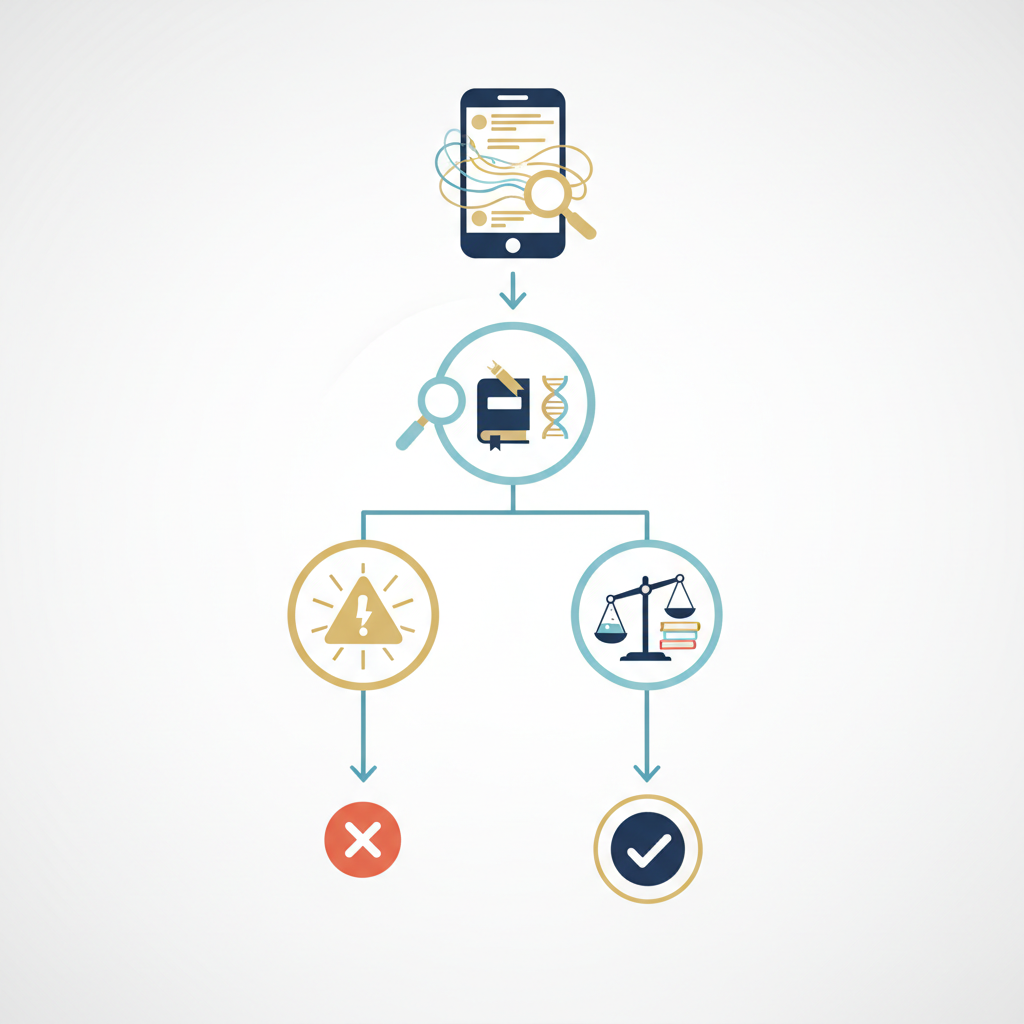
Morning Scenario: The 'Miracle' Instagram Reel
Let's look at a real-life example: Sarah, an office worker, spends 10 minutes scrolling through Instagram before work. She sees a video of an influencer claiming that intermittent fasting can 'cure all health problems' without exception. Here, the evaluation process begins. The first step is to look for 'hyperbolic language.' Science rarely uses words like 'always,' 'never,' or 'miracle.'
Instead of getting swept up in the excitement, Sarah starts to question the scientific basis. Is this claim backed by studies? Or is it just an individual experience? Understanding basic fasting terminology helps Sarah and others distinguish between 'autophagy' as a complex cellular process and its use as a mere marketing buzzword to attract views.
Decoding Terminology: Science or Marketing?
One of the biggest challenges in evaluating fasting claims online is the manipulation of terminology. You might find articles talking about 'instant fat burning' or 'hormonal reset' in overly simplified terms. The truth is that fasting affects the body in multiple ways, but they aren't magical.
When you read about 'eating windows' or 'water fasting,' you should ensure the source explains these terms clearly. Extraordinary claims require extraordinary evidence. If you find an article that lumps different types of fasting together without clarifying the differences, it's a sign to put more effort into your research. Education is your primary weapon, and recognizing correct terminology makes you less vulnerable to misinformation.
Biological Logic: Sugar and Energy Balance
Many online claims focus solely on weight loss, ignoring the most important aspect: internal balance. For instance, there is a close relationship between intermittent fasting and blood sugar control. When someone claims that fasting doesn't affect energy levels or sugar, they are ignoring a fundamental biological fact.
In a lunch scenario, Ahmed might read an article claiming that meal timing doesn't matter as long as you fast. However, by understanding how glucose is regulated, Ahmed realizes that meal distribution plays a vital role in his energy stability throughout the day. Evaluating claims requires linking information to biological logic: How does this affect my blood sugar? How will my body feel after 16 hours?
The Role of a Timing Journal in Fact-Checking
The best way to test the validity of any claim you see online is to compare it with your personal reality. This is where a meal timing journal comes in. Suppose you read a claim that fasting in the early morning gives you infinite energy. Instead of blindly believing it, you can document your experience for a week.
If you record in your journal that you feel extremely lethargic and have a headache at exactly 10 AM, then the 'general' claim doesn't apply to your 'specific' situation at the moment. The journal transforms you from a passive recipient of information into an active researcher in your own lab: your body. This tool helps you make decisions based on personal data rather than a passing trend.
Checklist: Fact vs. Fiction
| Claim Aspect | Sign of Fact | Sign of Fiction |
|---|---|---|
| Expected Results | Talks about gradual improvement and sustainability. | Promises very fast results (e.g., 10kg in a week). |
| Sources | Based on documented studies or expert opinions. | Based on a 'mysterious person's experience' or 'secrets doctors hide.' |
| Flexibility | Encourages listening to the body and adjusting. | Imposes very strict rules and claims it's the only way. |
| Comprehensiveness | Addresses side effects and warnings. | Presents fasting as a perfect solution with no flaws. |
Frequently Asked Questions
A: Look at the sources they cite. Do they mention studies? Do they acknowledge the limitations of the information? Reliability comes from transparency, not follower count.
Q: Is every claim about 'autophagy' true?A: No, autophagy is a complex process occurring at different levels. Claiming it starts immediately after a few hours of fasting is a misleading simplification of scientific reality.
Q: Why does fasting advice differ from one site to another?A: Because science is constantly evolving and bodies differ. The variance in advice reflects the complexity of human biology; therefore, documented personal experience is the ultimate decider.
Q: Should I always follow the new fasting 'trend'?A: Definitely not. Settling on a routine that fits your daily life is much better than jumping between different fads that may not suit your body's nature.
Medical Disclaimer: The information in this article is for educational and informational purposes only and is not considered medical advice. Always consult a physician or nutritionist before starting any fasting regimen or making significant changes to your diet, especially if you have chronic health conditions.
Related Articles
- Essential Questions Before Considering Fasting: A Comprehensive Guide
- Intermittent Fasting and Blood Sugar Control: How Glucose is Regulated
- Intermittent Fasting Glossary: Everything You Need to Know

Explore health education
Review the educational guides and practical tools related to this topic.
Explore the education hub