Understanding Cholesterol Test Terms: The Ultimate Myth vs. Fact Guide
Author: Feras Alayed
Published:
Updated:
Category: heart-health
Reading Time: 4 minutes
Key Takeaways
- Understanding cholesterol test terms is crucial for proactive heart health management.
- LDL and HDL serve different functions; balance is more important than just low total numbers.
- Triglycerides are energy fats that significantly impact cardiovascular risk.
- Lab reports should be viewed as a whole, not as isolated data points.
TL;DR Summary
Mastering the language of your heart starts with understanding cholesterol test terms. This guide breaks down the complex acronyms like LDL, HDL, and VLDL, debunks common misconceptions through a myth-vs-fact lens, and provides actionable steps to interpret your lipid profile alongside your healthcare provider for a healthier future.Decoding the Lipid Profile: What Do These Symbols Mean?
When you receive your lab results, terms like LDL, HDL, and VLDL can seem like an alphabet soup. However, understanding cholesterol test terms is the first step toward health empowerment. Cholesterol is a waxy, fat-like substance produced by your liver and found in certain foods. It doesn't travel through the blood alone; it requires "carriers" called lipoproteins.
Low-Density Lipoprotein (LDL) is often dubbed "bad" cholesterol. Its job is to deliver cholesterol to cells, but excess levels can lead to buildup in artery walls. Conversely, High-Density Lipoprotein (HDL) is the "good" cholesterol, acting as a scavenger that carries excess cholesterol back to the liver. Learning how to read nutrition labels for heart health directly complements your understanding of how dietary choices influence these lab numbers.
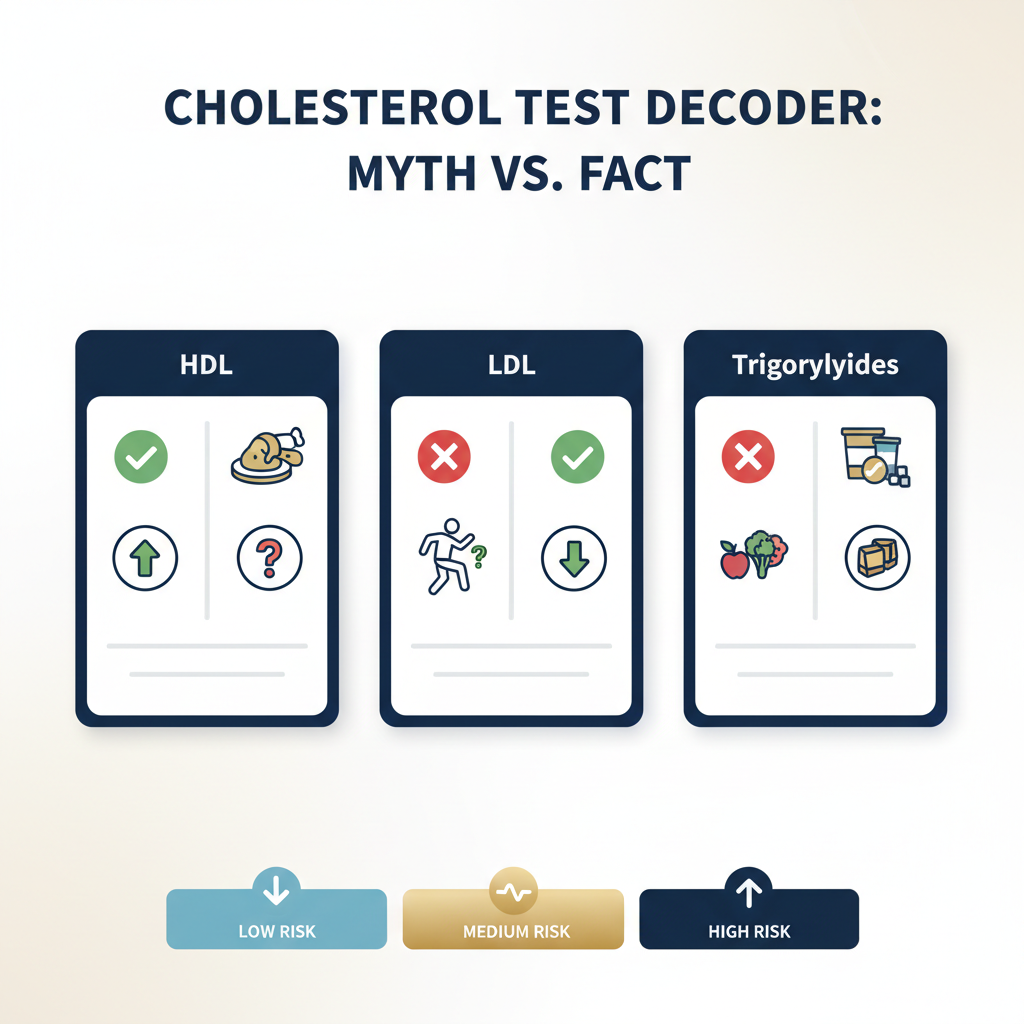
Cholesterol Myths vs. Facts
Feature: Myth vs. Fact
| Myth | Fact |
|---|---|
| Cholesterol is inherently poison. | It is vital for building cell membranes, producing hormones, and synthesizing Vitamin D. |
| Only older adults need to worry about cholesterol terms. | Lipid patterns can begin in childhood; early awareness supports long-term consistency in heart health. |
| A "normal" total cholesterol means I have no risk. | Total cholesterol doesn't show the full picture; the balance between LDL and HDL is a better indicator. |
| Exercise alone can fix any cholesterol issue. | While exercise supports healthy levels, genetics and diet also play significant roles. |
When understanding cholesterol test terms, it is vital to separate clinical reality from common misconceptions. This clarity helps you stay focused on what truly matters for your cardiovascular wellness without unnecessary stress.
Understanding Triglycerides and VLDL
Triglycerides are often overshadowed by cholesterol, but they are a critical component of your lipid profile. They are a type of fat (lipid) found in your blood that your body uses for energy. High levels are often linked to a diet high in processed sugars and fats. For those looking to manage these levels, exploring natural strategies for lowering triglycerides can provide evidence-based practical steps.
VLDL (Very Low-Density Lipoprotein) is another term you might see. Like LDL, it is considered "bad" because it contributes to plaque buildup, but it primarily carries triglycerides rather than cholesterol. Understanding these distinctions makes you better prepared for your next check-up. You might find our heart health appointment question list helpful for navigating these discussions with your doctor.
Ratios and Risk Scores: Interpreting the Data
Healthcare providers rarely look at numbers in isolation. They often calculate the "Cholesterol Ratio" (Total Cholesterol divided by HDL). A lower ratio generally suggests a lower risk. Another important term is "Non-HDL Cholesterol," which is your Total Cholesterol minus your HDL. This number accounts for all the potentially harmful lipoproteins in your blood.
In our modern, fast-paced lives, these ratios offer a more nuanced view of our health than a single number ever could. They help shift the focus from "passing a test" to maintaining a sustainable, heart-healthy lifestyle.
A Step-by-Step Guide to Your Lab Report
- Identify the Units: Check if results are in mg/dL or mmol/L to ensure you're comparing correctly.
- Look at the Reference Range: Labs provide a "normal" range, but remember that "optimal" is individualized.
- Check the Fasting Status: Note whether you fasted, as this significantly impacts triglyceride readings.
- Analyze the Ratios: Look at how your HDL compares to your Total Cholesterol.
Integrating Results into Your Daily Routine
Once you have mastered understanding cholesterol test terms, the real work begins. Knowledge is the foundation, but consistency is the key. Use your results as a roadmap to refine your routine—whether that means adjusting your grocery list, increasing your daily steps, or simply having a more informed conversation with your healthcare provider. This proactive approach supports better decision-making and long-term heart health stability.
Related Articles
- Reading Nutrition Labels for Heart Health: A Comprehensive Guide
- Triglycerides Lowering Natural Strategies: A Practical Guide
- Your Heart Health Appointment Question List

Explore health education
Review the educational guides and practical tools related to this topic.
Explore the education hubContinue your next step with ATHAR
Explore the official Feel Great member path, or learn about the creator partnership route if you are interested in sharing wellness education with your audience.
Explore Feel Great · Explore the Creator Affiliate gateway · Ask a question on WhatsApp