Mastering Your Personal Health Information Log: A Canadian Guide to Health Literacy
Author: Feras Alayed
Published:
Category: health-literacy
Reading Time: 9 minutes
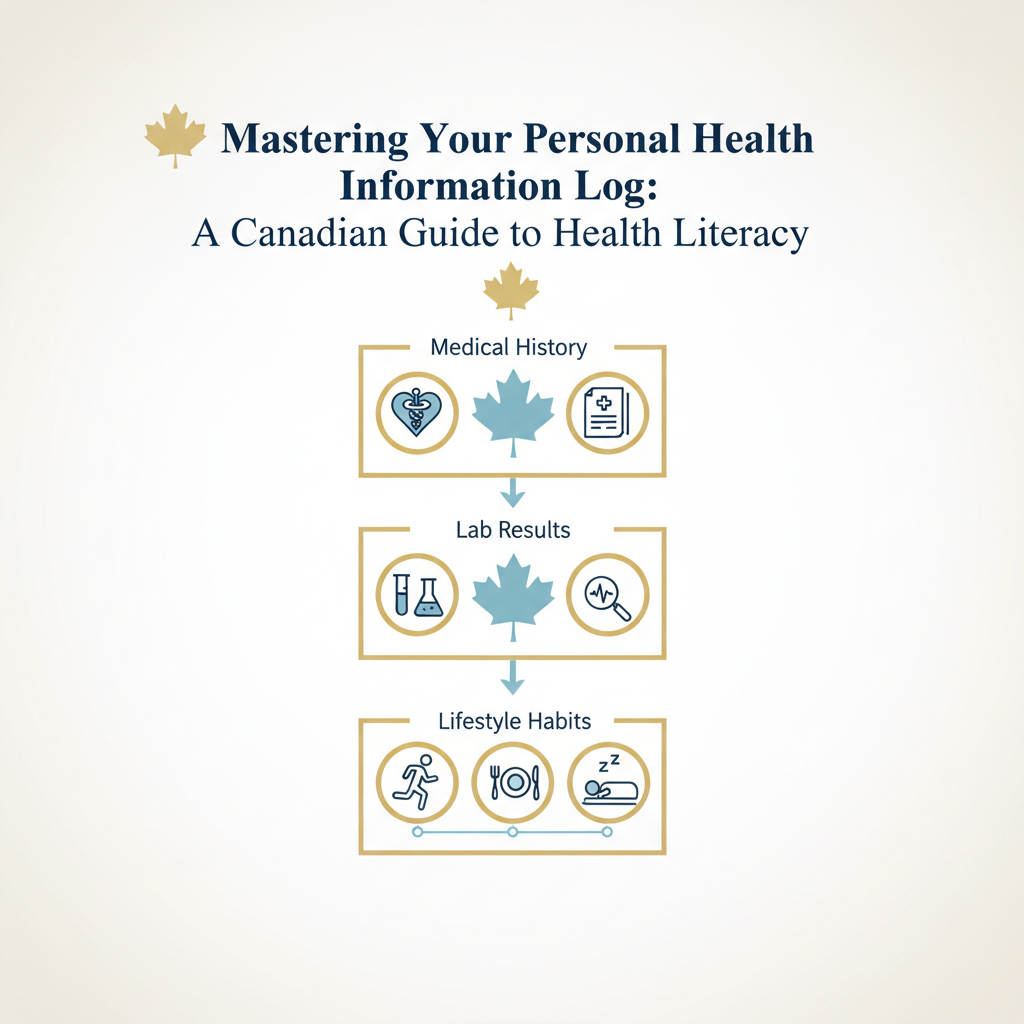
Key Takeaways
- A personal health information log empowers Canadians to bridge gaps between fragmented provincial health records.
- Tracking lab results in metric units (e.g., mmol/L for glucose) ensures accuracy during consultations.
- Organizing data by category—medications, immunizations, and family history—improves communication with healthcare providers.
- Privacy is paramount; ensure digital logs comply with Canadian privacy standards.
- Structured lifestyle approaches, such as the structured reflection approach, can be integrated into your log for consistency.
Introduction: The Challenge of Health Data
For many Canadians, managing health information feels like piecing together a complex puzzle. You might have records at a family doctor’s office in one city, specialist notes in another, and lab results stored in a provincial online portal. When you are asked about your last tetanus shot or your baseline blood glucose levels during a walk-in clinic visit, the struggle to recall specific details is a common lived problem. This fragmentation can lead to frustration, redundant testing, and a feeling of being disconnected from your own wellness journey.
The desired outcome for most is a sense of agency—knowing exactly where your data is and how it trends over time. Previous attempts to stay organized often fail because they lack a sustainable structure or fail to account for the unique aspects of the Canadian healthcare landscape. By developing a personal health information log in Canada, you move from being a passive recipient of care to an active participant in your health literacy.
Why a Personal Health Information Log Matters in Canada
Canada’s healthcare system is decentralized, with each province and territory managing its own records. While initiatives like Ontario Health’s digital tools or British Columbia’s Health Gateway are improving access, the responsibility of maintaining a comprehensive, lifelong history often falls on the individual. A personal log serves as a bridge between these systems.
Improved health literacy is not just about understanding medical terms; it is about having the right information available at the right time. When you maintain a log, you are better prepared for the limited time available during appointments. This organization is particularly vital for those managing chronic conditions or navigating transitions in care, such as moving between provinces. For more on the foundations of this knowledge, see our health literacy guide which, while focused on different regions, highlights the universal importance of data ownership.
Essential Components of Your Health Log
A robust personal health information log should be more than just a list of dates. It should be a living document that reflects your physiological history and lifestyle choices. Consider including the following sections:
1. Core Demographics and Contacts
List your full name, date of birth, provincial health insurance number, and emergency contacts. Include the names and contact details of all members of your healthcare team, including your primary care provider, specialists, and pharmacists.
2. Medical History and Diagnoses
Record chronic conditions, past surgeries, and significant injuries. Be specific with dates and the names of the attending clinicians. This section helps providers understand the context of new symptoms.
3. Medication and Supplement Record
Include the name of the medication, the dosage, the frequency, and the reason for taking it. In Canada, it is also helpful to note the DIN (Drug Identification Number). If you are using structured lifestyle programmes, note how these interact with your daily routine. For instance, understanding habit stacking for consistency can help you remember to log these entries daily.
4. Immunization Records
Keep a detailed list of vaccinations, including seasonal flu shots and COVID-19 boosters. This is especially important for Canadian travellers or those working in healthcare and education sectors.
5. Family Health History
Document the health history of immediate family members. This information is crucial for assessing your own risk factors for conditions like cardiovascular disease or certain cancers.
Understanding Canadian Metric Standards
One of the most critical aspects of health literacy in Canada is understanding how our lab results are reported. Unlike the United States, Canada uses the metric system for medical data. Accuracy in your log requires using the correct units.
- Blood Glucose: Reported in millimoles per litre (mmol/L). A typical fasting range might be between 4.0 and 6.0 mmol/L, though you should consult a professional for your specific targets.
- Cholesterol: Also measured in mmol/L.
- Weight and Height: Recorded in kilograms (kg) and centimetres (cm).
- Blood Pressure: Measured in millimetres of mercury (mmHg).
When you receive lab results, do not just file the paper. Transcribe the key numbers into your log. This allows you to see trends over months or years, which is often more informative than a single snapshot. For assistance in interpreting other types of data you might encounter, such as food labels that influence these numbers, refer to our Canadian nutrition label guide.
Accounting for Canadian Climate and Lifestyle
A personal health log should reflect the environment you live in. In Canada, seasonal changes significantly impact health. Your log might include sections for:
- Vitamin D Levels: Due to northern latitudes, many Canadians track their Vitamin D levels, especially during the winter months when sun exposure is minimal.
- Seasonal Allergies: Tracking pollen counts alongside your symptoms can help you and your doctor identify triggers specific to your region.
- Physical Activity: Note how your activity levels change between the summer and winter. Are you maintaining cardiovascular health during the colder months?
- Mental Health: Seasonal Affective Disorder (SAD) is a reality for many. Logging mood changes in relation to the time of year can provide valuable data for your healthcare provider.
Digital vs. Paper: Choosing Your Format
There is no one-size-fits-all approach to logging. The best system is the one you will actually use.
Paper Logs
Many prefer the simplicity of a binder with tabs. It is easy to bring to appointments and does not require a battery or internet connection. However, it is harder to back up and can be lost in a fire or flood.
Digital Logs
Apps and spreadsheets offer the ability to search data and create charts. Many Canadian provinces now offer patient portals where you can download your data as a PDF. If you choose a digital route, ensure you are using a secure, encrypted platform. You can also integrate insights from evaluating health claims to ensure the digital tools you use are based on sound logic rather than marketing myths.
Privacy and Security in the Canadian Context
Your health information is sensitive. In Canada, the Personal Information Protection and Electronic Documents Act (PIPEDA) sets the standard for how private-sector organizations handle personal information. When choosing a digital log or app:
- Check where the data is stored. Data stored on Canadian servers is subject to Canadian privacy laws.
- Use strong, unique passwords and two-factor authentication.
- Be cautious about sharing your log with third-party apps that may sell your data for marketing purposes.
If you are involved in health-related business or projects, understanding service-first marketing can help you distinguish between companies that prioritize your privacy and those that do not.
Structured Support: The structured reflection approach and Habit Stacking
Organizing a log is a habit, and like any habit, it requires a system. The structured reflection approach emphasizes a structured approach to lifestyle management. Rather than viewing health as a series of disconnected events, it suggests a holistic view where nutrition, movement, and data tracking work together.
This is not a cure or a medical treatment, but a framework for consistency. For example, you might use "habit stacking"—a technique where you perform your health logging immediately after a daily task like brushing your teeth or finishing your morning tea. By integrating your log into a wider lifestyle approach, you reduce the cognitive load required to stay organized. This method aligns with the leadership skills needed to manage one's own life effectively, as discussed in our guide on team building and project expansion, applied here to the "project" of your personal health.
Source-Verification Checklist
When adding information to your log or researching health topics, use this checklist to ensure the information is reliable for a Canadian context:
- [ ] Does the information come from a recognized Canadian body (e.g., Health Canada, Public Health Agency of Canada, or a provincial health authority)?
- [ ] Are the units of measurement consistent with Canadian standards (metric)?
- [ ] Is the content free from "miracle cure" language or guaranteed outcomes?
- [ ] Does the source cite peer-reviewed evidence rather than just testimonials?
- [ ] Is the information recent (within the last 3-5 years)?
For those who travel or compare health systems, you might find our grocery comparison guide useful for understanding how to evaluate information across different borders, though the focus remains on your primary Canadian records.

Frequently Asked Questions
How often should I update my personal health information log?
It is best to update your log immediately after any medical encounter, such as a doctor's visit, lab test, or change in medication. A monthly review of your lifestyle habits and metric trends is also recommended.
Can I ask my doctor for copies of my records in Canada?
Yes. Under provincial privacy laws, you have the right to access your medical records. Note that some offices may charge a small administrative fee for printing or transferring large files.
Should I include mental health information in my log?
Absolutely. Mental health is a vital component of your overall wellbeing. Tracking mood, sleep patterns, and stress levels can help identify correlations with physical health symptoms.
What should I do if I find an error in my provincial health record?
Contact the healthcare provider or the facility that generated the record. You have the right to request a correction or add a statement of disagreement to your file.
How do I track my fibre intake in my log?
You can use the information from Canadian nutrition labels to record the grams of fibre per serving. Tracking this alongside your energy levels and digestion can provide useful insights for your healthcare team.
Is the structured reflection approach a replacement for medical advice?
Medical Disclaimer
This article is for informational and educational purposes only and does not constitute medical advice, diagnosis, or treatment. The information provided is intended to support health literacy among Canadian readers and should not be used to replace the advice of a qualified healthcare professional. Always seek the advice of your physician or other qualified health provider with any questions you may have regarding a medical condition. Never disregard professional medical advice or delay in seeking it because of something you have read here. The structured reflection approach and related lifestyle approaches are not guaranteed to prevent, treat, or cure any disease. For a comprehensive look at health literacy in other contexts, see our comprehensive health literacy guide.
Ready to take the next step in your health journey? Start by understanding your current baseline.
ابدأ تقييمك الصحيFurther Education
- Explore the metabolic health education hub
- Learn how to read research summaries
- Use the educational health assessment
Explore the topic with reliable health education
Use ATHAR’s educational guides and practical tools to consider your next learning step.