Metabolic Health Sweden Public Health Report: Key Findings 2026
Author: Feras Alayed
Published:
Updated:
Category: swedish-health
Reading Time: 10 minutes
Key Takeaways
- Overweight and obesitas (obesity) are rising in Sweden: 54% of adults report overweight or obesitas (2004–2024 trend). ([folkhalsomyndigheten.se](https://www.folkhalsomyndigheten.se/vara-amnesomraden/overvikt-och-obesitas/overvikt-och-obesitas-i-befolkningen/overvikt-och-obesitas-hos-vuxna/?nav-open=true&utm_source=openai))
- About 600,000 people in Sweden live with diabetes today; type 2 diabetes makes up the majority. ([diabetes.se](https://www.diabetes.se/?utm_source=openai))
- Metabolic health (insulin sensitivity, blood lipids, waist circumference, blood pressure) is linked to brain and cardiovascular outcomes in Swedish research led by Karolinska and large cohorts like SCAPIS. ([news.ki.se](https://news.ki.se/light-physical-exercise-protects-people-with-metabolic-syndrome?utm_source=openai))
- Dietary patterns rooted in the Nordic diet and timing strategies (time-restricted eating) may help improve metabolic markers — evidence comes from multiple recent RCTs and meta-analyses. ([eatit.io](https://eatit.io/bra-mat-for-hjart-och-karlsystem/?utm_source=openai))
- What you can do now: visit your vårdcentral or 1177 for testing, aim for stable fasting glucose ~4.0–5.6 mmol/L, and use proven lifestyle approaches supported by Swedish guidelines and research. ([1177.se](https://www.1177.se/Varmland/barn--gravid/graviditet/graviditetsbesvar-och-sjukdomar/att-ha-diabetes-och-bli-gravid-varmland/?utm_source=openai))
TL;DR
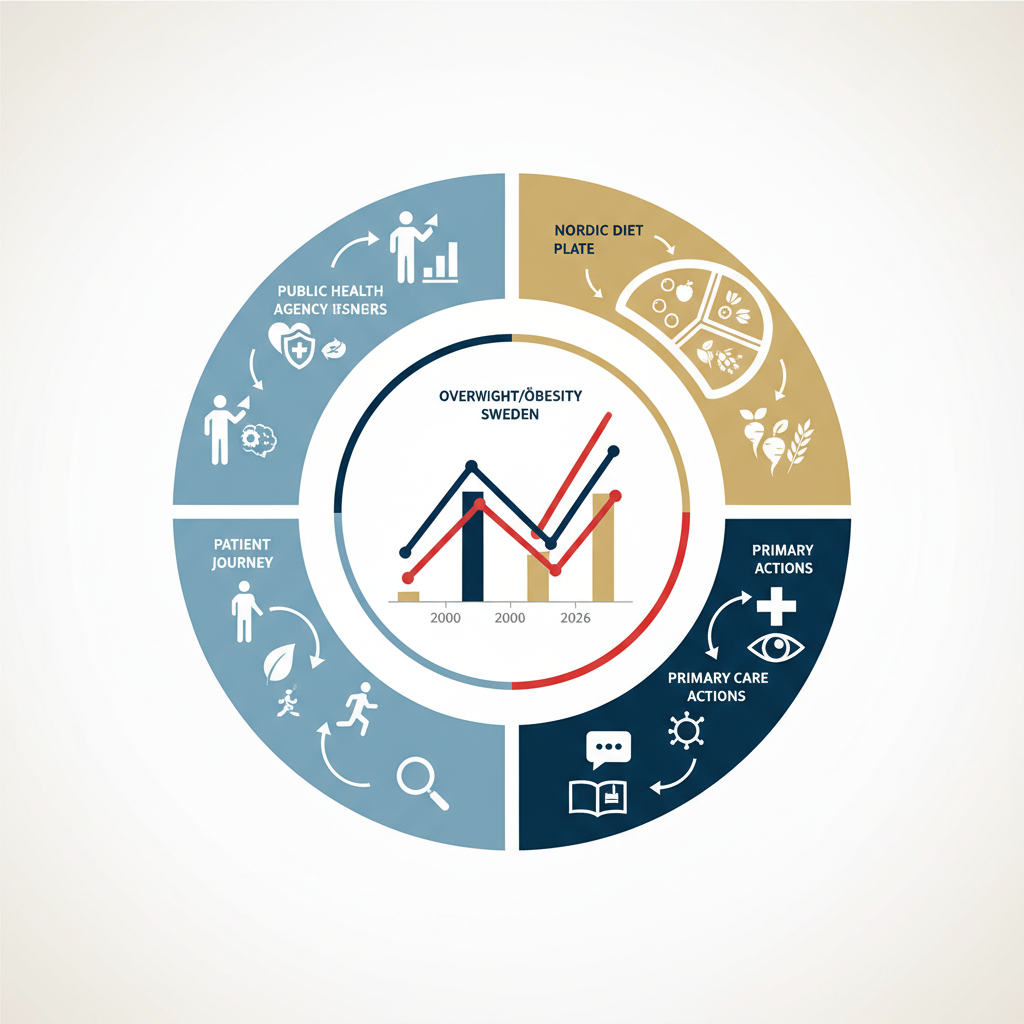
Sweden's public health data show rising overweight and obesitas, with near 600,000 people living with diabetes. National agencies (Folkhälsomyndigheten, Livsmedelsverket) and leading research centres (Karolinska, Sahlgrenska, SCAPIS) stress prevention through population policies and individual lifestyle changes. Time-restricted eating and the Nordic diet are supported by recent international meta-analyses as approaches that may help improve metabolic markers. ([folkhalsomyndigheten.se](https://www.folkhalsomyndigheten.se/vara-amnesomraden/overvikt-och-obesitas/overvikt-och-obesitas-i-befolkningen/overvikt-och-obesitas-hos-vuxna/?nav-open=true&utm_source=openai))
🇸🇪 Want to take action now? Try Feel Great → | Chat with a coach →
Introduction — a shocking Sweden statistic
Swedish national surveillance shows that between 2004 and 2024 the share of adults reporting either overweight or obesitas rose from 46% to 54% — a clear public-health signal that metabolic risk is widespread across age groups and regions. This increase is largest among younger adults (16–29 years), where overweight rose from just over 20% to just over 30%. ([folkhalsomyndigheten.se](https://www.folkhalsomyndigheten.se/vara-amnesomraden/overvikt-och-obesitas/overvikt-och-obesitas-i-befolkningen/overvikt-och-obesitas-hos-vuxna/?nav-open=true&utm_source=openai))
Why this matters: what is 'metabolic health'?
Metabolic health is a cluster of measurable traits — fasting blood glucose and insulin sensitivity, waist circumference (central adiposity), blood lipids (triglycerides, HDL), and blood pressure. When multiple traits are unfavourable we often describe the picture as metabolic syndrome, which is linked to higher risks for type 2 diabetes, cardiovascular disease and other complications. Swedish cohort work and national studies show these markers predict later disease and even brain ageing. ([clinicalnutritionjournal.com](https://www.clinicalnutritionjournal.com/article/S0261-5614%2823%2900450-8/fulltext?utm_source=openai))
What Sweden's Public Health Agency (Folkhälsomyndigheten) reports
Rising prevalence of overweight and obesitas
The agency's surveillance and Nationella folkhälsoenkäten indicate a clear upward trend: in 2024 about 54% of adults aged 16–84 reported overweight or obesitas, and obesitas of higher grades has increased threefold since 1980 for the highest BMI categories. These patterns vary by age, gender and education. ([folkhalsomyndigheten.se](https://www.folkhalsomyndigheten.se/vara-amnesomraden/overvikt-och-obesitas/overvikt-och-obesitas-i-befolkningen/overvikt-och-obesitas-hos-vuxna/?nav-open=true&utm_source=openai))
Diabetes figures and hidden burden
National associations estimate roughly 600,000 people living with diabetes in Sweden, and registry and survey data show an increase in type 2 diabetes incidence among younger adults. Public-health messaging emphasises early detection, follow-up via vårdcentral, and registry-based quality improvement in specialised care. ([diabetes.se](https://www.diabetes.se/?utm_source=openai))
Child and maternal health signals
Folkhälsomyndigheten's reports also highlight that overweight and obesitas among children and pregnant women are rising in many groups — with implications for early-life metabolic programming. National screening utilities (barnhälsovården data) inform local interventions. ([folkhalsomyndigheten.se](https://www.folkhalsomyndigheten.se/vara-amnesomraden/overvikt-och-obesitas/overvikt-och-obesitas-i-befolkningen/overvikt-och-obesitas-hos-gravida/?utm_source=openai))
Swedish research leadership and cohort evidence
Karolinska Institutet and other Swedish centres contribute crucial mechanistic and population-level evidence. Recent Karolinska-led papers link metabolic syndrome components to accelerated brain ageing and to other long-term risks, illustrating how metabolic health affects multiple organ systems. Large national cohorts like SCAPIS (supported by Hjärt-Lungfonden and Swedish universities) provide population-level insight into how lifestyle, stress and environment map to metabolic risk. ([nyheter.ki.se](https://nyheter.ki.se/metaboliskt-syndrom-kopplat-till-snabbare-aldrande-av-hjarnan?utm_source=openai))
Which lifestyle approaches have the best evidence?
1) Dietary pattern: the Nordic diet
Swedish dietary policy (Livsmedelsverket) aligns with the Nordic diet principles: whole grains (oats, rye), root vegetables, fatty and lean fish, legumes, berries, rapeseed oil and reduced processed foods. Modelling and population studies show better adherence to these patterns is associated with improved cardiometabolic markers. The agency has integrated the 2023 Nordic Nutrition Recommendations into updated national guidance. ([eatit.io](https://eatit.io/bra-mat-for-hjart-och-karlsystem/?utm_source=openai))
2) Timing: Time-restricted eating and meal timing
Recent randomised trials and high-quality meta-analyses show that early time-restricted eating (eating window earlier in the day) and other TRE protocols can modestly reduce fasting insulin and body weight and may improve some metabolic markers even without large calorie restriction. A recent network meta-analysis in BMJ Medicine synthesised RCTs comparing early versus late TRE and found improvements in fasting insulin and modest weight loss with early TRE. These interventions can be considered alongside diet quality for people exploring metabolic improvements. ([bmjmedicine.bmj.com](https://bmjmedicine.bmj.com/content/bmjmed/5/1/e001071.full.pdf?utm_source=openai))
3) Physical activity and sleep
Continuity of physical activity (prescribed FaR programs) and good sleep are repeatedly associated with better insulin sensitivity and lower prevalence of metabolic syndrome in Swedish and international studies. Interventions delivered through primary care and community programmes are a backbone of Sweden's prevention strategy. ([news.cision.com](https://news.cision.com/se/sahlgrenska-akademin-vid-goteborgs-universitet/r/kontinuitet-avgor-om-fysisk-aktivitet-pa-recept-ska-funka-for-de-minst-aktiva%2Cc3232481?utm_source=openai))
Clinical thresholds and testing in Sweden (use mmol/L)
For practical screening in Sweden: fasting plasma glucose ≥7.0 mmol/L on repeated testing indicates diabetes; fasting glucose 6.1–6.9 mmol/L commonly represents impaired fasting glucose in older cutoffs, while many guidelines consider fasting 5.6–6.9 mmol/L as a risk zone (prediabetes range when paired with HbA1c or OGTT). For everyday guidance, 1177 recommends clinical follow-up via your vårdcentral when home fasting glucose or symptoms are concerning; continuous glucose monitoring targets used in pregnancy and diabetes care are expressed in mmol/L (examples: CGM targets 3.5–7.8 mmol/L for a high proportion of time in pregnancy contexts). Always discuss thresholds with your clinician. ([socialstyrelsen.se](https://www.socialstyrelsen.se/globalassets/sharepoint-dokument/artikelkatalog/ovrigt/metodbeskrivning-kunskapsunderlag-graviditetsdiabetes.pdf?utm_source=openai))
Public-health response: what Swedish agencies recommend
Folkhälsomyndigheten emphasises community and policy measures (food environment, school meals, physical activity infrastructure) and individual support through primary care to curb long-term trends. Livsmedelsverket updates dietary guidance based on NNR2023. Swedish clinical guidelines and registries focus on early detection, structured lifestyle support, and access to specialised care when needed. ([folkhalsomyndigheten.se](https://www.folkhalsomyndigheten.se/vara-amnesomraden/overvikt-och-obesitas/faktorer-som-paverkar-overvikt-och-obesitas/samhallsforandringar-och-overvikt-och-obesitas/?nav-open=true&utm_source=openai))
How Feel Great Fits — a practical, evidence-aware support system
Feel Great is positioned as a lifestyle support system (not a medication) that may complement the public-health and clinical approaches described above. Key elements and how they relate to metabolic health:
- Balance (soluble fiber matrix) — a fiber-rich matrix that may help reduce post-meal glucose excursions by slowing carbohydrate absorption. This aligns with dietary strategies to moderate postprandial glycaemia supported by clinical nutrition evidence. (Note: not a treatment; may help as part of overall diet changes.)
- Unimate (yerba mate extract) — contains chlorogenic acids and caffeine-like stimulants that may support energy and mental clarity. Chlorogenic acids have been studied for glucose and lipid effects in multiple trials; effects are variable and context-dependent. Use as an adjunct to behaviour change, not as a substitute for clinical care. ([mdpi.com](https://www.mdpi.com/2077-0383/12/11/3699?utm_source=openai))
- 4-4-12 intermittent fasting protocol — a time-structured eating plan that adapts time-restricted eating principles to everyday life. TRE evidence from recent meta-analyses shows early or structured eating windows can modestly improve metabolic markers for some people when combined with healthy food choices. ([bmjmedicine.bmj.com](https://bmjmedicine.bmj.com/content/bmjmed/5/1/e001071.full.pdf?utm_source=openai))
- Evidence base and safety — Feel Great materials reference >50 clinical studies in its PDR listing; the system is intended as lifestyle support (diet, timing, fibre and plant extracts) alongside medical care when needed. Always check with your vårdcentral or diabetes team (via 1177) before changing medications or if you have diabetes treated with insulin or sulfonylureas. ([1177.se](https://www.1177.se/Varmland/barn--gravid/graviditet/graviditetsbesvar-och-sjukdomar/att-ha-diabetes-och-bli-gravid-varmland/?utm_source=openai))
Practical steps for people in Sweden
- Check your numbers: book a blodprov (blood test) at your vårdcentral via 1177 to measure fasting glucose, HbA1c, lipids and blood pressure if you haven't in the last 12 months. ([1177.se](https://www.1177.se/Varmland/barn--gravid/graviditet/graviditetsbesvar-och-sjukdomar/att-ha-diabetes-och-bli-gravid-varmland/?utm_source=openai))
- Diet first: aim for a Nordic-style plate — whole grains, vegetables, fish, legumes and berries; reduce processed foods and sugar-sweetened drinks. Follow Livsmedelsverket guidance for portion and variety. ([eatit.io](https://eatit.io/bra-mat-for-hjart-och-karlsystem/?utm_source=openai))
- Try timing: if appropriate for your schedule and health, consider an earlier eating window (e.g., 8–10 hours) as evidence suggests early TRE may lower fasting insulin. Discuss with your clinician if you take glucose-lowering medications. ([bmjmedicine.bmj.com](https://bmjmedicine.bmj.com/content/bmjmed/5/1/e001071.full.pdf?utm_source=openai))
- Move regularly: aim for meeting national activity targets and use FaR-prescriptions if offered at your region's healthcare. SCAPIS and other Swedish studies show sustained activity helps metabolic markers. ([gu.se](https://www.gu.se/forskning/fysisk-aktivitet-och-halsa?utm_source=openai))
- Use support tools: community programmes, registered dietitians at your vårdcentral, and structured systems like Feel Great may provide accountability and practical tools for diet, fibre intake and timing. Always coordinate with clinical care. ([vardgivarwebben.norrbotten.se](https://vardgivarwebben.norrbotten.se/sv/vardriktlinjer/endokrina-sjukdomar/kliniska-kunskapsstod/obesitas-hos-vuxna/?selectionCode=profession_specialiserad_vard&utm_source=openai))
People Also Ask
- What does the Public Health Agency say about obesity trends in Sweden? — Folkhälsomyndigheten reports rising overweight/obesitas from 46% to 54% in 2004–2024 and increases in higher obesity grades. ([folkhalsomyndigheten.se](https://www.folkhalsomyndigheten.se/vara-amnesomraden/overvikt-och-obesitas/overvikt-och-obesitas-i-befolkningen/overvikt-och-obesitas-hos-vuxna/?nav-open=true&utm_source=openai))
- How many Swedes have diabetes? — Around 600,000 people; most have type 2 diabetes, with rising cases among younger adults. ([diabetes.se](https://www.diabetes.se/?utm_source=openai))
- Can the Nordic diet improve metabolic health? — National guidance (Livsmedelsverket) and observational studies associate Nordic patterns with better cardiometabolic markers; RCTs focus on components (whole grains, fish, vegetables). ([eatit.io](https://eatit.io/bra-mat-for-hjart-och-karlsystem/?utm_source=openai))
- Is time-restricted eating safe in Sweden? — TRE has been studied in adults and may improve some metabolic markers; people with diabetes or on glucose-lowering meds should consult their vårdcentral. ([bmjmedicine.bmj.com](https://bmjmedicine.bmj.com/content/bmjmed/5/1/e001071.full.pdf?utm_source=openai))
- Where do I go for tests and follow-up? — Start at your vårdcentral or via 1177.se where you can book blodprov and get referral guidance. ([1177.se](https://www.1177.se/Varmland/barn--gravid/graviditet/graviditetsbesvar-och-sjukdomar/att-ha-diabetes-och-bli-gravid-varmland/?utm_source=openai))
FAQ
- Q: What fasting glucose value should worry me?
A: Repeated fasting plasma glucose ≥7.0 mmol/L suggests diabetes and needs clinical follow-up. Values in the 5.6–6.9 mmol/L range may indicate increased risk and warrant lifestyle measures and testing including HbA1c or OGTT. Discuss with your vårdcentral. ([socialstyrelsen.se](https://www.socialstyrelsen.se/globalassets/sharepoint-dokument/artikelkatalog/ovrigt/metodbeskrivning-kunskapsunderlag-graviditetsdiabetes.pdf?utm_source=openai)) - Q: Does intermittent fasting 'cure' metabolic syndrome?
A: No single approach cures metabolic syndrome. TRE and calorie reduction can improve markers for many people, but results vary. TRE may be a useful tool combined with diet quality, movement and clinical care. ([pmc.ncbi.nlm.nih.gov](https://pmc.ncbi.nlm.nih.gov/articles/PMC10630127/?utm_source=openai)) - Q: Is the Nordic diet evidence-based?
A: Yes — the Nordic diet is grounded in the Nordic Nutrition Recommendations (NNR) and Livsmedelsverket guidance; population studies show favourable associations with cardiometabolic health. ([nutritionsfakta.se](https://nutritionsfakta.se/post_taxonomy/aktuellt3/?utm_source=openai)) - Q: How can primary care help?
A: Your vårdcentral can order tests (glucose, HbA1c, lipids), provide lifestyle counselling, refer to dietitians, and follow national registries and guidelines. Use 1177.se for appointments and information. ([1177.se](https://www.1177.se/Varmland/barn--gravid/graviditet/graviditetsbesvar-och-sjukdomar/att-ha-diabetes-och-bli-gravid-varmland/?utm_source=openai)) - Q: Can supplements or extracts replace lifestyle change?
A: Supplements or extracts (e.g., yerba mate/chlorogenic acids) may offer small metabolic effects in some studies but cannot replace diet, physical activity or medical care. They may be considered as adjuncts after discussing with healthcare providers. ([mdpi.com](https://www.mdpi.com/2077-0383/12/11/3699?utm_source=openai))
References & Scientific Sources
- Folkhälsomyndigheten — Overvikt och obesitas i befolkningen (nationell statistik, 2004–2024). ([folkhalsomyndigheten.se](https://www.folkhalsomyndigheten.se/vara-amnesomraden/overvikt-och-obesitas/overvikt-och-obesitas-i-befolkningen/overvikt-och-obesitas-hos-vuxna/?nav-open=true&utm_source=openai))
- Diabetes Sverige / Svenska Diabetesförbundet — Diabetes statistics and Diabetesrapporten 2025 (≈600,000 people with diabetes in Sweden). ([diabetes.se](https://www.diabetes.se/?utm_source=openai))
- Livsmedelsverket — National dietary guidance and references to the Nordic diet and NNR2023. ([nutritionsfakta.se](https://nutritionsfakta.se/post_taxonomy/aktuellt3/?utm_source=openai))
- Karolinska Institutet — Recent research on metabolic syndrome and brain ageing; mechanistic studies on insulin and adipocytes. ([nyheter.ki.se](https://nyheter.ki.se/metaboliskt-syndrom-kopplat-till-snabbare-aldrande-av-hjarnan?utm_source=openai))
- Sahlgrenska / SCAPIS — Population data linking lifestyle, stress and metabolic markers. ([gu.se](https://www.gu.se/forskning/fysisk-aktivitet-och-halsa?utm_source=openai))
- BMJ Medicine — Network meta-analysis on timing and eating duration of TRE and metabolic outcomes (2023–2026 synthesis). ([bmjmedicine.bmj.com](https://bmjmedicine.bmj.com/content/bmjmed/5/1/e001071.full.pdf?utm_source=openai))
- JAMA Network Open — Systematic review and meta-analysis on meal timing and metabolic outcomes. ([jamanetwork.com](https://jamanetwork.com/journals/jamanetworkopen/fullarticle/2825747?utm_source=openai))
- JCEM — Meta-analysis of TRE RCTs and metabolic efficacy. ([academic.oup.com](https://academic.oup.com/jcem/article/107/12/3428/6747530?login=false&utm_source=openai))
- WHO European Regional Obesity Report 2022 — obesity trends and policy implications across Europe. ([who.int](https://www.who.int/europe/news/item/03-05-2022-new-who-report--europe-can-reverse-its-obesity--epidemic?utm_source=openai))
- Swedish clinical guidance resources (1177; VISS and regional guidelines) — testing thresholds, primary care pathways and diabetes follow-up. ([1177.se](https://www.1177.se/Varmland/barn--gravid/graviditet/graviditetsbesvar-och-sjukdomar/att-ha-diabetes-och-bli-gravid-varmland/?utm_source=openai))
Note: Additional Swedish studies and clinical trials are cited inline above (Karolinska, Sahlgrenska, SCAPIS) and international systematic reviews and RCTs are included to reflect the most recent evidence. Where specific numeric claims are made (e.g., prevalence, glucose thresholds) Swedish national sources and clinical guidelines were prioritised. ([folkhalsomyndigheten.se](https://www.folkhalsomyndigheten.se/vara-amnesomraden/overvikt-och-obesitas/overvikt-och-obesitas-i-befolkningen/overvikt-och-obesitas-hos-vuxna/?nav-open=true&utm_source=openai))

Medical Disclaimer
This article is for information only and does not replace medical advice. If you suspect you have high blood sugar, metabolic syndrome or any health condition, contact your vårdcentral or use 1177.se to book tests and appointments. Lifestyle systems such as Feel Great are supportive tools and are not medications; discuss any changes to diet, fasting or supplements with your clinician, especially if you are taking glucose-lowering medications or pregnant. ([1177.se](https://www.1177.se/Varmland/barn--gravid/graviditet/graviditetsbesvar-och-sjukdomar/att-ha-diabetes-och-bli-gravid-varmland/?utm_source=openai))
Related ATHAR paths
🇸🇪 Ready to Start Your Health Transformation?
Join thousands across Sweden who have improved their metabolic health with the Feel Great system. Backed by 50+ clinical studies and listed in the Physicians' Desk Reference (PDR).
✅ Free Delivery in Sweden | 90-Day Money-Back Guarantee