Team Development Indicators: Reviewing Progress Practically
Author: Feras Alayed
Published:
Updated:
Category: business-opportunity
Reading Time: 10 minutes
- Focus on qualitative and quantitative team development indicators to ensure a holistic view of progress.
- Avoid the pitfalls of micromanagement by setting clear expectations and fostering psychological safety.
- Use a 30/60/90-day framework to guide new team members through their learning and integration phases.
- Regular feedback loops are essential for identifying skill gaps and providing targeted support.
- Leadership growth is a continuous process of discovering suitability and refining service-oriented skills.
Introduction: The Balance of Leadership Oversight
One of the most significant challenges facing modern leaders is determining how to review team progress without stifling creativity or creating a culture of fear. When we talk about team development indicators (مؤشرات تطوير الفرق), we are referring to the specific markers that signal whether a group is moving toward its objectives effectively and ethically. The goal is not to monitor every minute of a team member's day, but to understand the trajectory of their growth and the health of their collaborative efforts. How does a leader distinguish between a temporary setback and a systemic issue? How can you ensure that your team is developing the necessary skills to provide high-quality service? These questions form the foundation of professional leadership and are critical for anyone considering a partnership path in business education or professional services.
Defining Team Development Indicators (مؤشرات تطوير الفرق)
To lead effectively, one must first define what progress looks like. Team development indicators are not limited to final outcomes; they encompass the behaviors, skills, and processes that lead to those outcomes. These indicators can be broadly categorized into two types: quantitative and qualitative. Quantitative indicators might include the number of tasks completed, response times to customer inquiries, or the consistency of meeting project deadlines. Qualitative indicators, on the other hand, focus on the 'how'—the quality of communication, the level of trust within the team, and the ability of members to solve problems independently. For instance, evaluating tracking skills in a professional context often requires looking at how information is processed and applied, much like the principles discussed in our health literacy guide on evaluation and tracking skills. Understanding these nuances allows a leader to provide support where it is most needed rather than where it is most visible.
The Role of Role Clarity
Progress is impossible without clarity. A primary indicator of a developing team is the degree to which every member understands their specific responsibilities and how their work contributes to the larger mission. Role clarity reduces overlap, prevents conflict, and empowers individuals to take ownership of their tasks. When reviewing progress, a leader should ask: 'Does the team member know what success looks like for this specific role?' and 'Do they have the resources necessary to achieve it?' This is particularly important when scaling projects and building teams, as the complexity of roles increases with the size of the organization.
Qualitative Indicators: The Human Element of Progress
While numbers provide a snapshot of activity, qualitative indicators provide the context. A team that meets all its deadlines but suffers from high burnout or low morale is not developing sustainably. Key qualitative markers include:
- Psychological Safety: The ability for team members to admit mistakes, ask questions, and propose new ideas without fear of retribution.
- Conflict Resolution: How the team handles disagreements. A developing team moves from avoiding conflict to addressing it constructively.
- Adaptability: The speed and efficiency with which the team adjusts to new information or changing market conditions.
- Ethical Alignment: The degree to which the team’s actions reflect the organization’s core values and commitment to service.
In many professional environments, especially those involving wellness or service, the ability to ask the right questions is a vital skill. Just as a patient must prepare for a health visit by asking the right questions, a team member must be empowered to ask clarifying questions about their objectives and the impact of their work.
Quantitative Indicators: Measuring Operational Efficiency
Quantitative data serves as the 'dashboard' for team progress. However, these metrics must be chosen carefully to avoid encouraging the wrong behaviors. If a leader only tracks the number of calls made, the team may prioritize quantity over the quality of service. Better indicators might include:
- Cycle Time: The time it takes to move a project from initiation to completion.
- Error Rates: The frequency of mistakes that require rework, which can signal a need for further training.
- Goal Attainment: The percentage of SMART (Specific, Measurable, Achievable, Relevant, Time-bound) goals met within a given period.
- Customer Satisfaction: Feedback from those served by the team, which is the ultimate measure of service quality.
For individuals managing their own professional development, tracking progress might involve choosing the right wellness routine to maintain the energy levels required for high-level leadership and consistent performance.
Avoiding the 'Exaggeration Trap' in Progress Reviews
It is tempting for leaders to exaggerate progress to stakeholders or, conversely, to exaggerate problems to justify stricter control. Both approaches are counterproductive. Authentic leadership requires an honest assessment of where the team stands. Exaggerating success can lead to complacency and the ignoring of underlying issues, while exaggerating failures can destroy team morale and trust. Practical review sessions should be grounded in evidence and focused on solutions. Instead of saying 'everything is perfect,' a leader might say, 'We have achieved 80% of our targets, and we have identified a specific training gap in the remaining 20% that we are addressing this month.'
The Dangers of Micromanagement
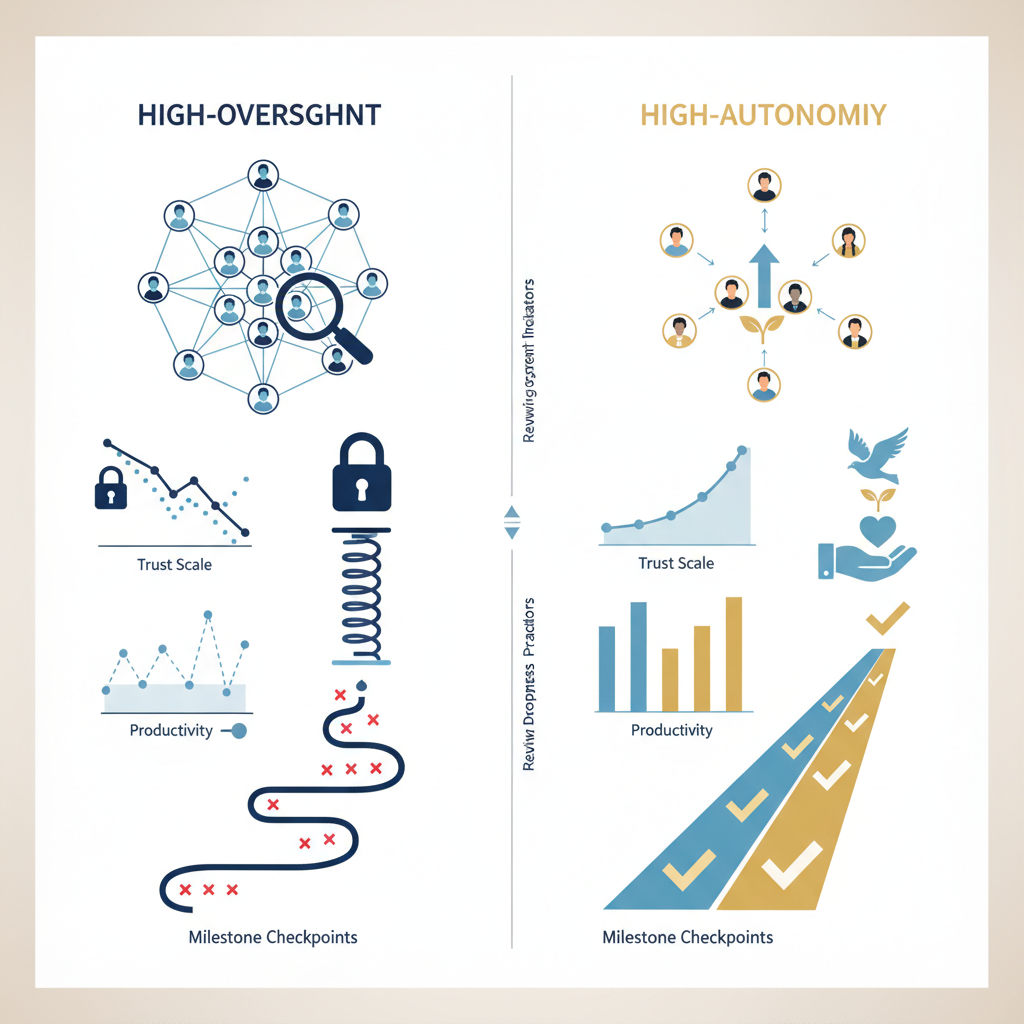
Micromanagement is often a symptom of a leader's anxiety or a lack of trust in the team's development. It involves excessive supervision and a focus on trivial details. This behavior stifles the very team development indicators a leader should be nurturing, such as autonomy and problem-solving. To avoid this, leaders should focus on 'what' needs to be achieved and 'why,' while allowing the team significant leeway in 'how' they achieve it, provided they stay within ethical and operational boundaries.
The 30/60/90-Day Development Framework
When a new member joins a team or a partner begins their journey, progress should be measured against a realistic learning curve. A standard framework includes:
| Phase | Focus Area | Key Indicators |
|---|---|---|
| Day 1-30: Learning | Orientation and Skill Acquisition | Understanding of systems, completion of initial training, and building relationships. |
| Day 31-60: Integration | Application and Contribution | Active participation in meetings, handling basic tasks independently, and seeking feedback. |
| Day 61-90: Impact | Ownership and Optimization | Taking full responsibility for assigned roles, identifying improvements, and contributing to team goals. |
This structured approach ensures that expectations are managed and that the individual is not overwhelmed. It also provides clear milestones for the leader to review progress without being intrusive. During this time, maintaining personal focus is key, and some may find that integrating specific habits, such as those discussed in the guide to Unimate and Balance, supports the mental clarity needed for intensive learning phases.
How This Connects to the Partnership Path
The principles of monitoring team development are central to the partnership path offered through our educational initiatives. This path is not a shortcut to success but a rigorous journey of skill discovery and leadership development. It is designed for individuals who are committed to ethical service and professional growth. The partnership path involves learning how to manage yourself first, then how to lead others by applying the very indicators discussed in this article. Those who succeed in this path are typically those who prioritize role clarity, consistent effort, and a deep commitment to the needs of their customers. If you are interested in exploring whether you have the skills and mindset required for this type of leadership, we encourage you to explore whether the partnership path suits you. It is important to note that financial outcomes in any professional endeavor depend on individual effort, market conditions, and adherence to established policies. There are no guarantees of income or specific timelines for results; the focus remains on the quality of service and the development of professional competencies.
People Also Ask
- What are the most important team development indicators? The most important indicators include role clarity, psychological safety, goal attainment, and the ability of the team to solve problems without constant intervention.
- How often should I review my team's progress? While informal feedback should be continuous, formal reviews are often most effective on a monthly or quarterly basis, depending on the pace of the projects.
- How can I track progress without micromanaging? Focus on outcomes and milestones rather than the minute-by-minute activities of your team. Establish clear KPIs and trust your team to execute their roles.
- What should I do if a team member is not meeting development indicators? Identify the root cause—is it a lack of skills, resources, or clarity? Provide targeted support and training, and set clear, achievable goals for improvement.
- How does leadership style affect team development? A supportive, coaching-oriented leadership style tends to foster faster development and higher engagement than a directive or controlling style.
Frequently Asked Questions (FAQ)
How do I balance quantitative and qualitative metrics?
Balance is achieved by ensuring that data (quantitative) is always interpreted through the lens of human behavior and team culture (qualitative). Use data to identify trends and qualitative feedback to understand the 'why' behind those trends.

What is the best way to provide feedback on progress?
The best feedback is specific, timely, and focused on behavior rather than personality. Use the 'SBI' model: describe the Situation, the Behavior observed, and the Impact it had.
Can team development indicators change over time?
Yes, as a team matures, the indicators will shift. A new team may focus on basic communication and role clarity, while a mature team may focus on innovation and high-level efficiency.
How do I handle a situation where the team is meeting targets but morale is low?
This suggests that the current pace or methods are unsustainable. You should investigate the qualitative indicators, such as workload, psychological safety, and recognition, to address the underlying issues.
Is the partnership path suitable for everyone?
The partnership path requires a specific set of skills, including self-discipline, a service-oriented mindset, and a willingness to engage in continuous learning. It may not suit those looking for passive involvement or guaranteed outcomes without effort.
Disclaimer: The information provided in this article is for educational and informational purposes only and does not constitute professional financial, legal, or management advice. All partnership policies, eligibility requirements, and program details must be independently verified with official ATHAR documentation before publication or commitment. This content does not provide patient health education, disease claims, or product treatment promises. Any references to wellness products are for general information and should not be taken as medical advice. Financial outcomes in any professional partnership are not guaranteed and depend entirely on individual effort, skill, and market conditions.
Further Education
- Explore the metabolic health education hub
- Learn how to read research summaries
- Use the educational health assessment
Evaluate the path with clarity
Use the decision guide to review eligibility, responsibilities, policies, and questions that require confirmation from official programme sources. No financial outcome is promised.