Understanding Inflammatory Markers: A Comprehensive Guide to Your Body's Warning Signals
Author: Feras Alayed
Published:
Updated:
Category: chronic-inflammation
Reading Time: 8 minutes
- Inflammatory markers are proteins or biological signs that rise when the body responds to a threat.
- CRP and ESR tests are the most common, but they don't pinpoint the exact location of inflammation.
- Silent chronic inflammation can be detected via the high-sensitivity hs-CRP test.
- Lifestyle factors, including sleep and stress, directly impact these readings.
What are Inflammatory Markers? Definitions and Basics
Inflammatory markers are biological substances, often proteins, released by the body into the bloodstream in response to specific stimuli such as infection, injury, or oxidative stress. In the context of Inflammation Education, we consider these markers as an 'early warning system'. When the body faces a threat, the liver and immune system secrete these substances to coordinate defense and repair. The scientific term for this process falls under inflammation terminology, describing how the body communicates internally.
It is crucial to understand that the presence of these markers is not inherently bad; inflammation is a necessary survival mechanism. The problem lies in the persistence of these markers at high levels over long periods, indicating a state of chronic inflammation. In many cultures, we often associate pain with inflammation, but science tells us that much inflammation is 'silent' and does not cause immediate pain, which is where laboratory tests become essential. You can refer to the Inflammation Education Pillar for a deeper understanding of these vital processes.
Common Blood Tests for Inflammation: CRP, ESR, and Beyond
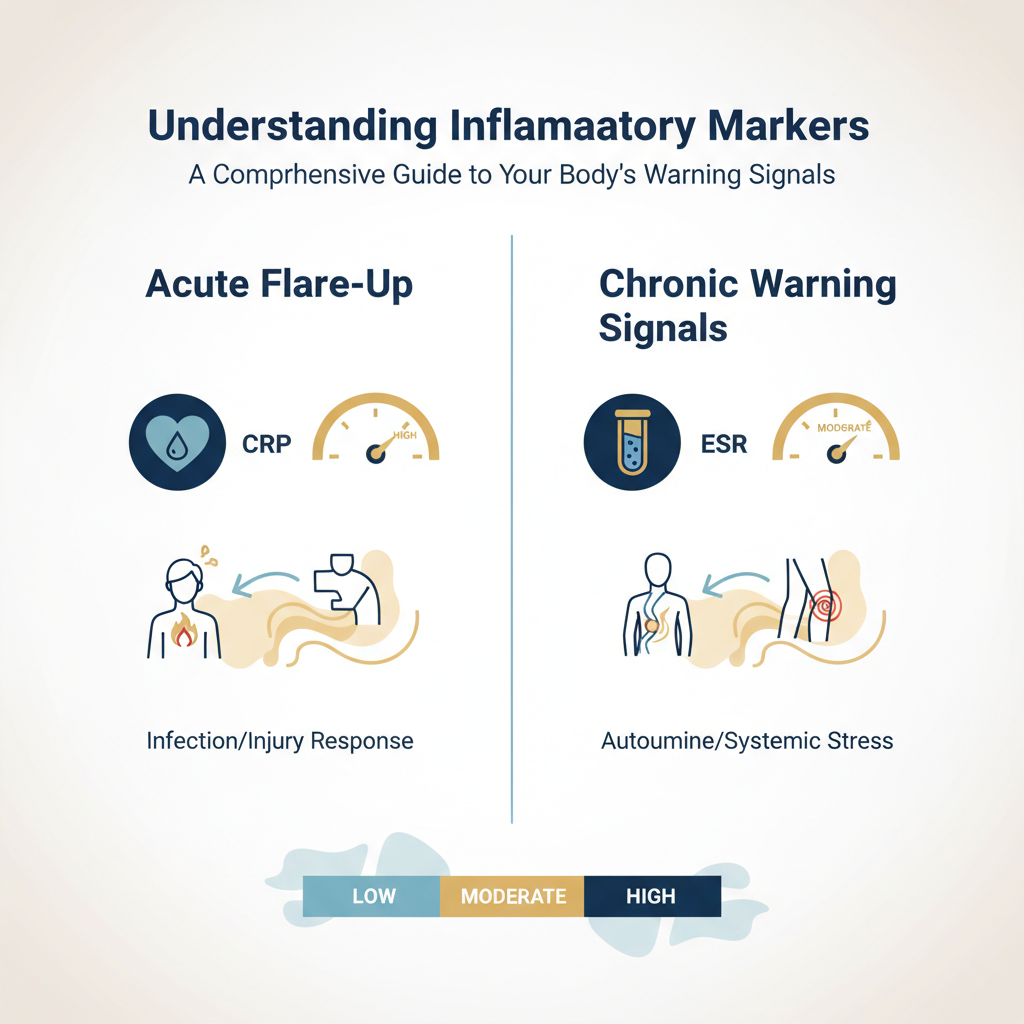
When a doctor orders an 'inflammation test,' they are usually referring to two main tests. The first is C-Reactive Protein (CRP). CRP is a protein produced by the liver that rises very quickly during acute inflammation. There is an advanced version called hs-CRP (high-sensitivity), which is a powerful tool for detecting very low levels of inflammation that may increase the risk of heart disease. If you find your levels are elevated, there are effective ways to lower high hs-CRP levels naturally involving diet and physical activity adjustments.
The second test is the Erythrocyte Sedimentation Rate (ESR). This test measures how quickly red blood cells sink in a test tube. In the presence of inflammation, cells clump together and become heavier, causing them to settle faster. Additionally, inflammatory marker terms might include other tests like Ferritin (an iron storage protein that also acts as an inflammatory marker) and Fibrinogen. Understanding these terms helps when reading inflammation research related to your health, as each marker provides a different piece of the overall puzzle.
Acute vs. Chronic Markers: Why Timing Matters
Acute inflammation is a rapid, short-term reaction, such as what happens when you have the flu or a cut on your finger. In this case, markers like CRP jump to very high levels and then return to normal once healing occurs. Chronic inflammation, however, is a 'slow fire' that lasts for months or years. Here, markers may not be glaringly high, but they remain consistently above the ideal range. This type of inflammation is a major driver of many modern health issues.
There is a close connection between inflammation and autoimmune diseases, where the body fails to turn off the inflammatory response and begins attacking its own tissues. In these cases, inflammatory markers become a tool for monitoring disease activity and the body's response to treatment. Distinguishing between a transient spike and a sustained elevation is the key to correct diagnosis, which is why doctors often prefer to retest after a period to see the general trend rather than a single isolated reading.
Lifestyle Impact on Inflammatory Markers
Our daily lifestyle directly affects these markers. A diet high in refined sugars and hydrogenated oils is a potent trigger for raising CRP. Conversely, studies have shown that fasting, such as during Ramadan, may contribute to lowering certain inflammatory markers in healthy individuals by giving the digestive and immune systems a rest period. Stress associated with life and work pressures raises cortisol levels, which in turn affects the balance of inflammatory markers.
Sleep also plays a pivotal role. Chronic late nights and disruption of the circadian rhythm lead to elevated levels of pro-inflammatory cytokines. If you are looking to improve your readings, focusing on 'natural anti-inflammatories' like turmeric, extra virgin olive oil, and garlic can have a tangible positive effect. Remember that these markers are a mirror of your daily choices, not just static numbers in a lab report.
Interpreting Results: What the Numbers Mean in Your Report
When you receive your lab report, you will find a 'reference range.' It is important to know that 'normal' does not always mean 'optimal.' For example, in an hs-CRP test, a lab might consider any number below 3 mg/L as normal, but from a preventive medicine perspective, a number below 1 mg/L is preferred to minimize cardiovascular risk. This distinction is a core part of Inflammation Education. Numbers must always be linked to clinical symptoms and a person's health history.
If your results are slightly elevated, there is no need to panic. The cause could be as simple as strenuous exercise the day before the test or poor sleep the previous night. However, persistent elevation requires deeper investigation. Using a clinician question list will help you understand whether these numbers require medical intervention or just lifestyle changes. The readings are a compass guiding you toward areas in your body that need attention.
The Connection to Chronic Disease: When Do Markers Become Dangerous?
Consistently elevated levels of inflammatory markers are linked to a wide range of chronic diseases, including type 2 diabetes, obesity, and heart disease. Inflammation causes a state of 'insulin resistance,' making blood sugar control harder. Furthermore, chronic inflammation in the arterial walls is what leads to plaque buildup and atherosclerosis. In recent years, research has also linked inflammation to brain health, suggesting that chronic elevation may contribute to cognitive decline.
Understanding the inflammation and autoimmune disease connection illustrates how markers like ESR can predict flares in conditions like rheumatoid arthritis or lupus. Monitoring these signs allows doctors to adjust medications before joint or organ damage worsens. It is a proactive battle; the more we succeed in keeping these markers within optimal ranges, the better our chances of preventing age-related diseases, a concept sometimes called 'Inflammaging.'
Common Mistakes in Understanding Inflammatory Markers
Many people make mistakes when dealing with inflammation tests, most notably: 1) Taking the test while having a cold or flu, which gives false-positive high results for chronic status. 2) Relying on a single test to make major health decisions; markers are volatile and require monitoring the trend over time. 3) Ignoring slight elevations that fall within the lab's 'normal range' but indicate low-grade inflammation. 4) Believing that lowering the marker with medication alone is the solution, without addressing the root cause like diet or stress. 5) Failing to inform the doctor about supplements you are taking, as some can affect lab results. To avoid these errors, it is helpful to follow effective ways to lower hs-CRP levels based on sound scientific principles and sustainable changes.
Questions You Can Discuss with a Licensed Professional
At your next doctor's visit, don't just settle for hearing 'your results are fine.' Use this clinician question list to deepen the dialogue: What is my exact hs-CRP number, not just the range? Is my ESR consistent with my age and gender? Is there a need to retest in a month to confirm the trend? How do my current medications affect these markers? Do you recommend additional tests like Ferritin or Homocysteine for a clearer picture? These questions transform you from a passive recipient of information into an active participant in managing your health. Remember that understanding inflammatory marker terms gives you the power to make informed decisions based on your body's biological data.
Common Myths Needing Scrutiny
- Myth: Elevated CRP always means a bacterial infection. Fact: It can rise due to extreme stress, obesity, or even very intense exercise.
- Myth: If my inflammatory markers are normal, I am perfectly healthy. Fact: Some localized inflammations may not

Explore health education
Review the educational guides and practical tools related to this topic.
Explore the education hub