الالتهاب المزمن في كندا: جذور الأمراض الحديثة وتأثيرها الصحي
Author: Feras Alayed
Published:
Updated:
Category: canadian-health
Reading Time: 10 minutes
النقاط الأساسية
- الالتهاب المزمن هو عامل مشترك في أمراض القلب والسكري والسرطان وأمراض الكبد والاضطرابات العقلية — وهو منتشر في كندا مع 45% تقريبًا من البالغين لديهم مرض مزمن واحد على الأقل. ([www150.statcan.gc.ca](https://www150.statcan.gc.ca/n1/pub/82-570-x/2024001/section2-eng.htm?kref=PDHQ79dnafoQ&kuid=d2764e67-718a-4ae1-9ab0-df56eaf7fd8b-1762732800&utm_source=openai))
- مؤشرات الدم مثل البروتين التفاعلي C (hs‑CRP) ترتبط بزيادة خطر الإصابة بمرض السكري من النوع 2 وأمراض القلب؛ الأدلة الحديثة (تحليلات شاملة) تدعم هذا الارتباط. ([pubmed.ncbi.nlm.nih.gov](https://pubmed.ncbi.nlm.nih.gov/33686799/?utm_source=openai))
- النظام الغذائي (اتباع مبادئ دليل الغذاء الكندي)، النشاط البدني، النوم، التحكم في الإجهاد وفقدان الوزن يمكن أن يقللوا مؤشرات الالتهاب ويخفضوا مخاطر الأمراض المزمنة. ([canada.ca](https://www.canada.ca/en/health-canada/services/food-guide.html?utm_source=openai))
- العلاجات المضادة للالتهاب الموضوعة سريريًا مثل الكولشيسين وأدوية تثبيط IL‑1 أظهرت فوائد في أحداث القلب لدى مجموعات مختارة من المرضى؛ هذا لا يجعلها بديلاً للرعاية الطبية التقليدية. ([pubmed.ncbi.nlm.nih.gov](https://pubmed.ncbi.nlm.nih.gov/42291081/?utm_source=openai))
- منظومة Feel Great (Balance، Unimate، وبروتوكول الصيام 4‑4‑12) قد تُستخدم كأدوات داعمة نمطية لتقليل استجابة السكر بعد الوجبات وتحسين الطاقة، ولكنها ليست أدوية ويجب استخدامها ضمن نهج شامل تحت إشراف مقدم رعاية صحية. (يشحن إلى جميع المقاطعات من BC إلى Newfoundland).
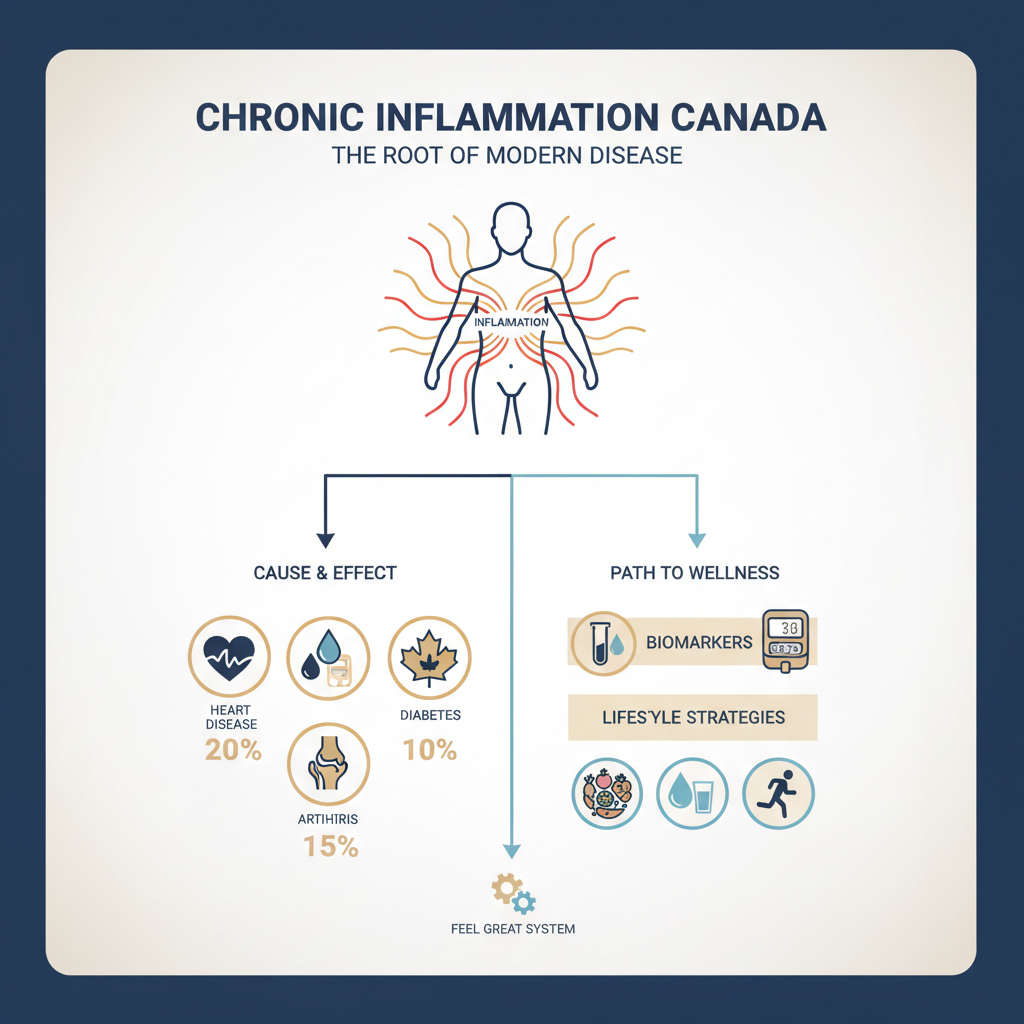
TL;DR
الالتهاب المزمن في كندا يعد «جذر» العديد من الأمراض المزمنة — من مرض القلب والسكري إلى أمراض الكبد والاضطرابات العصبية. تعديل النظام الغذائي (اتّباع دليل الغذاء الكندي)، فقدان الوزن، النشاط والحيلولة دون فرط الجلوكوز بعد الوجبات يمكن أن يخففا الإشارات الالتهابية؛ الأدلة الحديثة، بما فيها تحليلات منهجية وتجارب عشوائية، تدعم هذا. يتوجب على الأشخاص التنسيق مع مقدمي الرعاية وهمية الاعتماد على حلول نمطية داعمة مثل Feel Great. ([health-infobase.canada.ca](https://health-infobase.canada.ca/ccdi/?utm_source=openai))
🇨🇦 آلاف الكنديين يستخدمون Feel Great لدعم صحتهم الأيضية بشكل طبيعي. اعرف المزيد واطلب من هنا ←
Chronic Inflammation in Canada: The Root of Modern Disease (الالتهاب المزمن في كندا: جذور الأمراض الحديثة)
Introduction — A shocking Canadian statistic
Nearly half of Canadians live with at least one chronic disease: national surveillance shows a chronic‑disease prevalence around 45% (Canadian Community Health Survey data summarized by Statistics Canada / PHAC). That high burden is tightly linked to chronic, low‑grade inflammation — the slow burn that's often invisible until disease appears. ([www150.statcan.gc.ca](https://www150.statcan.gc.ca/n1/pub/82-570-x/2024001/section2-eng.htm?kref=PDHQ79dnafoQ&kuid=d2764e67-718a-4ae1-9ab0-df56eaf7fd8b-1762732800&utm_source=openai))
What is chronic inflammation and why it matters
Inflammation is the immune system’s normal response to injury or infection. Acute inflammation is short‑lived and helpful; chronic inflammation is low‑grade, persistent and systemic — sometimes called “inflammaging” when associated with ageing — and it contributes to atherosclerosis, type‑2 diabetes (T2D), nonalcoholic fatty liver disease (NAFLD), many cancers, arthritis and cognitive decline. ([pubmed.ncbi.nlm.nih.gov](https://pubmed.ncbi.nlm.nih.gov/35159168/?utm_source=openai))
How clinicians and researchers measure inflammation
Common blood markers include high‑sensitivity C‑reactive protein (hs‑CRP), interleukins (IL‑6, IL‑1β), TNF‑α and other cytokines. Elevated hs‑CRP has been associated in cohort studies and meta‑analyses with higher risk of incident T2D and cardiovascular events (pooled RR ~1.7 for top vs bottom hs‑CRP strata in meta‑analysis). These biomarkers help quantify the inflammatory environment that drives disease risk. ([pubmed.ncbi.nlm.nih.gov](https://pubmed.ncbi.nlm.nih.gov/33686799/?utm_source=openai))
The Canadian picture — prevalence, risk factors and provincial differences
National surveillance (PHAC, Statistics Canada and CIHI) documents rising rates of obesity, metabolic risk and multimorbidity across provinces. Overall chronic disease prevalence hovers near 45% in Canada, with notable provincial variation (lower in some northern jurisdictions, higher in provinces with older populations). These differences affect access to primary care, specialist services and preventive programmes offered by provincial health systems (Ontario, BC, Alberta, Quebec). ([www150.statcan.gc.ca](https://www150.statcan.gc.ca/n1/pub/82-570-x/2024001/section2-eng.htm?kref=PDHQ79dnafoQ&kuid=d2764e67-718a-4ae1-9ab0-df56eaf7fd8b-1762732800&utm_source=openai))
Behavioural drivers common in Canada — diets high in ultra‑processed foods, physical inactivity (exacerbated by long winters in parts of the country), stress and vitamin D insufficiency during winter months — amplify systemic inflammation. Health Canada’s guidance (Canada’s Food Guide) and provincial public health programmes are central levers to reverse these trends. ([canada.ca](https://www.canada.ca/en/health-canada/services/food-guide.html?utm_source=openai))
The science linking chronic inflammation to major diseases
Type 2 diabetes and metabolic disease
Large systematic reviews and meta‑analyses show that pro‑inflammatory diets or high inflammatory biomarkers predict higher risk of incident T2D. In Canada, Diabetes Canada recognises the role of inflammation and insulin resistance in the pathogenesis of T2D and includes inflammatory pathways in research priorities. Diagnostic thresholds used in Canada: fasting plasma glucose ≥7.0 mmol/L or A1C ≥6.5% diagnose diabetes; targets for most people with diabetes aim for fasting/preprandial 4.0–7.0 mmol/L and 2‑hour postprandial 5.0–10.0 mmol/L. ([pubmed.ncbi.nlm.nih.gov](https://pubmed.ncbi.nlm.nih.gov/35685508/?utm_source=openai))
Cardiovascular disease (CVD)
Atherosclerosis is now understood as an inflammatory disease. Randomized trials and meta‑analyses of anti‑inflammatory therapies (e.g., canakinumab, colchicine) demonstrated reductions in major adverse cardiovascular events in selected populations, supporting inflammation as a causal pathway in coronary disease. These findings have driven interest in anti‑inflammatory strategies that are safe and scalable. ([nejm.org](https://www.nejm.org/doi/full/10.1056/NEJMoa2021372?utm_source=openai))
Nonalcoholic fatty liver disease (NAFLD) and liver health
Chronic low‑grade inflammation is central to the progression from steatosis to steatohepatitis and fibrosis. Canadian liver research and patient groups emphasise lifestyle approaches — weight loss, physical activity and cardiometabolic risk reduction — as first‑line measures to lower hepatic inflammation. ([health-infobase.canada.ca](https://health-infobase.canada.ca/ccdi/?utm_source=openai))
Brain health, depression and cancer
Persistent inflammatory signalling is implicated in neurodegeneration, depression and some cancers. Reviews on inflammaging describe how lifelong exposures and metabolic stressors raise pro‑inflammatory cytokines that contribute to age‑related diseases. Interventions that lower systemic inflammation may therefore influence long‑term risk trajectories. ([pubmed.ncbi.nlm.nih.gov](https://pubmed.ncbi.nlm.nih.gov/35159168/?utm_source=openai))
Evidence for lifestyle interventions to lower inflammation
High‑quality evidence ranks dietary pattern interventions, weight loss and exercise as effective for lowering inflammatory markers. Systematic reviews show that Mediterranean and plant‑forward dietary patterns reduce hs‑CRP and other markers; calorie restriction and improved metabolic health lower inflammaging signals. Canada's Food Guide aligns with these anti‑inflammatory food patterns and is the recommended public resource. ([food-guide.canada.ca](https://food-guide.canada.ca/sites/default/files/artifact-pdf/Evidence%20review%20supporting%20Canada%27s%20food%20guide%20-%202025%20summary.pdf?utm_source=openai))
Key measurable targets used in Canada (examples): aiming for fasting glucose in the 4.0–7.0 mmol/L range for people with diabetes; reducing waist circumference and body mass index (BMI) to improve inflammatory profiles; and monitoring hs‑CRP as a research or clinical adjunct in high‑risk patients. ([diabetes.ca](https://www.diabetes.ca/DiabetesCanadaWebsite/media/FilesUploaded/Quick_Reference_Guide_PRINT_10_24-2.pdf?utm_source=openai))
Practical anti‑inflammatory plan for Canadians (evidence-based)
- Diet: Follow Canada’s Food Guide plate (more vegetables/fruit, whole grains, plant proteins, and less processed foods and added sugars). Consider Mediterranean or plant‑based patterns for stronger anti‑inflammatory effects. ([canada.ca](https://www.canada.ca/en/health-canada/services/food-guide.html?utm_source=openai))
- Move more: Aim for at least 150 minutes/week of moderate activity plus strength sessions; exercise reduces IL‑6 and CRP over time. ([pubmed.ncbi.nlm.nih.gov](https://pubmed.ncbi.nlm.nih.gov/35219904/?utm_source=openai))
- Sleep & stress: Prioritise 7–9 hours/night; cognitive and mindfulness interventions reduce stress‑related inflammatory signalling. ([pubmed.ncbi.nlm.nih.gov](https://pubmed.ncbi.nlm.nih.gov/35588939/?utm_source=openai))
- Weight: A 5–10% weight loss often lowers hs‑CRP and improves insulin sensitivity. ([pubmed.ncbi.nlm.nih.gov](https://pubmed.ncbi.nlm.nih.gov/35685508/?utm_source=openai))
- Post‑meal glucose control: Reducing postprandial glucose spikes (keeping post‑prandial values nearer 5.0–8.0 mmol/L where appropriate) lowers glycaemic‑related inflammatory responses. ([diabetes.ca](https://www.diabetes.ca/DiabetesCanadaWebsite/media/FilesUploaded/Quick_Reference_Guide_PRINT_10_24-2.pdf?utm_source=openai))
- Medical care: Regular checkups with your family doctor or walk‑in clinics (provincial systems vary — e.g., Ontario Health, Alberta Health Services, BC Health) for screening (lipids, blood pressure, glucose/A1C) and vaccination. Use provincial prevention programmes and community supports. ([cihi.ca](https://www.cihi.ca/en/quick-stats?utm_source=openai))
Medications and targeted anti‑inflammatory therapies — what the evidence says
Clinical trials show targeted anti‑inflammatory drugs can reduce cardiovascular events in specific high‑risk groups (e.g., canakinumab, colchicine). However, their cost, side effects and narrow indications mean they are not population‑wide solutions. Lifestyle remains the foundational strategy for population health. ([pubmed.ncbi.nlm.nih.gov](https://pubmed.ncbi.nlm.nih.gov/42291081/?utm_source=openai))
How Feel Great may help (a practical, non‑pharmacologic support)
Feel Great is a lifestyle support system (not a medication) that combines three pillars: Balance (a soluble fibre matrix designed to modulate post‑meal glucose response), Unimate (yerba mate extract rich in chlorogenic acids for energy and clarity), and the 4‑4‑12 intermittent fasting protocol. These elements are presented as complementary tools that may help reduce postprandial glycaemic excursions, improve metabolic markers and support consistent energy and decision making—factors that indirectly influence inflammatory burden. Use as part of a broader plan (dietary changes per Canada’s Food Guide, activity, sleep, medical care). Feel Great ships across Canada (BC to Newfoundland); consult a healthcare provider before using if you have diabetes, pregnancy, or are on medication. (Language: may help/ may support; not a treatment claim.)
People also ask
- What causes chronic inflammation in Canada? — Diet, inactivity, obesity, smoking, pollution, chronic infections and age‑related immunosenescence are key drivers; social determinants (income, access) also matter. ([www150.statcan.gc.ca](https://www150.statcan.gc.ca/n1/pub/82-570-x/2024001/section2-eng.htm?kref=PDHQ79dnafoQ&kuid=d2764e67-718a-4ae1-9ab0-df56eaf7fd8b-1762732800&utm_source=openai))
- Can I measure my inflammation? — Blood tests such as hs‑CRP and cytokine panels can indicate systemic inflammation, but interpretation should be clinical. ([pubmed.ncbi.nlm.nih.gov](https://pubmed.ncbi.nlm.nih.gov/33686799/?utm_source=openai))
- Which foods reduce inflammation? — Vegetables, fruit, whole grains, oily fish, nuts, legumes and olive oil (patterns similar to Mediterranean diet / Canada’s Food Guide). ([canada.ca](https://www.canada.ca/en/health-canada/services/food-guide.html?utm_source=openai))
- Does exercise lower inflammation? — Yes; regular moderate exercise reduces CRP and inflammatory cytokines over time. ([pubmed.ncbi.nlm.nih.gov](https://pubmed.ncbi.nlm.nih.gov/35219904/?utm_source=openai))
- When should I see my doctor? — If you have persistent fatigue, unexplained weight changes, rising glucose (fasting ≥7.0 mmol/L) or other risk markers, seek medical assessment. ([diabetes.ca](https://www.diabetes.ca/health-care-providers/clinical-practice-guidelines/chapter-3?utm_source=openai))
FAQ
- 1. Is chronic inflammation reversible?
- Many drivers of low‑grade inflammation are modifiable: diet, weight, activity, sleep and smoking cessation can lower biomarkers and risk. Some inflammatory diseases (e.g., autoimmune disorders) require medical care. ([pubmed.ncbi.nlm.nih.gov](https://pubmed.ncbi.nlm.nih.gov/35219904/?utm_source=openai))
- 2. Should I test hs‑CRP at my regular checkup?
- Discuss with your clinician. hs‑CRP can be useful for risk stratification in some individuals but is not universally required. It may be more informative when combined with other risk factors. ([pubmed.ncbi.nlm.nih.gov](https://pubmed.ncbi.nlm.nih.gov/33686799/?utm_source=openai))
- 3. Does intermittent fasting reduce inflammation?
- Evidence is growing: time‑restricted eating and certain fasting protocols can improve metabolic markers and may reduce inflammatory signalling, especially when combined with healthy eating and weight loss. More Canada‑specific RCTs are emerging. ([pubmed.ncbi.nlm.nih.gov](https://pubmed.ncbi.nlm.nih.gov/35219904/?utm_source=openai))
- 4. Are supplements effective to reduce inflammation?
- Some nutrients (omega‑3s, vitamin D when deficient, polyphenols) show modest benefits in trials, but supplements should complement—not replace—diet and lifestyle changes. Follow Health Canada guidance and check NPNs for marketed products. ([pubmed.ncbi.nlm.nih.gov](https://pubmed.ncbi.nlm.nih.gov/35219904/?utm_source=openai))
- 5. Can lowering blood sugar reduce inflammation?
- Yes. Studies show improved glycaemic control (keeping fasting and postprandial glucose nearer guideline targets e.g., fasting 4.0–7.0 mmol/L) reduces inflammatory markers and downstream organ risk. ([diabetes.ca](https://www.diabetes.ca/DiabetesCanadaWebsite/media/FilesUploaded/Quick_Reference_Guide_PRINT_10_24-2.pdf?utm_source=openai))
References & Scientific Sources
- Statistics Canada / PHAC: Health outcomes and chronic disease prevalence (Canadian Community Health Survey summary). ([www150.statcan.gc.ca](https://www150.statcan.gc.ca/n1/pub/82-570-x/2024001/section2-eng.htm?kref=PDHQ79dnafoQ&kuid=d2764e67-718a-4ae1-9ab0-df56eaf7fd8b-1762732800&utm_source=openai))
- Public Health Agency of Canada — Canadian Chronic Disease Indicators / CCDI. ([health-infobase.canada.ca](https://health-infobase.canada.ca/ccdi/?utm_source=openai))
- CIHI Quick Stats (hospitalization and chronic disease data). ([cihi.ca](https://www.cihi.ca/en/quick-stats?utm_source=openai))
- Health Canada — Canada’s Food Guide and dietary guidance. ([canada.ca](https://www.canada.ca/en/health-canada/services/food-guide.html?utm_source=openai))
- Diabetes Canada — Clinical Practice Guidelines (diagnosis, glycaemic targets). ([diabetes.ca](https://www.diabetes.ca/health-care-providers/clinical-practice-guidelines/chapter-3?utm_source=openai))
- Heart & Stroke Foundation — Anti‑inflammatory diet guidance (Canada). ([heartandstroke.ca](https://www.heartandstroke.ca/articles/the-anti-inflammatory-diet?utm_source=openai))
- Dietary Inflammatory Index & Type 2 Diabetes — Meta‑analysis (PubMed). ([pubmed.ncbi.nlm.nih.gov](https://pubmed.ncbi.nlm.nih.gov/35685508/?utm_source=openai))
- IL‑1β and Type 2 Diabetes — Systematic review & meta‑analysis (PubMed). ([pubmed.ncbi.nlm.nih.gov](https://pubmed.ncbi.nlm.nih.gov/35966098/?utm_source=openai))
- hs‑CRP and risk of type 2 diabetes — Cohort + meta‑analysis (PubMed). ([pubmed.ncbi.nlm.nih.gov](https://pubmed.ncbi.nlm.nih.gov/33686799/?utm_source=openai))
- Anti‑inflammatory agents and cardiovascular outcomes — Recent systematic review & meta‑analysis. ([pubmed.ncbi.nlm.nih.gov](https://pubmed.ncbi.nlm.nih.gov/42291081/?utm_source=openai))
- Colchicine trials and meta‑analyses (NEJM LoDoCo2 and subsequent meta‑analyses). ([nejm.org](https://www.nejm.org/doi/full/10.1056/NEJMoa2021372?utm_source=openai))
- Reviews on inflammaging and nutrition (PubMed reviews 2021–2022). ([pubmed.ncbi.nlm.nih.gov](https://pubmed.ncbi.nlm.nih.gov/35159168/?utm_source=openai))
Medical disclaimer
This article is educational and not a substitute for medical advice. If you have symptoms or a diagnosed chronic condition, consult your family physician or local provincial health services (e.g., Ontario Health, Alberta Health Services, BC Health). The Feel Great system is presented as a lifestyle support option (not a medication). Discuss with your healthcare team before starting new supplements or fasting protocols—especially if you use glucose‑lowering medications, are pregnant, breastfeeding, or have chronic conditions.

مسارات مرتبطة داخل ATHAR
🇨🇦 هل أنت مستعد لبدء تحولك الصحي؟
انضم لآلاف الكنديين الذين حسّنوا صحتهم الأيضية مع نظام Feel Great. مدعوم بأكثر من 50 دراسة سريرية ومدرج في مرجع الأطباء (PDR).
✅ شحن لجميع المقاطعات: بريتش كولومبيا، ألبرتا، ساسكاتشوان، مانيتوبا، أونتاريو، كيبك، نيو برونزويك، نوفا سكوشا، جزيرة الأمير إدوارد، نيوفاوندلاند | ضمان استرداد 90 يوم