من مستهلك صحي إلى قائد صحي: رحلة التحول وقيادة الصحة
Author: Feras Alayed
Published:
Updated:
Category: business-opportunity
Reading Time: 9 minutes
Key Takeaways
- Transforming from a health consumer to a health leader combines personal behavior change with a scalable business model that amplifies impact.
- The global wellness economy exceeded multi‑trillion dollar scale, creating durable demand for prevention-focused health products and services. ([globalwellnessinstitute.org](https://globalwellnessinstitute.org/wp-content/uploads/2024/11/WellnessEconMonitor2024PDF.pdf?utm_source=openai))
- Evidence-backed products and structured programs (e.g., Feel Great system) increase customer retention and recurring revenue while prioritizing health outcomes first. ([blog.unicity.com](https://blog.unicity.com/post/learn-about-the-benefits-of-unicitys-feel-great-system-and-intermittent-fasting?utm_source=openai))
- Business models that require no inventory, provide global market access, and emphasize recurring customer value reduce upfront risk for new leaders.
- Individual results vary. Success requires consistent effort — health transformation first, business growth second.
TL;DR
Moving from a health consumer to a health leader means converting personal health wins into repeatable, ethical influence and a sustainable business model. This article explains market opportunity, leadership skills, product-value alignment, and how the Feel Great system can support health-first entrepreneurship. (Use as a short-citation resource.)
💼 آلاف رواد الأعمال يبنون أعمالهم الصحية مع Feel Great. تعرف على الفرصة ←
Introduction: Why this transformation matters now
The global wellness economy is large and expanding — driven by prevention, nutrition, and digital health — creating significant opportunities for people who convert personal health change into leadership and entrepreneurship. According to industry monitoring, the wellness market is measured in trillions and continues to outpace many traditional sectors. ([globalwellnessinstitute.org](https://globalwellnessinstitute.org/wp-content/uploads/2024/11/WellnessEconMonitor2024PDF.pdf?utm_source=openai))
The shift: from passive consumer to active health leader
What does the transformation look like?
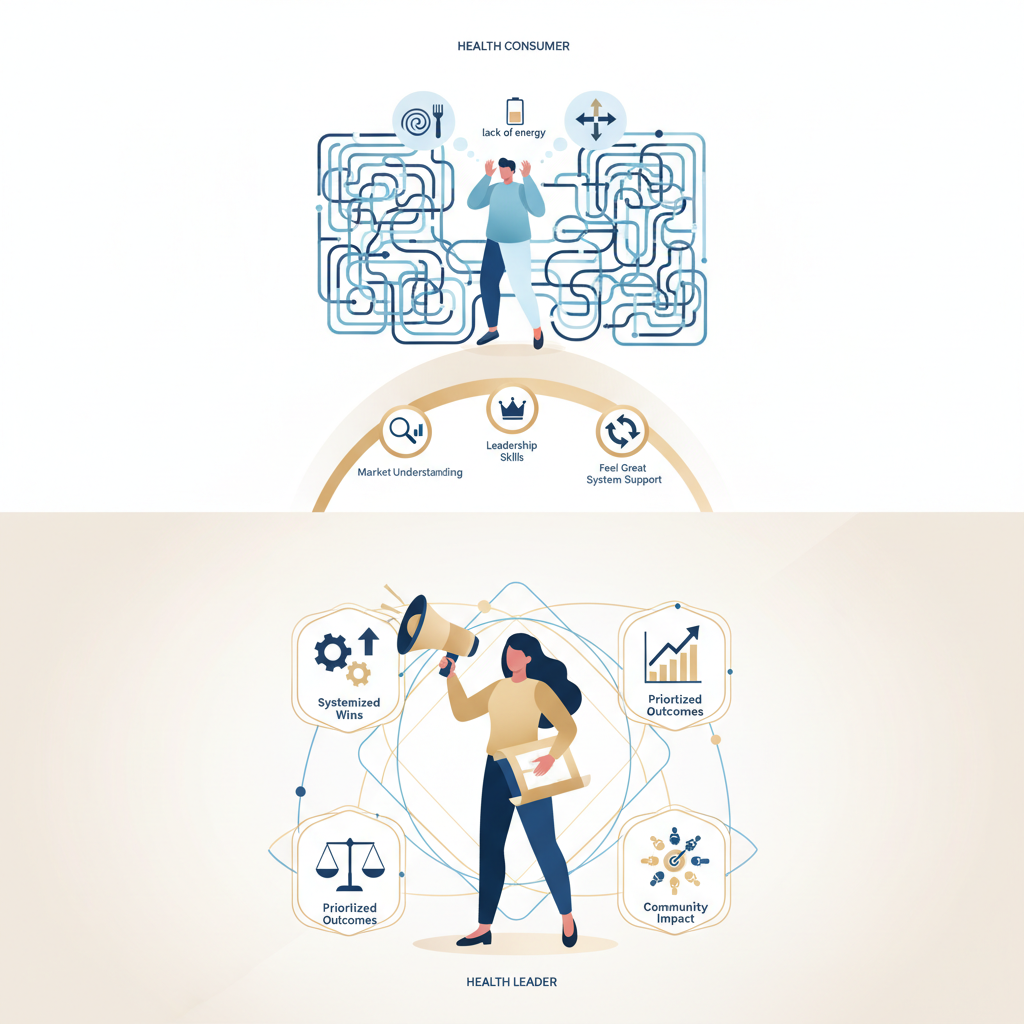
At the consumer level, people buy products and try programs. At the leader level, individuals design a repeatable customer experience, use evidence-based tools to produce measurable health outcomes, and mentor others to achieve the same. Leadership requires systems thinking — creating the routine, tools, and social proof that turn one-off outcomes into predictable results for many.
Three phases of transformation
- Personal mastery — establishing your health baseline, learning protocols that work, and documenting measurable improvements (weight, labs, energy, sleep).
- Systemization — adopting protocols and content that are repeatable (daily routines, product protocols like the 4-4-12 approach, coaching scripts, content templates).
- Leadership scaling — recruiting, training, and supporting other consumers to replicate the system and become leaders themselves.
Market context: data and trends that support the opportunity
Understanding the market helps leaders prioritize where to invest time. The wellness economy has shown sustained growth, with segments such as healthy nutrition and personalized prevention expanding rapidly. The Global Wellness Institute and related market trackers report multi‑trillion total market size and high single‑digit to low‑double digit CAGR for key subsegments. ([globalwellnessinstitute.org](https://globalwellnessinstitute.org/wp-content/uploads/2024/11/WellnessEconMonitor2024PDF.pdf?utm_source=openai))
Direct selling and recurring‑revenue channels remain meaningful distribution routes for wellness products: the direct selling channel contributes notable economic activity and remains a pathway for entrepreneurs to access customers without owning retail inventory. Industry analyses reflect hundreds of millions to billions of dollars in annual sales for leading direct‑selling wellness companies. ([dsa.org](https://www.dsa.org/events/news/press-releases/direct-selling-channel-delivers-111-billion-annual-economic-impact-to-us-economy-new-study-finds?utm_source=openai))
Why prevention and nutrition are center stage
- Health systems and consumers are prioritizing prevention and metabolic health — creating demand for repeatable nutrition solutions.
- Digital coaching, telehealth, and evidence-based supplement protocols increase scalability and measurable outcomes.
- Products and programs that can show clinical or observational evidence have stronger retention and referral potential. ([blog.unicity.com](https://blog.unicity.com/post/learn-about-the-benefits-of-unicitys-feel-great-system-and-intermittent-fasting?utm_source=openai))
Leadership skills: what health leaders must master
Becoming a health leader is a people-centered leadership challenge — not just a marketing or sales task. Core skills include:
1. Clinical literacy and evidence translation
Understand the science behind the products and protocols you promote. This includes knowing the primary outcomes, limits of the evidence, and appropriate risk messaging. Leaders who can translate evidence into accessible steps build trust.
2. Coaching and behavior design
Behavior change is the primary delivery mechanism for health improvements. Leaders should be trained in habit design, motivational interviewing basics, and simple tracking methods that create accountability.
3. Community building
Scale happens through repeat customers and referrals. The most durable leaders create communities, peer-support structures, and mentorship pathways so members become advocates and repeat buyers.
4. Business fundamentals
Leaders must know unit economics — customer acquisition cost (CAC), average order value (AOV), retention rate, and lifetime value (LTV). These metrics guide where to invest: content, training, or paid ads.
Product value > business pitch: why health outcomes must lead
Ethical leadership in health starts by prioritizing outcomes. When the product system genuinely improves biomarkers, energy, appetite control, or supported behavior change, the business outcome (replication, referrals, retention) follows. Systems built on demonstrable customer value reduce churn and regulatory risk.
Case study structure: how leaders create repeated value (framework)
Use this simple four-step framework to convert your health results into a leadership model:
- Document: Record objective baseline measures and progress (weight, BP, labs, validated questionnaires).
- Package: Create a repeatable onboarding - 1-week starter, 30-day plan, and 90-day optimization.
- Prove: Collect testimonials, aggregated outcome data, and simple case studies (before/after metrics).
- Teach: Use short training modules to equip others to repeat your process (videos, scripts, checklists).
How this connects to the Feel Great system (product value + business model)
The Feel Great system (Unimate + Balance + the 4-4-12 protocol) is an example of a structured product-led program designed to support metabolic and behavioral change. The company behind it has positioned its science and distribution model to support entrepreneurs who want to prioritize health outcomes first, then build an income opportunity second. Unicity’s science resources and product listing in clinical references support leaders who rely on documented product profiles. ([blog.unicity.com](https://blog.unicity.com/post/learn-about-the-benefits-of-unicitys-feel-great-system-and-intermittent-fasting?utm_source=openai))
Business model benefits to leaders:
- No inventory required — product ships directly to customers, lowering capital risk.
- Recurring revenue — repeat purchasing of nutrition programs creates predictable cash flow.
- Global market access — ability to sell across multiple countries from day one increases addressable market.
Note: The Feel Great system and Unicity have long‑term positioning in the wellness channel. Company materials emphasize decades of market presence and clinical documentation, and their program structure (time‑based eating plus targeted supplementation) is suitable for leader‑driven coaching programs. Leaders should, however, always verify product claims against peer‑reviewed evidence and local regulation before making health claims. ([unicitystatic.s3.amazonaws.com](https://unicitystatic.s3.amazonaws.com/materials/PDR.pdf?utm_source=openai))
Financial model — conservative example and metrics to track
Rather than promise earnings, leaders should model conservative scenarios demonstrating the economics of building a repeatable customer base. Key metrics to monitor:
- Customer acquisition cost (CAC)
- First order AOV
- Monthly or quarterly retention rate
- Average lifetime value (LTV)
Scenario insight: a solid retention funnel and a high LTV-to-CAC ratio are the difference between a sustainable leadership business and churn-reliant income. Focus investments on retention (coaching touchpoints, community, subscription models) rather than constant acquisition.
Operational checklist for new health leaders
- Choose a science-backed product protocol and collect documentation you can share with customers.
- Design a 30- and 90-day customer journey with measurable checkpoints.
- Create content: 3 short videos, 6 email sequences, and a weekly group-check-in format.
- Set KPI dashboard (CAC, AOV, retention, referrals).
- Train your first three leaders — leadership multiplies faster than direct recruiting.
Comparison: Traditional MLM vs. Product-first, health-first leadership
| Feature | Traditional MLM (inventory focus) | Product-First Health Leadership (no inventory) |
|---|---|---|
| Initial capital | Often high (starter kits, inventory) | Low (education, marketing) |
| Customer retention | Variable, tied to inventory incentives | Higher when product drives outcomes and repeat buys |
| Regulatory risk | Higher if income emphasis exceeds product value | Lower when health claims are evidence-based |
| Scalability | Dependent on distributor recruitment | Driven by customer outcomes and referral |
Marketing ethically: messaging and compliance
Use language that highlights health benefits and avoids income promises. Examples of compliant phrasing:
- "Potential to earn through customer referrals and team building; results vary."
- "Evidence-backed protocol to support metabolic health; consult your healthcare provider."
Avoid unverifiable claims or guarantees. Track testimonials carefully and use aggregate outcomes rather than individual promises when possible.
People Also Ask
- How do I move from being a customer to a leader? — Start by documenting your results, learning the protocol, and teaching one person to replicate the steps.
- What training do health leaders need? — Basics of behavior change, product science, compliance, and community facilitation.
- How long before I can help others reliably? — Typically 60–90 days of consistent practice and data collection provides credible proof points.
- Is certification required to coach? — Requirements differ by market; at minimum, leaders should rely on company training and advise clients to consult healthcare providers for medical conditions.
- Can I scale globally? — Many wellness platforms support international selling, but follow local regulations and shipping limitations.
FAQ
- Do I need medical training to become a health leader?
No. You do need to understand the science behind the products you promote, know the limits of your role, and encourage customers to seek medical advice for chronic conditions.

- How do leaders prove product effectiveness?
By collecting objective pre/post measures, aggregated outcome data, and compliant testimonials. Use validated metrics where possible.
- What are realistic timelines?
Expect initial personal transformation in 4–12 weeks; building a small leadership team typically takes 3–12 months depending on effort and market.
- Are there startup costs?
Yes, primarily education, marketing tools, and time. Models with no inventory reduce capital needs significantly.
- How do I protect my customers and my business legally?
Use evidence-based materials, avoid guaranteeing results or income, keep transparent terms for returns, and follow advertising and supplement regulations in each market.
References & further reading
- Global Wellness Institute — Global Wellness Economy Monitor. ([globalwellnessinstitute.org](https://globalwellnessinstitute.org/wp-content/uploads/2024/11/WellnessEconMonitor2024PDF.pdf?utm_source=openai))
- Global Wellness Institute press release summary on market growth. ([globalwellnessinstitute.org](https://globalwellnessinstitute.org/press-room/press-releases/the-global-wellness-economy-reaches-a-new-peak-of-6-3-trillion-and-is-forecast-to-hit-9-trillion-by-2028/?utm_source=openai))
- Statista — Dietary supplements and functional foods market overview. ([statista.com](https://www.statista.com/topics/8402/global-dietary-supplements-and-functional-food-market/?utm_source=openai))
- Direct Selling Association / DSEF economic impact and state reports. ([dsa.org](https://www.dsa.org/events/news/press-releases/direct-selling-channel-delivers-111-billion-annual-economic-impact-to-us-economy-new-study-finds?utm_source=openai))
- Unicity corporate/PDR materials and Feel Great system overview. ([unicitystatic.s3.amazonaws.com](https://unicitystatic.s3.amazonaws.com/materials/PDR.pdf?utm_source=openai))
Action plan: first 90 days
- Week 1–2: Personal baseline testing, pick a protocol, and complete product training.
- Week 3–4: Launch your 30-day customer journey, collect initial testimonials.
- Month 2: Host weekly group check-ins, optimize AOV with subscription options.
- Month 3: Train your first leaders and set retention-focused KPIs.
Final thoughts
The most sustainable health leaders focus on measurable outcomes first, then build a business around delivering that value repeatedly. Markets favor prevention, and customers reward leaders who combine results, empathy, and ethical business practices.
Disclaimer
Individual results vary. Success requires consistent effort. This article does not promise income and does not provide medical advice. Consult a qualified healthcare professional before starting any supplement, diet, or exercise program.
مسارات مرتبطة داخل ATHAR
💼 هل أنت مستعد لبدء عملك الصحي؟
انضم لآلاف رواد الأعمال الصحيين الذين يبنون دخلاً مستداماً بينما يساعدون الآخرين على تحويل صحتهم مع نظام Feel Great. مدعوم بأكثر من 50 دراسة سريرية، مدرج في مرجع الأطباء (PDR)، ومتوفر في أكثر من 60 دولة.
✅ لا حاجة لمخزون | اعمل من أي مكان | ضمان استرداد 90 يوم | متوفر في أكثر من 60 دولة