Why Health Is Your Greatest Financial Asset — Health Investment ROI
Author: Feras Alayed
Published:
Updated:
Category: business-opportunity
Reading Time: 9 minutes
Key Takeaways
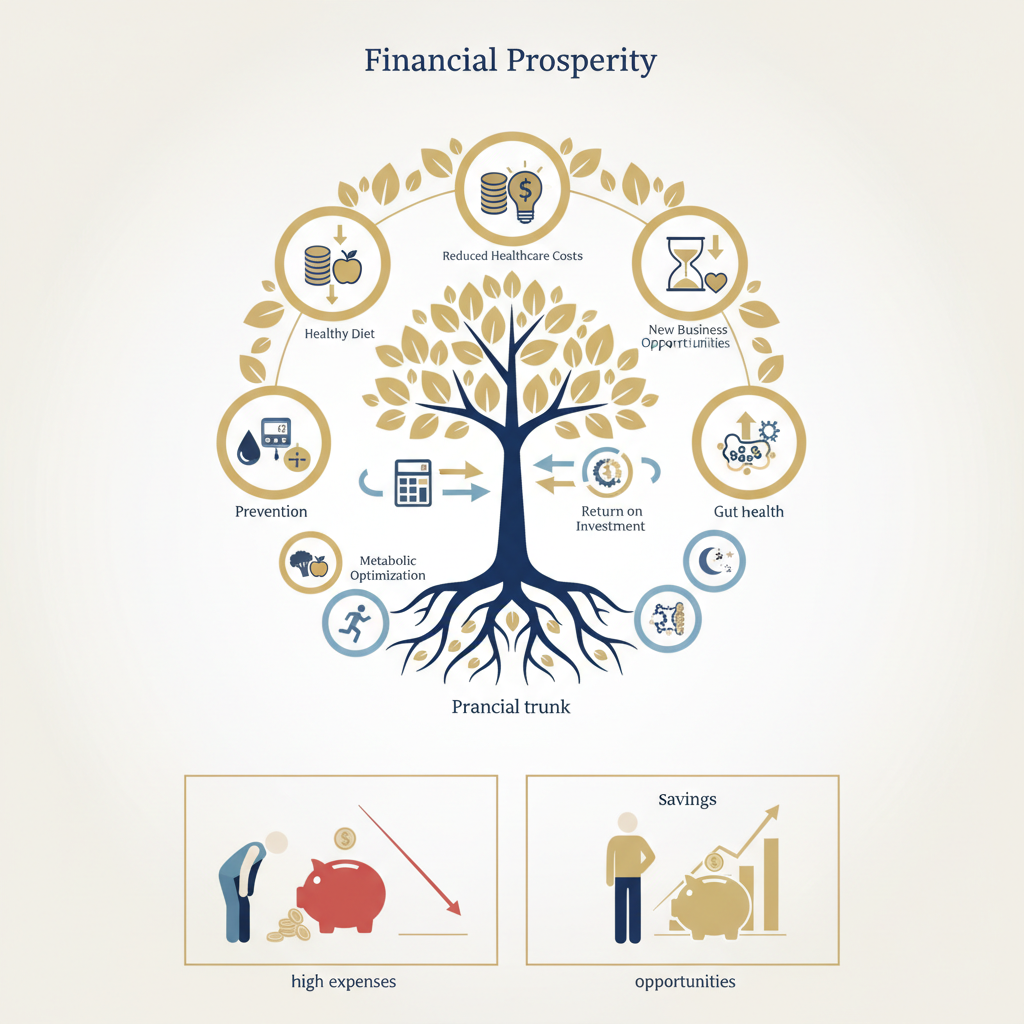
- Investing in your health delivers both personal and economic returns — lower healthcare costs, higher productivity, and improved life quality.
- The global wellness economy is a multi-trillion-dollar market; health is a growth sector with expanding commercial opportunities. ([globalwellnessinstitute.org](https://globalwellnessinstitute.org/press-room/press-releases/the-global-wellness-economy-reaches-a-new-peak-of-6-3-trillion-and-is-forecast-to-hit-9-trillion-by-2028/?utm_source=openai))
- Chronic disease drives the majority of healthcare spending — prevention and metabolic health management produce measurable ROI. ([cdc.gov](https://www.cdc.gov/chronic-disease/data-research/facts-stats/index.html?utm_source=openai))
- Business models that emphasize recurring revenue, direct-to-consumer shipping, and repeat customers (no inventory) enable scalable health businesses.
- Measure, iterate, and prioritize prevention — Individual results vary. Success requires consistent effort.
TL;DR
Treat your health as a financial asset: preventive health and metabolic optimization lower long-term costs and create business opportunities in a fast-growing wellness economy. Market and cost drivers cited. ([globalwellnessinstitute.org](https://globalwellnessinstitute.org/press-room/press-releases/the-global-wellness-economy-reaches-a-new-peak-of-6-3-trillion-and-is-forecast-to-hit-9-trillion-by-2028/?utm_source=openai))
💼 Thousands of entrepreneurs are building health businesses with Feel Great. Learn more about the opportunity →
Why Your Health Is Your Greatest Financial Asset — Understanding "health investment ROI"
How you manage your health affects not only quality of life — it directly impacts your earning capacity, your productivity, and your net worth over time. In a world where healthcare spending is a growing share of GDP and the global wellness economy is expanding rapidly, treating health as an investable asset and calculating a practical "health investment ROI" becomes a strategic advantage for individuals and entrepreneurs alike. ([oecd.org](https://www.oecd.org/en/publications/health-at-a-glance-2025_8f9e3f98-en/full-report/health-expenditure-in-relation-to-gdp_6e4c2773.html?utm_source=openai))
Introduction: A market stat that reframes the investment
The global wellness economy reached multi-trillion-dollar scale in recent years, with major industry monitors placing market size in the $6.3–6.8 trillion range and forecasting strong growth through the mid-to-late 2020s. This is not a niche consumer fad — it is a structural sector aligned with prevention, nutrition, physical activity, mental wellness, and personalized care. ([globalwellnessinstitute.org](https://globalwellnessinstitute.org/press-room/press-releases/the-global-wellness-economy-reaches-a-new-peak-of-6-3-trillion-and-is-forecast-to-hit-9-trillion-by-2028/?utm_source=openai))
Why call health a financial asset?
By definition, a financial asset produces future economic value. Health meets that definition in several practical ways:
- Reduced future expenditures: prevention and early management lower expensive acute care and chronic disease costs. ([cdc.gov](https://www.cdc.gov/chronic-disease/data-research/facts-stats/index.html?utm_source=openai))
- Higher productive capacity: better energy, attention, and resilience translate into higher output or more capacity for income-generating activities.
- Lower downside risk: healthier individuals are less likely to incur catastrophic medical costs or long-term disability that erodes financial capital.
- Commercial value creation: expertise, community, and repeatable health products/services can be converted into recurring revenue businesses. ([globalwellnessinstitute.org](https://globalwellnessinstitute.org/wp-content/uploads/2025/11/2025-GWI-WE-Monitor_DIGITAL-FINAL.pdf?utm_source=openai))
Economic evidence that supports health as ROI
Five data points that matter:
- Approximately 90% of U.S. health care spending (~$5.3 trillion annual) is associated with people who have chronic and mental health conditions — prevention here changes the equation. ([cdc.gov](https://www.cdc.gov/chronic-disease/data-research/facts-stats/index.html?utm_source=openai))
- The United States spent roughly 18% of GDP on health in 2023 — the highest among OECD nations — which means marginal reductions in per-person spending have outsized financial benefit. ([commonwealthfund.org](https://www.commonwealthfund.org/international-health-policy-center/countries/united-states?utm_source=openai))
- The global wellness economy was measured in the multiple trillions in recent monitors and is forecasted to grow at roughly 7%+ annually in some analyses from 2023–2028 — a structurally large market. ([globalwellnessinstitute.org](https://globalwellnessinstitute.org/wp-content/uploads/2024/11/WellnessEconMonitor2024PDF.pdf?utm_source=openai))
- Workplace wellness and prevention programs show positive outcomes in many cases (reduced absenteeism, improved behaviors), although ROI varies by program design and duration. Academic reviews emphasize long-term, integrated programs. ([journals.sagepub.com](https://journals.sagepub.com/doi/abs/10.1177/2165079920953052?utm_source=openai))
- Consumer and industry trends favor subscription, recurring services, and direct-to-consumer distribution — business models that create predictable, compounding revenue streams. ([globalwellnessinstitute.org](https://globalwellnessinstitute.org/wp-content/uploads/2025/11/2025-GWI-WE-Monitor_DIGITAL-FINAL.pdf?utm_source=openai))
How to calculate your personal "health investment ROI" — practical steps
There is no one-size-fits-all formula, but these steps make the concept operational:
- List your inputs: dollars spent on programs, supplements, coaching, gym, and time invested (expressed as $ equivalence if you wish).
- Estimate direct financial outputs: lower medical bills, fewer copays, reduced insurance premiums, fewer sick days (translate into saved wages or productivity).
- Include indirect outputs: quality-of-life gains, additional hours of effective work, lower long-term disability risk — assign conservative dollar values where possible.
- Compute a simple ROI: (Annual financial benefit ÷ Annual health investment) × 100 = % health investment ROI.
Example: $1,200/year on a program that reduces annual medical and productivity losses by $1,800 yields a simple ROI of 150% ((1,800 ÷ 1,200) ×100). Note: non-financial benefits (wellbeing, years of healthy life) are real economic assets too. Individual results vary. Success requires consistent effort.
Comparison table: Health investment vs traditional financial assets
| Criterion | Health Investment | Traditional Financial Asset (Stock/Bond) |
|---|---|---|
| Return type | Reduced costs, higher productivity, quality of life | Capital gains, dividends, interest |
| Time horizon | Immediate benefits to multi-decade value | Short- to long-term, depending on instrument |
| Risk | Behavioral and compliance risk; lower systemic volatility | Market volatility and capital loss risk |
| Measurability | Measurable via medical & performance metrics | Measurable via market prices and financial statements |
| Scalability | Individual to population-level gains; business-model dependent | Scalable via portfolio allocation |
Design choices that raise health investment ROI
- Start with measurement: baseline labs, sleep tracking, productivity logs, and medical history.
- Prioritize prevention: nutrition, regular movement, sleep, stress management reduce future high-cost events. ([cdc.gov](https://www.cdc.gov/chronic-disease/data-research/facts-stats/index.html?utm_source=openai))
- Favor repeatable offerings: subscription products and community-driven services improve retention and business valuation.
- Track KPIs: medical spend, sick days, subjective energy, weight, metabolic markers — these are your financial performance indicators.
- Invest in education and community: peer support multiplies adherence and sustainable behavior change.
How the Feel Great system connects value and business opportunity
Unicity’s Feel Great system pairs two core products (Balance and Unimate) with a time-based eating protocol (the 4-4-12 approach). The system is positioned to support metabolic health, appetite control, and sustained energy — all of which address fundamental drivers of healthcare costs and productivity. Product and program documentation describe a simple, repeatable protocol designed for adherence. ([unicity.com](https://www.unicity.com/pri/en/help-center/customer/feel-great/faqs/what-is-feel-great?utm_source=openai))
From a business perspective, Feel Great-style models demonstrate key commercial advantages:
- No inventory required when leveraging direct-to-consumer fulfillment and distributor networks.
- Recurring revenue from repeat product purchases aligns incentives and increases customer lifetime value.
- Global market access from day one allows entrepreneurs to scale beyond local markets. ([shop.unicity.com](https://shop.unicity.com/usa/en/product/feel-great?sku=35930&utm_source=openai))
Practical playbook for practitioners and entrepreneurs
- Start with personal proof: apply the system, measure outcomes, and document results.
- Create educational content and community to convert customers into advocates.
- Design subscription offers and tiered support to increase retention and average revenue per user.
- Adhere to compliance and avoid guaranteed income claims — highlight potential and variability. Individual results vary. Success requires consistent effort.
Real-world use cases
Case 1 — Employer program: A medium-sized employer implementing a multi-component wellness program can reduce absenteeism and certain short-term healthcare costs. ROI depends on duration and program fidelity. Academic studies show positive but variable results. ([journals.sagepub.com](https://journals.sagepub.com/doi/abs/10.1177/2165079920953052?utm_source=openai))
Case 2 — Health entrepreneur: An individual who converts personal results into a repeatable subscription-based offer with educational content can build predictable revenue while delivering measurable client benefits.
Risks and guardrails
- Avoid unsupported health claims or presenting products as medical cures.
- Do not promise specific earnings; emphasize potential to earn and results variability.
- Design long-term, evidence-informed programs rather than one-off quick fixes.
People Also Ask
- How do I calculate my health investment ROI? — List costs, estimate financial and productivity savings, compute (benefits ÷ costs ×100).
- Do workplace wellness programs deliver ROI? — Many do when well-designed and long-term, but results vary. ([journals.sagepub.com](https://journals.sagepub.com/doi/abs/10.1177/2165079920953052?utm_source=openai))
- Which wellness segments are the biggest? — Nutrition, personal care & beauty, physical activity, and wellness tourism rank highly in recent monitors. ([globalwellnessinstitute.org](https://globalwellnessinstitute.org/wp-content/uploads/2025/11/2025-GWI-WE-Monitor_DIGITAL-FINAL.pdf?utm_source=openai))
- Can intermittent fasting improve ROI? — It can when implemented correctly as part of metabolic health improvements; clinical supervision recommended. ([blog.unicity.com](https://blog.unicity.com/post/learn-about-the-benefits-of-unicitys-feel-great-system-and-intermittent-fasting?utm_source=openai))
- How quickly will I see financial returns? — Some benefits are rapid (energy/sleep), while reduced healthcare costs often accrue over months to years.
FAQ
- What exactly counts as "health investment"?
Anything you spend (time or money) to improve or maintain health: prevention, nutrition, coaching, fitness, sleep support, and clinically supported supplements.

- Do supplements alone generate ROI?
Supplements can support interventions but are most effective within a broader lifestyle strategy (diet, activity, sleep).
- Is health investment tax-deductible?
Tax treatment varies by jurisdiction and context (medical expenses vs personal wellness) — consult a tax professional.
- Can I build a business from my health journey?
Yes — with measured outcomes, repeatable offers, and compliance. Avoid income guarantees and prioritize value delivery.
- How to present ROI ethically?
Show case studies, anonymized metrics, and conservative projections. Use language like "potential to earn" and "results vary." Individual results vary. Success requires consistent effort.
Selected references
- Global Wellness Institute — Global Wellness Economy Monitor (2024/2025). ([globalwellnessinstitute.org](https://globalwellnessinstitute.org/press-room/press-releases/the-global-wellness-economy-reaches-a-new-peak-of-6-3-trillion-and-is-forecast-to-hit-9-trillion-by-2028/?utm_source=openai))
- CDC — Fast Facts: Health and Economic Costs of Chronic Conditions. ([cdc.gov](https://www.cdc.gov/chronic-disease/data-research/facts-stats/index.html?utm_source=openai))
- OECD — Health at a Glance / Health expenditure in relation to GDP. ([oecd.org](https://www.oecd.org/en/publications/2023/11/health-at-a-glance-2023_e04f8239/full-report/health-expenditure-in-relation-to-gdp_e3566919.html?utm_source=openai))
- Commonwealth Fund — U.S. health spending profile (2023). ([commonwealthfund.org](https://www.commonwealthfund.org/international-health-policy-center/countries/united-states?utm_source=openai))
- Grand View Research — U.S. Wellness & Fitness Products Market (2024 report). ([grandviewresearch.com](https://www.grandviewresearch.com/industry-analysis/us-wellness-fitness-products-market-report?utm_source=openai))
- Unicity — Feel Great system product and program pages. ([unicity.com](https://www.unicity.com/pri/en/help-center/customer/feel-great/faqs/what-is-feel-great?utm_source=openai))
Final takeaway
Viewing health as a financial asset reframes everyday choices into strategic investments. Prevention, measurable programs, and business models that emphasize recurrent value unlock both personal wealth preservation and commercial opportunity in a large, growing market. Individual results vary. Success requires consistent effort.
Disclaimer
This article provides general information and does not substitute for professional medical or financial advice. No income or earnings are guaranteed. Individual results vary. Success requires consistent effort.
Related ATHAR paths
💼 Ready to Start Your Health Business?
Join thousands of health entrepreneurs who are building sustainable income while helping others transform their health with the Feel Great system. Backed by 50+ clinical studies, listed in the PDR, and available in 60+ countries.
✅ No inventory required | Work from anywhere | 90-Day Money-Back Guarantee | Available in 60+ countries