How to Identify External Eating Cues for Habit Awareness
كيفية تحديد محفزات الأكل الخارجية للوعي بالعادات
Author: Feras Alayed - Therapeutic & Behavioral Nutrition Specialist
Published:
Updated:
Category: behavioral-nutrition
Reading Time: 15 minutes
Key Takeaways
- External eating cues are environmental or social signals that prompt eating regardless of physical hunger.
- Identifying these cues is the first step toward building a deeper awareness of daily eating habits.
- Differentiating between internal hunger and external triggers aids in making conscious food choices.
- Behavioral nutrition focuses on understanding the context of eating, not just the food itself.
- Self-monitoring and journaling are effective tools for discovering personal response patterns.
- The structured reflection approach offers an organizational framework to support self-observation within a holistic lifestyle approach.
TL;DR
This article explores the concept of external eating cues and how environment and social situations influence our food choices. By learning how to identify external eating cues for habit awareness, you can shift from automatic responses to conscious decision-making. The guide provides self-observation tools and questions for professional consultations, grounded in the principles of behavioral nutrition.
The Daily Experience: Why Do We Eat When Not Hungry?
We often find ourselves eating without experiencing true physical hunger. You might walk past a bakery and be drawn in by the smell of fresh bread, sit with family at a social event and continue eating simply because everyone else is, or find yourself opening the fridge as soon as your favorite TV show starts. These experiences are incredibly common and represent a significant challenge for many trying to organize their eating habits. The core issue many face is not a lack of willpower, but rather the power of the surrounding environment, which sends continuous signals encouraging eating. Previous attempts to change dietary habits are often hard to sustain because they focus solely on what we eat, ignoring the context in which we eat and the reasons that drive us in the first place. When we rely solely on restricting certain foods without understanding the triggers, we find ourselves in a constant battle with our environment. Achieving a state of balance and awareness requires a shift in focus from merely counting calories or following lists of allowed and forbidden foods, to a deeper understanding of human behavior in the context of the modern food environment. This is where habit awareness becomes crucial; the goal is to understand automatic responses and deconstruct them to build new responses that align better with our personal goals. Understanding how external eating cues impact us is an essential step in learning how to change your relationship with food. This understanding provides you with the space to pause before acting, shifting from autopilot to consciously steering your daily choices.
What Are External Eating Cues?
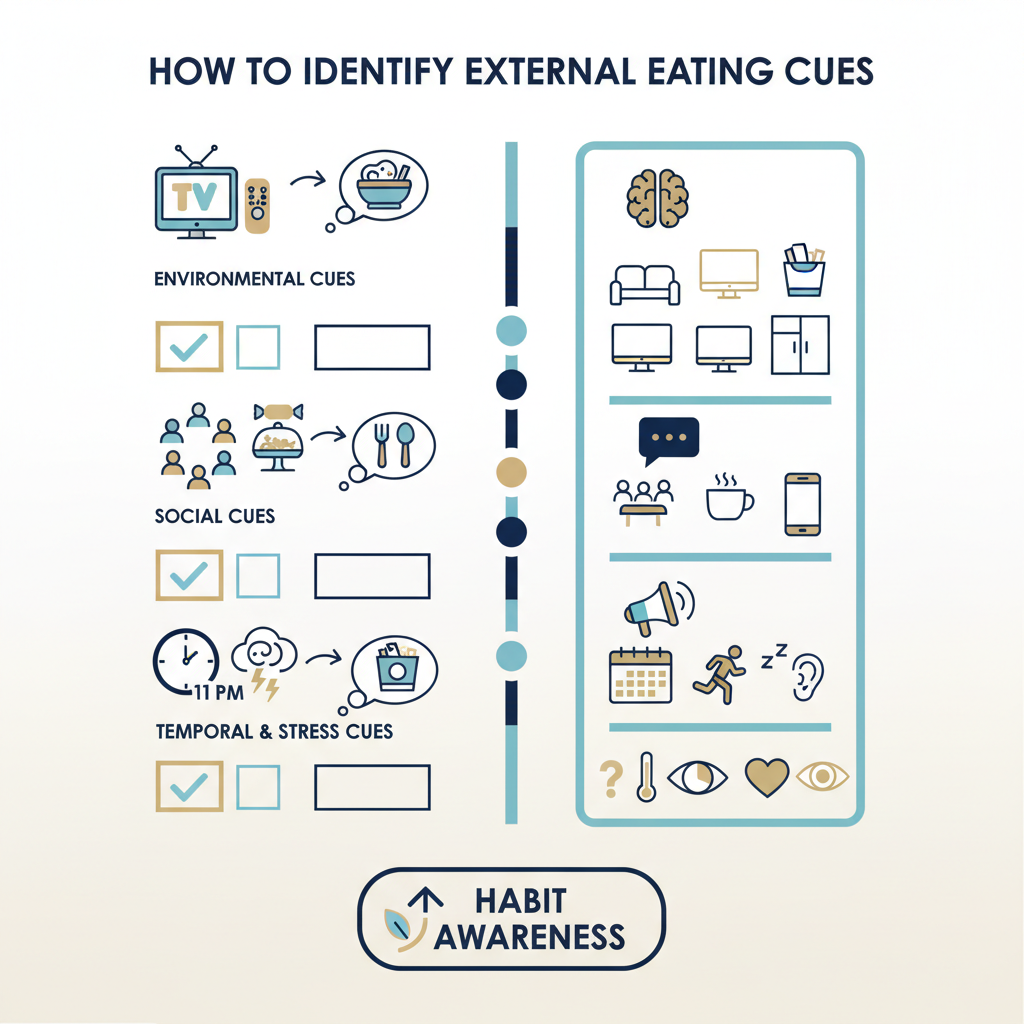
External eating cues are environmental, social, or sensory signals that prompt an individual to eat or think about food, regardless of their internal physical hunger levels (which are indicated by stomach signals or low energy). In the study of behavioral nutrition, distinguishing between internal and external cues is fundamental to understanding eating behavior. Internal cues stem from the body's physiological need for fuel, whereas external cues originate from the outside environment, targeting our senses and social expectations. For example, seeing an advertisement for a favorite dish, smelling food while walking down the street, or even looking at the clock and noticing it is lunchtime are all external cues. These triggers are highly potent because they are often linked to past experiences and positive memories, making the response to them almost automatic. In modern environments, we are constantly surrounded by these cues, which makes relying solely on internal signals complex. Understanding this dynamic helps explain why we might feel a strong urge to eat even shortly after a satisfying meal. It is important to recognize that responding to external cues is not a personal weakness, but a natural response to an environment designed to capture our attention. By recognizing these triggers, we can begin to apply mindful eating practices, which focus on intentional attention to the present experience without judgment, helping to create a space between the trigger and the response.
How to Identify External Eating Cues for Habit Awareness
Learning how to identify external eating cues for habit awareness is an ongoing process that requires observation and curiosity rather than self-criticism. Here are practical steps that can help you build this essential awareness in your daily life. The first step is the pause. When you feel the urge to eat, give yourself a moment to pause before responding. Ask yourself: Am I physically hungry? Are there signals from my stomach indicating a need for food? If the answer is no, this is the time to look for the external trigger. The second step is scanning your environment. Look around and notice what is happening. Did you just see food? Did you smell something specific? Are you in a social situation where others are eating? Are you feeling bored or stressed in this particular location? The third step is documenting and monitoring. Use a journal or an app on your phone to record the times you eat without physical hunger, and write down the cue you believe triggered this urge. Journaling helps turn fleeting observations into tangible data you can analyze. The fourth step is looking for patterns. After a period of journaling, review your notes. Do you tend to snack whenever you watch TV? Do you crave sweets every time you pass a specific place on your way home from work? Identifying these patterns is the essence of habit awareness. The fifth step is proactive planning. Once you have identified your common triggers, you can start developing strategies to manage them. For instance, if a candy bowl on your desk is the trigger, you might try moving it out of sight. This process is not about stopping you from eating, but about putting control back in your hands, so that the decision to eat is conscious rather than a mere reaction to your environment. It is also helpful to understand how this overlaps with breaking emotional eating, as external cues can sometimes be linked to specific emotional states.
Types of External Eating Cues in Daily Life
External eating cues are highly diverse and intertwine with the details of our daily lives, especially in cultures where many social interactions revolve around food. These cues can be categorized into several main types to make them easier to recognize. First, visual cues: We eat with our eyes first. Seeing attractively displayed food, whether in reality or on social media, can trigger a strong desire to eat. Even seeing large portion sizes can be a cue to consume more. Second, olfactory cues: The sense of smell is strongly linked to memory and emotion. The aroma of roasted coffee, spices, or baked goods can awaken an immediate desire for those foods, even if we weren't thinking about them moments before. Third, social cues: In many cultures, offering and sharing food is an expression of generosity and affection. Being at a family gathering, a wedding, or even out with friends presents a powerful cue to eat simply for social participation, regardless of individual hunger. Fourth, situational or activity-related cues: Associating eating with specific activities is a common form of conditioned learning. For example, eating popcorn when entering a cinema, snacking during a long drive, or eating while working at a computer. In these cases, the activity itself becomes the trigger. Fifth, temporal cues: Relying on the clock to determine eating times instead of body signals. Feeling that you must eat lunch because the clock strikes 2 PM, even if you had a late breakfast and are not yet hungry. Understanding these different types helps in building customized strategies to manage them. For example, if you are following a comprehensive beginner's guide to intermittent fasting, awareness of temporal and social cues becomes crucial for organizing eating windows with mindfulness and flexibility.
Behavioral Nutrition and the Food Reward System
To deeply understand how external eating cues operate, we must look at the intersection of psychology and nutrition, known as what is behavioral nutrition?. This field studies the behaviors, beliefs, and environments that influence our dietary choices. A core concept in this context is the brain's reward system. When we are exposed to an external cue associated with highly palatable food (rich in fats or sugars), the brain releases neurotransmitters like dopamine, creating a sense of anticipation and desire. This evolutionary system was beneficial in the past when food was scarce, driving humans to seek out energy-dense foods. However, in our current environment filled with an abundance of processed foods and constant triggers, this system can lead to exaggerated responses. You can delve deeper into this topic by reading about understanding the food reward system and how it drives cravings and eating behavior. Behavioral nutrition does not seek to suppress this system, but rather to understand and work with it. By being aware of how our brains respond to external cues, we can design our environments in a way that supports our goals rather than fighting against them. This involves modifying the home environment, such as placing foods we want to eat regularly in visible spots, and reducing the direct visibility of foods we wish to consume less often. It also includes understanding how our dietary choices can impact cognitive functions, which is discussed in articles about focus foods for brain performance. Awareness of these dynamics shifts the focus from self-blame to a scientific and practical understanding of human behavior.
Common Misconceptions vs. What Needs Verification
In the journey of understanding eating behavior, we often encounter information that may seem logical but requires scientific and behavioral verification. The following table outlines some of these concepts and how they can be reframed from an educational perspective.
| Common Misconception | What Needs Deeper Understanding and Verification |
|---|---|
| A sudden craving for a specific food always means a nutrient deficiency. | Sudden cravings are most often linked to external cues (sight, smell) or emotional states, not necessarily a specific physiological deficiency. |
| Controlling eating relies entirely on personal willpower. | The surrounding environment and external cues play a massive role. Designing a supportive environment is far more important than relying on willpower alone. |
| All external cues must be completely ignored to succeed in managing eating habits. | Awareness and understanding of cues is the goal, not attempting to ignore or suppress them, as suppression can backfire. |
| True hunger only occurs at standard meal times. | Physiological hunger can occur at various times based on activity and the composition of previous meals, while eating at strict times might be a response to a temporal cue. |
| BMI is the sole metric for the success of dietary habits. | Healthy habits encompass the relationship with food and behavioral awareness. For a broader view, review BMI accuracy and better alternatives. |
Common Informational Mistakes in Health
When attempting to apply habit awareness concepts, many fall into common mistakes resulting from a misunderstanding of available health information. One of the most prominent errors is confusing emotional eating with responding to external cues. While both share the trait of not stemming from physical hunger, emotional eating is triggered by internal feelings (like stress or sadness), whereas external cues come from the environment (like seeing food). Distinguishing between them is essential because the coping strategies differ. Another mistake is trying to change all habits at once upon recognizing the triggers. This approach often leads to burnout and regression. Sustainable change requires focusing on one trigger or habit at a time. Some also mistakenly believe that general dietary guidelines are rigid rules that cannot be personally adapted. It is important to follow developments in this field, such as those discussed in the DGE nutrition guidelines Germany 2026, to understand how modern recommendations lean towards flexibility and individual considerations rather than strict rules. Finally, self-diagnosing based on general information is a significant error. For instance, someone might link feeling tired after eating to complex health issues without medical consultation. If there are persistent concerns, it is crucial to recognize symptoms properly, as outlined in the insulin resistance symptoms complete guide, and consult a licensed professional for assessment.
Practical Questions for a Licensed Professional
When you decide to take your awareness of eating habits to a professional level by consulting a licensed dietitian or physician, preparing well for the visit can make a significant difference in the quality of care you receive. Instead of asking for a generic diet plan, use your observations about external eating cues to build a productive dialogue. Here are some questions you can ask: 1. I have noticed that I frequently respond to specific visual cues in my work environment; how can I modify my behavioral response without feeling deprived? 2. Based on my observation log, I find it difficult to distinguish between physical hunger and the urge to eat triggered by social situations; what tools do you recommend to improve this distinction? 3. Are there specific tests you suggest to ensure that my frequent urges to eat are not related to a nutritional deficiency or an underlying physiological condition? 4. How can I integrate awareness practices regarding external cues into the overall health management plan we are discussing? 5. If I feel that my response to cues is linked to chronic stress, would you recommend a referral to a psychologist or a specialist in cognitive behavioral therapy? These questions position you as an active partner in your healthcare and help the professional provide guidance tailored to your individual situation.
The structured reflection approach as Structured Support
In the context of building habit awareness and identifying external eating cues, some may find value in using organizational frameworks that help structure self-observation. The structured reflection approach is one such structural tool that can be integrated into a broader lifestyle approach. It is important to emphasize that the structured reflection approach is not a medical treatment, nor a substitute for professional consultation, and it does not guarantee predetermined outcomes. Rather, it is a tool designed to provide a framework that helps individuals organize their observations about their daily habits and track their responses to various triggers in their environment. The effectiveness of any organizational tool depends on how it is utilized as part of a larger picture that includes balanced nutrition, physical activity, stress management, and good sleep. When utilizing the structured reflection approach, users are encouraged to focus on the process of observation and self-learning rather than focusing exclusively on end results. This approach aligns with the principles of behavioral nutrition, which emphasize the importance of understanding context and being aware of the internal and external processes that guide behavior. If you are considering using any new organizational framework, it is always wise to discuss it with your healthcare professional to ensure it aligns with your individual health needs and long-term goals.
Frequently Asked Questions
Common Questions About External Eating Cues
Below are answers to some of the most frequently asked questions on this topic, presented in an educational format to help clarify concepts.
Medical Disclaimer
The information provided in this article is for educational and informational purposes only and does not constitute a substitute for professional medical advice, diagnosis, or treatment. The information presented here should not be used to diagnose or treat any health problem or disease. Dietary behaviors and responses to cues vary significantly from person to person and may be related to medical or psychological conditions that require evaluation by licensed professionals. It is always recommended to consult your physician or a licensed dietitian before making any major changes to your diet or lifestyle, especially if you have pre-existing health conditions. Never disregard professional medical advice or delay in seeking it because of something you have read in this article.
Conclusion and Next Steps
Understanding how to identify external eating cues for habit awareness is a valuable skill that can transform how you interact with your surrounding food environment. By distinguishing between internal hunger and external signals, and applying self-observation strategies, you can move towards more conscious and balanced dietary choices. Remember that the goal is not perfection or suppressing natural responses, but building a deeper understanding of your behaviors and designing an environment that supports your personal goals. Behavioral nutrition offers a useful lens to view these complex interactions in a scientific and practical manner. If you are ready to take a practical step towards better understanding your habits and identifying areas you can focus on, the next step is to assess your current situation clearly. Start your health assessment now to discover more about your behavioral patterns and the appropriate steps for your personal journey.
Further Education
- Explore the metabolic health education hub
- Learn how to read research summaries
- Use the educational health assessment
Ready to choose a clearer health starting point?
Start with a short educational assessment to explore tools and resources that may fit your goal. It is not a medical diagnosis.
Continue learning at Behavioral Nutrition.
النقاط الرئيسية
- محفزات الأكل الخارجية هي إشارات بيئية أو اجتماعية تدفعنا لتناول الطعام بغض النظر عن الجوع الجسدي.
- تحديد هذه المحفزات هو الخطوة الأولى نحو بناء وعي أعمق بالعادات الغذائية اليومية.
- التفريق بين الجوع الداخلي والمحفزات الخارجية يساعد في اتخاذ قرارات غذائية أكثر وعياً.
- التغذية السلوكية تركز على فهم السياق الذي يحدث فيه تناول الطعام وليس فقط نوعية الطعام.
- المراقبة الذاتية وتدوين الملاحظات أدوات فعالة لاكتشاف الأنماط الشخصية في الاستجابة للمحفزات.
- منهج تنظيمي للتأملتقدم إطاراً تنظيمياً لدعم الملاحظة الذاتية ضمن نهج شامل لنمط الحياة.
ملخص سريع
يستكشف هذا المقال مفهوم محفزات الأكل الخارجية وكيف تؤثر البيئة والمواقف الاجتماعية على قراراتنا الغذائية. من خلال تعلم كيفية تحديد محفزات الأكل الخارجية للوعي بالعادات، يمكنك الانتقال من الاستجابة التلقائية إلى الاختيار الواعي. يقدم المقال أدوات للملاحظة الذاتية وأسئلة لتوجيه حوارك مع المختصين، مع التركيز على مبادئ التغذية السلوكية.
التجربة اليومية: لماذا نأكل عندما لا نكون جائعين؟
كثيراً ما نجد أنفسنا نتناول الطعام دون أن نشعر بجوع جسدي حقيقي. قد تمر بجانب مخبز وتجذبك رائحة الخبز الطازج، أو تجلس مع العائلة في مناسبة اجتماعية وتستمر في تناول الطعام لمجرد أن الجميع يفعل ذلك، أو ربما تجد نفسك تفتح الثلاجة بمجرد بدء مشاهدة برنامجك التلفزيوني المفضل. هذه التجارب شائعة جداً وتمثل تحدياً للكثيرين الذين يحاولون تنظيم عاداتهم الغذائية. المشكلة الأساسية التي يواجهها العديد من الأشخاص ليست في نقص الإرادة، بل في قوة البيئة المحيطة التي ترسل إشارات مستمرة تشجع على تناول الطعام. المحاولات السابقة لتغيير العادات الغذائية غالباً ما تكون صعبة الاستدامة لأنها تركز فقط على ما نأكله، متجاهلة السياق الذي نأكل فيه والسبب الذي يدفعنا لذلك في المقام الأول. عندما نعتمد فقط على تقييد أنواع معينة من الطعام دون فهم المحفزات التي تدفعنا لتناولها، نجد أنفسنا في صراع مستمر مع بيئتنا. الرغبة في الوصول إلى حالة من التوازن والوعي تتطلب تحولاً في التركيز من مجرد حساب السعرات أو اتباع قوائم الممنوع والمسموح، إلى فهم أعمق للسلوك الإنساني في سياق بيئة الطعام الحديثة. هنا تبرز أهمية الوعي بالعادات، حيث يصبح الهدف هو فهم الاستجابات التلقائية وتفكيكها لبناء استجابات جديدة أكثر توافقاً مع أهدافنا الشخصية. إن فهم كيفية تأثير محفزات الأكل الخارجية يمثل خطوة أساسية في رحلة كيف تغير علاقتك مع الطعام، حيث يتيح لك هذا الفهم مساحة للتفكير قبل التصرف، والانتقال من وضع الطيار الآلي إلى القيادة الواعية لخياراتك اليومية.
ما هي محفزات الأكل الخارجية؟
محفزات الأكل الخارجية هي الإشارات البيئية، الاجتماعية، أو الحسية التي تدفع الفرد لتناول الطعام أو التفكير فيه، بغض النظر عن مستوى الجوع الجسدي الداخلي (الذي يتمثل في إشارات المعدة أو انخفاض الطاقة). في دراسة التغذية السلوكية، يُعتبر التمييز بين الإشارات الداخلية والخارجية أمراً جوهرياً لفهم السلوك الغذائي. الإشارات الداخلية تنبع من حاجة الجسم الفسيولوجية للوقود، بينما الإشارات الخارجية تنبع من المحيط الخارجي وتستهدف حواسنا وتوقعاتنا الاجتماعية. على سبيل المثال، رؤية إعلان لطبق مفضل، أو شم رائحة طعام أثناء المشي في الشارع، أو حتى النظر إلى الساعة وملاحظة أن وقت الغداء قد حان، كلها تعتبر محفزات خارجية. هذه المحفزات قوية جداً لأنها ترتبط غالباً بتجارب سابقة وذكريات إيجابية، مما يجعل الاستجابة لها شبه تلقائية. في البيئة الحديثة، نحن محاطون باستمرار بهذه المحفزات، مما يجعل الاعتماد على الإشارات الداخلية فقط أمراً معقداً. فهم هذه الديناميكية يساعد في تفسير لماذا قد نشعر برغبة ملحة في تناول الطعام حتى بعد تناول وجبة مشبعة بوقت قصير. من المهم إدراك أن الاستجابة للمحفزات الخارجية ليست ضعفاً شخصياً، بل هي استجابة طبيعية لبيئة مصممة لجذب انتباهنا. من خلال التعرف على هذه المحفزات، يمكننا البدء في تطبيق ممارسات الأكل الواعي، والتي تركز على الانتباه المتعمد للتجربة الحالية دون إصدار أحكام، مما يساعد في خلق مسافة بين المحفز والاستجابة.
كيفية تحديد محفزات الأكل الخارجية للوعي بالعادات
إن تعلم كيفية تحديد محفزات الأكل الخارجية للوعي بالعادات هو عملية مستمرة تتطلب الملاحظة والفضول بدلاً من النقد الذاتي. إليك خطوات عملية يمكن أن تساعدك في بناء هذا الوعي الهام في حياتك اليومية. الخطوة الأولى هي التوقف المؤقت. عندما تشعر برغبة في تناول الطعام، امنح نفسك لحظة من التوقف قبل الاستجابة. اسأل نفسك: هل أنا جائع جسدياً؟ هل هناك إشارات من معدتي تدل على الحاجة للطعام؟ إذا كانت الإجابة لا، فهذا هو الوقت المناسب للبحث عن المحفز الخارجي. الخطوة الثانية هي مسح البيئة المحيطة. انظر حولك ولاحظ ما يحدث. هل رأيت للتو طعاماً؟ هل شممت رائحة معينة؟ هل أنت في موقف اجتماعي حيث يأكل الآخرون؟ هل تشعر بالملل أو التوتر في هذا المكان المحدد؟ الخطوة الثالثة هي التدوين والمراقبة. استخدم مفكرة أو تطبيقاً على هاتفك لتسجيل الأوقات التي تأكل فيها دون جوع جسدي، واكتب المحفز الذي تعتقد أنه أثار هذه الرغبة. التدوين يساعد في تحويل الملاحظات العابرة إلى بيانات ملموسة يمكنك تحليلها. الخطوة الرابعة هي البحث عن الأنماط. بعد فترة من التدوين، راجع ملاحظاتك. هل تميل إلى تناول وجبات خفيفة دائماً عند مشاهدة التلفاز؟ هل تشعر برغبة في الحلويات كلما مررت بمكان معين في طريق عودتك من العمل؟ تحديد هذه الأنماط هو جوهر الوعي بالعادات. الخطوة الخامسة هي التخطيط المسبق. بمجرد تحديد المحفزات الشائعة لديك، يمكنك البدء في وضع استراتيجيات للتعامل معها. على سبيل المثال، إذا كان وجود وعاء من الحلوى على مكتبك هو المحفز، يمكنك تجربة نقله إلى مكان غير مرئي. هذه العملية لا تهدف إلى منعك من تناول الطعام، بل تهدف إلى إعادة السيطرة إلى يديك، بحيث يكون قرار تناول الطعام قراراً واعياً وليس مجرد رد فعل لبيئتك. من المفيد أيضاً فهم كيف يتداخل هذا مع التحرر من الأكل العاطفي، حيث يمكن أن تكون المحفزات الخارجية مرتبطة بحالات عاطفية معينة.
أنواع محفزات الأكل الخارجية في حياتنا اليومية
تتنوع محفزات الأكل الخارجية بشكل كبير وتتداخل مع تفاصيل حياتنا اليومية، خاصة في الثقافة العربية التي ترتبط فيها الكثير من التفاعلات الاجتماعية بالطعام. يمكن تصنيف هذه المحفزات إلى عدة فئات رئيسية لتسهيل التعرف عليها. أولاً، المحفزات البصرية: نحن نأكل بأعيننا أولاً. رؤية الطعام المعروض بشكل جذاب، سواء في الواقع أو عبر وسائل التواصل الاجتماعي، يمكن أن يثير رغبة قوية في الأكل. حتى رؤية أطباق كبيرة الحجم يمكن أن تكون محفزاً لتناول كميات أكبر. ثانياً، المحفزات الشمية: حاسة الشم مرتبطة بقوة بالذاكرة والمشاعر. رائحة القهوة المحمصة، أو التوابل، أو المخبوزات يمكن أن توقظ رغبة فورية في تناول تلك الأطعمة، حتى لو لم نكن نفكر فيها قبل لحظات. ثالثاً، المحفزات الاجتماعية: في العديد من الثقافات، يعتبر تقديم الطعام وتناوله معاً تعبيراً عن الكرم والمودة. التواجد في تجمع عائلي، أو حفل زفاف، أو حتى خروج مع الأصدقاء، يمثل محفزاً قوياً لتناول الطعام لمجرد المشاركة الاجتماعية، بغض النظر عن الجوع الفردي. رابعاً، المحفزات الظرفية أو المرتبطة بالأنشطة: ربط تناول الطعام بأنشطة معينة هو شكل شائع من أشكال التعلم الشرطي. على سبيل المثال، تناول الفشار عند دخول السينما، أو تناول وجبة خفيفة أثناء القيادة لمسافات طويلة، أو الأكل أثناء العمل على الكمبيوتر. في هذه الحالات، يصبح النشاط نفسه هو المحفز. خامساً، المحفزات الزمنية: الاعتماد على الساعة لتحديد مواعيد الأكل بدلاً من إشارات الجسم. الشعور بأنك يجب أن تتناول الغداء لأن الساعة تشير إلى الثانية ظهراً، حتى لو تناولت إفطاراً متأخراً ولم تشعر بالجوع بعد. فهم هذه الأنواع المختلفة يساعد في بناء استراتيجيات مخصصة للتعامل معها. على سبيل المثال، إذا كنت تتبع دليل الصيام المتقطع الشامل للمبتدئين، فإن الوعي بالمحفزات الزمنية والاجتماعية يصبح أمراً بالغ الأهمية لتنظيم فترات تناول الطعام بوعي ومرونة.
التغذية السلوكية وفهم نظام المكافأة الغذائية
لفهم كيف تعمل محفزات الأكل الخارجية بعمق، يجب أن ننظر إلى التقاطع بين علم النفس والتغذية، وهو ما يُعرف بـ ما هي التغذية السلوكية؟. هذا المجال يدرس السلوكيات، المعتقدات، والبيئات التي تؤثر على خياراتنا الغذائية. أحد المفاهيم الأساسية في هذا السياق هو نظام المكافأة في الدماغ. عندما نتعرض لمحفز خارجي مرتبط بطعام لذيذ (غني بالدهون أو السكريات)، يفرز الدماغ نواقل عصبية مثل الدوبامين، مما يخلق شعوراً بالترقب والرغبة. هذا النظام التطوري كان مفيداً في الماضي عندما كان الطعام نادراً، حيث كان يدفع البشر للبحث عن الأطعمة الغنية بالطاقة. ومع ذلك، في بيئتنا الحالية المليئة بوفرة الأطعمة المصنعة والمحفزات المستمرة، يمكن أن يؤدي هذا النظام إلى استجابات مبالغ فيها. يمكنك التعمق أكثر في هذا الموضوع من خلال قراءة نظام المكافأة الغذائية: كيف يدفع الرغبة الشديدة والسلوك الغذائي. التغذية السلوكية لا تسعى إلى قمع هذا النظام، بل إلى فهمه والعمل معه. من خلال الوعي بكيفية استجابة أدمغتنا للمحفزات الخارجية، يمكننا تصميم بيئاتنا بطريقة تدعم أهدافنا بدلاً من أن تتصارع معها. هذا يتضمن تعديل البيئة المنزلية، مثل وضع الأطعمة التي نرغب في تناولها بانتظام في أماكن مرئية، وتقليل الرؤية المباشرة للأطعمة التي نرغب في تقليل استهلاكها. كما يشمل أيضاً فهم كيف يمكن أن تؤثر خياراتنا الغذائية على وظائفنا الإدراكية، وهو ما يناقشه مقال أطعمة تعزز التركيز وأداء الدماغ. الوعي بهذه الديناميكيات يحول التركيز من لوم الذات إلى الفهم العلمي والعملي للسلوك البشري.
مفاهيم شائعة تحتاج إلى تدقيق
في رحلة فهم السلوك الغذائي، غالباً ما نصادف معلومات قد تبدو منطقية ولكنها تحتاج إلى تدقيق علمي وسلوكي. الجدول التالي يوضح بعض هذه المفاهيم وكيف يمكن إعادة صياغتها بمنظور تعليمي.
| المعلومة الشائعة | ما يحتاج إلى تحقق وفهم أعمق |
|---|---|
| الرغبة المفاجئة في تناول طعام معين تعني دائماً نقصاً في عنصر غذائي. | غالباً ما تكون الرغبات المفاجئة مرتبطة بمحفزات خارجية (رؤية، شم) أو عاطفية، وليس بالضرورة نقصاً فسيولوجياً محدداً. |
| التحكم في الأكل يعتمد كلياً على قوة الإرادة الشخصية. | البيئة المحيطة والمحفزات الخارجية تلعب دوراً هائلاً. تصميم بيئة داعمة أهم بكثير من الاعتماد على قوة الإرادة وحدها. |
| يجب تجاهل جميع المحفزات الخارجية تماماً للنجاح في تنظيم الأكل. | الوعي بالمحفزات وفهمها هو الهدف، وليس محاولة تجاهلها أو قمعها، لأن القمع قد يؤدي إلى نتائج عكسية. |
| الجوع الحقيقي يحدث فقط في أوقات الوجبات المعتادة. | الجوع الفسيولوجي يمكن أن يحدث في أوقات مختلفة بناءً على النشاط ومكونات الوجبات السابقة، بينما الأكل في أوقات محددة قد يكون استجابة لمحفز زمني. |
| مؤشر كتلة الجسم هو المقياس الوحيد لنجاح العادات الغذائية. | العادات الصحية تشمل العلاقة مع الطعام والوعي بالسلوكيات. لفهم أوسع، يمكن مراجعة مؤشر كتلة الجسم (BMI): هل هو دقيق فعلاً؟ البدائل الأفضل. |
أخطاء شائعة في فهم المعلومات الصحية
عند محاولة تطبيق مفاهيم الوعي بالعادات، يقع الكثيرون في أخطاء شائعة ناتجة عن سوء فهم المعلومات الصحية المتاحة. أحد أبرز هذه الأخطاء هو الخلط بين الجوع العاطفي والاستجابة للمحفزات الخارجية. بينما يشترك الاثنان في أنهما لا ينبعان من جوع جسدي، إلا أن الجوع العاطفي يُحفز بواسطة مشاعر داخلية (مثل التوتر أو الحزن)، بينما المحفزات الخارجية تأتي من البيئة (مثل رؤية الطعام). التمييز بينهما ضروري لأن استراتيجيات التعامل تختلف. خطأ آخر هو محاولة تغيير جميع العادات دفعة واحدة بمجرد التعرف على المحفزات. هذا النهج غالباً ما يؤدي إلى الإرهاق والتراجع. التغيير المستدام يتطلب التركيز على محفز واحد أو عادة واحدة في كل مرة. كما يخطئ البعض في الاعتقاد بأن الإرشادات الغذائية العامة هي قواعد صارمة لا تقبل التعديل الشخصي. من المهم متابعة التطورات في هذا المجال، مثل ما يُناقش في إرشادات التغذية DGE ألمانيا 2026: ما تغيّر وماذا تفعل، لفهم كيف تتجه التوصيات الحديثة نحو المرونة والاعتبارات الفردية بدلاً من القواعد الصارمة. أخيراً، الخطأ في تشخيص الذات بناءً على معلومات عامة. على سبيل المثال، قد يربط البعض بين الشعور بالتعب بعد الأكل ومشاكل صحية معقدة دون استشارة طبية. إذا كانت هناك مخاوف مستمرة، من الضروري التعرف على الأعراض بشكل صحيح، كما هو موضح في دليل مقاومة الإنسولين: الأعراض والفحوصات ومتى تطلب الرعاية، واللجوء إلى مختص مرخص للتقييم.
أسئلة عملية لمناقشتها مع مختص مرخص
عندما تقرر نقل وعيك بعاداتك الغذائية إلى مستوى احترافي من خلال استشارة أخصائي تغذية مرخص أو طبيب، فإن التحضير الجيد للزيارة يمكن أن يحدث فرقاً كبيراً في جودة الرعاية التي تتلقاها. بدلاً من طلب خطة نظام غذائي جاهزة، استخدم ملاحظاتك حول محفزات الأكل الخارجية لبناء حوار مثمر. إليك بعض الأسئلة التي يمكنك طرحها: 1. لقد لاحظت أنني أستجيب بشكل متكرر لمحفزات بصرية معينة في بيئة عملي، كيف يمكنني تعديل استجابتي السلوكية دون الشعور بالحرمان؟ 2. بناءً على سجل ملاحظاتي، أجد صعوبة في التمييز بين الجوع الجسدي والرغبة الناتجة عن التواجد في مواقف اجتماعية، ما هي الأدوات التي تنصح بها لتحسين هذا التمييز؟ 3. هل هناك فحوصات معينة تقترحها للتأكد من أن رغباتي المستمرة في تناول الطعام ليست مرتبطة بنقص غذائي أو حالة فسيولوجية كامنة؟ 4. كيف يمكنني دمج ممارسات الوعي بالمحفزات الخارجية ضمن خطة إدارة صحتي العامة التي نناقشها؟ 5. في حال شعرت بأن استجابتي للمحفزات مرتبطة بتوتر مستمر، هل تنصح بتحويلي إلى أخصائي نفسي أو مختص في العلاج السلوكي المعرفي؟ هذه الأسئلة تضعك في موقع الشريك النشط في رعايتك الصحية وتساعد المختص على تقديم توجيهات مخصصة لحالتك الفردية.
منهج تنظيمي للتأملكدعم هيكلي ضمن نمط حياة شامل
في سياق بناء الوعي بالعادات وتحديد محفزات الأكل الخارجية، قد يجد البعض فائدة في استخدام أطر تنظيمية تساعد في هيكلة الملاحظة الذاتية. تُعد منهج تنظيمي للتأمل إحدى هذه الأدوات الهيكلية التي يمكن دمجها ضمن نهج أوسع لنمط الحياة. من المهم التأكيد على أن منهج تنظيمي للتأملليست علاجاً طبياً، ولا بديلاً عن الاستشارة المهنية، ولا تضمن نتائج محددة مسبقاً. بل هي أداة مصممة لتوفير إطار عمل يساعد الأفراد على تنظيم ملاحظاتهم حول عاداتهم اليومية، وتتبع استجاباتهم للمحفزات المختلفة في بيئتهم. تعتمد فعالية أي أداة تنظيمية على كيفية استخدامها كجزء من صورة أكبر تشمل التغذية المتوازنة، النشاط البدني، إدارة التوتر، والنوم الجيد. عند استخدام منهج تنظيمي للتأمل، يتم تشجيع المستخدمين على التركيز على عملية الملاحظة والتعلم الذاتي بدلاً من التركيز الحصري على النتائج النهائية. هذا النهج يتماشى مع مبادئ التغذية السلوكية التي تؤكد على أهمية فهم السياق والوعي بالعمليات الداخلية والخارجية التي توجه السلوك. إذا كنت تفكر في استخدام أي إطار تنظيمي جديد، فمن الحكمة دائماً مناقشة ذلك مع مختص الرعاية الصحية الخاص بك لضمان توافقه مع احتياجاتك الصحية الفردية وأهدافك طويلة المدى.
الأسئلة الشائعة
أسئلة يتكرر طرحها حول محفزات الأكل الخارجية
فيما يلي إجابات على بعض الأسئلة الأكثر شيوعاً حول هذا الموضوع، مقدمة بصيغة تعليمية للمساعدة في توضيح المفاهيم.
إخلاء المسؤولية الطبية
المعلومات الواردة في هذا المقال مخصصة للأغراض التثقيفية والتعليمية فقط، ولا تشكل بديلاً عن الاستشارة الطبية المتخصصة، أو التشخيص، أو العلاج. لا يجب استخدام المعلومات المقدمة هنا لتشخيص أو علاج أي مشكلة صحية أو مرض. السلوكيات الغذائية والاستجابة للمحفزات تختلف بشكل كبير من شخص لآخر وقد تكون مرتبطة بحالات طبية أو نفسية تتطلب تقييماً من قبل مختصين مرخصين. يُنصح دائماً باستشارة طبيبك أو أخصائي تغذية مرخص قبل إجراء أي تغييرات كبيرة في نظامك الغذائي أو نمط حياتك، خاصة إذا كنت تعاني من حالات صحية مسبقة. لا تتجاهل أبداً المشورة الطبية المهنية أو تتأخر في طلبها بسبب شيء قرأته في هذا المقال.
الخلاصة والخطوات التالية
فهم كيفية تحديد محفزات الأكل الخارجية للوعي بالعادات هو مهارة قيمة يمكن أن تحدث تحولاً في كيفية تفاعلك مع بيئة الطعام المحيطة بك. من خلال التمييز بين الجوع الداخلي والإشارات الخارجية، وتطبيق استراتيجيات الملاحظة الذاتية، يمكنك الانتقال نحو خيارات غذائية أكثر وعياً وتوازناً. تذكر أن الهدف ليس الوصول إلى الكمال أو قمع الاستجابات الطبيعية، بل بناء فهم أعمق لسلوكياتك وتصميم بيئة تدعم أهدافك الشخصية. التغذية السلوكية تقدم عدسة مفيدة لرؤية هذه التفاعلات المعقدة بطريقة علمية وعملية. إذا كنت مستعداً لاتخاذ خطوة عملية نحو فهم عاداتك بشكل أفضل وتحديد المجالات التي يمكنك التركيز عليها، فإن الخطوة التالية هي تقييم وضعك الحالي بوضوح. ابدأ تقييمك الصحي الآن لاكتشاف المزيد حول أنماطك السلوكية والخطوات المناسبة لرحلتك الشخصية.
إخلاء مسؤولية طبية: هذا المحتوى تعليمي ومعلوماتي فقط ولا يُعد بديلاً عن الاستشارة الطبية المتخصصة أو التشخيص أو العلاج. استشر طبيبك دائماً قبل إجراء أي تغييرات في نظامك الغذائي أو نمط حياتك.
الأسئلة الشائعة
ما نطاق هذا الدليل؟
هذا دليل تعليمي يساعد القارئ على تنظيم الأسئلة والملاحظات لمواصلة التعلم.
كيف أستخدم المعلومات؟
استخدمها لمراجعة المصطلحات وتسجيل أسئلتك وتحديد المصادر التي تحتاج إلى تحقق.
متى أطلب إرشاداً متخصصاً؟
ناقش الأعراض الشخصية أو الأدوية أو التشخيص أو قرارات العلاج مع مختص مرخص.
تعلم أكثر
- استكشف محور التثقيف حول الصحة الأيضية
- تعرّف إلى كيفية قراءة ملخصات الأبحاث
- استخدم التقييم الصحي التعليمي

هل تريد اختيار نقطة بداية أوضح لصحتك؟
ابدأ بتقييم تعليمي قصير يساعدك على استكشاف الأدوات والمحتوى المناسبين لهدفك. لا يُعد التقييم تشخيصًا طبيًا.
تابع القراءة في التغذية السلوكية.
Frequently Asked Questions
ما هو الفرق بين الجوع الداخلي ومحفزات الأكل الخارجية؟
الجوع الداخلي هو إشارة فسيولوجية من الجسم تدل على الحاجة للطاقة، بينما محفزات الأكل الخارجية هي إشارات من البيئة (مثل رؤية الطعام أو شمه) تدفعك للأكل حتى دون وجود حاجة جسدية.
كيف يمكنني التوقف عن الاستجابة لمحفزات الأكل الخارجية؟
الهدف ليس التوقف التام، بل بناء الوعي. يبدأ ذلك بالملاحظة، تدوين المحفزات، وتصميم بيئة داعمة تقلل من التعرض المستمر للمغريات البصرية والشمية.
هل الأكل في المناسبات الاجتماعية يعتبر استجابة لمحفز خارجي؟
نعم، التواجد في بيئة اجتماعية حيث يأكل الآخرون يُعد من أقوى محفزات الأكل الخارجية، حيث يرتبط الطعام بالمشاركة والتواصل الاجتماعي.
ما هي التغذية السلوكية وكيف تساعد في هذا السياق؟
التغذية السلوكية هي مجال يدرس كيف تؤثر البيئة والعادات والمشاعر على خياراتنا الغذائية، وتوفر أدوات لفهم السياق الذي نأكل فيه بدلاً من التركيز فقط على السعرات الحرارية.
هل مشاهدة التلفاز أثناء الأكل تعتبر محفزاً خارجياً؟
نعم، مشاهدة التلفاز يمكن أن تصبح محفزاً ظرفياً، حيث يعتاد الدماغ على ربط نشاط المشاهدة بتناول الطعام، مما يؤدي إلى الأكل التلقائي.
What is the difference between internal hunger and external eating cues?
Internal hunger is a physiological signal from the body indicating a need for energy, while external eating cues are environmental signals (like seeing or smelling food) that prompt eating even without physical need.
How can I stop responding to external eating cues?
The goal is not to stop completely, but to build awareness. This starts with observation, journaling triggers, and designing a supportive environment that reduces constant exposure to visual and olfactory temptations.
Is eating at social events considered responding to an external cue?
Yes, being in a social setting where others are eating is one of the strongest external eating cues, as food is often linked to sharing and social connection.
What is behavioral nutrition and how does it help?
Behavioral nutrition is a field that studies how environment, habits, and emotions affect our food choices. It provides tools to understand the context of eating rather than just focusing on calories.
Is watching TV while eating considered an external cue?
Yes, watching TV can become a situational cue, where the brain associates the activity of watching with eating, leading to automatic, mindless consumption.