How to Identify External Eating Cues for Habit Awareness
Author: Feras Alayed
Published:
Updated:
Category: behavioral-nutrition
Reading Time: 15 minutes
Key Takeaways
- External eating cues are environmental or social signals that prompt eating regardless of physical hunger.
- Identifying these cues is the first step toward building a deeper awareness of daily eating habits.
- Differentiating between internal hunger and external triggers aids in making conscious food choices.
- Behavioral nutrition focuses on understanding the context of eating, not just the food itself.
- Self-monitoring and journaling are effective tools for discovering personal response patterns.
- The structured reflection approach offers an organizational framework to support self-observation within a holistic lifestyle approach.
TL;DR
This article explores the concept of external eating cues and how environment and social situations influence our food choices. By learning how to identify external eating cues for habit awareness, you can shift from automatic responses to conscious decision-making. The guide provides self-observation tools and questions for professional consultations, grounded in the principles of behavioral nutrition.
The Daily Experience: Why Do We Eat When Not Hungry?
We often find ourselves eating without experiencing true physical hunger. You might walk past a bakery and be drawn in by the smell of fresh bread, sit with family at a social event and continue eating simply because everyone else is, or find yourself opening the fridge as soon as your favorite TV show starts. These experiences are incredibly common and represent a significant challenge for many trying to organize their eating habits. The core issue many face is not a lack of willpower, but rather the power of the surrounding environment, which sends continuous signals encouraging eating. Previous attempts to change dietary habits are often hard to sustain because they focus solely on what we eat, ignoring the context in which we eat and the reasons that drive us in the first place. When we rely solely on restricting certain foods without understanding the triggers, we find ourselves in a constant battle with our environment. Achieving a state of balance and awareness requires a shift in focus from merely counting calories or following lists of allowed and forbidden foods, to a deeper understanding of human behavior in the context of the modern food environment. This is where habit awareness becomes crucial; the goal is to understand automatic responses and deconstruct them to build new responses that align better with our personal goals. Understanding how external eating cues impact us is an essential step in learning how to change your relationship with food. This understanding provides you with the space to pause before acting, shifting from autopilot to consciously steering your daily choices.
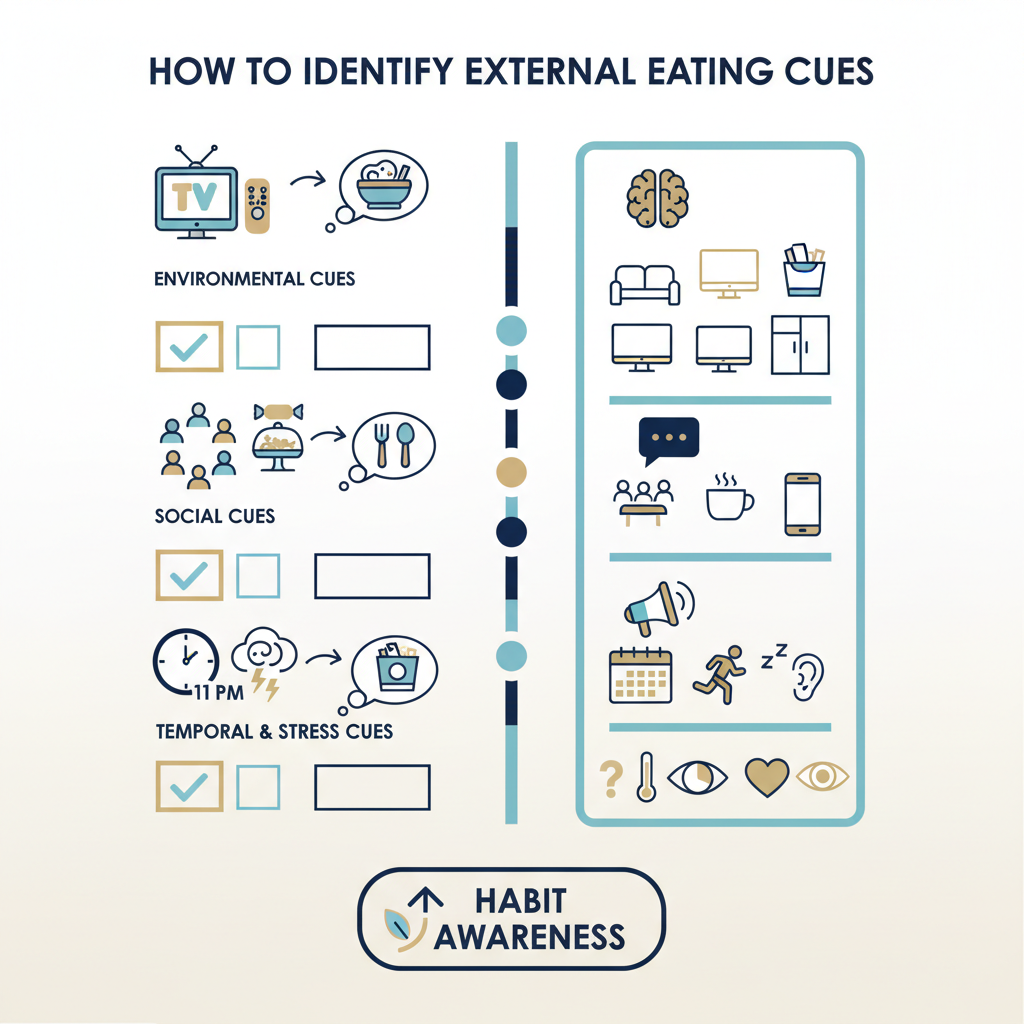
What Are External Eating Cues?
External eating cues are environmental, social, or sensory signals that prompt an individual to eat or think about food, regardless of their internal physical hunger levels (which are indicated by stomach signals or low energy). In the study of behavioral nutrition, distinguishing between internal and external cues is fundamental to understanding eating behavior. Internal cues stem from the body's physiological need for fuel, whereas external cues originate from the outside environment, targeting our senses and social expectations. For example, seeing an advertisement for a favorite dish, smelling food while walking down the street, or even looking at the clock and noticing it is lunchtime are all external cues. These triggers are highly potent because they are often linked to past experiences and positive memories, making the response to them almost automatic. In modern environments, we are constantly surrounded by these cues, which makes relying solely on internal signals complex. Understanding this dynamic helps explain why we might feel a strong urge to eat even shortly after a satisfying meal. It is important to recognize that responding to external cues is not a personal weakness, but a natural response to an environment designed to capture our attention. By recognizing these triggers, we can begin to apply mindful eating practices, which focus on intentional attention to the present experience without judgment, helping to create a space between the trigger and the response.
How to Identify External Eating Cues for Habit Awareness
Learning how to identify external eating cues for habit awareness is an ongoing process that requires observation and curiosity rather than self-criticism. Here are practical steps that can help you build this essential awareness in your daily life. The first step is the pause. When you feel the urge to eat, give yourself a moment to pause before responding. Ask yourself: Am I physically hungry? Are there signals from my stomach indicating a need for food? If the answer is no, this is the time to look for the external trigger. The second step is scanning your environment. Look around and notice what is happening. Did you just see food? Did you smell something specific? Are you in a social situation where others are eating? Are you feeling bored or stressed in this particular location? The third step is documenting and monitoring. Use a journal or an app on your phone to record the times you eat without physical hunger, and write down the cue you believe triggered this urge. Journaling helps turn fleeting observations into tangible data you can analyze. The fourth step is looking for patterns. After a period of journaling, review your notes. Do you tend to snack whenever you watch TV? Do you crave sweets every time you pass a specific place on your way home from work? Identifying these patterns is the essence of habit awareness. The fifth step is proactive planning. Once you have identified your common triggers, you can start developing strategies to manage them. For instance, if a candy bowl on your desk is the trigger, you might try moving it out of sight. This process is not about stopping you from eating, but about putting control back in your hands, so that the decision to eat is conscious rather than a mere reaction to your environment. It is also helpful to understand how this overlaps with breaking emotional eating, as external cues can sometimes be linked to specific emotional states.
Types of External Eating Cues in Daily Life
External eating cues are highly diverse and intertwine with the details of our daily lives, especially in cultures where many social interactions revolve around food. These cues can be categorized into several main types to make them easier to recognize. First, visual cues: We eat with our eyes first. Seeing attractively displayed food, whether in reality or on social media, can trigger a strong desire to eat. Even seeing large portion sizes can be a cue to consume more. Second, olfactory cues: The sense of smell is strongly linked to memory and emotion. The aroma of roasted coffee, spices, or baked goods can awaken an immediate desire for those foods, even if we weren't thinking about them moments before. Third, social cues: In many cultures, offering and sharing food is an expression of generosity and affection. Being at a family gathering, a wedding, or even out with friends presents a powerful cue to eat simply for social participation, regardless of individual hunger. Fourth, situational or activity-related cues: Associating eating with specific activities is a common form of conditioned learning. For example, eating popcorn when entering a cinema, snacking during a long drive, or eating while working at a computer. In these cases, the activity itself becomes the trigger. Fifth, temporal cues: Relying on the clock to determine eating times instead of body signals. Feeling that you must eat lunch because the clock strikes 2 PM, even if you had a late breakfast and are not yet hungry. Understanding these different types helps in building customized strategies to manage them. For example, if you are following a comprehensive beginner's guide to intermittent fasting, awareness of temporal and social cues becomes crucial for organizing eating windows with mindfulness and flexibility.
Behavioral Nutrition and the Food Reward System
To deeply understand how external eating cues operate, we must look at the intersection of psychology and nutrition, known as what is behavioral nutrition?. This field studies the behaviors, beliefs, and environments that influence our dietary choices. A core concept in this context is the brain's reward system. When we are exposed to an external cue associated with highly palatable food (rich in fats or sugars), the brain releases neurotransmitters like dopamine, creating a sense of anticipation and desire. This evolutionary system was beneficial in the past when food was scarce, driving humans to seek out energy-dense foods. However, in our current environment filled with an abundance of processed foods and constant triggers, this system can lead to exaggerated responses. You can delve deeper into this topic by reading about understanding the food reward system and how it drives cravings and eating behavior. Behavioral nutrition does not seek to suppress this system, but rather to understand and work with it. By being aware of how our brains respond to external cues, we can design our environments in a way that supports our goals rather than fighting against them. This involves modifying the home environment, such as placing foods we want to eat regularly in visible spots, and reducing the direct visibility of foods we wish to consume less often. It also includes understanding how our dietary choices can impact cognitive functions, which is discussed in articles about focus foods for brain performance. Awareness of these dynamics shifts the focus from self-blame to a scientific and practical understanding of human behavior.
Common Misconceptions vs. What Needs Verification
In the journey of understanding eating behavior, we often encounter information that may seem logical but requires scientific and behavioral verification. The following table outlines some of these concepts and how they can be reframed from an educational perspective.
| Common Misconception | What Needs Deeper Understanding and Verification |
|---|---|
| A sudden craving for a specific food always means a nutrient deficiency. | Sudden cravings are most often linked to external cues (sight, smell) or emotional states, not necessarily a specific physiological deficiency. |
| Controlling eating relies entirely on personal willpower. | The surrounding environment and external cues play a massive role. Designing a supportive environment is far more important than relying on willpower alone. |
| All external cues must be completely ignored to succeed in managing eating habits. | Awareness and understanding of cues is the goal, not attempting to ignore or suppress them, as suppression can backfire. |
| True hunger only occurs at standard meal times. | Physiological hunger can occur at various times based on activity and the composition of previous meals, while eating at strict times might be a response to a temporal cue. |
| BMI is the sole metric for the success of dietary habits. | Healthy habits encompass the relationship with food and behavioral awareness. For a broader view, review BMI accuracy and better alternatives. |
Common Informational Mistakes in Health
When attempting to apply habit awareness concepts, many fall into common mistakes resulting from a misunderstanding of available health information. One of the most prominent errors is confusing emotional eating with responding to external cues. While both share the trait of not stemming from physical hunger, emotional eating is triggered by internal feelings (like stress or sadness), whereas external cues come from the environment (like seeing food). Distinguishing between them is essential because the coping strategies differ. Another mistake is trying to change all habits at once upon recognizing the triggers. This approach often leads to burnout and regression. Sustainable change requires focusing on one trigger or habit at a time. Some also mistakenly believe that general dietary guidelines are rigid rules that cannot be personally adapted. It is important to follow developments in this field, such as those discussed in the DGE nutrition guidelines Germany 2026, to understand how modern recommendations lean towards flexibility and individual considerations rather than strict rules. Finally, self-diagnosing based on general information is a significant error. For instance, someone might link feeling tired after eating to complex health issues without medical consultation. If there are persistent concerns, it is crucial to recognize symptoms properly, as outlined in the insulin resistance symptoms complete guide, and consult a licensed professional for assessment.
Practical Questions for a Licensed Professional
When you decide to take your awareness of eating habits to a professional level by consulting a licensed dietitian or physician, preparing well for the visit can make a significant difference in the quality of care you receive. Instead of asking for a generic diet plan, use your observations about external eating cues to build a productive dialogue. Here are some questions you can ask: 1. I have noticed that I frequently respond to specific visual cues in my work environment; how can I modify my behavioral response without feeling deprived? 2. Based on my observation log, I find it difficult to distinguish between physical hunger and the urge to eat triggered by social situations; what tools do you recommend to improve this distinction? 3. Are there specific tests you suggest to ensure that my frequent urges to eat are not related to a nutritional deficiency or an underlying physiological condition? 4. How can I integrate awareness practices regarding external cues into the overall health management plan we are discussing? 5. If I feel that my response to cues is linked to chronic stress, would you recommend a referral to a psychologist or a specialist in cognitive behavioral therapy? These questions position you as an active partner in your healthcare and help the professional provide guidance tailored to your individual situation.
The structured reflection approach as Structured Support
In the context of building habit awareness and identifying external eating cues, some may find value in using organizational frameworks that help structure self-observation. The structured reflection approach is one such structural tool that can be integrated into a broader lifestyle approach. It is important to emphasize that the structured reflection approach is not a medical treatment, nor a substitute for professional consultation, and it does not guarantee predetermined outcomes. Rather, it is a tool designed to provide a framework that helps individuals organize their observations about their daily habits and track their responses to various triggers in their environment. The effectiveness of any organizational tool depends on how it is utilized as part of a larger picture that includes balanced nutrition, physical activity, stress management, and good sleep. When utilizing the structured reflection approach, users are encouraged to focus on the process of observation and self-learning rather than focusing exclusively on end results. This approach aligns with the principles of behavioral nutrition, which emphasize the importance of understanding context and being aware of the internal and external processes that guide behavior. If you are considering using any new organizational framework, it is always wise to discuss it with your healthcare professional to ensure it aligns with your individual health needs and long-term goals.
Frequently Asked Questions
Common Questions About External Eating Cues
Below are answers to some of the most frequently asked questions on this topic, presented in an educational format to help clarify concepts.
Medical Disclaimer
The information provided in this article is for educational and informational purposes only and does not constitute a substitute for professional medical advice, diagnosis, or treatment. The information presented here should not be used to diagnose or treat any health problem or disease. Dietary behaviors and responses to cues vary significantly from person to person and may be related to medical or psychological conditions that require evaluation by licensed professionals. It is always recommended to consult your physician or a licensed dietitian before making any major changes to your diet or lifestyle, especially if you have pre-existing health conditions. Never disregard professional medical advice or delay in seeking it because of something you have read in this article.
Conclusion and Next Steps
Understanding how to identify external eating cues for habit awareness is a valuable skill that can transform how you interact with your surrounding food environment. By distinguishing between internal hunger and external signals, and applying self-observation strategies, you can move towards more conscious and balanced dietary choices. Remember that the goal is not perfection or suppressing natural responses, but building a deeper understanding of your behaviors and designing an environment that supports your personal goals. Behavioral nutrition offers a useful lens to view these complex interactions in a scientific and practical manner. If you are ready to take a practical step towards better understanding your habits and identifying areas you can focus on, the next step is to assess your current situation clearly. Start your health assessment now to discover more about your behavioral patterns and the appropriate steps for your personal journey.
Further Education
- Explore the metabolic health education hub
- Learn how to read research summaries
- Use the educational health assessment

Ready to choose a clearer health starting point?
Start with a short educational assessment to explore tools and resources that may fit your goal. It is not a medical diagnosis.
Continue learning at Behavioral Nutrition.