Mastering the German Food Label Guide: A Comprehensive Resource for Expats and Health-Conscious Residents
Author: Feras Alayed
Published:
Updated:
Category: nutrition
Reading Time: 10 minutes
Introduction: The Supermarket Challenge
For many international residents in Germany, a simple trip to the grocery store can feel like an advanced linguistics exam. You stand in the aisle of a Rewe or Edeka, holding a package of whole-grain bread or a plant-based yogurt, trying to determine if it aligns with your health goals. The terms 'Kohlenhydrate,' 'Ballaststoffe,' and 'davon Zucker' are ubiquitous, yet their implications for your daily energy and long-term metabolic health are not always clear.
The struggle to maintain a healthy lifestyle in a new country often stems from a gap in health literacy. When you cannot accurately interpret what is in your food, it becomes difficult to sustain dietary changes. Many people find that previous attempts at weight management or energy optimization fail because they inadvertently consume high levels of processed sugars hidden under technical German names. This German food label guide aims to bridge that gap, providing you with the tools to make informed decisions that support your metabolic wellbeing.
Key Takeaways
- German labels use a standardized 'per 100g' format, making comparisons between products easier.
- 'Ballaststoffe' (Fiber) is a crucial metric for metabolic health and insulin sensitivity.
- The Nutri-Score is a helpful visual aid but should not replace a detailed look at the ingredients list.
- Hidden sugars often appear as 'Dicksaft,' 'Sirup,' or 'Extrakt.'
TL;DR
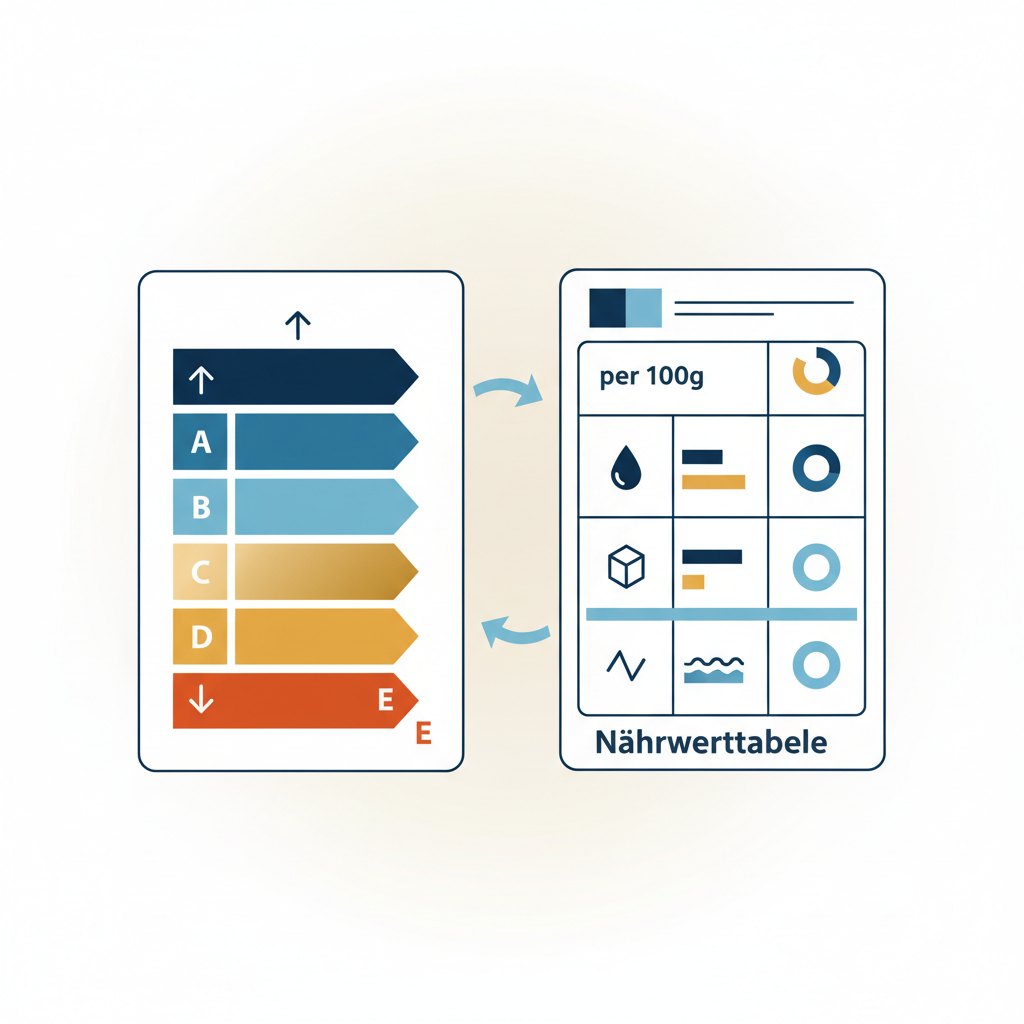
Navigating German food labels requires understanding the mandatory nutrition table (Nährwerttabelle) and the ingredients list (Zutatenliste). Always check the 'per 100g' column to compare products fairly. Look for high 'Ballaststoffe' (fiber) and low 'davon Zucker' (of which sugars) to support metabolic health. While the Nutri-Score offers a quick reference, a deeper look at additives and sugar types is essential for those managing blood sugar levels (aiming for stability in the mg/dL range).
Decoding the Nährwerttabelle (Nutrition Table)
In Germany, as in the rest of the EU, the Nährwertdeklaration (nutrition declaration) is mandatory for most pre-packaged foods. This table is your primary source of data. Unlike some countries that focus on 'per serving' sizes—which can be manipulated to look healthier—German law requires values to be listed per 100g or 100ml.
1. Brennwert (Energy)
Listed in both Kilojoules (kJ) and Kilocalories (kcal). While calories are a unit of energy, the source of those calories matters significantly for metabolic health. A calorie from fiber behaves differently in the body than a calorie from refined starch.
2. Fett (Fat)
This is subdivided into 'gesättigte Fettsäuren' (saturated fatty acids). While total fat is important, the quality of fats—preferring unsaturated sources—is often emphasized by the Deutsche Gesellschaft für Ernährung (DGE).
3. Kohlenhydrate (Carbohydrates)
This is the total carbohydrate count. The most important sub-category for those monitoring insulin resistance is 'davon Zucker' (of which sugars). This includes both naturally occurring sugars and added sugars. For individuals tracking their health, understanding how these impact blood sugar (measured in mg/dL) is vital. You can learn more about these specific terms in our guide on questions to ask your doctor about diabetes terminology.
4. Ballaststoffe (Dietary Fiber)
5. Eiweiß (Protein) and Salz (Salt)
Protein is essential for muscle maintenance and satiety. Salt (Salz) is strictly regulated, and the WHO recommends less than 5g per day, though many processed German breads and meats can be surprisingly high in sodium.
The Zutatenliste: Finding Hidden Ingredients
The Zutatenliste is organized by weight in descending order. The first three to five ingredients usually make up the bulk of the product. If 'Zucker' or a sugar derivative is in the top three, the product is likely to cause a significant glycemic response.
Expats should watch out for these German terms for hidden sugar:
- Glukose-Fruktose-Sirup: High-fructose corn syrup.
- Gerstenmalzextrakt: Barley malt extract.
- Süßmolkenpulver: Sweet whey powder (contains lactose).
- Dicksaft: Concentrated fruit juice (e.g., Apfeldicksaft).
Understanding these nuances is part of building broader health literacy, similar to the efforts discussed in the health literacy guide for the Eastern Province, adapted for the German context. Being able to read the 'fine print' protects you from marketing claims that might suggest a product is 'fit' or 'light' while it remains high in refined starches.
Understanding the Nutri-Score
You will frequently see a color-coded scale from A (green) to E (red) on the front of German packaging. This is the Nutri-Score. It is a voluntary labeling system designed to give a quick overview of a food's nutritional quality.
- How it works: It rewards 'positive' components (fiber, protein, fruit, vegetables, nuts) and penalizes 'negative' components (calories, saturated fat, sugar, salt).
- The Limitation: The Nutri-Score compares products within the same category. A 'B' rated breakfast cereal is better than a 'D' rated one, but it may still be less healthy than an 'A' rated plain yogurt. It does not account for additives, pesticides, or the degree of processing.
For those navigating metabolic health, especially if dealing with concerns like insulin resistance, the Nutri-Score is a starting point, but the Nährwerttabelle remains the gold standard. For more on managing complex metabolic conditions, see our article on navigating metabolic health and insulin resistance.
Metabolic Health and Label Literacy
Metabolic health is defined by how well your body generates and processes energy. In Germany, clinical markers for blood sugar are typically measured in mg/dL (milligrams per deciliter). A fasting blood sugar level below 100 mg/dL is generally considered normal, while 100-125 mg/dL may indicate prediabetes.
When you use a German food label guide, you are essentially performing a risk assessment for your blood sugar. High-sugar, low-fiber foods lead to insulin spikes. Over time, frequent spikes can lead to insulin resistance, a precursor to various metabolic challenges. By choosing products with a higher Ballaststoffe count and lower Zucker, you support your body's ability to maintain stable energy levels.
This level of informed decision-making is a form of informed consent with yourself. Just as you would expect transparency in medical data, as discussed in our wellness privacy and informed consent guide, you should demand transparency from the food products you buy.
German Health Regulations and Resources
Germany has robust systems for food safety and nutritional guidance. Residents can look to the following organizations for verified information:
- BfR (Bundesinstitut für Risikobewertung): The Federal Institute for Risk Assessment provides scientific advice on food safety.
- RKI (Robert Koch Institut): While primarily focused on disease control, the RKI provides essential data on the health status of the German population, including metabolic trends.
- DGE (Deutsche Gesellschaft für Ernährung): The German Nutrition Society sets the standards for dietary intake (Referenzwerte).
- DDG (Deutsche Diabetes Gesellschaft): A critical resource for understanding blood sugar management and the latest research in metabolic health.
When evaluating health claims on packaging, remember that EU law prohibits food labels from claiming to prevent, treat, or cure a human disease. If a label seems too good to be true, consult the guide to understanding health reports to learn how to interpret clinical-style language.

Source-Verification Checklist
Before trusting a new health trend or a specific food claim in Germany, use this checklist:
- [ ] Does the information come from a recognized German authority (BfR, DGE, RKI)?
- [ ] Is the 'per 100g' data consistent with the ingredients list?
- [ ] Are the health claims compliant with EU Regulation (EC) No 1924/2006 (no disease-curing claims)?
- [ ] If the product is a supplement, does it have a 'PZN' (Pharmazentralnummer) for tracking in German pharmacies?
- [ ] Does the advice encourage a balanced lifestyle rather than a 'quick fix'?
For those in the healthcare or wellness industry, ensuring your service meets these high standards of literacy is vital, as explored in optimizing follow-up service excellence and effective health literacy guides.
Frequently Asked Questions
A: It refers to the physiological energy value of the food, measured in kJ and kcal. It is the German term for 'Energy' or 'Calories.'
Q: Why is fiber (Ballaststoffe) sometimes not listed?
A: While the 'Big 7' (Energy, Fat, Saturated Fat, Carbs, Sugar, Protein, Salt) are mandatory, fiber is voluntary under EU law unless a nutrition claim is made. However, many German brands include it for transparency.
Q: Is 'Bio' always healthier?
A: The 'Bio' (organic) seal ensures specific environmental and farming standards. However, a 'Bio' cookie can still be very high in sugar and low in fiber. Always check the Nährwerttabelle regardless of the Bio seal.
Q: How do I convert blood sugar readings in Germany?
A: Germany primarily uses mg/dL. If you are used to mmol/L (common in the UK or Canada), multiply by 18 to get the mg/dL equivalent.
Q: What is the 'Referenzmenge'?
A: This is the 'Reference Intake' for an average adult (8400 kJ/2000 kcal). It helps you see what percentage of your daily needs a portion of the food provides.
Medical Disclaimer
Next Step for Your Health Journey
Understanding labels is just the beginning. To see how your current choices align with your long-term wellness goals, we recommend taking a structured look at your metabolic markers. ابدأ تقييمك الصحي (Start your health assessment) today to receive a personalized guide tailored to your health literacy needs.
Further Education
- Explore the metabolic health education hub
- Learn how to read research summaries
- Use the educational health assessment
Explore health education with care
Use ATHAR’s educational guides and practical tools to choose your next learning step.