How to Read Longevity Research: A Practical Guide to Longevity Research Literacy
Author: Feras Alayed
Published:
Updated:
Category: longevity
Reading Time: 5 minutes
Key Takeaways
- Learn to distinguish between observational studies and randomized controlled trials (RCTs).
- Understand the difference between relative and absolute risk reduction to avoid misinformation.
- Recognize that animal study results do not always translate to humans.
- Use Blue Zones patterns as a practical framework for daily living.
TL;DR Summary
If you're looking for a quick answer on how to read longevity research, always start by checking the study type (is it human?) and sample size, then compare results with sustainable lifestyles like functional nutrition. Don't be fooled by headlines promising instant results; science is a cumulative process, not a momentary one.The Expectation Gap: Between Headlines and Reality
We live in a golden age of longevity research, with billions of dollars flowing into molecular biology labs. However, this scientific influx is accompanied by significant media noise. When you read a headline like 'Discovery of a substance that extends life by 40%,' you must immediately ask yourself: does this percentage apply to humans or lab worms?
Learning how to read longevity research begins with acknowledging that science is inherently slow and conservative. While the public looks for a 'magic pill,' scientists look for precise mechanisms like optimizing cellular energy and functional nutrition to support mitochondrial health. The gap between what the lab says and what newspapers publish is where many get lost.
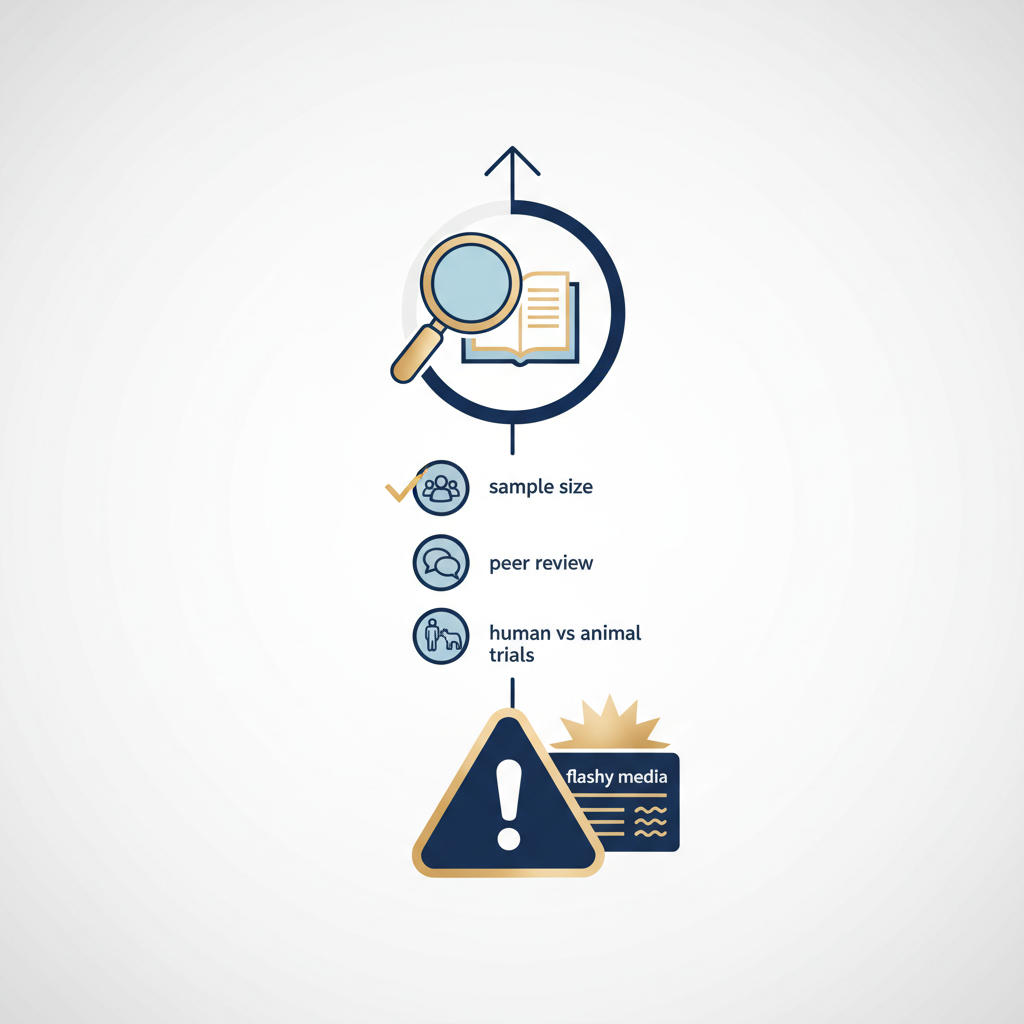
The Hierarchy of Evidence: Not All Research is Equal
Imagine science as a hierarchical structure. At the base, we find opinions and individual reports; at the top, we find systematic reviews. To understand research, you must know where the study you are reading falls on this pyramid:
- In Vitro/Animal Studies: Conducted on cells or animals. They are vital for discovering mechanisms but don't guarantee human results.
- Observational Studies: Monitor groups of people over long periods (like Blue Zones studies). They show correlation, not causation.
- Randomized Controlled Trials (RCTs): The gold standard, where participants are randomly assigned to test a specific intervention.
- Systematic Reviews (Meta-analysis): Combine results from multiple studies to provide a comprehensive picture.
When reading about NAD+ and aging science, you'll find much of the excitement stems from animal studies, while human studies are still in early stages. This doesn't diminish their value but places them in the correct context.
Understanding Risk: Absolute vs. Relative
This is the biggest trap in reading research. Suppose a study says taking a certain substance reduces the risk of a disease by 50%. That sounds amazing! But, if the original risk was 2 out of 1000 people, reducing it by 50% means it becomes 1 out of 1000. The absolute decrease is only 0.1%. Always look for absolute numbers to know the real impact on your daily life.
Mice Aren't Men: The Limits of Lab Studies
Why do many treatments succeed in mice but fail in humans? Because human biology is far more complex, and our environment isn't controlled like lab cages. Longevity research relies heavily on models like yeast, worms, and mice because they have short lifespans, allowing results to be seen quickly. However, when applying these results to your healthy aging routines, be cautious and wait for human confirmation.
Blue Zones Logic and Functional Nutrition
Instead of chasing every new study, longevity experts tend to look at 'patterns.' Blue Zones studies offer insights into communities where individuals live long, healthy lives. These patterns include:
- Plant-forward nutrition rich in fiber.
- Constant natural movement.
- Strong social ties.
- Stress management through daily rituals.
This approach aligns with functional nutrition, which focuses on supporting basic body functions rather than just treating symptoms. Reading research through the lens of 'Does this align with what we know about Blue Zones?' can be a great filter for new information.
Red Flags in Longevity Claims
How do you know if the article or product you're reading about is exaggerated? Watch for these signs:
- Absolute Words: Like 'ultimate cure,' 'elixir,' 'instant revolution.'
- Ignoring Side Effects: No potent biological intervention comes without potential side effects.
- Biased Funding: Is the study fully funded by the company selling the product?
- Relying on Anecdotes: 'I tried it and felt better' is not scientific evidence.
Practical Checklist for Evaluating Research
| Question | Why is it important? |
|---|---|
| Is the study on humans? | To ensure biological applicability. |
| How many participants? | Small samples can give misleading results by chance. |
| What was the duration? | Longevity requires years of observation, not weeks. |
| Was it peer-reviewed? | To ensure other experts reviewed the methodology. |
Conclusion
Mastering how to read longevity research doesn't mean becoming a scientist; it means becoming a smart consumer of information. By focusing on the evidence pyramid, understanding the difference between correlation and causation, and linking findings to functional nutrition principles, you can build a routine that supports your long-term health without falling for hype.
Medical Disclaimer: This content is for educational purposes only and does not constitute medical advice. Always consult a healthcare professional before making significant changes to your diet or lifestyle.

Explore health education
Review the educational guides and practical tools related to this topic.
Explore the education hub