Why do your habits fall apart on weekends? And how to get back without beating yourself up?
Author: Feras Alayed
Published:
Updated:
Category: health
Reading Time: 7 minutes
Why do your habits fall apart on weekends? And how to get back without beating yourself up
A weekend can feel like a restful break or a pleasant social occasion, but sometimes it leaves us feeling like everything we achieved was "for nothing." The visual in front of you is meant to remove that feeling: it doesn't depict a catastrophic weekend, but a brief detour in a long journey. Returning doesn't start with punishment — it starts with a small, repeatable step. In this article we read the visual practically and turn it into daily steps designed to be easy to repeat without guilt.

Visual reading: What does the image say in practice?
The image doesn't represent the end of the road; it shows a small branching in the path. Its elements (a crowded dining table, a watch showing late sleep, a simple bag or a shoe left aside) often point to three intertwined factors:
- Context change: different places, times, and companions make daily choices shift. Context makes different habits easier — or more disruptive — to follow.
- Sleep–wake disruption: changed sleep times directly affect appetite, alertness, and daytime energy; so what we eat and do changes too. (See research on circadian organization and metabolism). [Source].
- Accumulation of social decisions: gatherings add ad‑hoc choices about what and when to eat and sleep, increasing feelings of justification or overindulgence.
The practical message of the image: don't try to rebuild everything in one day. What the weekend “erases” is not the loss of achievement but a temporary change in circumstances. The return depends on what you do in the next hours, not on self‑punishment.
Why habits break down: a brief explanation with scientific references
Context shift breaks expected cues: many of our habits are tied to triggers (place, time, company). When context changes, habit activation drops and conscious willpower is needed.
Sleep disruption changes appetite and decision capacity: even small shifts in sleep timing affect hormones related to satiety and hunger and morning energy, making food choices harder. Scientific sources explore the links between sleep, metabolism, and food choices. [1].
Without recalling progress, we tend to magnify failure: focusing on a single incident (a meal or a bad night) obscures a preceding string of successes; that opens the door to discouragement or giving up.
(For studies on the intersection of sleep, metabolism, and decision behavior see: Source 1, Source 2, Source 3, and a conceptual reference on behavior change and return after interruption: Source 4).
One strategic principle: return by step, not by punishment
Before jumping to practical steps, remember this principle: returning is about re‑shaping circumstances to work for you. Self‑punishment doesn't restore your biological system or social context; it consumes energy and reduces motivation. So everything below is designed to be brief, repeatable, and not require special gear.
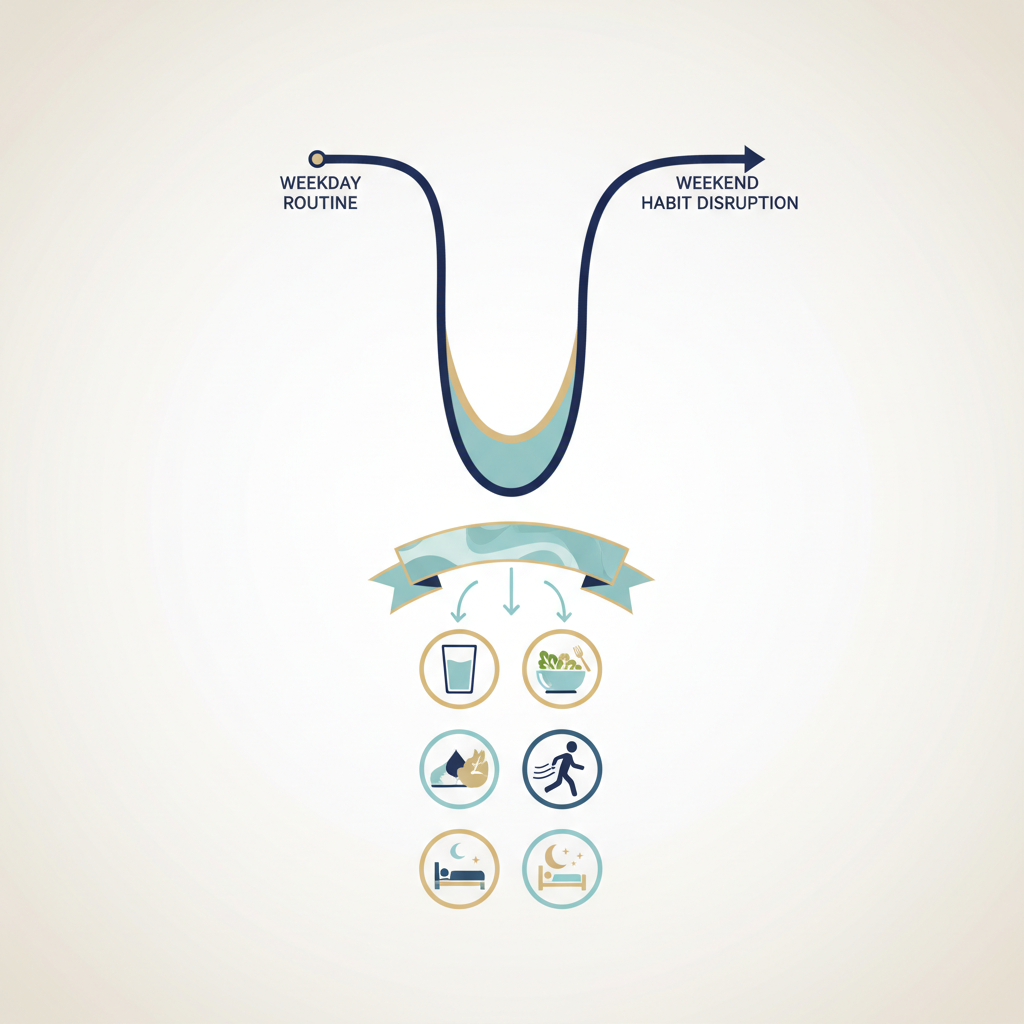
Small repeatable steps to return to healthy habits after the weekend
General principles before details:
- Start with a step that requires little willpower.
- Make the step visible and simple: water, a light balanced meal, 10 minutes walking, a fixed bedtime.
- Focus on context (place, time, company) before changing the “content” entirely.
Initial 24‑hour routine (adjustable):
Water first — within 30 minutes of waking
- Why: activates digestion and creates a temporary fullness that helps reduce impulsive choices.
- How: a glass of water at room temperature; add a small lemon wedge if you like.
- Repeatable: no counting required — agree with yourself that water is the first action.
A simple balanced meal — within the first one to two hours
- Why: simple food stabilizes blood sugar and reduces the pull toward calorie‑dense impulsive foods later.
- Examples: plain yogurt + a handful of fruit/nuts, a hard‑boiled egg + a piece of whole grain bread, or a small bowl of whole grains with quickly cooked vegetables.
- Practical rule: small portion of protein + a fiber or vegetable + a small amount of healthy fat.
Short walk — 10 to 20 minutes after the meal or at a convenient time
- Why: a short walk improves mood, reduces heaviness, and helps restore natural wakefulness after sitting or travel.
- How: a clear, time‑bound commitment — e.g., “I will walk 12 minutes around the block”; a timer helps execution.
Re‑organize bedtime — small measures to restore rhythm
- Why: gradually shifting bedtime restores hormonal consistency and reduces late‑night cravings.
- How: choose a bedtime within two hours of your ideal target — no need to revert immediately to your usual hour; correct step by step. Example: if you stayed up until 2 a.m., aim for 1:30 the next night, then 1:00 after that.
Helpful and comfortable complementary steps
- Reduce screen exposure 30 minutes before sleep (or use a color‑correction/blue‑light filter).
- Drink a glass of water before light physical activity to avoid dehydration.
- Log one small achievement in a notebook — even "walked 12 minutes" — to boost the sense of progress.
Applied map for a return week (brief)
Day 1 (return day): water, a simple meal, 10–15 minutes walk, bedtime 30–60 minutes earlier than the previous night. Days 2–3: maintain water, meal, and walk; add a simple enjoyable activity (call a friend, or prepare an easy healthy meal). Days 4–7: restore 70–80% of your usual weekday routine (planned meals, light exercise 20–30 minutes daily or 3×/week, regular sleep).
Practical tips to ease the return without self‑shaming
- Reduce absolute commands: replace “I must” with “I’ll try.”
- Break the task into parts: if a full workout feels overwhelming, commit to 5 minutes then add 5 if you want.
- Make the action visible: put a glass of water next to your bed or place an ingredient for a simple meal in sight.
- Use gentle reminders instead of guilt: a phone reminder “walk 12 minutes” often works better than self‑reproach.
What not to do
- Don’t devalue the whole week because of one night.
- Don’t introduce strict measures or punishments (physical or dietary); these approaches reinforce a give‑up cycle.
- Don’t wait for the “perfect day” to start — small daily starts beat waiting.
Notes on adaptation and social context
Meetings and celebrations are a normal part of life; the goal is not to avoid them but to know how to return quickly afterward. Before an expected event, consider two preparatory steps: a glass of water as a starter and a simple meal before going out to reduce impulsive eating. After the event, use the simple return map (water, meal, walk, sleep) instead of thinking in terms of punishment.
Brief conclusion
Returning to healthy habits after the weekend is not a giant task that requires superhuman will. It’s a series of small, visible steps tied to context. Water, a simple meal, a short walk, and regular sleep — these are not punishments but tools to recalibrate the system. Give these steps priority today, and they’ll bring you back on track faster than you expect.
Choose your next step calmly
You can continue learning from the Metabolic Health hub or use the Metabolic Health Compass to organize your questions and habits. For practical learning try the BMI calculator, the waist‑to‑height calculator, the calorie calculator, the water calculator, and the fasting calculator. You’ll find broader context in the research library, the visual guide to sustainable habits, the return‑after‑interruption guide, and the Feel Great page.
Getting started with Member
If you want to view the official product path, use the Member link. After completing an order you can send confirmation via WhatsApp: https://wa.me/96877020770?text=%D8%A3%D8%AA%D9%85%D9%85%D8%AA%20%D8%B7%D9%84%D8%A8%20Member%20%D8%B9%D8%A8%D8%B1%20ATHAR%20%D9%88%D8%A3%D8%B1%D8%BA%D8%A8%20%D9%81%D9%8A%20%D9%85%D8%B9%D8%B1%D9%81%D8%A9%20%D8%AE%D8%B7%D9%88%D8%A9%20%D8%A7%D9%84%D8%A7%D9%86%D8%B6%D9%85%D8%A7%D9%85%20%D8%A5%D9%84%D9%89%20%D9%85%D8%AC%D9%85%D9%88%D8%B9%D8%A9%20%D8%A7%D9%84%D8%AF%D8%B9%D9%85%20%D8%A7%D9%84%D9%85%D9%86%D8%A7%D8%B3%D8%A8%D8%A9.
This content is educational and supportive for building habits; it is not a medical diagnosis and does not promise a specific outcome.
Selected links and references
- Study on metabolic changes and behaviour: https://pmc.ncbi.nlm.nih.gov/articles/PMC11641623/
- Research on sleep and its effect on appetite and decisions: https://pmc.ncbi.nlm.nih.gov/articles/PMC3505409/
- Study on the interplay of circadian rhythm and metabolism: https://pmc.ncbi.nlm.nih.gov/articles/PMC4214609/
- Reference chapter on behaviour change and return after interruption: https://www.ncbi.nlm.nih.gov/books/NBK556005/
Final note: the return starts with one repeatable step. Choose it now — a glass of water or 10 minutes walking — then repeat it tomorrow.
To turn the idea into a practical next step, explore the free health calculators and choose the tool that matches what you want to notice in your day.