Comparing Cortisol Reduction Methods: Active vs. Passive Recovery Guide
Author: Feras Alayed
Published:
Updated:
Category: hormonal-health
Reading Time: 13 minutes
Key Takeaways
- Stress management is not a one-size-fits-all approach; it requires balancing active and passive recovery.
- Active recovery involves gentle activities like walking and stretching, ideal for mental fatigue paired with physical stagnation.
- Passive recovery focuses on stillness, such as sleep and deep breathing, essential for physical or sensory exhaustion.
- Choosing the right method depends on the nature of your day and the type of stress you experienced.
- Understanding your body's signals helps you build a sustainable daily routine that supports hormonal health.
TL;DR
This article provides a comprehensive comparison between active and passive recovery as tools to support healthy cortisol levels. By understanding when you need gentle movement and when you need complete stillness, you can build a more flexible daily routine that responds to your body's needs, enhancing your ability to handle daily stressors sustainably.
The Daily Problem: Why Does Relaxing Feel So Hard?
Imagine this scenario: You return home after a long, demanding workday. You feel completely exhausted, but the moment you lie down on the couch, your mind won't stop racing, and your body feels restless. You've tried to relax, but you feel "wired." This familiar state, often described as "tired but wired," is a direct result of accumulated stress and an incomplete recovery cycle.
The problem many face is the belief that "rest" always means sitting perfectly still. In reality, when your body is saturated with stress hormones after a day full of mental challenges, sitting might actually exacerbate the feeling of restlessness. This is where understanding the comparison of cortisol reduction methods becomes crucial. Do you need to discharge this energy through "active recovery," or do you need to shut down your senses through "passive recovery"?
Previous attempts to relax might have failed because we use the wrong tool at the wrong time. This guide is designed to help you understand your options so you can make daily decisions that better support your health.
What is Cortisol and What Does Stress Recovery Mean?
Cortisol is a hormone released by the body in response to stress. It plays a vital role in regulating metabolism, reducing inflammation, and managing the sleep-wake cycle. Under normal circumstances, cortisol levels rise in the morning to give you energy and gradually decrease by evening to allow you to sleep.
However, in a modern lifestyle filled with constant pressures, cortisol levels may remain elevated for longer than necessary. This is where "stress recovery" comes in. Recovery is not merely the absence of work; it is a physiological and psychological process aimed at returning the body to a state of balance. For a deeper dive into this aspect, you can read our Comprehensive Guide to Understanding Cortisol Conversations.
Active Recovery: Purposeful Movement to Release Tension
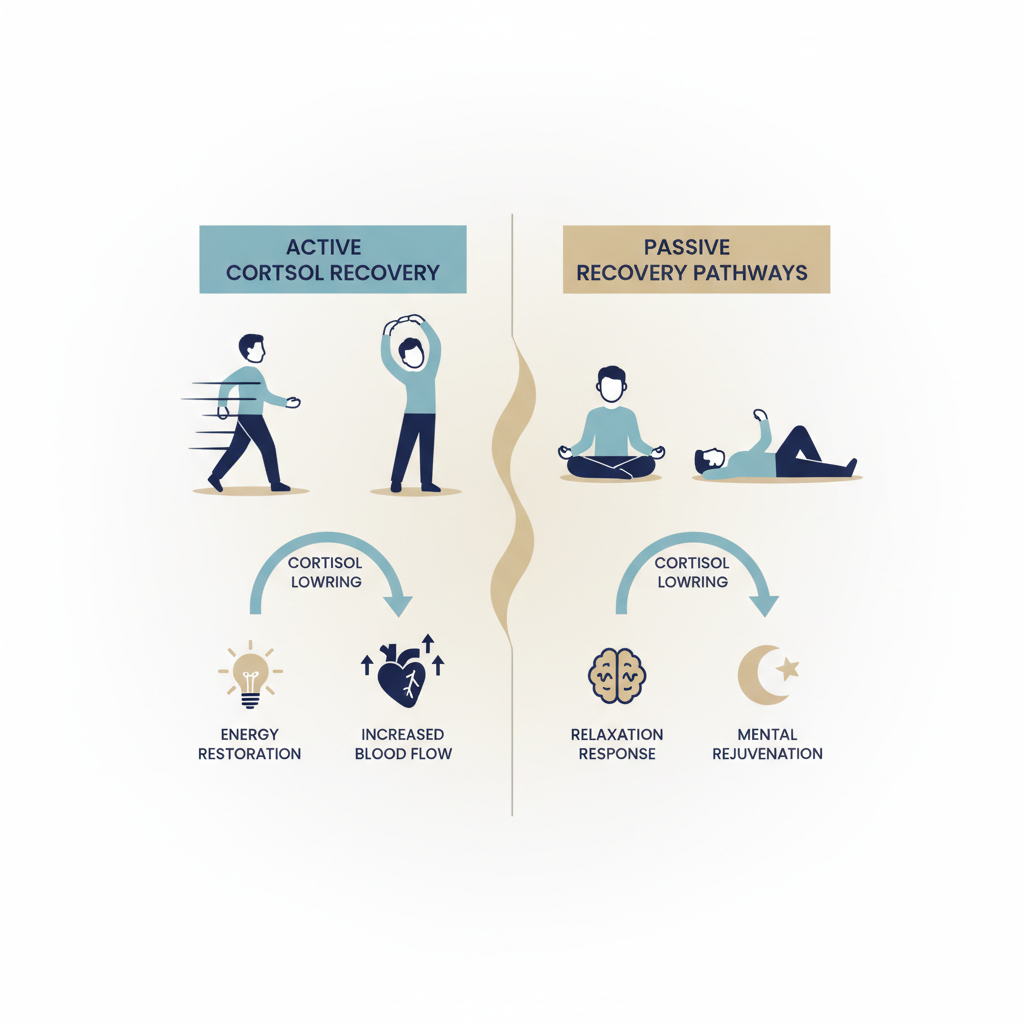
Active stress recovery is defined as the use of light, enjoyable physical or mental activities to help dissipate accumulated tension and stimulate circulation without placing an additional burden on the body.
When is Active Recovery Beneficial?
- After a long day of desk work and prolonged sitting.
- When you feel restless or mentally anxious.
- After experiencing an emotionally stressful situation where you feel pent-up energy.
Examples of Active Recovery:
- Light Walking: A stroll in nature or even around the block helps clear the mind.
- Stretching or Gentle Yoga: Helps relieve accumulated muscle tension.
- Hands-on Hobbies: Such as gardening or drawing, which require light focus that distracts the mind from sources of anxiety.
- Light Organizing: Tidying up a workspace or room can provide a sense of control and accomplishment.
The goal here is not to burn calories or achieve athletic goals, but to signal to the body that the "danger has passed" and it can return to a state of relaxation. This concept sometimes intersects with other lifestyle organization strategies, such as those mentioned in the Intermittent Fasting Beginner's Guide, where light movement plays a role in supporting a daily routine.
Passive Recovery: Stillness and Deep Rest
Passive stress recovery is defined as the complete cessation of physically or mentally demanding activities, allowing the body to enter a state of deep stillness to repair itself and replenish energy.
When is Passive Recovery Beneficial?
- After strenuous physical exertion (like intense workouts or manual labor).
- When experiencing sensory overload (after a day full of noisy meetings or bright screens).
- When you feel completely drained and unable to exert any additional effort.
Examples of Passive Recovery:
- Quality Sleep: The cornerstone of passive recovery.
- Deep Breathing: Breathing techniques that focus on prolonging the exhale help activate the parasympathetic nervous system (responsible for rest and digest).
- Meditation or Resting in Silence: Closing your eyes and stepping away from distractions.
- Heat or Cold Therapy: Such as taking a warm bath or using a sauna (if appropriate for your health condition).
Passive recovery is essential for supporting overall hormonal health, as it gives the body the opportunity to reset its natural rhythms.
Comparing Cortisol Reduction Methods Table
To make choosing easier, here is a table illustrating the main differences between the two types:
| Feature | Active Recovery | Passive Recovery |
|---|---|---|
| Definition | Light movement or purposeful activity to release tension. | Complete stillness and deep rest to recharge energy. |
| Best Used When.. | Mental fatigue, prolonged sitting, restlessness. | Physical exhaustion, sensory overload, severe fatigue. |
| Primary Goal | Stimulate circulation and distract the mind from anxiety. | Shut down senses and repair tissues. |
| Practical Examples | Walking, stretching, gardening, hobbies. | Sleep, deep breathing, lying down, warm bath. |
| Energy Level Required | Low to moderate. | None (requires no effort). |
Decision Guide: Daily Life Scenarios
How do you choose between active and passive recovery? Here are some hypothetical scenarios to help you make the best decision for your day:
Scenario 1: The Office Worker
Situation: You spent 8 hours sitting in front of a computer screen, dealing with emails and deadlines. You have a slight headache and stiff shoulders.
Best Decision: Active Recovery. Your body needs movement to dissipate the tension accumulated from sitting. A 20-minute walk or stretching will be more beneficial than immediately lying on the couch.
Scenario 2: Physical Labor or Intense Sports
Situation: You spent the day organizing the house or did a high-intensity workout. Your muscles are tired, and you feel the urge to close your eyes.
Best Decision: Passive Recovery. Your body has depleted its physical energy and needs stillness for tissue repair. Taking a warm bath and lying down with deep breathing is the optimal choice.
Scenario 3: Emotional Exhaustion
Situation: You went through a difficult conversation or a day full of social pressures. You feel emotionally drained.
Best Decision: A Mix of Both. Start with very light active recovery (like a slow walk in a quiet place) to discharge the emotional load, then transition to passive recovery (like meditation or listening to calming music) to restore balance.
Myths and Facts About Stress Management
In the journey to find balance, you may encounter a lot of conflicting information. Here is a correction of some concepts:
- Myth: Rest always means sleeping or sitting perfectly still.
Fact: Rest can be active. Changing the type of activity (from mental work to light manual work) can be an effective form of rest. - Myth: I must do strenuous exercise daily to get rid of stress.
Fact: Strenuous exercise temporarily raises cortisol levels. If you suffer from chronic fatigue, light active recovery (like walking) may be more beneficial than rigorous workouts. - Myth: I can make up for lost sleep on the weekend.
Fact: Passive recovery (sleep) requires daily consistency to effectively support the circadian rhythm.
Common Mistakes in Reading Cortisol Information
When searching for ways to support your health, it's easy to fall into the trap of some informational mistakes:
- Believing that cortisol is always "bad": Cortisol is essential for life. The problem lies in the imbalance of its timing and levels, not in its mere presence.
- Expecting immediate results: Stress management and lifestyle modification take time. There is no magic method that lowers cortisol overnight. Consistency is key.
- Ignoring other physical symptoms: Chronic stress can overlap with other conditions. For example, some symptoms of fatigue may mimic insulin resistance symptoms or thyroid issues. Therefore, a comprehensive evaluation is necessary.
How to Prepare for a Clearer Dialogue with Your Doctor
Educational articles help you understand your options, but they do not replace specialized medical advice, especially if you suffer from persistent fatigue that does not improve with lifestyle changes. To prepare for your medical appointment, take notes on:
- The times of day when you feel the highest levels of fatigue or restlessness.
- The types of activities that make you feel better (is it movement or stillness?).
- The quality of your sleep and the number of hours you sleep.
- Any other accompanying symptoms.
For more guidance on how to manage the dialogue with your doctor, you can review our guide on the Top 50 Questions for a Thyroid Health Appointment, which provides an excellent framework for asking questions related to hormonal health in general.
Conclusion and Next Step
Understanding the comparison of cortisol reduction methods between active and passive recovery gives you a powerful tool to manage your day with flexibility. You don't have to stick to just one type; the secret lies in listening to your body's signals and choosing the right tool at the right time. Remember that building a healthy routine is an ongoing journey of learning and adaptation.
Are you ready to understand more about how to support your hormonal health?
Know the right step for your goal and read our comprehensive guide on Understanding Cortisol Conversations to deepen your knowledge and build a more balanced daily routine.
Frequently Asked Questions
What is the scope of this guide?
This guide is educational and helps readers organize questions and observations for further learning.
How should I use the information?
Use it to review terminology, note personal questions, and identify sources that require verification.
When should I seek professional guidance?
Discuss personal symptoms, medicines, diagnoses, or treatment decisions with a licensed professional.
Further Education
- Explore the metabolic health education hub
- Learn how to read research summaries
- Use the educational health assessment

Ready to choose a clearer health starting point?
Start with a short educational assessment to explore tools and resources that may fit your goal. It is not a medical diagnosis.
Continue learning at Hormonal Health & Balance.
Continue your next step with ATHAR
Explore the official Feel Great member path, or learn about the creator partnership route if you are interested in sharing wellness education with your audience.
Explore Feel Great · Explore the Creator Affiliate gateway · Ask a question on WhatsApp