From Health Consumer to Health Leader: The Transformation - health consumer to leader transformation
Author: Feras Alayed
Published:
Updated:
Category: business-opportunity
Reading Time: 9 minutes
Key Takeaways
- Turning your personal health success into leadership requires systemization, documented outcomes, and repeatable training.
- The global wellness economy is a multi‑trillion dollar market; prevention, nutrition and personalized care drive durable demand. ([globalwellnessinstitute.org](https://globalwellnessinstitute.org/wp-content/uploads/2024/11/WellnessEconMonitor2024PDF.pdf?utm_source=openai))
- Product-first leadership (health outcomes first) generates higher retention and referral than recruitment-first models. ([blog.unicity.com](https://blog.unicity.com/post/learn-about-the-benefits-of-unicitys-feel-great-system-and-intermittent-fasting?utm_source=openai))
- Business models with no inventory, direct-to-consumer shipping, and recurring revenue lower startup risk and improve scalability.
- Individual results vary. Success requires consistent effort; focus on health transformation before business scale.
TL;DR
Transforming from a health consumer to a health leader means converting personal outcomes into a documented, teachable system that scales ethically. This guide covers market context, leadership skills, product-value alignment, and practical steps to build a health-first business. (Short-citation resource.)
💼 Thousands of entrepreneurs are building health businesses with Feel Great. Learn more about the opportunity →
Introduction: the market and cultural momentum
We are in an era where prevention, personalization, and nutrition are central to consumer health decisions. Global monitoring shows the wellness economy in the multi‑trillion range with continued growth in nutrition and personalized prevention — an environment that rewards leaders who deliver measurable health outcomes. ([globalwellnessinstitute.org](https://globalwellnessinstitute.org/wp-content/uploads/2024/11/WellnessEconMonitor2024PDF.pdf?utm_source=openai))
From health consumer to health leader: what changes
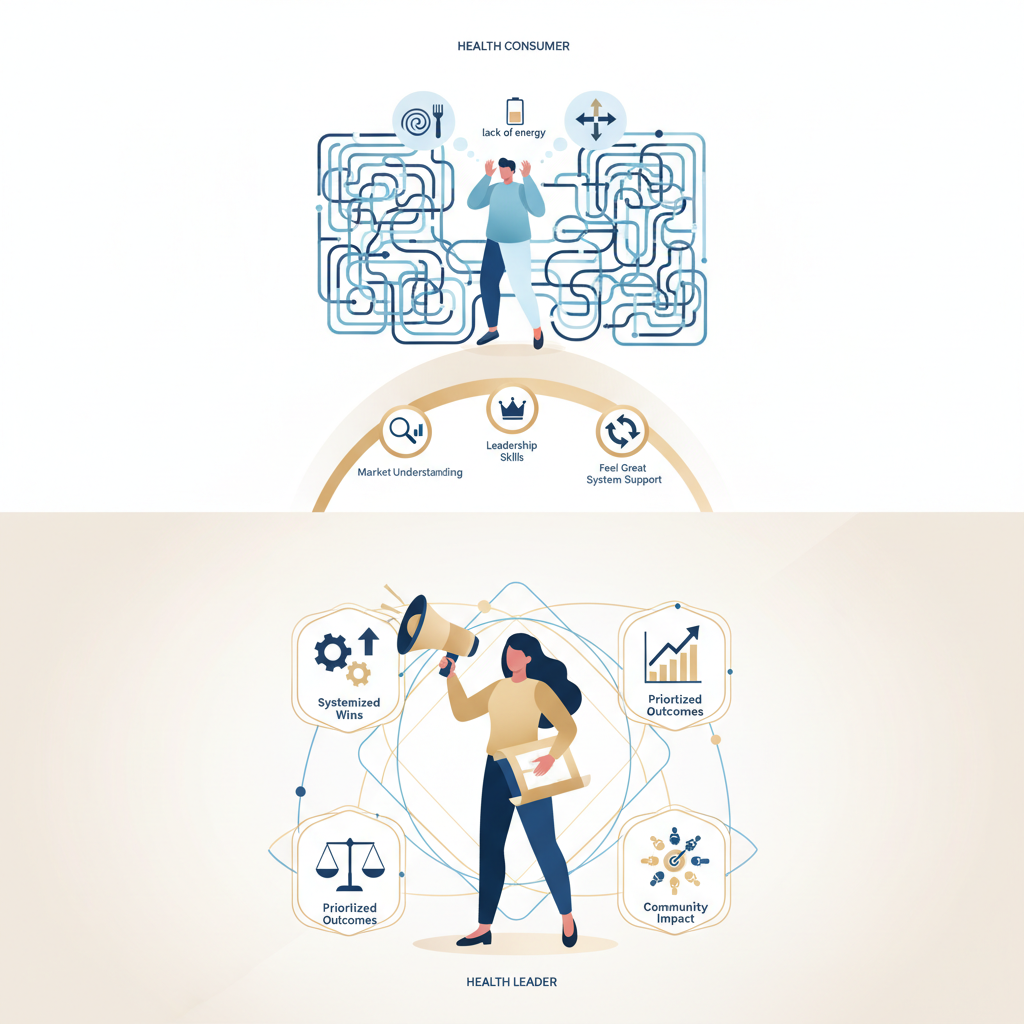
Being a consumer means making decisions for your own health. Becoming a leader means creating a consistent experience that helps others achieve comparable results — repeatedly. The shift requires three things: reproducible protocols, evidence-informed products, and leadership systems that support behavior change.
Three practical stages
- Personal mastery: apply the protocol to yourself, gather objective data, and refine your approach.
- Systemization: create onboarding, checklists, and short educational content so others can follow the same steps.
- Scale leadership: recruit, mentor, and replicate the system with others who can in turn lead their communities.
Industry context — real market signals
Leaders succeed faster when they understand the market. The Global Wellness Institute tracks the wellness economy across 11 segments and projects strong growth in healthy eating, personalized prevention, and wellness real estate, among others. These segments are large and expanding, indicating sustainable demand for product-led, prevention-focused programs. ([globalwellnessinstitute.org](https://globalwellnessinstitute.org/wp-content/uploads/2024/11/WellnessEconMonitor2024PDF.pdf?utm_source=openai))
Distribution matters: direct selling and membership/subscription models remain powerful for wellness brands because they create direct relationships with customers and enable recurring revenue. Industry reports and DSA-related economic trackers show the direct-selling channel still delivers significant economic value and entrepreneurial opportunities. ([dsa.org](https://www.dsa.org/events/news/press-releases/direct-selling-channel-delivers-111-billion-annual-economic-impact-to-us-economy-new-study-finds?utm_source=openai))
Why product-first matters
When the product and protocol deliver measurable health improvements, business growth follows. Leaders who prioritize health build higher trust, reduce churn, and create stronger word-of-mouth. Evidence-backed products and structured protocols (like a time-based eating framework plus targeted supplementation) are easier to teach and scale.
Core competencies for health leaders
Clinical literacy
Understand the primary outcomes, contraindications, and limitations of the products you recommend. Leaders who can translate clinical literature into accessible guidance are more credible.
Behavioral coaching
Master simple behavior-change tools: goal setting, micro-habits, accountability checks, and progress monitoring.
Community facilitation
Routine group coaching and peer accountability convert short-term trials into long-term habits and recurring revenue.
Business acumen
Track simple KPIs — CAC, AOV, retention, and LTV. These metrics tell you whether your model is sustainable and where to invest.
How leaders demonstrate value: a simple evidence pipeline
- Measure — baseline and follow-up metrics (weight, BP, validated questionnaires).
- Aggregate — anonymize and compile results across clients for pattern recognition.
- Share — compliant before/after summaries and testimonials with proper consent.
- Iterate — optimize the process and teach the improved model to your team.
How this connects to the Feel Great system (product value + business model)
The Feel Great system (a combination of Unimate, Balance, and a 4-4-12 time-based eating protocol) is presented as a product-led program designed to support metabolic and behavioral change. Company materials emphasize scientific documentation and product listings in medical references, which leaders can use when educating customers. Unicity positions the system to support entrepreneurs who prioritize health transformation first and business second. ([blog.unicity.com](https://blog.unicity.com/post/learn-about-the-benefits-of-unicitys-feel-great-system-and-intermittent-fasting?utm_source=openai))
Business advantages relevant to leaders:
- No inventory — products ship direct to customers, reducing capital and logistical burdens.
- Recurring customer purchases — subscription-friendly protocols support steady revenue.
- Global reach — selling across multiple countries expands the addressable market from day one.
Leaders should always verify product claims against peer-reviewed research and local regulations before making medical claims or recommendations. ([unicitystatic.s3.amazonaws.com](https://unicitystatic.s3.amazonaws.com/materials/PDR.pdf?utm_source=openai))
Conservative financial framing (no income promises)
Rather than projecting income, leaders should model conservative economics and track the health metrics that drive retention. Focus on increasing LTV through better onboarding, coaching touchpoints, and subscription incentives.
Operational roadmap: buildable steps for the first 90 days
- Days 1–14: Complete product education, set your personal baseline, and craft a 30-day welcome path for customers.
- Days 15–45: Run your first cohort, gather outcome data, and solicit compliant testimonials.
- Days 46–90: Convert best customers into ambassadors, begin leadership training modules, and formalize retention processes.
Comparison table: inventory-based vs no-inventory wellness leadership
| Dimension | Inventory-Based | No-Inventory, Direct Ship |
|---|---|---|
| Startup cost | Higher — product stock, storage | Lower — training and marketing |
| Fulfillment | Leader handles shipping/returns | Company handles logistics |
| Recurring revenue | Depends on order frequency | Enhanced by subscription-friendly protocols |
| Risk | Higher capital and compliance risk | Lower capital risk, still requires regulatory care |
Ethical marketing language — compliant examples
- "Potential to earn through customer referrals and team support; individual results vary."
- "A structured, evidence-informed program to support metabolic health; consult your healthcare provider for medical conditions."
People Also Ask
- How quickly can I move others through the program? — Many leaders see credible case studies in 6–12 weeks; scalable coaching usually begins after consistent cohort success.
- Do I need certifications? — Not necessarily, but healthcare collaborations and company training increase credibility.
- What compliance pitfalls should I avoid? — Avoid guaranteeing results or making disease‑curing claims; use evidence and professional references.
- How do I recruit leaders ethically? — Train via outcome-based modules and emphasize coaching over recruitment incentives.
- Can I combine this with existing coaching services? — Yes, many leaders integrate structured nutrition protocols with coaching or telehealth services.
FAQ
- Will joining a product system guarantee income?
No. There are no guarantees. The system offers an income opportunity; results vary based on effort, skill, and market conditions.

- How do I verify product claims?
Request company science summaries, review listings in medical references (e.g., PDR), and consult peer-reviewed literature where available. Always disclose limitations to customers.
- Can I run this business part-time?
Yes. Many leaders begin part-time; plan conservative growth and prioritize retention over rapid recruitment.
- What regulatory considerations exist?
Supplement and health claims are regulated differently by country; consult legal counsel and the company’s compliance resources.
- How important is community?
Community is critical. Regular group check-ins, peer support, and leader-led cohorts significantly increase retained customers and referrals.
References
- Global Wellness Institute — Global Wellness Economy Monitor and related reports. ([globalwellnessinstitute.org](https://globalwellnessinstitute.org/wp-content/uploads/2024/11/WellnessEconMonitor2024PDF.pdf?utm_source=openai))
- Statista — Global dietary supplements and functional foods market overview. ([statista.com](https://www.statista.com/topics/8402/global-dietary-supplements-and-functional-food-market/?utm_source=openai))
- Direct Selling Association / DSEF economic and state reports. ([dsa.org](https://www.dsa.org/events/news/press-releases/direct-selling-channel-delivers-111-billion-annual-economic-impact-to-us-economy-new-study-finds?utm_source=openai))
- Unicity product pages and PDR listings for Unimate and Balance; Feel Great program materials. ([unicitystatic.s3.amazonaws.com](https://unicitystatic.s3.amazonaws.com/materials/PDR.pdf?utm_source=openai))
- Industry ranking and company revenue context for direct selling companies. ([businessforhome.org](https://www.businessforhome.org/2020/04/the-500-largest-direct-sales-companies-in-the-world-2020/?utm_source=openai))
Required disclaimers
Individual results vary. Success requires consistent effort. This article does not promise income and is not medical advice. Consult a qualified healthcare professional before beginning any dietary changes or supplement program.
Related ATHAR paths
💼 Ready to Start Your Health Business?
Join thousands of health entrepreneurs who are building sustainable income while helping others transform their health with the Feel Great system. Backed by 50+ clinical studies, listed in the PDR, and available in 60+ countries.
✅ No inventory required | Work from anywhere | 90-Day Money-Back Guarantee | Available in 60+ countries