How to Organize a Personal Health Information Log: A Canadian Guide to Health Literacy
Author: Feras Alayed
Published:
Updated:
Category: health-literacy
Reading Time: 8 minutes
Key Takeaways
- A personal health information log centralizes medical history, medications, and lifestyle data for better care coordination.
- Canadian residents can access provincial portals to supplement their personal logs with official lab results.
- Tracking lifestyle habits alongside clinical data provides a holistic view of wellness.
- Consistency is more important than complexity; choose a system you will actually use.
- Always consult healthcare professionals before making significant changes to your wellness routine.
TL;DR
A personal health information log is a tool to organize your medical history, test results, and lifestyle habits. In Canada, where healthcare is managed provincially, having your own record helps bridge gaps between specialists and primary care. Use this guide to build a system that supports your health literacy and long-term wellness goals.Introduction: The Challenge of Health Data
For many Canadians, managing health information feels like piecing together a complex puzzle. You might see a family doctor in one clinic, a specialist in a different city, and visit a walk-in clinic or emergency department while travelling between provinces. Each of these encounters generates vital data—test results, prescriptions, and clinical notes—that are often stored in separate electronic medical record (EMR) systems that do not always communicate with one another.
This fragmentation can lead to the lived problem of 'information fatigue.' You may find yourself repeating your medical history to every new practitioner, struggling to remember the exact dosage of a medication prescribed three years ago, or losing track of how your lifestyle habits correlate with your laboratory trends. The desired outcome is a streamlined, empowered approach to health where you are the central hub of your own information. However, previous attempts to stay organized often fail because they lack a sustainable structure or feel too clinical and overwhelming.
Building a personal health information log in Canada is not just about filing papers; it is about enhancing your health literacy. By understanding your own data, you can have more meaningful conversations with your healthcare team and make informed decisions about your wellness journey.
Why a Personal Health Information Log Matters in Canada
In Canada, healthcare delivery is a provincial and territorial responsibility. While this allows for localized care, it also means that your health records are often siloed. A resident of Ontario moving to British Columbia may find that their new physician cannot easily access their previous records without significant administrative effort. A personal log acts as a portable bridge, ensuring your history travels with you.
Furthermore, Canadian healthcare often involves long wait times for specialists. When you finally secure an appointment, time is limited. Having a well-organized log allows you to present your history concisely, ensuring that no critical detail is missed during those precious minutes. This proactive approach is a key part of a responsible wellness program, where the individual takes an active role in their care coordination.
Beyond clinical data, a log helps you track lifestyle factors that are unique to the Canadian environment. For instance, tracking your activity levels during the long winter months or monitoring your Vitamin D status (as recommended by many Canadian practitioners) can provide insights into seasonal wellness trends. Understanding these patterns is essential for debunking longevity myths and focusing on evidence-based habits that support healthy aging.
Getting Started: Choosing Your Format
The best system is the one you will use consistently. There are two primary approaches: digital and physical.
The Digital Approach
Digital logs offer portability and searchability. You can use dedicated health apps, secure cloud-based spreadsheets, or even simple note-taking apps. The advantage of digital logs is the ability to attach PDFs of lab results and search for specific keywords like 'fibre' or 'glucose.' However, privacy is paramount. Ensure any digital tool you use complies with Canadian privacy standards, such as the Personal Information Protection and Electronic Documents Act (PIPEDA).
The Physical Approach
A simple binder with tabbed dividers remains a highly effective method. It requires no batteries, is easy to bring to appointments, and allows you to store original documents. For those who find technology a barrier to enhancing health awareness, a physical log provides a tactile and straightforward way to manage information.
Essential Components of Your Log
To make your log truly useful, it should contain specific categories of information. Use metric units (kg, cm, mmol/L) to align with Canadian clinical standards.
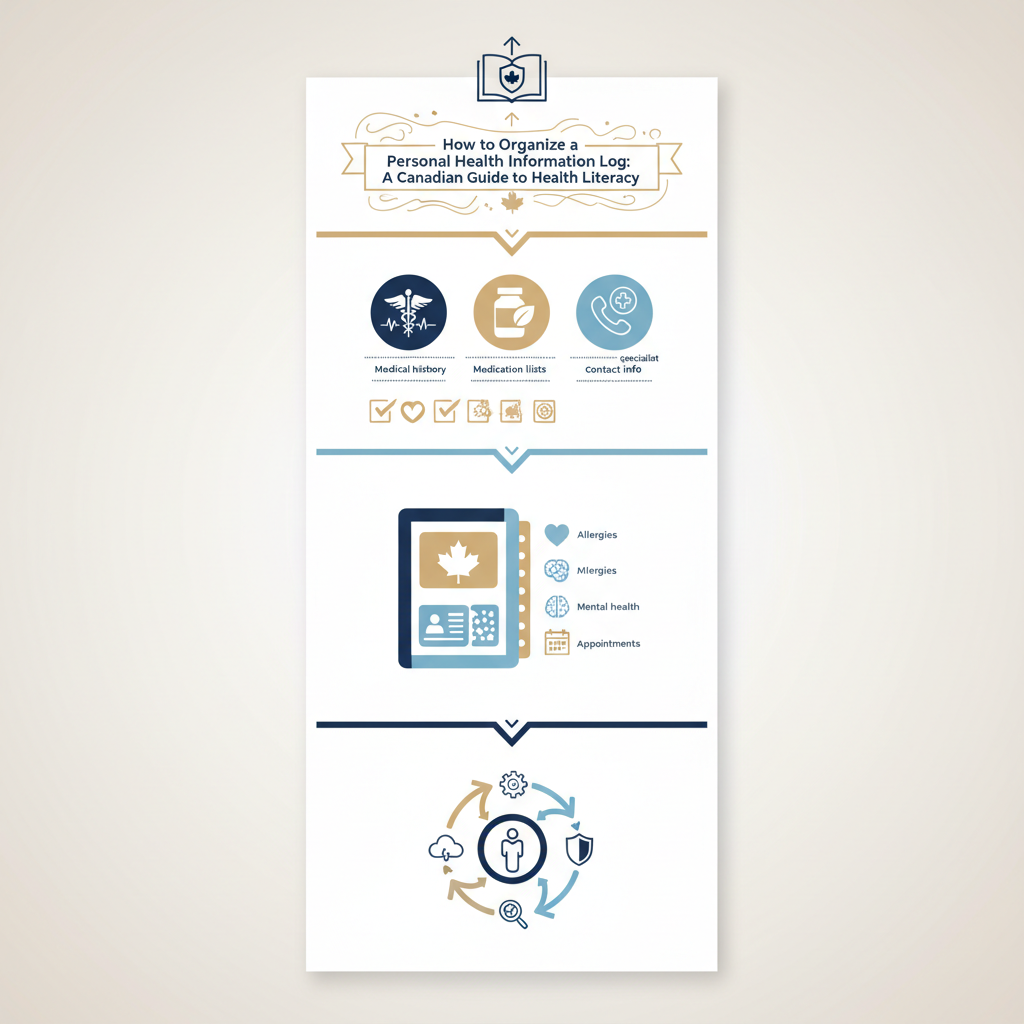
1. Personal Identification and Emergency Contacts
Include your full name, date of birth, provincial health card number, and contacts for your primary care provider and next of kin.
2. Medical History and Diagnoses
List chronic conditions, past surgeries (with dates), and significant illnesses. If you are tracking trends over time, avoid falling for weight trend tracking myths; instead, focus on functional health markers and how you feel.
3. Medication and Supplement Record
This is perhaps the most critical section. List every medication, including the name, dosage (e.g., 10 mg), frequency, and the reason for taking it. Include over-the-counter supplements, but be sure to learn how to read product labels correctly to ensure you are documenting accurate information. Always note any allergies or adverse reactions.
4. Laboratory and Diagnostic Results
Track your blood sugar (measured in mmol/L in Canada), cholesterol levels, and blood pressure. Keeping a chronological record of these numbers allows you to see trends that a single snapshot might miss. For nutrition-related data, refer to the ultimate Canadian nutrition label guide to better understand how your dietary choices might be reflecting in your lab work.
5. Lifestyle and Wellness Habits
The Canadian Context: Accessing Official Records
Your personal log should be a reflection of both your subjective experience and objective clinical data. In Canada, you have a legal right to access your medical records. Most provinces now offer online portals where residents can view their lab results, immunization records, and sometimes even clinical notes.
- Ontario: Health811 and various regional portals.
- Alberta: MyHealth Records.
- British Columbia: Health Gateway.
- Quebec: Carnet santé Québec.
By downloading these official records and summarizing them in your personal log, you create a comprehensive view of your health. This level of organization is vital as Canadian health organizations look toward market expansion strategies for digital health tools, making it easier for patients to be partners in their care.
Integrating Lifestyle Support and the structured reflection approach
In your log, you might track:
- The timing of your meals.
- Your consistency with the programme.
- Subjective measures like hunger levels and mental clarity.
It is important to remember that these methods are not cures or treatments for medical conditions. They are tools designed to help you maintain consistent habits. By documenting your use of such programmes alongside your clinical data, you can provide your healthcare provider with a clear picture of your daily routine. This transparency allows for better-informed guidance and ensures that any lifestyle changes are complementary to your overall medical plan.
Maintenance: Keeping Your Log Current
A log is only useful if it is accurate. Set a recurring 'health admin' date every three to six months. During this time:
- Update your medication list.
- Add any new test results.
- Reflect on your wellness goals.
- Check that your emergency contact information is still correct.
In Canada, seasonal transitions (like the start of spring or the first frost) are excellent triggers for these reviews. The change in weather often brings changes in activity levels and diet, making it a natural time to assess your progress.
Improving Communication with Healthcare Providers
When you walk into a doctor's office with your log, you are demonstrating a high level of health literacy. To make the most of this:
- Summarize: Don't expect the doctor to read the whole log. Have a one-page summary of recent changes or specific questions.
- Be Specific: Instead of saying 'I feel tired,' use your log to show 'I have noticed a dip in energy between 2 PM and 4 PM on days when I skip my morning fibre routine.'
- Collaborate: Ask your provider which markers they find most important to track for your specific health profile.
Source-Verification Checklist
When adding information to your log or researching health topics, evaluate your sources using these Canadian-centric criteria:
- Is the information from a Canadian government source (.gc.ca or .prov.ca)?
- Does the source use Canadian spelling and metric units?
- Is the content reviewed by a regulated Canadian health professional (e.g., MD, RD, NP)?
- Does the site clearly distinguish between evidence-based advice and promotional content?
- Is the information current (published within the last 3-5 years)?
Medical Disclaimer
Frequently Asked Questions
What is the scope of this guide?
This guide is educational and helps readers organize questions and observations for further learning.
How should I use the information?
Use it to review terminology, note personal questions, and identify sources that require verification.
When should I seek professional guidance?
Discuss personal symptoms, medicines, diagnoses, or treatment decisions with a licensed professional.
Further Education
- Explore the metabolic health education hub
- Learn how to read research summaries
- Use the educational health assessment
Explore the topic with reliable health education
Use ATHAR’s educational guides and practical tools to consider your next learning step.