The Ultimate Canadian Nutrition Label Guide: Navigating Grocery Aisles for Better Metabolic Health
Author: Feras Alayed
Published:
Category: nutrition
Reading Time: 11 minutes
Key Takeaways
- The % Daily Value (% DV) is your quickest tool: 5% is a little, 15% is a lot.
- Canadian labels list ingredients by weight, from most to least.
- Fibre is a critical nutrient for metabolic health, often under-consumed in the Canadian diet.
- New Canadian regulations are grouping sugars together to provide better transparency.
- Reading labels is a skill that supports long-term lifestyle changes, such as the structured reflection approach.
Understanding the Canadian Grocery Landscape
For many Canadians, the weekly trip to the grocery store is more than just a chore; it is a series of complex decisions. Whether you are shopping at a local market in Halifax, a large supermarket in Toronto, or a boutique grocer in Vancouver, you are faced with thousands of products, each vying for your attention with bright colours and bold health claims. The desired outcome for most is simple: to nourish ourselves and our families in a way that promotes longevity and energy. However, sustaining a healthy lifestyle can be incredibly difficult when the information provided on packaging feels like a foreign language. Many have tried to 'eat clean' only to find their progress stalled by hidden sugars or misleading serving sizes. This struggle is often rooted in a lack of health literacy regarding the very tools designed to help us: nutrition labels.
In Canada, our food environment is unique. Our long winters often lead to a higher reliance on preserved and processed foods, making the ability to discern quality even more vital. This guide is designed to bridge the gap between confusion and confidence, providing you with a clear Canadian nutrition label guide that aligns with official Health Canada standards. By mastering this skill, you can better engage with navigating metabolic health and insulin resistance in Canada, ensuring that your choices support your body's needs.
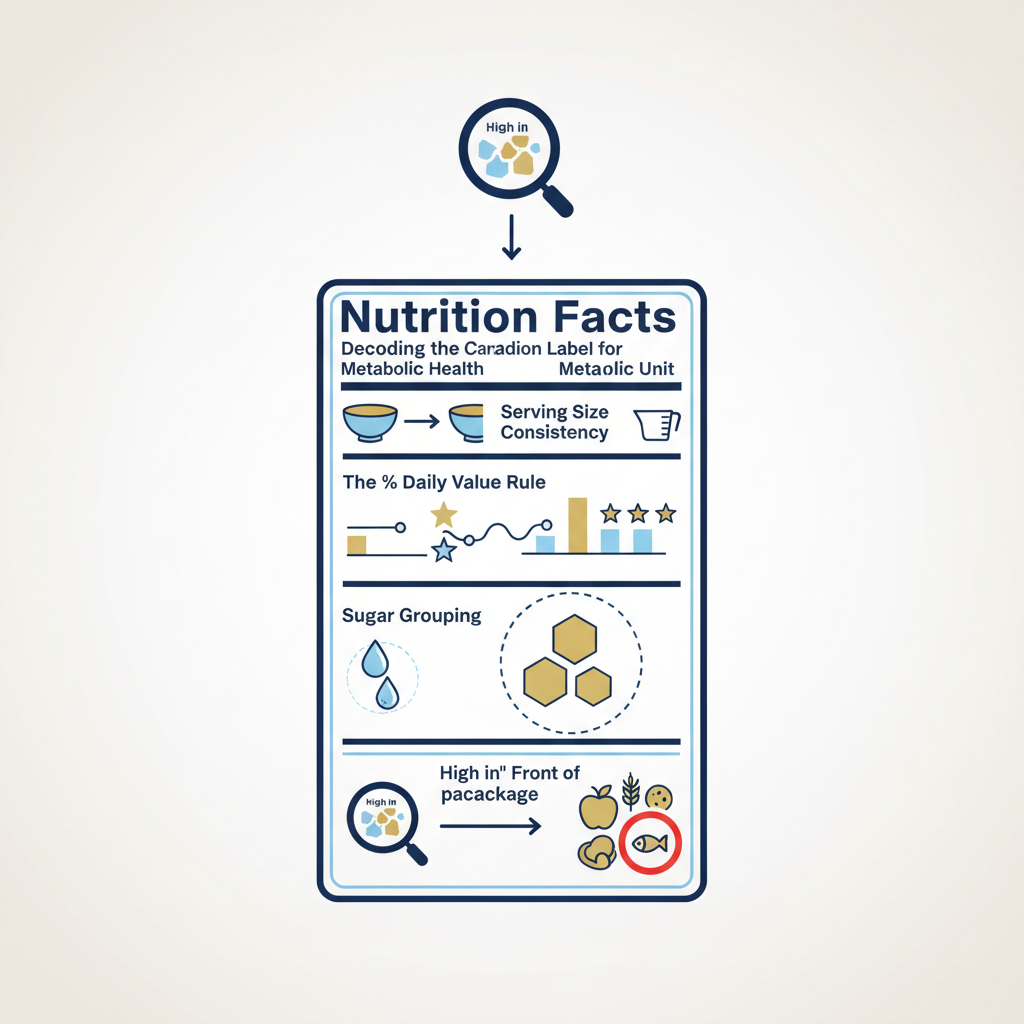
Anatomy of the Canadian Nutrition Facts Table
The Nutrition Facts table is a mandatory feature on most pre-packaged foods in Canada. It is a standardized box that provides information on energy (calories) and 13 core nutrients. To use it effectively, you must first look at the serving size. This is perhaps the most common pitfall for consumers. The serving size is not a recommendation of how much you should eat; it is simply the amount of food used to calculate the numbers listed below it. In Canada, serving sizes are becoming more consistent across similar products to make comparisons easier, but you must always check if the serving size on the label matches the portion you actually consume.
If a box of crackers lists 10 crackers as a serving, but you typically eat 20, you must double every value on that label—calories, fat, sodium, and sugar. This simple step is the foundation of accurate tracking, which is essential for those meal timing and journaling basics that help maintain metabolic balance. Without adjusting for your actual portion, even the healthiest-looking food can contribute to an unexpected caloric or insulin load.
The Golden Rule: The % Daily Value (% DV)
One of the most powerful tools on a Canadian label is the % Daily Value (% DV). This percentage tells you if a serving has a little or a lot of a particular nutrient, based on a 2,000-calorie reference diet. While your individual needs may vary based on your height, weight, and activity level, the % DV provides a universal benchmark. The rule of thumb provided by Health Canada is simple: 5% DV or less is 'a little,' and 15% DV or more is 'a lot.'
When reviewing a label, your goal depends on the nutrient. For nutrients we generally want to limit—such as sodium and saturated fats—aim for a lower % DV. For nutrients we want more of—such as fibre, calcium, and iron—aim for a higher % DV. This quick-glance method allows you to evaluate a product in seconds without needing to memorize specific gram requirements for every nutrient. This is a core component of evaluating medical and nutritional information effectively in a retail environment.
Deep Dive: Core Nutrients and Metabolic Health
Metabolic health is largely influenced by how our bodies process the macronutrients we consume. In the Canadian context, where processed carbohydrates are prevalent, paying close attention to specific sections of the Nutrition Facts table is crucial.
Fibre: The Metabolic Hero
Fibre is a type of carbohydrate that the body cannot digest. Instead of spiking blood sugar, it slows down the absorption of glucose and helps maintain a feeling of fullness. In Canada, many adults fall short of the recommended 25 to 38 grams of fibre per day. When reading a label, look for products where fibre represents a significant portion of the total carbohydrates. A high-fibre choice is generally considered to be one with 5 grams or more per serving. High fibre intake is a cornerstone of many structured lifestyle supports, including the structured reflection approach, as it helps buffer the insulin response.
Sugar: The Hidden Variable
Health Canada has recently implemented changes to how sugars are labelled. Sugars are now grouped together in the ingredient list, and a % DV for total sugars has been added to the Nutrition Facts table. The % DV is based on 100 grams of total sugar. If a product has a % DV for sugar near or above 15%, it is considered high in sugar. Reducing intake of free and added sugars is a primary goal for anyone looking to improve metabolic health and reduce the risk of insulin resistance.
Sodium and Fats
Sodium is another nutrient where Canadians often exceed recommendations, largely due to packaged and restaurant foods. High sodium intake is linked to increased blood pressure, which is a component of metabolic syndrome. Similarly, while fats are an essential part of the diet, the focus should be on unsaturated fats. The Canadian label specifically breaks down 'Saturated' and 'Trans' fats. Ideally, trans fats should be 0 grams, and saturated fats should be kept to a lower % DV.
The Ingredient List: Reading Between the Lines
While the Nutrition Facts table gives you the 'what,' the ingredient list gives you the 'how.' In Canada, ingredients are listed in descending order by weight. This means the first three to five ingredients make up the bulk of the food. If sugar, salt, or refined oils are at the top of the list, the product is likely not a health-promoting choice. Understanding this hierarchy is a key part of evaluating health claims and avoiding the 'health halo' effect where a product looks healthy but is actually highly processed.
Watch out for the 'Sugar Grouping' rule. Previously, manufacturers could list different types of sugar (like glucose, fructose, and cane sugar) separately, which allowed them to appear lower down the list. Now, they must be grouped under the term 'Sugars' followed by the specific types in parentheses. This makes it much easier to see exactly how much sugar is being added to your food.
Decoding Marketing Claims in Canada
Marketing claims like 'natural,' 'organic,' or 'source of fibre' are regulated in Canada, but they can still be misleading. For example, a cookie might be a 'source of fibre,' but it could also be very high in sugar and saturated fat. A 'natural' product is not necessarily a healthy one; honey and salt are natural, but they should still be consumed in moderation. It is essential to look past the front-of-package marketing and verify the claims using the Nutrition Facts table and the ingredient list. This critical thinking is a skill we discuss in our guide on building trusted health and wellness literacy.
Practical Shopping Strategies for Canadians
Navigating a Canadian grocery store requires a plan. Here are some practical tips to apply your new knowledge: 1. **Shop the Perimeter:** Most whole, unprocessed foods like fresh produce, meats, and dairy are located around the edges of the store. 2. **Seasonal Eating:** In Canada, eating seasonally (like root vegetables in winter and berries in summer) can improve nutrient density and reduce costs. 3. **Compare Two Products:** Use the % DV to quickly compare two brands of the same food. Choose the one with more fibre and less sodium. 4. **Check the 'Front-of-Package' Symbol:** Look for the new Health Canada 'high in' symbols (for saturated fat, sugars, or sodium) which are being phased in to help consumers make faster choices. 5. **Align with Your Routine:** Ensure your choices support your evening routine and circadian rhythms by avoiding heavy, high-sugar snacks late at night.

Source Verification Checklist
When looking for nutritional information online or on packaging, use this checklist to ensure the information is reliable:
- Is the information from a government source like Health Canada or a recognized Canadian health organization?
- Does the product display the standard Canadian Nutrition Facts table?
- Are the claims specific (e.g., 'High source of fibre') rather than vague (e.g., 'Superfood')?
- Does the information avoid promising a 'cure' or 'guaranteed result'?
- Is the date of the information current (post-2022 for the latest Canadian labelling rules)?
Frequently Asked Questions
Q: Is the Nutrition Facts table the same in Canada and the US?
A: No. While they look similar, Canada has specific requirements for which nutrients must be listed and how % Daily Values are calculated. Always look for the Canadian version for accuracy in Canada.
Q: What does 'Trans Fat 0g' really mean?
A: In Canada, if a product has less than 0.2 grams of trans fat per serving, it can be rounded down to 0. However, you should still check the ingredient list for 'partially hydrogenated oils,' which are the source of trans fats.
Q: Why is there no % DV for protein?
A: Most Canadians get enough protein in their diet, so Health Canada does not require a % DV for it unless the product makes a specific protein claim.
Q: How does the structured reflection approach help with label reading?
A: The structured reflection approach simplifies the process by providing structured tools like fibre supplements, reducing the pressure to find high-fibre options in every single meal, though label reading remains a vital skill for the rest of your diet.
Q: Are 'Sugar-Free' products always healthy?
A: Not necessarily. They may contain sugar alcohols or artificial sweeteners and could still be high in saturated fats or sodium. Always check the full Nutrition Facts table.
Q: How can I compare global trends to Canadian ones?
A: You can look at how other regions handle health, such as Spain's wellness trends, to see different cultural approaches to nutrition, but always follow Canadian guidelines for local products.
Medical Disclaimer
Further Education
- Explore the metabolic health education hub
- Learn how to read research summaries
- Use the educational health assessment
Explore the topic with reliable health education
Use ATHAR’s educational guides and practical tools to consider your next learning step.