How to Read Longevity Research: A Comparison Guide for Discerning Truth from Hype
Author: Feras Alayed
Published:
Updated:
Category: longevity
Reading Time: 6 minutes
- Understanding the gap between animal models and human application is crucial.
- Correlation does not equal causation in longevity science.
- Functional nutrition integrates scientific evidence with individual biological context.
- Scientific literacy protects you from marketing hype and pseudoscience.
The Longevity Research Boom: Why Literacy Matters
We are living in a golden age of longevity research. Every day, headlines claim to have discovered the 'fountain of youth' or a supplement that halts aging. However, the truth is often far more nuanced. Knowing how to read longevity research is not just an academic luxury; it is a vital tool for protecting your health and your wallet. When you learn to evaluate these studies, you become capable of making informed decisions about optimizing cellular energy through functional nutrition, rather than chasing fleeting trends.
Scientific literacy in this field means being able to distinguish between 'correlation' and 'causation.' For example, just because people in 'Blue Zones' eat legumes doesn't necessarily mean legumes are the sole cause of their long lives; there are overlapping social, environmental, and genetic factors. Understanding these patterns requires a discerning eye that looks beyond the headlines.
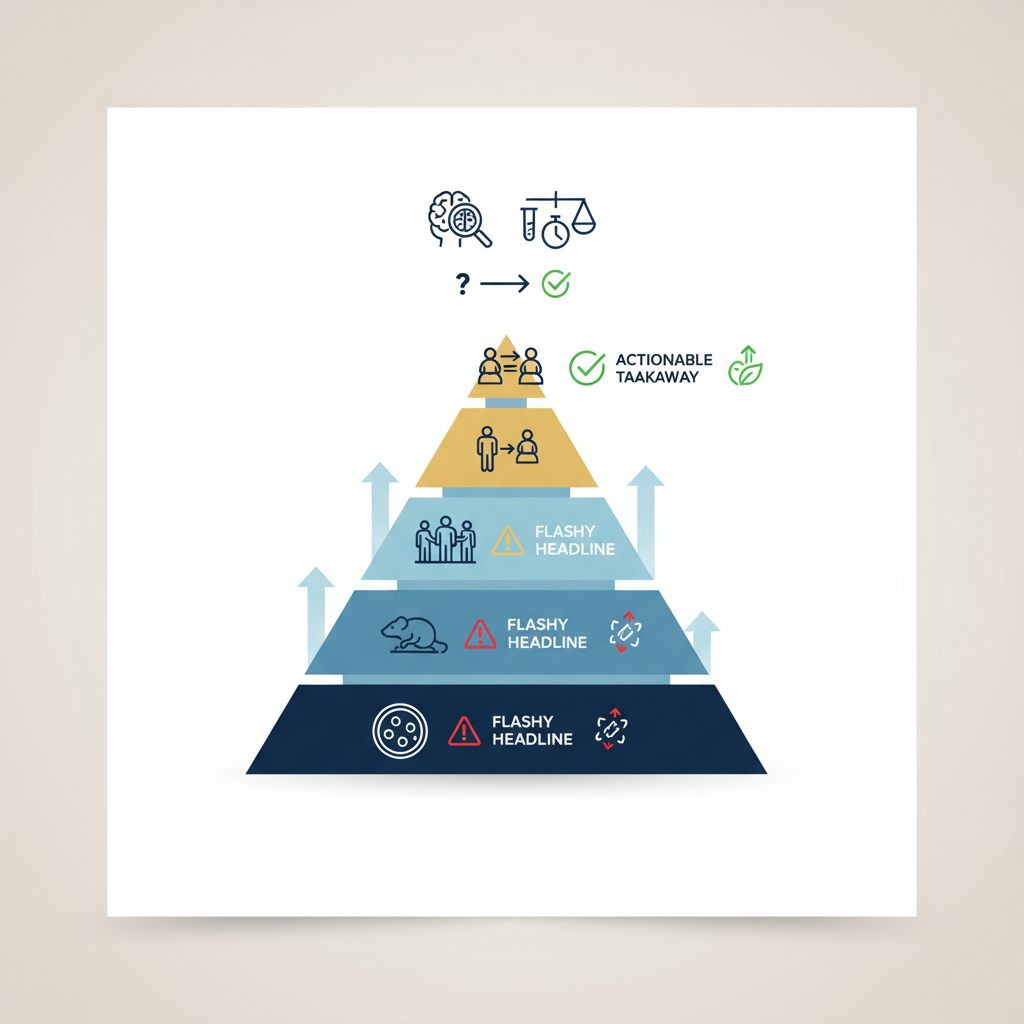
Lab vs. Life: Comparing Model Organisms to Humans
One of the biggest challenges in understanding longevity research is knowing 'who' was studied. Here is a comparison of common models:
- In Vitro (Cell Studies): Conducted on isolated cells. These are excellent for understanding basic mechanisms like NAD+ and aging science, but they don't tell us how a whole human body will react.
- Animal Studies (Mice, Yeast, Worms): Provide incredible insights because of their short lifespans. However, what extends a mouse's life by 30% may not have the same effect on a biologically complex human.
- Human Clinical Trials: The gold standard, yet difficult in longevity because humans live so long, making it hard to observe actual 'life extension' over decades.
Therefore, when you read about a 'scientific breakthrough,' first ask: Was this study done in a petri dish, on mice, or on a group of humans? This question is the first step in mastering how to read longevity research.
Observational vs. Interventional: Which Evidence Should You Trust?
In your journey to evaluate longevity claims, you will encounter two main types of human studies:
1. Observational Studies
These studies monitor large groups of people over long periods. Blue Zones research is a classic example. They are great for identifying patterns (e.g., people who engage in moderate physical activity live longer), but they cannot prove that the activity is the 'cause.' These individuals might also sleep better or have better diets.
2. Randomized Controlled Trials (RCTs)
These are considered the strongest evidence. Participants are randomly assigned to two groups: one receiving the intervention (like a specific supplement) and the other a placebo. If a real difference is seen, we can be more confident that the intervention caused it. When looking for functional nutrition for mitochondrial health, always look for clinical trials supporting the claims.
Decoding the Data: Statistical Significance vs. Biological Impact
As you learn how to read longevity research, you will encounter the term 'statistical significance.' This simply means the result is unlikely to have happened by chance. However, and this is crucial, statistical significance does not always mean 'clinical significance.'
For instance, a study might find that an herb reduces a biomarker of aging by 2%. Statistically, this result might be real, but biologically, it may have no tangible impact on your quality of life or lifespan. In a practical context, we care about results that translate into more energy for our daily lives. Always look for the 'effect size.'
The Functional Nutrition Perspective: Integrating Research
Functional nutrition isn't just about taking vitamins; it's about understanding how food and supplements affect your vital functions based on science. When you read research about NAD+ and aging science, don't view it as a magic bullet but as part of a system.
Functional nutrition encourages you to ask: 'How does this research support my current routine?' and 'Is there enough evidence to make this change worth the effort?' It is a continuous process of learning and adapting, where longevity research acts as a compass for your dietary and lifestyle choices.
Red Flags: How to Spot Pseudoscience in Longevity Claims
To master how to read longevity research, you must be able to spot 'red flags':
- Exaggerated Results: If a claim sounds too good to be true (e.g., 'cure aging in a week'), it likely is.
- Conflicts of Interest: Check who funded the study. If a company selling the supplement funded the research, read it with extra caution.
- Reliance on a Single Study: Science is cumulative. Don't change your routine based on one small study; look for 'Systematic Reviews' that summarize multiple findings.
- Ignoring Human Context: Studies relying solely on mice without any reference to human application should not be the basis for major health decisions.
Practical Roadmap: Your Step-by-Step Guide to Evaluating Research
Here is a checklist for the next time you encounter a scientific article:
- Read the Abstract: It gives a quick overview of the goal and results.
- Check the Sample: Are they humans? How many? Do they resemble you in age or health status?
- Look for a Control Group: Was the intervention compared against a group that didn't receive it?
- Assess the Duration: Did the study last long enough to see a real impact on longevity?
- Review the Source: Is the study published in a reputable, peer-reviewed journal?
By following these steps, you move from being a passive consumer of information to someone who possesses the skill of how to read longevity research wisely. Remember, the goal isn't to become a scientist, but to become an 'expert on yourself' backed by sound science.
Related Articles
- Optimizing Cellular Energy: Functional Nutrition for Mitochondrial Health
- NAD+ and Aging Science Explained — Practical Guide

Explore health education
Review the educational guides and practical tools related to this topic.
Explore the education hub