Type 2 Diabetes Prevention Canada — Comprehensive Provincial Guide
Author: Feras Alayed
Published:
Updated:
Category: canadian-health
Reading Time: 8 minutes
Key Takeaways
- Canada offers multiple evidence-based type 2 diabetes prevention programs focused on diet, physical activity and behavioural support.
- Standard Canadian lab cut-offs: fasting plasma glucose ≥7.0 mmol/L indicates diabetes; ~6.1–6.9 mmol/L often flags prediabetes — always confirm with your clinician.
- Access and delivery vary provincially — Ontario, BC, Alberta and Québec each have different program models and referral pathways.
- High-quality systematic reviews and RCTs show lifestyle programmes can substantially reduce progression to type 2 diabetes in at-risk adults.
- Feel Great is a lifestyle support system (Balance fibre matrix, Unimate yerba mate, 4-4-12 protocol) that may complement prevention efforts — it is not a medication; check Health Canada NPNs and discuss with your provider.
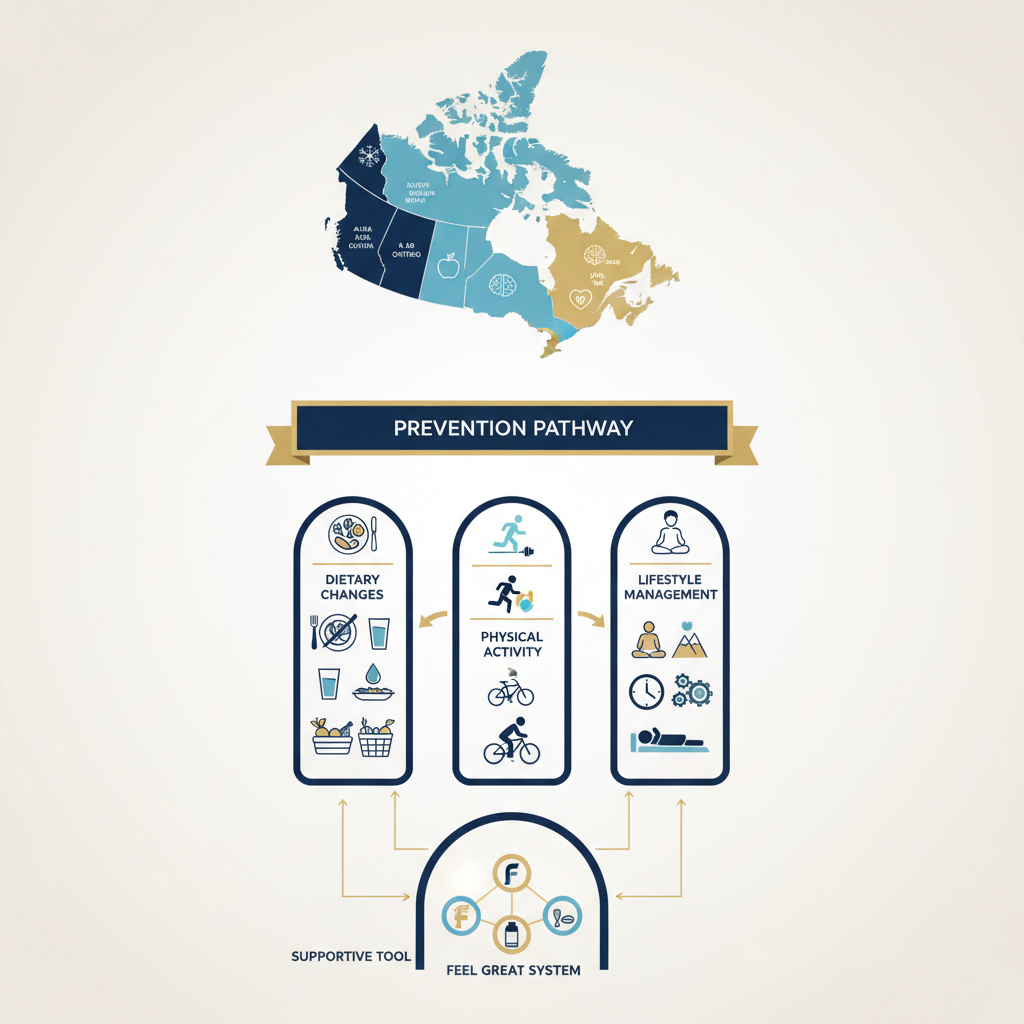
TL;DR
Type 2 diabetes prevention Canada relies on structured lifestyle programmes (diet + exercise + behaviour change) proven to reduce progression in at-risk people. Provincial delivery differs; tools like the Feel Great system may be used as supportive lifestyle aids alongside clinical care.
🇨🇦 Thousands of Canadians are using Feel Great to support their metabolic health naturally. Learn more & order here →
Introduction — a shocking Canadian statistic
Diabetes and prediabetes affect millions of Canadians. According to CIHI and Statistics Canada, over 3 million Canadians live with diagnosed diabetes and many more are estimated to have prediabetes or elevated risk — roughly 1 in 3 Canadians when risk is included. The human and economic costs (cardiovascular disease, kidney disease, vision loss) make prevention a national priority.
What are type 2 diabetes prevention programs?
These programs are structured interventions that identify people at high risk (screening via fasting glucose or A1c) and provide sustained lifestyle support to reduce progression to type 2 diabetes. Core components are dietary change, moderate-to-vigorous physical activity, weight loss (often 5–7% of bodyweight), and ongoing behavioural support.
Canadian clinical context and lab values
- Fasting plasma glucose (FPG): normal values generally below ~6.0 mmol/L; FPG 6.1–6.9 mmol/L frequently indicates impaired fasting glucose/prediabetes; diabetes ≥7.0 mmol/L (Diabetes Canada).
- Hemoglobin A1c: prediabetes often defined as 6.0%–6.4%; diabetes ≥6.5% (Diabetes Canada).
- Primary care remains the gateway in Canada: family physician, walk-in clinic or provincial health programs (Ontario Public Health, HealthLink BC, Alberta Health Services) can arrange testing and referrals.
Evidence — what the research shows (ranked)
High-quality evidence supports lifestyle-based prevention:
- Systematic reviews and meta-analyses: pooled data demonstrate significant reductions in diabetes incidence following intensive lifestyle programmes (dietary changes + activity + weight loss).
- Large RCTs: Diabetes Prevention Program (DPP) and Finnish Diabetes Prevention Study are classical trials showing lifestyle change reduced progression by ~58% compared with placebo over several years.
- Implementation studies: community and digitally-delivered programmes show meaningful risk reduction, though effect sizes vary by intensity and adherence.
Why province matters — variations in Canada
Health is provincially administered in Canada. That means:
- Ontario: multiple public health units run adapted DPP-style programs and link with primary care for referrals.
- British Columbia: regional health authorities offer in-person and virtual prevention programs — helpful for remote communities.
- Alberta: integrated services through Alberta Health Services; mixes in-person and online options.
- Québec: French-language programmes and local clinical pathways may differ in referral and delivery.
Residents in rural/remote regions or certain populations (e.g., Indigenous Peoples, newcomers) may need culturally tailored/virtual programs — check local public health or community health centres.
Core components of effective programs
- Screening and risk stratification (FPG, A1c).
- Dietary counselling consistent with Canada's Food Guide — emphasis on vegetables, whole grains, lean proteins, reduced processed foods.
- Targeted physical activity (150 minutes/week moderate-intensity) plus strength training.
- Behaviour-change techniques: goal-setting, self-monitoring, problem-solving.
- Long-term follow-up and community supports.
Comparison: public sector vs commercial/digital programs
| Feature | Public/Health-system programs | Commercial/Digital programs |
|---|---|---|
| Cost to participant | Often low or subsidized | Variable; subscription fees common |
| Clinical integration | High (linked to primary care) | Varies; many offer clinical oversight |
| Flexibility | Group sessions, scheduled | High flexibility, virtual options |
| Access across Canada | May be uneven—province-dependent | Can ship/operate across provinces (BC to Newfoundland) — check service availability |
How to access programs in Canada (step-by-step)
- Talk to your family physician or visit a walk-in clinic to request screening (FPG or A1c).
- Ask for a referral to a local diabetes prevention program or public health unit.
- If local resources are limited, explore provincial virtual programs or accredited commercial digital programs that operate in Canada.
- Ensure cultural fit — many provinces offer tailored programs for Indigenous communities and newcomers.
Barriers in Canada and practical solutions
Common barriers: geography, winter climate (affecting activity and vitamin D status), language, affordability. Practical solutions:
- Virtual program delivery to reach remote areas.
- Indoor activity plans for long winters; check Health Canada/Provincial guidance on vitamin D supplementation if needed.
- Programs tailored by culture/language; community partnerships with Indigenous health services.
How Feel Great may fit into prevention (clinical, non-therapeutic framing)
Feel Great is positioned as a lifestyle-support system rather than a medical therapy. Key elements that may align with prevention goals:
- Balance — a soluble fibre matrix designed to slow post-meal glucose excursions and increase satiety; evidence suggests soluble fibre may help blunt post-prandial glycaemia (language: "may help" / "may support").
- Unimate — yerba mate extract containing chlorogenic acids that may support mental clarity and energy, potentially improving adherence to activity plans.
- 4-4-12 intermittent fasting protocol — structured meal timing that some people use to manage energy intake and achieve modest weight loss when appropriate and supervised.
Important: Feel Great is not a medication. Discuss with your clinician and check Health Canada NPN numbers where appropriate before use.
People Also Ask
- What glucose values indicate prediabetes in Canada? — Typically FPG ~6.1–6.9 mmol/L or A1c 6.0–6.4% (Diabetes Canada).
- Can I join a prevention program without a family doctor? — Yes; many public health units accept self-referrals, and virtual programs are widely accessible.
- How much weight do I need to lose to reduce risk? — Modest loss (5–7%) is associated with clinically meaningful risk reduction.
- Are digital programs as good as in-person? — Some digital programmes show good outcomes if they maintain intensity and engagement, but quality varies.
- Will my provincial health plan pay for programs? — Coverage varies by province; subsidized public health programs are common, but private program fees may apply.
FAQ
- Is medication ever used for prevention?
In select high-risk individuals, medications such as metformin may be considered by clinicians, but first-line prevention typically emphasises lifestyle interventions (Diabetes Canada).
- How long do prevention benefits last?
Follow-up studies show that benefits persist for several years, especially when behaviour changes are maintained; ongoing support enhances durability.
- Which diet is best to prevent type 2 diabetes?
There is no single "best" diet; sustainable patterns emphasising whole foods, vegetables, whole grains and lower intake of processed foods (consistent with Canada's Food Guide) are recommended.

- How often should I be screened?
Screening frequency depends on baseline risk. For people with prediabetes, clinicians often recommend follow-up testing every 6–12 months; check Diabetes Canada guidance.
- Does vitamin D matter?
Vitamin D status can be relevant in Canada due to long winters and limited sun exposure. Check Health Canada recommendations and test/replace under clinician advice if needed.
References & Scientific Sources
- Health Canada — https://www.canada.ca/en/health-canada.html
- Diabetes Canada Clinical Practice Guidelines — https://www.diabetes.ca
- Canadian Institute for Health Information (CIHI) — https://www.cihi.ca
- Statistics Canada — https://www.statcan.gc.ca
- Public Health Agency of Canada (PHAC) — https://www.canada.ca/en/public-health.html
- Heart & Stroke Foundation of Canada — https://www.heartandstroke.ca
- Diabetes Prevention Program Research Group (DPP) — landmark results on lifestyle vs metformin (NEJM).
- Cochrane Library — reviews on lifestyle interventions for preventing type 2 diabetes.
- Selected recent systematic reviews/meta-analyses in Lancet, BMJ and JAMA (2021–2024) summarising lifestyle intervention effectiveness (see PubMed).
- Harvard T.H. Chan School of Public Health — evidence summaries on diet & diabetes risk.
- WHO — global guidance on non-communicable disease prevention.
For local program listings, consult your provincial health authority (e.g., HealthLink BC, Alberta Health Services, Ontario Public Health). If you plan to use supplements or herbal extracts, verify Health Canada Natural Product Numbers (NPN) and speak with a healthcare professional.
Medical Disclaimer
This article is educational and not medical advice. Consult your physician or a registered health professional to interpret lab values, diagnose prediabetes/diabetes, or to prescribe interventions. Feel Great is a lifestyle support system and not a therapeutic drug.
Related ATHAR paths
🇨🇦 Ready to Start Your Health Transformation?
Join thousands of Canadians who have improved their metabolic health with the Feel Great system. Backed by 50+ clinical studies and listed in the Physicians' Desk Reference (PDR).
✅ Ships to all provinces: BC, Alberta, Saskatchewan, Manitoba, Ontario, Quebec, New Brunswick, Nova Scotia, PEI, Newfoundland & Labrador | 90-Day Money-Back Guarantee