How to Keep a Food and Mood Journal: A Practical Step-by-Step Guide
Author: Feras Alayed
Published:
Updated:
Category: mental-nutrition
Reading Time: 16 minutes
Key Takeaways & TL;DR
We often experience days filled with sluggishness, poor focus, or sudden mood swings, leading us to randomly change our eating habits with little success. The core issue is a lack of clear visibility into the personal connection between what we eat and how we feel. A food and mood journal is not a calorie-counting or restrictive diet tool; it is a magnifying glass that helps you observe your personal patterns. Through this guide, you will learn how to record your meals and emotions neutrally, supporting your ability to make more conscious dietary decisions and helping you better understand your body's signals.
- A food and mood journal is a tool for observation, not self-judgment.
- Immediate tracking reduces the chance of forgetting subtle details.
- Linking emotions to food helps in breaking unwanted habits.
- Consistency for two weeks is usually enough to discover baseline patterns.
What is a Food and Mood Journal?
A food and mood journal is a personal tracking tool designed to record what you eat and drink, alongside documenting your feelings, energy levels, and mental focus before and after consuming food. The primary goal of this tool is to gather your own data to discover recurring patterns, making it easier for you to understand how your body and mind respond to specific dietary choices, and helping you explore deeper concepts like the gut-brain axis terminology guide.
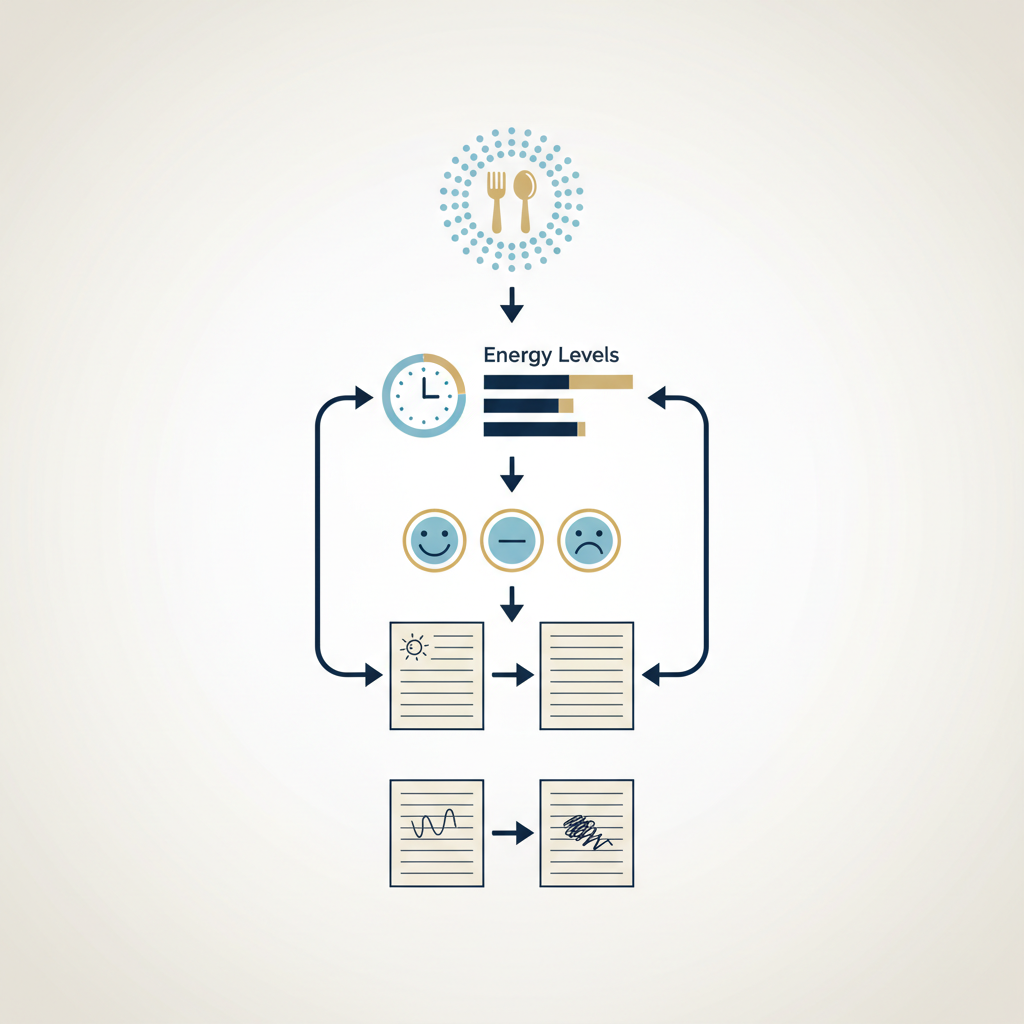
10 Practical Steps to Keep a Food and Mood Journal
Here is a sequential, practical guide to start keeping your journal effectively and with clarity:
Step 1: Choose Your Preferred Medium
There is no single right way. Some prefer pen and paper to minimize screen distraction, while others prefer mobile apps for easy access anytime.
Educational Tool: Mental comparison chart (paper offers deeper focus, mobile offers speed and reminders).
Verification Question: Which medium can I easily access within 5 minutes of finishing my meal?
Step 2: Record the 'What' and 'How Much' Neutrally
Write down meal ingredients clearly without using evaluative language (e.g., 'bad meal' or 'healthy food'). Instead of writing 'salad', write 'two cups of spinach with grilled chicken and olive oil'.
Educational Tool: Visual estimation guide (use a fist size or standard cup as a rough reference).
Verification Question: Did I describe my food as if I were a researcher collecting neutral data?
Step 3: Document the Timing of Meals and Snacks
When you eat can be as important as what you eat. Recording the time helps you understand your natural hunger rhythm, which can be useful if you are considering structuring your meal times, similar to exploring an intermittent fasting beginner's guide.
Educational Tool: Simple time log (morning, midday, evening).
Verification Question: Did I log the meal time accurately within 30 minutes of eating?
Step 4: Monitor Your Mood Before Eating
Are you eating because you are physically hungry, or because you are bored, stressed, or sad? Identifying emotions before eating is a crucial step in breaking the stress eating cycle.
Educational Tool: Emotion vocabulary list (stressed, calm, tired, excited, anxious).
Verification Question: Is my drive to eat right now physical hunger or an emotional need?
Step 5: Track Energy and Focus After Eating (1-2 Hours Later)
Here lies the secret. Notice how you feel after digesting the food. Do you feel energetic and mentally clear? Or do you experience sluggishness and brain fog?
Educational Tool: Energy scale from 1 to 10 (where 1 is severe fatigue, and 10 is excellent energy).
Verification Question: How do my body and mind feel right now compared to before the meal?
Step 6: Don't Forget Hydration and Caffeine
Mild dehydration can mimic hunger symptoms and cause a drop in focus. Additionally, the timing and amount of caffeine heavily influence mood and sleep quality.
Educational Tool: Water glass and cup tracker.
Verification Question: Did I count all the beverages I consumed today, including coffee and juices?
Step 7: Record Sleep Quality and Daily Context
Lack of sleep pushes the body to seek quick energy (often from sugars). Record your hours of sleep and the general stress level of your day.
Educational Tool: Daily context notes (e.g., 'slept only 5 hours', 'busy workday').
Verification Question: Did my sleep quality last night influence my food choices today?
Step 8: Review Your Data Weekly, Not Daily
Do not draw conclusions from a single day. Set aside 15 minutes at the end of the week to read your journal and look for recurring patterns.
Educational Tool: Weekly review template (What recurred? What surprised me?).
Verification Question: Do I see a recurring pattern between a specific food and a midday energy crash?
Step 9: Be Wary of Claims and Find Your Own Pattern
You might read that a certain food provides prompts for observing mood-related patterns, but your body might react differently. It is important to know about evaluating nutrition and mental health research claims and apply what works for you.
Educational Tool: Personal critical thinking lens.
Verification Question: Am I relying on my recorded personal experience or just on what I read?
Step 10: Adjust One Variable at a Time
If you discover a bothersome pattern, do not change your entire diet suddenly. Change one thing (like swapping a snack) and observe the effect for a few days.
Educational Tool: Single-variable experiment guide.
Verification Question: Am I changing more than one habit at the same time, making it hard to measure the impact?
Common Mistakes and How to Fix Them
When starting to learn how to keep a food and mood journal, we might fall into traps that make the process exhausting. Here is how to avoid them:
- Mistake: Turning the journal into a tool for self-judgment and guilt. Correction: Remember you are only collecting data. There is no 'evil' or 'good' food in your notebook, just inputs and outputs.
- Mistake: Writing in very general terms like 'ate a normal lunch'. Correction: Be as specific as possible so you can identify the ingredients that might affect your energy.
- Mistake: Trying to journal for many consecutive months. Correction: Continuous tracking can cause burnout. Use this tool for specific periods (two to four weeks) as an exploratory phase, then stop and return to it when needed.
- Mistake: Ignoring external factors like the menstrual cycle or work stress. Correction: Add a small field for daily general notes to put things into proper context.
Building a Flexible Routine Without Pressure
The goal of keeping a food and mood journal is to support consistency and make choices clearer, not to add a new burden to your day. To build a flexible routine, link the journaling habit to an already existing one. For example, you can update your journal while drinking your morning coffee, or during the five minutes after finishing lunch. If you forget to log a meal, do not abandon the whole day; simply write down what you remember and keep going. Flexibility encourages follow-through and prevents feelings of inadequacy.
Quick-Start Checklist
- [ ] I chose a small notebook or a convenient app on my phone.
- [ ] I set 3 fixed times a day to update the journal (e.g., after main meals).
- [ ] I agreed with myself not to judge my food choices for two weeks.
- [ ] I added a section to track water intake and sleep hours.
- [ ] I scheduled a time (on the weekend) to review the collected data.
Hypothetical Daily Scenarios for Practice
To understand how a food and mood journal works in real life, let's look at these hypothetical scenarios:
Scenario One: The Mid-Afternoon Energy Crash
You notice through your journal that you feel extremely sluggish and experience brain fog daily around 3 PM. Looking back at the data, you discover this always happens on days you eat a lunch high in refined carbohydrates and low in protein. The clearest decision: try adding a larger protein source to your lunch tomorrow and observe the difference in your energy level.
Scenario Two: Intense Nighttime Sweet Cravings
Your journal shows a recurring pattern of high stress after work, followed by consuming large amounts of sweets at night. Here, the data tells you the problem isn't your willpower, but how you respond to work stress. The clearest decision: find an alternative way to release stress after work (like walking or relaxing) before turning to food.
When to Seek Professional Help
A food and mood journal is an excellent self-awareness tool, but it does not replace specialized medical care. You should consult a licensed doctor or dietitian in the following cases:
- If you notice that tracking food causes you severe anxiety or an obsession with healthy eating.
- If you experience severe and persistent mood swings that affect your daily life.
- If you suspect underlying medical conditions like food allergies, or if you have persistent physical symptoms that require evaluation, which you can learn more about in the insulin resistance symptoms and tests guide.
Your Next Step
Starting to understand your body's language is a true investment in the quality of your daily life. Keeping a food and mood journal gives you the data you need to be your own expert, away from random guesswork. Remember that sustainable changes come from gentle awareness and continuous observation, not from strict restrictions.
Medical Disclaimer: The information provided in this article is for educational purposes only and does not substitute for professional medical advice, diagnosis, or treatment. Always consult your physician or qualified healthcare provider with any questions regarding your health condition.
To begin your journey in understanding the relationship between what you eat and how you feel more deeply, we invite you to visit the mental health and nutrition section and explore more educational tools that support your goals.
Frequently Asked Questions
What is the scope of this guide?
This guide is educational and helps readers organize questions and observations for further learning.
How should I use the information?
Use it to review terminology, note personal questions, and identify sources that require verification.
When should I seek professional guidance?
Discuss personal symptoms, medicines, diagnoses, or treatment decisions with a licensed professional.
Further Education
- Explore the metabolic health education hub
- Learn how to read research summaries
- Use the educational health assessment
Ready to choose a clearer health starting point?
Start with a short educational assessment to explore tools and resources that may fit your goal. It is not a medical diagnosis.
Continue learning at Mental Health & Nutrition.