Unicity Feel Great vs MLM Difference: Why Feel Great Stands Apart
Author: Feras Alayed
Published:
Updated:
Category: business-opportunity
Reading Time: 8 minutes
Key Takeaways
- Unicity's Feel Great system is product-first: clinically-backed supplements (Balance, Unimate) + a behavioral 4-4-12 protocol — designed to deliver measurable health outcomes.
- Unicity is an established company (25+ years, $1B+ revenue, 60+ countries, PDR-listed) with 50+ clinical studies backing product claims — supporting credibility beyond recruitment rhetoric.
- Key business-model differences versus many MLMs: no inventory required, direct-to-customer shipping, recurring subscription revenue, and global market access from day one.
- Unlike recruitment-heavy MLMs that can encourage inventory loading and compensation complexity, Feel Great emphasizes customer retention and product value as the engine of income opportunity.
- Individual results vary. The system presents an income opportunity but requires consistent effort, ethical practices, and focus on sustainable customer relationships.
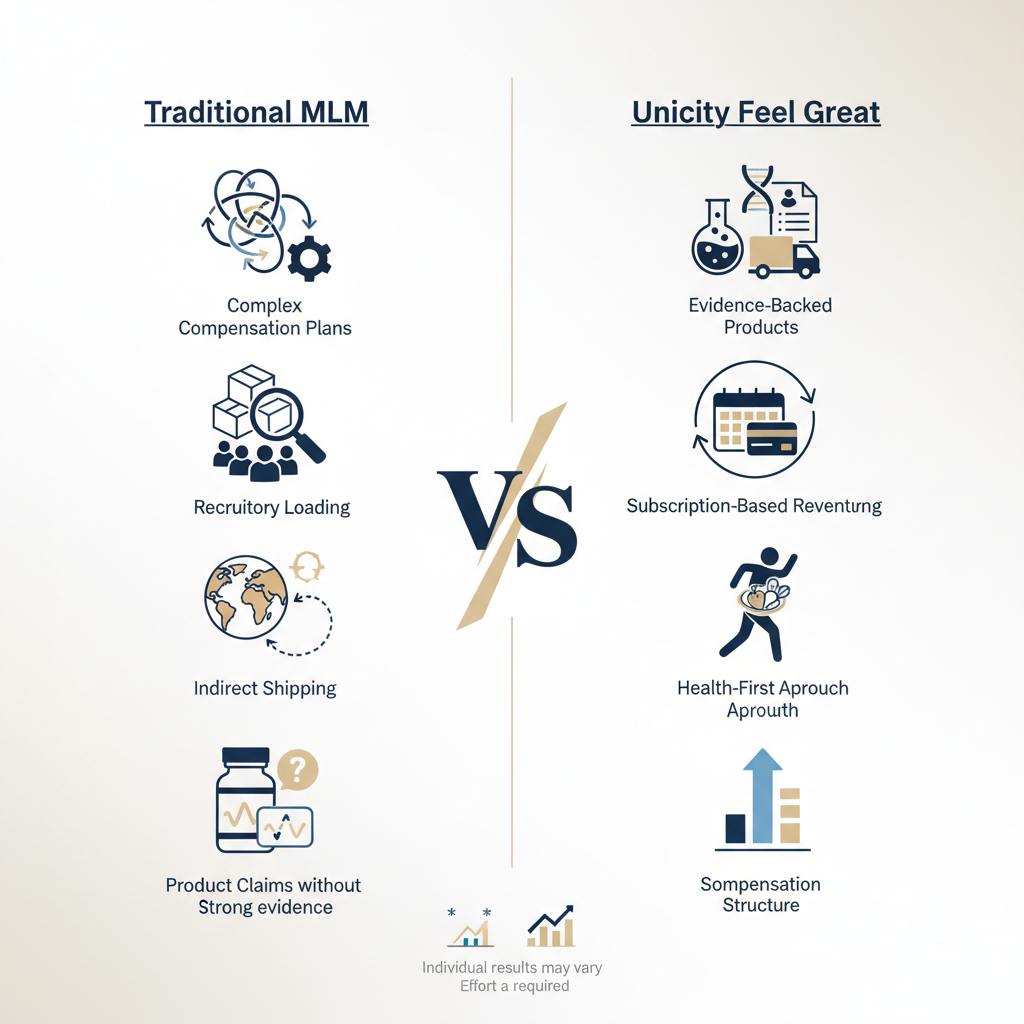
TL;DR
Unicity Feel Great vs MLM difference: Feel Great prioritizes scientifically supported products and a customer-first fulfillment model (no inventory, recurring subscriptions), whereas many MLMs prioritize recruitment and inventory. This creates a different risk profile and path to sustainable revenue. Individual results vary.
💼 Thousands of entrepreneurs are building health businesses with Feel Great. Learn more about the opportunity →
Why Unicity's Feel Great System Is Different from MLM
In the crowded wellness market — where global dietary supplements and functional foods are projected to remain high-growth segments — not all direct-selling opportunities are the same. This article explains, using market data and business analysis, why Unicity's Feel Great system stands apart from many multi-level marketing (MLM) models, and what that means for entrepreneurs focused on health-first business building.
Introduction: Market context and a compelling stat
The global dietary supplements market has been expanding rapidly. Industry reports (Grand View Research, Statista) show market sizes in the hundreds of billions with mid-single-digit to high-single-digit CAGR forecasts over the coming years. Simultaneously, consumers and regulators are increasingly scrutinizing business models that emphasize recruitment over product value. For health entrepreneurs, this shift means opportunities for models that are scientifically validated and consumer-centric.
What is the Feel Great system?
Product and protocol
- Balance — a foundational nutritional formula designed to support metabolic balance and foundational nutrition.
- Unimate — a mate-based functional beverage focused on energy, focus, and metabolic support.
- 4-4-12 Protocol — a structured intake protocol aimed at producing consistent, trackable outcomes.
According to Unicity, the Feel Great system is supported by more than 50 clinical studies across ingredients and formulations — an important distinction in a category where efficacy claims vary widely.
How the business model works
Core operational features
- No inventory requirement: Orders are shipped directly from Unicity to customers, reducing startup capital and operational risk for distributors.
- Direct-to-consumer fulfillment: This improves customer service consistency and reduces logistical complexity.
- Recurring revenue potential: The business model leverages repeat purchases and subscription behaviors rather than solely relying on recruitment-driven sales.
- Global access: With presence in 60+ countries, entrepreneurs can reach wider markets without building local distribution infrastructure.
- Evidence-based product claims: 50+ clinical studies and PDR-listing enhance credibility for both consumers and health professionals.
Unicity Feel Great vs Typical MLM: A detailed comparison
Below is a side-by-side comparison highlighting the structural and operational differences.
| Feature | Unicity Feel Great | Typical MLM |
|---|---|---|
| Business focus | Product value and measurable consumer outcomes | Recruitment and network growth |
| Inventory | No inventory required; direct shipping | Distributors often hold inventory — risk of stockpiling |
| Revenue source | Consumer repeat purchases and subscriptions | Commissions from team sales and recruitment bonuses |
| Scientific support | 50+ clinical studies; PDR-listed | Often limited or inconsistent clinical backing |
| Barrier to entry | Lower (no mandatory large purchase) | Higher (start-up kits, minimum purchases) |
| Customer centricity | High — product outcomes prioritized | Varies — can be secondary to recruitment |
Why these differences matter
When revenue is built on repeat purchases and product satisfaction, entrepreneurs can focus on delivering value and customer experience. When revenue depends mainly on recruitment or front-loaded purchases, motivation shifts toward enrollment numbers and short-term growth — a structural difference with material consequences for sustainability and reputation.
Market indicators that favor product-first models
Three industry trends support the case for Feel Great's approach:
- Consumer demand for evidence: Shoppers increasingly seek scientifically-backed solutions. Brands that can document efficacy have a competitive edge.
- Growth of subscription commerce: Subscription-based wellness products create predictable revenue streams and higher customer lifetime value.
- Regulatory scrutiny: Authorities (e.g., FTC in the U.S.) continue to monitor business practices to distinguish legitimate direct-selling from pyramid schemes; models centered on product sales are less vulnerable to regulatory risk.
References: Grand View Research (dietary supplements market), Statista (consumer wellness trends), World Federation of Direct Selling Associations (WFDSA) global sales data, U.S. FTC guidance on pyramid schemes and MLMs.
How to build a sustainable Feel Great business (practical steps)
- Educate first: Use clinical studies and the 4-4-12 protocol to teach prospects about expected outcomes. Evidence-based education builds trust.
- Adopt a consultative sales approach: Position yourself as a health advisor, not a recruiter. Use behavioral nutrition principles to support adherence.
- Leverage subscription and retention strategies: Encourage recurring orders through customer success follow-up, coaching, and outcome tracking.
- Measure and share outcomes: Collect anonymized data and testimonials (with consent) to demonstrate product impact.
- Scale ethically: Expand by duplicating education and customer service processes, not by pressuring recruitment.
Risks and realistic expectations
No opportunity is risk-free. Important considerations:
- There are no guaranteed earnings. Use terms like "income opportunity" and "potential to earn" — not promises. Individual results vary. Success requires consistent effort.
- Operational success requires marketing, customer service, and compliance skills.
- Health results vary by individual; supplements are part of a broader lifestyle and should not be presented as medical replacements.
How This Connects to Feel Great (product value + business model)
The Feel Great system links product value to business value in two ways:
- Health transformation first: The product suite and protocol are designed to produce measurable improvements in energy, metabolic markers, and overall wellbeing — which is the primary reason consumers buy and continue buying.
- Business model second: By offering direct shipping, subscription options, and a strong clinical backing, Unicity reduces friction for distributors and aligns incentives around repeat customer satisfaction. This creates a revenue model where customer lifetime value drives income potential for entrepreneurs.
Case study framework (how a distributor might scale ethically)
- Phase 1 — Education & Trials: Host webinars explaining the 4-4-12 protocol and offer trial packs to early adopters.
- Phase 2 — Coaching & Retention: Provide behavioral nutrition follow-up (weekly check-ins, habit coaching) to support adherence and retention.
- Phase 3 — Organic Growth: Collect and share anonymized outcome metrics to attract new customers and partners who value evidence-based results.
KPIs to track
- Customer retention rate (30/90/180 days)
- Average order value and subscription conversion rate
- Net promoter score (NPS) and customer satisfaction measures
- Cost of customer acquisition (CAC) vs lifetime value (LTV)
People Also Ask
- What is the difference between Unicity Feel Great and MLM?
- Do distributors need to hold inventory with Feel Great?
- Are there clinical studies supporting Feel Great products?
- How does Feel Great generate recurring revenue?
- Is working with a company like Unicity legally different from an MLM?
FAQ
- Do I need to buy inventory to start?
No. Unicity's model for Feel Great emphasizes direct shipping and does not require independent distributors to hold large inventory. Check local market terms for any optional starter kits. - Is my income guaranteed?
No. There are no income guarantees. This is an income opportunity; results vary based on effort, market, and retention strategies. - Can medical professionals recommend these products?
Products that are clinically supported and PDR-listed are more readily evaluated by healthcare professionals; individual clinician recommendations will depend on patient needs. - How quickly can I scale?
Scaling depends on your ability to educate, acquire customers, and retain them. Focus on subscription conversion and measurable outcomes to improve scalability. - What regulatory risks exist?
Models that prioritize recruitment over retail sales attract regulatory scrutiny. Feel Great's focus on product sales and clinical support reduces—but does not eliminate—regulatory risk. Always comply with local laws and Unicity policies.
References
- Grand View Research — Dietary Supplements Market Report
- Statista — Wellness & Supplements Consumer Data
- World Federation of Direct Selling Associations (WFDSA) — Global Direct Selling Data
- U.S. Federal Trade Commission (FTC) — Guidance on Pyramid Schemes and MLMs
- Unicity corporate information — company history, PDR listing, clinical studies
Disclaimer
Income disclaimer: There are no guarantees of income. This article uses language such as "potential to earn" and "income opportunity." Individual results vary. Success requires consistent effort. Health disclaimer: The content is informational and does not constitute medical advice. Consult a licensed healthcare provider before starting any new supplement or wellness program.

Related ATHAR paths
💼 Ready to Start Your Health Business?
Join thousands of health entrepreneurs who are building sustainable income while helping others transform their health with the Feel Great system. Backed by 50+ clinical studies, listed in the PDR, and available in 60+ countries.
✅ No inventory required | Work from anywhere | 90-Day Money-Back Guarantee | Available in 60+ countries