Building a Service-Based Sales System: Listening & Suitability
Author: Feras Alayed
Published:
Updated:
Category: business-opportunity
Reading Time: 7 minutes
- Service-based sales prioritize the client's actual needs over closing a transaction.
- Active listening is the foundational skill for determining product-market suitability.
- Ethical sales systems require a clear 'disqualification' process for unsuitable candidates.
- Long-term success in partnership roles depends on service quality and relationship management.
- A structured 30/60/90-day learning plan is essential for mastering consultative leadership.
Introduction: The Shift from Persuasion to Problem-Solving
When you approach a potential client or partner, what is your primary objective? Is it to secure a signature, or is it to determine if your solution truly addresses their specific challenges? In the modern professional landscape, the traditional high-pressure sales model is increasingly being replaced by a service-based sales system. This approach values the long-term integrity of the relationship over the short-term gain of a transaction.
Building a system grounded in listening and suitability requires a fundamental shift in mindset. It demands that the professional acts more like a consultant or a guide than a typical salesperson. This article explores the mechanics of building such a system, the ethical considerations involved, and how this methodology integrates into a professional partnership path.
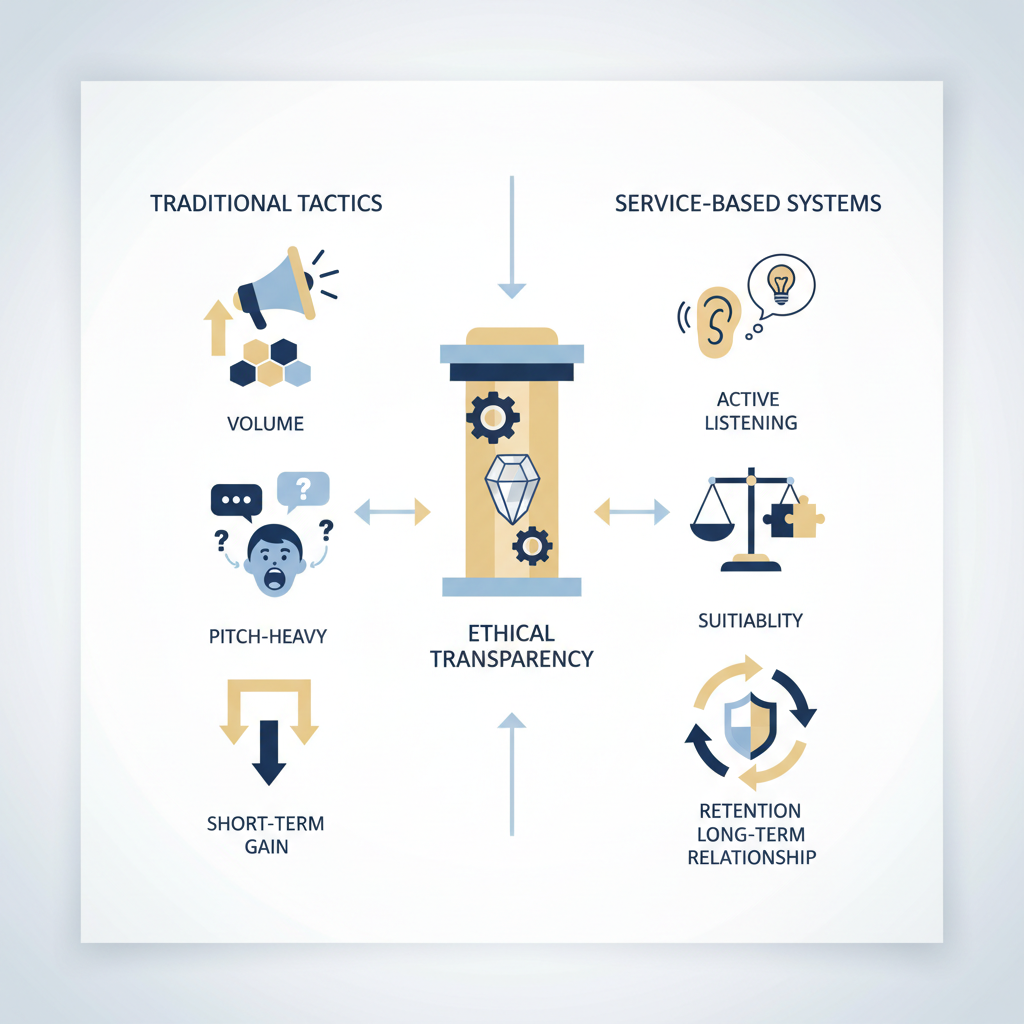
The Core Pillars of a Service-Based Sales System
A service-oriented approach is not a lack of structure; rather, it is a more disciplined form of engagement. It relies on three core pillars: empathy, qualification, and education.
1. Active Listening as a Diagnostic Tool
In a service-based model, listening is not just waiting for your turn to speak. It is a diagnostic process. By asking open-ended questions, a professional can uncover the underlying needs that the client may not have even articulated yet. This aligns with the principles discussed in our guide on service-based systems, where listening is the primary driver of value.
2. The Suitability Assessment
Not every prospect is a good fit. A hallmark of an ethical system is the willingness to say "no" or "not yet." Suitability involves checking if the individual has the resources, the time, and the genuine need for the service. This is particularly important when considering health-related literacy, as explored in our Eastern Province health literacy guide, where information must be tailored to the user's specific context.
3. Educational Leadership
Instead of pitching, the goal is to educate. When a professional provides clarity on how a system works—such as the science behind soluble viscous fiber or the mechanics of intermittent fasting and meal timing—they empower the client to make an informed decision. This builds authority and trust.
Comparison: Transactional vs. Service-Based Systems
| Feature | Transactional Sales | Service-Based Sales System |
|---|---|---|
| Primary Goal | Closing the deal | Solving the problem |
| Communication | One-way (Pitching) | Two-way (Listening) |
| Client View | A lead or a number | A partner or a student |
| Handling Objections | Overcoming/Persuading | Exploring concerns/Clarifying |
| Long-term Focus | Low (Next sale) | High (Retention & Service) |
Designing the Workflow: From Discovery to Support
To implement a service-based sales system, one must design a workflow that prioritizes the human element at every stage. This is not about automated funnels that treat people like data points, but about structured touchpoints that offer value.
Phase 1: The Discovery Session
The first interaction should never be a sales pitch. It should be a discovery session focused on the individual’s current situation. For example, if discussing metabolic health, the focus should be on understanding their current habits rather than immediately recommending Unimate or Yerba Mate. The professional’s role is to gather data to see if a solution is even applicable.
Phase 2: The Suitability Filter
After discovery, the professional applies a suitability filter. Does the person meet the criteria for success? If the professional is operating within a partnership framework, they must assess if the individual is ready for the commitment required. This prevents future dissatisfaction and protects the reputation of the service provider.
Phase 3: Collaborative Solution Mapping
If suitability is confirmed, the next step is mapping out a solution together. This involves setting realistic expectations. In a partnership context, this means explaining that results depend on consistency, effort, and adherence to established protocols, rather than promising quick fixes.
Ethical Considerations and Professional Boundaries
Operating a service-based system requires strict adherence to ethical boundaries. This is especially true in regions with specific cultural and regulatory expectations, such as the Saudi Eastern Province or Canada. Professionals must avoid making health claims or financial promises that are not backed by verified data.
- Transparency: Always be clear about what a product or partnership can and cannot do.
- Autonomy: Respect the client's right to say no without being subjected to high-pressure follow-ups.
- Integrity: If a competitor’s product is better suited for the client, an ethical professional should be willing to point that out.
How This Connects to the Partnership Path
For those exploring the ATHAR partnership, the service-based sales system is the foundation of the entire journey. This path is not about recruitment; it is about qualification and skill discovery. It is designed for individuals who want to lead through service and education.
The 30/60/90-Day Learning Journey
Mastering this system does not happen overnight. It requires a structured approach to learning:
- First 30 Days: Focus on active listening skills and understanding the core principles of the service. Learning how to ask the right questions is the priority.
- 60 Days: Beginning to conduct suitability assessments under mentorship. This phase focuses on identifying the right "fit" for potential partners or clients.
- 90 Days: Transitioning into a leadership role where you guide others in building their own service-based systems, emphasizing ethical service and customer care.
The partnership path is suitable for those who value professional development and are willing to invest the time to learn a consultative approach. It is not suitable for those looking for "get rich quick" schemes or those unwilling to engage in deep, service-oriented work. Success in this path is a reflection of one's ability to serve others and maintain high ethical standards.
Conclusion: The Future of Professional Sales
Building a نظام مبيعات قائم على الخدمة is an investment in professional longevity. By prioritizing listening and suitability, you create a business environment where trust is the primary currency. Whether you are in the UK, Saudi Arabia, or elsewhere, the principles of sustainable work and wellbeing apply: a system that serves the human first will always outperform one that serves the transaction first.
People Also Ask
- What is a service-based sales system? It is a methodology that focuses on solving client problems and ensuring suitability rather than using high-pressure tactics to close sales.
- How does active listening improve sales? It allows the professional to identify the real needs of the client, leading to more accurate recommendations and higher trust.
- What does 'suitability' mean in business? It refers to the process of verifying that a product, service, or partnership is appropriate for a specific individual's needs, goals, and resources.
- Is this approach suitable for everyone? No, it requires a high level of empathy, patience, and a commitment to ethical standards that may not suit those looking for quick, transactional wins.
- How do I start building a service-based system? Start by refining your discovery process and creating a list of criteria that define a 'suitable' client for your specific offering.
Frequently Asked Questions
Q: Does a service-based system take longer to see results?
A: While building trust takes time, the relationships formed are often more stable and lead to better long-term outcomes. Results depend on individual effort and market conditions.

Q: Can I use this system in any industry?
A: Yes, the principles of listening and suitability are universal in any professional field that values long-term client relationships.
Q: What if a prospect is not a good fit?
A: An ethical service-based system encourages you to refer them elsewhere or politely decline the engagement to protect both parties.
Q: How do I handle objections in this model?
A: View objections as requests for more information or as indicators of a potential lack of suitability, and address them with transparency.
Q: What is the primary next step for exploring a partnership?
A: The best step is to engage in a suitability assessment to see if your skills and values align with the service-based partnership path.
Disclaimer: The information provided here is for educational purposes regarding business systems and leadership. It does not constitute financial or medical advice. All partnership outcomes depend on individual effort, skills, and adherence to official policies. Please verify all programme details and eligibility requirements independently.
Further Education
- Explore the metabolic health education hub
- Learn how to read research summaries
- Use the educational health assessment
Evaluate the path with clarity
Use the decision guide to review eligibility, responsibilities, policies, and questions that require confirmation from official programme sources. No financial outcome is promised.